Brighthouse Shield/R/ Level II 6-Year Annuity
Filed pursuant to
Rule 424(b)(3)
333-279315 BRIGHTHOUSE SHIELD® LEVEL II 6-YEAR ANNUITY
Brighthouse Shield® Level II 6-Year Annuity is an individual single premium deferred index-linked separate account annuity
contract (the “Contract”) issued by Brighthouse Life Insurance Company of NY (“BLNY”, the “Company”, “we”, “our”
or “us”).
This Contract is available for use in connection with
Non-Qualified Plans, Traditional IRAs and Roth IRAs. This version of the Contract is only available in New York state. BLNY is located at 285 Madison Avenue, New York, NY
10017. The telephone number is 1-888-243-1932. Brighthouse Securities, LLC, 11225 North Community House Road, Charlotte, NC 28277, is the principal
underwriter and distributor of the Contracts.
The Risk Factors for this Contract appear on Page 15.
Please read the prospectus carefully before investing and keep it for future reference. This prospectus includes important information including a description of all material features, rights and obligations of the Contract. BLNY’s obligations under the Contract are subject to our financial strength and claims-paying ability. The Contract offers various Shield Options which provide certain protections in that the Company will absorb specified levels of negative index returns and the Performance Lock feature that allows you the option to lock the Interim Value. The currently offered Shield Options provide that we will absorb losses at least equal to 10%, 15%, and 25%. Under these Shield Options, the maximum amount of loss you could experience due to negative index performance at the end of a Term, after taking into account these levels of protection, would be: 90% for 10% downside protection; 85% for 15% downside protection; and 75% for 25% downside protection. We do not guarantee that there will always be a Shield Option that provides this minimum amount of, or any, protection. In return
for downside protection, we may limit positive index gains. We are not
obligated to offer any one particular Shield Option, but after your Contract is issued, there will always be one Shield Option available although it may not be substantially
similar to one of the currently available Shield Options. If we were to offer only one Shield Option, you would be limited to investing in that one Shield Option. If that
Shield Option does not meet your investment objectives or financial goals, you could transfer to the Fixed Account (if available at that time and subject to applicable conditions described in the “TRANSFERS” section, including the requirement to remain invested in the Fixed Account until the Fixed Account Term End Date), surrender your Contract and/or invest in another investment vehicle. If you surrender your Contract, you might incur taxes, tax penalties or other adjustments. If you invest in another investment vehicle, that investment may have different features, fees and risks than your Contract. Index-linked annuity contracts are complex insurance and investment vehicles. Before you invest, be
sure to ask your financial professional about the Contract’s features, benefits, risks and fees, and whether the Contract is appropriate for you
based upon your financial situation and objectives.
There are risks associated with investing in Shield Options. You may lose money, up to all or a significant amount of your principal, as well as earnings from prior Allocation Options. You should not buy this Contract if you are not willing to assume these investment risks.
The Contract may not be appropriate for you if you plan to take withdrawals from a Shield Option prior to the end of the Term End Date, especially if you plan to take ongoing withdrawals such as required minimum distributions or withdrawals taken under the systematic withdrawal program. An Interim Value calculation may apply to required minimum distributions, as well as to withdrawals taken under the systematic withdrawal program, and could result in a loss beyond the protection of the Shield Rate. In extreme circumstances, you could lose up to 100% of the value of your Shield Option if you make a withdrawal or surrender the Contract during a Term.
Withdrawals could also result in significant reductions to your contract value and the death benefit (perhaps by more than the amount withdrawn), as well as to the Performance Rate Adjustment on the Term End Date. Withdrawals may also be subject to a Withdrawal Charge, income taxes, and income tax penalties if taken before age 59 1∕2. If you do intend to take
ongoing withdrawals under the Contract, particularly from a Shield Option during the Term, you should consult with a financial professional.
You may cancel the
Contract within 10 days after receiving it by mailing or delivering the Contract to either us or the financial professional who sold it. You will receive (i) whatever your
Contract is worth on the day that we receive your cancellation request, plus (ii) the sum of all fees, taxes and charges deducted from the Purchase Payment during the Free
Look period. You should review this prospectus or consult with your financial professional, for additional information about the specific cancellation terms that apply.
Neither the Securities and Exchange Commission (the “SEC”) nor any state securities commission has approved or disapproved these securities or the adequacy of this prospectus. Any representation to the contrary is a criminal offense. Mutual funds, annuities and insurance products are not
deposits of any bank and are not insured or guaranteed by the Federal Deposit Insurance Corporation (the “FDIC”) or any other government agency.
You may lose money invested in the Contract.
The Contracts may be distributed through broker-dealers that have relationships with banks or other financial
institutions or by employees of such banks. However, the Contracts are not deposits or obligations of, or guaranteed by such institutions or any Federal regulatory agency. Investment in the Contract involves investment
risks, including possible loss of principal.
The principal underwriter of the Contract is Brighthouse Securities, LLC. The offering of the Contract is intended
to be continuous.
Prospectus dated July 18, 2024
STATUS PURSUANT TO SECURITIES EXCHANGE ACT OF 1934
As of the date of this prospectus, BLNY relies on the exemptions
provided by Rule 12h-7 under the Securities Act of 1934 from the requirement to file reports pursuant to Section 15(d) of that Act.
Special Terms
In this prospectus, the following capitalized terms have the indicated
meanings:
Account
Value. The total of the Fixed Account Value, the value of the Shield Option(s), and the Holding Account value under the Contract during the Accumulation Period.
Accumulation Period. The period prior to the Annuity Date.
Allocation Option. Includes the Shield Option(s), the Fixed Account, and Holding Account. The Holding Account is not an allocation option that you can allocate your Purchase Payment or Account Value into and there are only certain circumstances where we will transfer amounts to the Holding Account. See “HOLDING ACCOUNT.”
Annuitant. The natural person(s)
listed on the Contract Schedule on whose life Annuity Payments are based. Any reference to Annuitant will also include any Joint Annuitant under an Annuity
Option.
Annuity Date. A date on which you choose to begin receiving Annuity Payments. If we agree, you may change the Annuity Date, subject to certain requirements. If you do not choose an Annuity Date, the Annuity Date will be the Annuity Date indicated on the Contract Schedule.
Annuity Payments. A series of payments made by us during the Annuity Period, which we
guarantee as to dollar amount.
Annuity
Period. A period starting on the Annuity Date during which Annuity Payments are payable.
Annuity Service Office. The office indicated on the Contract Schedule to which notices and requests must be sent, or as
otherwise changed by notification from us.
BLNY (“we,” “us,” “our”). Brighthouse
Life Insurance Company of NY.
Beneficiary. The person(s) or
entity(ies) you name to receive a death benefit payable under the Contract upon the death of the Owner or a Joint Owner, or in certain circumstances, an
Annuitant.
Brighthouse Securities. Brighthouse Securities, LLC.
Business Day. Our “business day” is generally any day the
New York Stock Exchange (NYSE) is open for regular trading. For purposes of receipt of Notice for administrative requests and transactions, a Business Day
ends at the earlier of 4:00 PM Eastern Standard Time or when the NYSE closes. If the SEC determines the existence of emergency conditions on any day, and consequently, the NYSE does not open, then that day is not a Business Day.
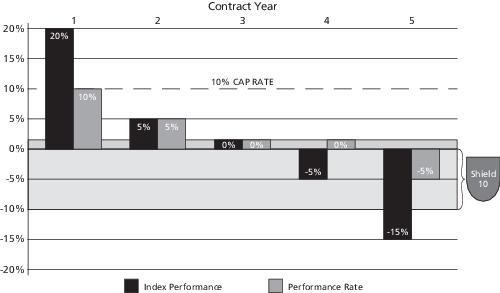
Cap Rate. The maximum
rate that may be credited at the Term End Date based on Index Performance. The Cap Rate may vary between Shield Options and, unless you have a Shield Option with a 1-year Term, is not an annual rate.
Code. The Internal Revenue Code of 1986, as amended, and all related laws and regulations, which are in effect during the term of the Contract.
Contract. The legal agreement between you and BLNY. It contains relevant provisions of
your deferred annuity.
Contract
Anniversary. An anniversary of the Issue Date of the Contract.
Contract Schedule. The schedule attached to your
Contract.
Contract Year. A one-year period starting on the Issue Date and on each Contract Anniversary thereafter.
Death Benefit Amount. For
Owners age 81 or older at the Issue Date of the Contract, the standard death benefit is the Account Value. For Owners age 80 or younger at the Issue Date of
the Contract, the standard death benefit (known as the Return of Premium death benefit) is the greater of the Account Value or your Purchase Payment (reduced
proportionally by the percentage reduction in Account Value of the Shield Option(s), the Fixed Account, and the Holding Account for each partial withdrawal (including any applicable Withdrawal Charge)). The Death Benefit Amount is determined as of the end of the Business Day on which we have received Notice of due proof of death and an acceptable election for the payment method.
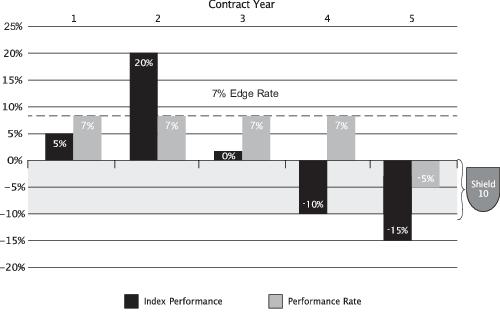
Edge Rate. The rate credited at the Term End Date if the Index Performance is equal to or greater than the Shield Rate. The Edge Rate may vary between Shield Options and, unless you
have a Shield Option with a 1-year Term, it is not an annual
rate. A Shield Option with an Edge Rate may also be referred to as a “Shield Option with Step Rate Edge” in the prospectus.
ERISA. Employee Retirement Income Security Act of 1974, as amended.
Exchange Act. Securities Exchange Act of 1934, as amended.
FDIC. Federal Deposit Insurance Corporation.
FINRA. Financial Industry Regulatory Authority.
Fixed Account. An account, if available, that consists of all of the
assets under the Contract other than those in the Separate Account or Holding Account. You may allocate your Purchase Payment to the Fixed Account, and you
may make a transfer into or out of the Fixed Account. The Fixed Account is part of the General Account assets of BLNY.
Fixed Account Term. The length of time over which the current Fixed Account interest rate is guaranteed. No Fixed Account Term will extend beyond the Annuity Date. The minimum Fixed Account Term depends on the date your Contract is issued but will not be less than one (1) year.
Fixed Account Term End Date. The Contract Anniversary on which a Fixed Account Term
ends.
Fixed Account Term Start
Date. The Contract Anniversary on which a Fixed Account Term is established. If chosen at issue, the initial Fixed Account Term Start Date begins on the Issue Date or otherwise it will begin on the first Contract Anniversary on which you allocate to the Fixed Account.
Fixed Account Value. The initial Fixed Account Value is the
amount of your Purchase Payment initially allocated to the Fixed Account. Thereafter, the Fixed Account Value equals: (a) the initial Fixed Account Value
or the Fixed Account Value on the most recent Contract Anniversary, including any transfers, whichever is applicable; plus (b) any interest credited by
us; less (c) the amount of any withdrawals (including any Withdrawal Charges); and less (d) any Premium Tax or other taxes, if applicable.
Free Look. If you change your mind about owning the Contract, you can cancel it within 10 days after receiving it. This is known as a “Free Look.” We ask that you submit your request to cancel in writing, signed by you, to us (e.g., the Annuity Service Office) or to the financial professional who sold it. When you cancel the Contract within this Free Look period, we will not assess a Withdrawal Charge. You will receive (i) whatever your Contract is worth on the day that we receive your cancellation request, plus (ii) the sum of all fees, taxes and charges deducted from the Purchase Payment during the Free Look period. The amount you receive may be more or less than your Purchase Payment depending upon the Shield Options you allocated your Purchase Payment to during the Free Look period. This means that you bear the risk of any decline in the Account Value of your Contract during the Free Look period.
Free Withdrawal Amount. The Free Withdrawal Amount in the
first Contract Year is zero. Thereafter, the Free Withdrawal Amount each Contract Year is equal to 10% of your Account Value as of the prior Contract
Anniversary, less the total amount withdrawn from the Account Value in the current Contract Year. The Free Withdrawal Amount is non-cumulative and is not
carried over to other Contract Years.
General Account. Comprised of BLNY’s assets, other than assets in any separate
accounts it may maintain.
Good
Order. A request or transaction generally is considered in “Good Order” if it complies with our administrative procedures and the required information is complete and accurate. A request or transaction may be rejected or delayed if not in Good Order. Good Order generally means the actual receipt by us of the instructions relating to the requested transaction in writing (or, when permitted, by telephone) along with all forms, information and supporting legal documentation necessary to effect the transaction. This information and documentation generally includes to the extent applicable to the transaction: your completed application; your contract number; the transaction amount (in dollars or percentage terms); the names and allocations to and/or from the Shield Options, or the Fixed Account if applicable, affected by the requested transaction; the signatures of all Contract Owners (exactly as indicated on the contract), if necessary; Social Security Number or Tax I.D.; and any other information or supporting documentation that we may require, including any spousal or Joint Owner’s consents. With respect to Purchase Payments, Good Order also generally includes receipt by us of sufficient funds to effect the purchase. We may, in our sole discretion, determine whether any particular transaction request is in Good Order, and we reserve the right to change or waive any Good Order requirement at any time. If you have any questions, you should contact us or your financial professional before submitting the form or request.
Holding Account. An account that may
hold Account Value prior to being transferred to the Shield Option(s) and/or the Fixed Account in accordance with your allocation instructions. Transfers can
only occur on a Contract Anniversary. The Holding Account has its own Holding Account interest rate, which is a fixed interest rate, and interest is credited
daily at an effective annual rate that we declare periodically. The Holding Account is part of the General Account assets of BLNY.
Index (Indices). The underlying index associated with a Shield Option which is used to determine the Index Performance on a Term End Date. We currently offer Shield Options with indices based on the performance of securities. In the future we may offer Shield Options based on other types of Indices. We may also add other indices for new Contracts at our discretion.
Index Performance. The percentage change in the Index Value measured from the Term Start Date to any day, including the
Term End Date, within the Term. Index Performance can be positive, zero or negative.
Index
Value. The Index Value of an Index, on a Business Day, is the published closing value of the Index on that Business Day. The Index Value on any day that is not a Business Day is the value as of the prior Business Day. If an Index Value is not published on a Business Day, the closing Index Value on the next Business Day in which the Index Value is published will be used.
Interim Value. For each Shield Option, Interim Value is the value we
assign on any Business Day other than the Term Start Date and the Term End Date. During the Transfer Period, the Interim Value of each Shield Option is equal
to the Investment Amount at the Term End Date in that Shield Option. After the Transfer Period, the Interim Value is a calculated value (as described in the “Interim Value Calculation” section) and is the amount that is available for annuitization, death benefits, withdrawals, Surrenders, and Performance Lock.
Investment Amount. The Investment Amount, for any Shield Option, is the
amount that is allocated to the Shield Option at the Term Start Date, reduced proportionately for any withdrawals at the time of such withdrawals (including
any applicable Withdrawal Charge) by the same percentage that the withdrawal reduces the Interim Value attributable to that Shield Option, and then, at Term End Date, adjusted by the Performance Rate. The remaining Investment Amount after a withdrawal will be used as the new Investment Amount for the Term until the Term End Date or the next Interim Value calculation for that Shield Option.
Issue Date. The date the Contract is issued.
Joint Annuitant. If there is more than one Annuitant, each Annuitant will be a Joint Annuitant of the Contract.
Joint Owner. If there is more than one Owner, each Owner will be a Joint Owner of the Contract. Joint Owners are limited to natural persons.
Maturity Date. The Maturity Date is the Contract Anniversary after the
oldest Owner’s 90th birthday or 10 years from the date we issue your Contract, whichever is later. The Contract will be annuitized at the Maturity Date.
Minimum Account Value. $2,000. If your Account Value falls below the Minimum Account Value as a result of a withdrawal (including any applicable Withdrawal Charge) we will treat the withdrawal request as a request for a full withdrawal.
Minimum Guaranteed Cap Rate.
The actual Minimum Guaranteed Cap Rate for your Contract is the amount shown on your
Contract Schedule but the rate will not be less than what is shown in the Minimum Guaranteed Cap Rates table. See “RATE CREDITING TYPES—Cap Rate."
Minimum Guaranteed Edge Rate. The actual Minimum Guaranteed
Edge Rate for your Contract is the amount shown on your Contract Schedule, but the rate will not be less than what is shown in the Minimum Guaranteed Edge
Rates table. See “RATE CREDITING TYPES—Step Rate Edge."
Minimum Guaranteed Interest Rate. The
current Minimum Guaranteed Interest Rate will not be less than 1%. This interest rate is guaranteed to be a rate not less than the minimum interest rate
allowed by state law—see Appendix D. The actual Minimum Guaranteed Interest Rate for your Contract is the amount shown on your Contract Schedule and
applies only to amounts in the Fixed Account.
Minimum Guaranteed Step Rate. The actual Minimum Guaranteed Step Rate
for your Contract is the amount shown on your Contract Schedule, but the rate will not be less than what is shown in the Minimum Guaranteed Step Rates table.
See “RATE CREDITING TYPES—Step Rate."
Notice. Any form of communication providing information we need, either
in a signed writing or another manner that we approve in advance. All Notices to us must be sent to our Annuity Service Office and received in Good Order. To
be effective for a Business Day, a Notice must be received in Good Order prior to the end of that Business Day.
NYSE. New York Stock Exchange.
Owner (“you”, “yours”). The person(s) entitled
to the ownership rights under the Contract. Subject to our administrative procedures, we may also permit ownership by a corporation (a type of non-natural
person) or certain other legal entities. If Joint Owners are named, all references to Owner shall mean Joint Owners.
Performance Lock. A feature that allows you the option to lock in the Interim Value of a Shield Option and that is automatically
included with your Contract on the Issue Date.
Performance Lock Value. The value of a Shield Option
after exercising Performance Lock. The Performance Lock Value is equal to the Interim Value at the end of the Business Day that you exercise Performance Lock,
reduced by the dollar amount of any subsequent withdrawals (including any applicable Withdrawal Charge).
Performance
Rate. The rate credited at the Term End Date and is based on the Index Performance, adjusted for the applicable Shield Rate, Cap Rate, Step Rate, or Edge Rate. The Performance Rate can be positive, zero or negative. At the Term End Date, any increase or reduction in the Investment Amount in a particular Shield Option is determined by multiplying the Performance Rate by the Investment Amount of the Shield Option on the last day of the Term.
Performance Rate Adjustment. The
adjustment made to the Investment Amount for each Shield Option on the Term End Date. This adjustment is based on the Performance Rate. This adjustment can be
positive, zero or negative. When the Performance Rate Adjustment is positive we may also refer to this adjustment as “earnings.” When the
Performance Rate Adjustment is negative we may also refer to this adjustment as “losses.”
Premium Tax. The amount of tax, if any, charged by the state or municipality. New York state does not currently assess
Premium Taxes on Purchase Payments.
Purchase Payment. The amount paid to us under the Contract as consideration for the
benefits it provides.
Rate Crediting Type. Either the Cap Rate, Step Rate, or Step Rate Edge.
RMD. Required Minimum Distribution.
SEC. Securities and Exchange Commission.
Separate Account. The separate account is Brighthouse Separate Account SA
II.
Shield 10. The Contract provides downside protection through the Shield 10, which is a Shield Rate where negative Index Performance of up to 10% of your Investment Amount is absorbed by us at the Term End Date, which would leave you to absorb any remaining negative Index Performance of up to 90% of your Investment Amount.
Shield 15. The Contract
provides downside protection through the Shield 15, which is a Shield Rate where negative Index Performance of up to 15% of your Investment Amount is absorbed
by us at the Term End Date, which would leave you to absorb any remaining negative Index Performance of up to 85% of your Investment Amount.
Shield 25. The Contract provides downside protection through the Shield 25, which is a Shield Rate where negative Index Performance of up to 25% of your Investment Amount is absorbed by us at the Term End Date, which would leave you to absorb any remaining negative Index Performance of up to 75% of your Investment Amount.
Shield Rate. A limited buffer
where we absorb part of any negative Index Performance at the Term End Date. Any negative Index Performance beyond the Shield Rate will reduce the Investment
Amount associated with the Shield Option. The Shield Rate may vary between Shield Options and, unless you have a Shield Option with a 1-year Term, is not an annual rate. We currently offer the following Shield Rates: Shield 10, Shield 15 and Shield 25.
Shield Option. You may allocate your Purchase Payment or transfer your Investment Amount to one or more of the available Shield Options. Each Shield Option offered through this Contract has an associated Term, Index, Shield Rate and a Rate Crediting Type.
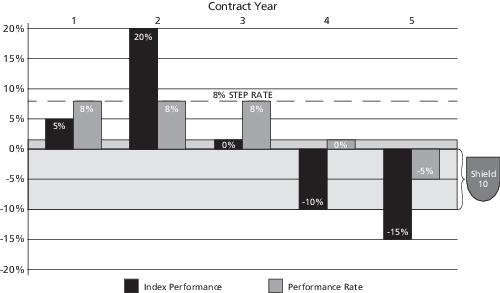
Step Rate. The rate credited at the Term End Date if the
Index Performance is equal to or greater than zero. The Step Rate
may vary between Shield Options and, unless you have a Shield Option with a 1-year Term, is not an annual rate.
Surrender. A full withdrawal of your Account Value.
Term. The Term is the number of years that the Shield Option
is in effect. We currently offer Terms of 1 year, 2 years, 3 years or 6 years. The initial Term(s) begin on the Issue Date.
Term End Date. The Contract Anniversary on which a Shield Option ends.
Term Start Date. The Contract Anniversary on which a Shield
Option is established. The initial Term Start Date(s) begins on the Issue Date, and thereafter, will be the Contract Anniversary coinciding with the duration
of the current Term you have selected.
Transfer Period. The five (5) calendar days following the Contract
Anniversary coinciding with the Term End Date for each applicable Shield Option and/or the Fixed Account Term End Date for the Fixed Account, during the Accumulation
Period.
Withdrawal Charge. A charge applied to the percentage of the
amount withdrawn from your Account Value in a Contract Year in excess of the Free Withdrawal Amount.
Summary
The Brighthouse Shield® Level II 6-Year Annuity is an individual single premium deferred
index-linked separate account annuity contract (the “Contract”) issued by BLNY, that provides for the potential accumulation of retirement savings. The Contract is intended for retirement or other long term investment purposes.
This version of the Contract is only available in New York state.
The Contract offers various Shield Options, which permit Owners
to potentially receive interest equal to the percentage returns of certain Securities Indices, up to a Cap Rate or equal to a specified Step Rate or Edge Rate, with
guarantees against a specified level of negative returns—guarantees we call “Shield Rates.” The protections specified by the Shield Rate and the level of positive
investment experience that can be credited to Account Value allowed by the Cap Rate or specified by the Step Rate or Edge Rate are only fully available for
the amounts held until the end of the Term.
We currently offer Shield Options based on Securities Indices. Additionally, each Shield Option has a Term of 1, 2,3 or 6 years in length, a Shield Rate (Shield 10, Shield 15 or Shield 25) and Rate Crediting Type (Cap Rate, Step Rate, or Step Rate Edge). For each Shield Option, you select the Term, the Shield Rate and which Securities Index you want the performance of your Contract to be based on. For example, if you select Shield 10 with a 1-Year Term, you may also select whether you want your Contract performance based on the Cap Rate, Step Rate, or Edge Rate, when applicable. A Fixed Account that guarantees a fixed rate of interest may also be available. Unless you allocate your entire Purchase
Payment to the Fixed Account, you may lose money by investing in the Contract.
The Cap Rate, Step Rate, and Step Rate Edge (each, a
“Rate Crediting Type”) are the three ways we offer that you can potentially receive positive interest based on the performance of an Index. The Cap Rate is the
maximum rate that may be credited at the Term End Date based on Index Performance. The Step Rate is the rate credited at the Term End Date if the Index Performance is equal to or greater than zero. For Shield Options with Step Rate Edge, the Edge Rate is the rate credited at the Term End Date if the Index Performance is equal to or greater than the Shield Rate. Shield Options with a Cap Rate are described in the Cap Rate Shield Option Rider attached to your Contract. Shield Options with a Step Rate are described in the Step Rate Shield Option Rider attached to your Contract. Shield Options with Step Rate Edge are described in the Step Rate Edge Shield Option Rider attached to your Contract.
New Cap Rates, Step Rates, and Edge Rates are declared for each subsequent Term. There are two ways you may find out what the renewal Cap Rates, Step Rates, and Edge Rates will be for a subsequent Term. Thirty (30) days before the current Term expires, we will send you a notification, written or electronic depending on your selected preferences, indicating your maturing Shield Options and how you can obtain the new Cap Rates, Step Rates, and Edge Rates. You may also access our website at https://www.brighthousefinancial.com/products/annuities/shield-annuities/shield-rates/ where at least two months of renewal rates for the Rate Crediting Types and the interest rate for the Fixed
Account are posted – i.e., for the current month and the following month. See “RATE CREDITING TYPES.”
You may withdraw a portion or all of your Account Value at any
time until you commence receiving Annuity Payments, subject to an adjustment to the Investment Amounts. Depending on the performance of the Indices you choose, this adjustment may be substantial. Withdrawal Charges may also apply.
Each Shield Option comes with Performance Lock, which allows you the option to lock the Interim Value on your Shield Options. For any Shield Option, once during each Term you may elect to lock the Interim Value. The Performance Lock Value, will be used as the value of that Shield Option for the remainder of the Term.
When you purchase the Contract, if you are age 81 or older at the Issue Date of the Contract, the standard death benefit is the Account Value. For Owners age 80 or younger at the Issue Date of the Contract, the standard death benefit (known as the Return of Premium death benefit) will be the greater of your (i) Account Value or (ii) Purchase Payment, reduced proportionally by the percentage reduction in Account Value of the Shield Option(s), the Fixed Account, and the Holding Account for each partial withdrawal (including any applicable Withdrawal Charge).
Like all annuity contracts the Contract offers a range of annuity options, which provide Annuity Payments for your lifetime.
We have the right to substitute a comparable index prior to the Term End Date if any Index is discontinued or we determine that our use of such Index should be discontinued because we are no longer licensed to use the Index, the method of calculation of the Index Value is substantially changed, or if Index Values become unavailable for any reason. We would attempt to choose a substitute index that has a similar investment objective and risk profile to the replaced index. The substituted index may not be acceptable to you. See “An Index may be Substituted.”
See “SPECIAL TERMS” in this prospectus for more detailed explanations of the terms associated with the Shield
Options.
The following chart
describes the key features of the Contract. Please read this prospectus for more detailed information about the Contract.
Key Features of the Contract
| |
Individual single premium deferred index-linked separate account annuity
contract. |
| |
The minimum Purchase Payment: $25,000. Prior approval required for a
Purchase Payment of less than $25,000 or $1,000,000 or
more. |
Owner and Annuitant Issue Ages |
|
| |
The Contract has two periods:
•The Accumulation Period, the period prior to the Annuity Date; and
•The Annuity Period, which begins on the Annuity Date and during which
Annuity Payments are provided. |
| |
The total of the Fixed Account Value, the value of the Shield Option(s), and
the Holding Account value under the Contract during the
Accumulation Period. |
| |
Each Shield Option has an associated Term, Index, Shield Rate and Rate
Crediting Type. |
| |
The Term may be 1, 2, 3, or 6 years in length. |
| |
The current Indices are as follows:
•S&P 500® Index (Price Return Index);
•Russell 2000® Index (Price Return Index);
•MSCI EAFE Index (Price Return Index); and
•Nasdaq-100 Index® (Price Return Index). |
| |
We currently offer different levels of protection:
Shield 10 — A Shield Rate where negative Index Performance of up to 10% of
your Investment Amount is absorbed by us at the Term End Date, which would
leave you to absorb any remaining negative Index Performance of
up to 90% of your Investment Amount.
Shield 15 — A Shield Rate where negative Index Performance of up to 15% of
your Investment Amount is absorbed by us at the Term End Date, which would
leave you to absorb any remaining negative Index Performance of
up to 85% of your Investment Amount.
Shield 25 — A Shield Rate where negative Index Performance of up to 25% of
your Investment Amount is absorbed by us at the Term End Date, which would
leave you to absorb any remaining negative Index Performance of
up to 75% of your Investment Amount. |
| |
A Shield Option can only have one associated Rate Crediting Type: Cap Rate,
Step Rate, or Step Rate Edge. |
| |
For any Shield Option, once during each Term you may elect to lock the Interim
Value. Once an Interim Value is locked it is irrevocable for the remainder of
that Term. The Performance Lock Value will be used as value of
the Shield Option for the remainder of the Term.
You can exercise Performance Lock by providing Notice of election on a
particular Business Day to lock the Interim Value on that day.
(See “PERFORMANCE LOCK.”) |
| |
The Interim Value is designed to represent the fair value of the Shield
Option on each Business Day between the Term Start Date and
Term End Date, taking into account the potential gain or loss
of the applicable Index at the end of the Term. The Interim
Value reflects the change in fair value due to economic factors of the investment instruments (including derivatives) supporting the Shield
Options.
The Interim Value is the amount that is available for annuitization, death
benefits, withdrawals, Surrenders, and Performance Lock. For
each Shield Option, we assign the value of Interim Value on any
Business Day other than the Term Start Date and Term End Date.
The Interim Value may be less than the Investment Amount at the
time the Interim Value is calculated even when the current
Index Value is higher than it was on the Term Start Date. See
“Interim Value Calculation.” |
| |
During the Accumulation Period you may only make transfers to or from the
Fixed Account, to or from the Shield Option(s), and from the
Holding Account. If you have not exercised Performance Lock,
you may make transfers only during the Transfer Period
following the Term End Date. The effective date of such
transfer is the first day of the Fixed Account Term and/or the Term(s) in
which the transfer is made.
If you have exercised Performance Lock, you may transfer on any Contract
Anniversary prior to the end of the Term and on the Term End
Date. You may only transfer the entire amount of your
Performance Lock Value on a Contract Anniversary that is not a
Term End Date. On the Term End Date, you have the Transfer
Period to transfer all or a portion of your Performance Lock Value. Partial transfers of a Shield Option (with or without Performance Lock)
are not permitted, except during the Transfer Period. See
“TRANSFERS.” |
| |
|
| |
You may withdraw some or all of your money at any time prior to the Annuity
Date. For any withdrawal taken on a Term End Date, a Performance Rate
Adjustment, as of the date of the withdrawal, will apply. For
any withdrawal taken between the Term Start Date and the Term
End Date, we use an Interim Value calculation, which will
reduce the Investment Amount for that Shield Option by the
percentage reduction in the Interim Value of that Shield Option. If you have exercised Performance Lock, a withdrawal will reduce your Performance Lock Value by the dollar amount of the withdrawal. The Performance Rate Adjustment and reduction (either proportionate or dollar for
dollar) may be substantial. In addition, a withdrawal taken in excess of the
Free Withdrawal Amount may be subject to a Withdrawal
Charge. |
| |
A percentage charge applied to withdrawals in excess of the Free Withdrawal
Amount.The Free Withdrawal Amount is 0% in the first Contract Year, and 10%
of Account Value in each subsequent Contract Year to the extent
that amount has not already been withdrawn that Contract
Year.The Withdrawal Charge is calculated at the time of each
withdrawal in accordance with the following: |
| |
|
|
|
|
| |
|
Number of
Complete
Contract
Years since Issue
Date |
Withdrawal
Charge
percentage |
|
| |
|
|
|
|
| |
|
|
|
|
| |
|
|
|
|
| |
|
|
|
|
| |
|
|
|
|
| |
|
|
|
|
| |
|
|
|
|
| |
See “WITHDRAWAL PROVISIONS — When No Withdrawal
Charge Applies” for a list of Withdrawal Charge
waivers. |
Systematic Withdrawal Program |
You may elect the Systematic Withdrawal Program to
provide automated processing of amounts withdrawn from
your Contract, subject to program terms. We do not assess a
charge for the program and you may terminate your
participation in the program at any time. Withdrawals
under the Systematic Withdrawal Program are
subject to the same Withdrawal Charge provisions and risks as
any other withdrawals under the Contract. Moreover, since withdrawal amounts from a Shield Option will reduce the Investment Amount for that Shield
Option by the percentage reduction in the Interim Value of that Shield
Option, a withdrawal when Interim Value is less than the
Investment Amount will cause a greater percentage reduction in
the Investment Amount that remains in your Shield Option
relative to the percentage reduction for the same withdrawal
amount when Interim Value is greater than the Investment Amount. If you
exercise Performance Lock on any Shield Option, the Performance
Lock Value for that Shield Option will be reduced by the dollar
amount of any subsequent withdrawals. Since withdrawals
under the Systematic Withdrawal Program are
automatic, you will have no control over the timing of those withdrawals. See
“WITHDRAWAL PROVISIONS – Systematic Withdrawal
Program” for availability and other
restrictions. |
| |
For Owners age 81 or older at the Issue Date of the Contract, the standard
death benefit is the Account Value. For Owners age 80 or
younger at the Issue Date of the Contract, the standard death
benefit (known as the Return of Premium death benefit) is the
greater of the Account Value or your Purchase Payment (reduced
proportionally by the percentage reduction in Account Value of
the Shield Option(s), the Fixed Account, and the Holding Account for each partial withdrawal (including any applicable Withdrawal Charge)). The Death
Benefit Amount is determined as of the end of the Business Day on which we
receive Notice of due proof of death and an acceptable election
for the payment method. |
| |
You can choose an Annuity Option. After Annuity Payments begin, you cannot
change the Annuity Option. You can choose one of the following Annuity
Options on a fixed payment basis or any other Annuity Option
acceptable to us: (i) Life Annuity with 10 Years of Annuity Payments Guaranteed; and
(ii)Joint and Last Survivor Annuity with 10 Years of Annuity Payments Guaranteed. The Annuity Options may be limited due to the requirements of the Code. |
| |
You will bear the following charges and expenses:
(i)Withdrawal Charges; and
(ii)Premium Tax and other taxes. |
| |
You may cancel the Contract within 10 days after receiving it by mailing or
delivering the Contract to either us or the financial professional who sold
it. This is known as a “Free Look.” You will
receive (i) whatever your Contract is worth, plus (ii) the sum
of all fees, taxes and charges deducted from the Purchase
Payment during the Free Look period, as of the effective date of the Free
Look, on the Business Day we receive your Contract and we will
not deduct a Withdrawal Charge. The amount you receive may be
more or less than your Purchase Payment depending on the Shield
Options you allocated your Purchase Payment to during the Free
Look period. |
The purchase of the Contract involves certain risks. You should
carefully consider the following factors, in addition to the matters set forth elsewhere in the prospectus, prior to purchasing the Contract.
There is a risk of substantial loss of your principal (unless
you allocated your entire Purchase Payment to the Fixed Account) because you agree to absorb all losses that exceed the Shield Rate for the Shield Options you select under
the Contract. This means that if a negative Index Performance for a Shield Option you select exceeds the corresponding Shield Rate at the Term End Date, you will bear the portion of the loss that exceeds the Shield Rate.
To determine the Interim Value, we apply a formula which does not reflect the actual performance of the applicable Index, but rather a determination of the value of hypothetical underlying investments at the time of the Interim Value calculation. This amount could be more or less than the Investment Amount on the Term End Date. It also means that you could have negative Interim Value, even if the Index Value has increased at the time of the calculation.
Withdrawals before a Term End Date could have adverse impacts
even if the Index Value has increased at the time of the calculation because an early withdrawal will not allow you to participate in the Index Performance for the Term with
your entire Investment Amount. If you withdraw Account Value allocated to a Shield Option, the withdrawal will reduce the Investment Amount for that Shield Option by the percentage reduction in the Interim Value of that Shield Option. A proportional reduction may be larger than the dollar amount of your withdrawal even if the Index Value has increased. If you have exercised the Performance Lock, a withdrawal will reduce your Performance Lock Value by the dollar amount of the
withdrawal.
No ownership of the underlying securities
When you purchase the Contract and allocate your Purchase Payment to a Shield Option(s), you will not be investing in the Index for the Shield Options you select or in a mutual fund or exchange traded fund that also tracks the Index. Your Performance Rate Adjustment for a Shield Option is limited by a Cap Rate, Step Rate, or Edge Rate, which means your Investment Amount will be lower than if you had invested in a mutual fund or exchange traded fund designed to track the performance of the applicable Index and the performance is greater than your Cap Rate, Step Rate or Edge Rate.
You may withdraw some or all of your money at any time prior to
the Annuity Date; however, any applicable Withdrawal Charge is calculated as a percentage of the amount withdrawn. After the first Contract Year, the Contract provides for
limited free access to your money, called the Free Withdrawal Amount. If you withdraw an amount that is greater than the Free Withdrawal Amount for your Contract, you may be subject to a Withdrawal Charge which will reduce the amount that is payable to you. For example, assume you make a $100,000 Purchase Payment at Contract issue. If your Account Value is $80,000 in the beginning of the sixth (6th) Contract Year and you take a full withdrawal from your Contract, the Free Withdrawal Amount is $8,000
(10% of $80,000) and a Withdrawal Charge percentage of 3% is applied to the remaining amount. This is a 3% reduction of your Account Value, less the Free Withdrawal Amount
($72,000 = $80,000 – $8,000). The Withdrawal Charge would be $2,160 (3% of $72,000). This results in a cash value of $77,840 paid to you ($77,840 = $80,000 – $2,160). For any withdrawal taken on a Term End Date, a Performance Rate Adjustment, as of the date of the withdrawal, will apply. For any withdrawal taken between the Term Start Date and the Term End Date, we use an Interim Value calculation, which will reduce the Investment Amount for that Shield Option by the percentage reduction in the Interim Value of that Shield
Option. If you have
exercised Performance Lock, a withdrawal will reduce your Performance Lock Value by the dollar amount of the withdrawal. The Performance Rate Adjustment and
reduction (either proportionate or dollar for dollar) may be substantial. Since withdrawal amounts from a Shield Option will reduce the Investment Amount
for that Shield Option by the percentage reduction in the Interim Value of that Shield Option, a withdrawal when Interim Value is less than the Investment
Amount will cause a greater percentage reduction in the Investment Amount that remains in your Shield Option relative to the percentage reduction for the same withdrawal amount when Interim Value is greater than the Investment Amount.
Effect of Withdrawals, Surrender, Annuitization or
Death
The method we use in calculating your
Interim Value may result in an amount that is less than the amount you would receive had you held the investment until the Term End Date. If you take a withdrawal when Index
Performance is negative, your remaining Investment Amount may be significantly less than if you waited to take the withdrawal when Index Performance was positive. For more information on how we determine Interim Value and the potential adverse impacts of a withdrawal before the Term End Date, see “Risk of Loss” above.
•
If you take a withdrawal, including RMDs, your Account Value will be reduced by the
amount withdrawn proportionally from your Shield Options, the Fixed Account, and the Holding Account unless you tell us from which specific Allocation Options, in which you currently have any Account Value, where the withdrawal should be taken.
•
If you die (unless your Contract was issued with the Return of Premium death benefit), or
Surrender your Contract prior to the Term End Date, we will pay either (i) the Interim Value, which may be less than if you held the Contract until all of your Shield Options reached their Term End Dates or (ii) the Performance Lock Value, which may be less than if you had not exercised Performance Lock before the Term End Date.
•
If your Contract is annuitized between the Term Start Date and Term End Date, we will use
either the Interim Value or the Performance Lock Value to calculate the Annuity Payments you will receive based on the applicable Annuity Option. In deciding on an Annuity Date, you should take into consideration the Term End Dates of your Shield Options relative to the Annuity Date you have chosen.
•
If you have not exercised the Performance Lock on a Shield Option, the amount that is
available before the Term End Date for annuitization, death benefits, withdrawals, Surrenders, and Performance Lock will be the Interim Value. If you have exercised the Performance Lock on a Shield Option, the amount that is available before the Term End Date for annuitization, death benefits, withdrawals, and Surrenders will be the Performance Lock Value.
•
If your Account Value falls below the Minimum Account Value as a result of a withdrawal,
we may terminate your Contract.
You may make transfers between the Fixed Account and the Shield
Option(s) and from the Holding Account to the Fixed Account and the Shield Options only during the Transfer Period. Unless you have a Shield Option with Performance Lock
Value, you cannot make transfers outside the Transfer Period and you cannot (i) transfer out of a current Shield Option to another Shield Option or the Fixed Account until the Term End Date of the current Shield Option, (ii) transfer out of the Fixed Account to a Shield Option until the Fixed Account Term End Date (which will not be less than one (1) year), or (iii) transfer from the Holding Account to a Shield Option or the Fixed Account until the next Contract Anniversary. In all cases, the amount transferred can only be transferred to new Shield Options or the Fixed Account. This may limit your ability to react to market conditions.
If you remain in your current Shield Option with the Performance Lock Value until the Term End Date and decide to transfer the Investment Amount to a new Shield Option, the Investment Amount on the Term Start Date of your new Shield Option will be the Performance Lock Value for that option, which may be higher or lower than the Investment Amount would have been on the Term End Date had you not exercised the Performance Lock.
In addition, you should understand that for renewals into the same Shield Option, a new Cap Rate, Step Rate or Edge Rate, as applicable, will be declared and will go into effect on the Contract Anniversary that coincides with the beginning of the new Shield Option.
Moreover, at the Term End Date, the Investment Amount allocated to the Shield Option that has reached its Term End Date will be automatically renewed into the same Shield Option unless you instruct us to transfer such amount into a different Shield Option(s) or the Fixed Account. You have the Transfer Period to notify us that you want to transfer some or all of your Investment Amount to a new Shield Option(s) or the Fixed Account. Thus, failure to provide such instructions during the Transfer Period will result in an automatic renewal for a period of at least one (1) year.
If you have exercised
the Performance Lock for a Shield Option you may transfer on any Contract Anniversary prior to the end of the Term and on the Term End Date. You may only transfer the entire
amount of your Performance Lock Value of that Shield Option on a Contract Anniversary that is not a Term End Date. On the Term End Date, you have the Transfer Period to
transfer all or a portion of your Performance Lock Value. Partial transfers of
Performance Lock Value prior to the Term End Date are not permitted.
Availability of Shield Options
Your selling firm may limit the Shield Options available through that firm when your Contract is issued or at Term End Date. Additionally, we may stop selling certain Shield Options. We are not obligated to offer any one particular Shield Option, but after your Contract is issued, there will always be one Shield Option available, although it may not be substantially similar to one of the currently available Shield Options. Consequently, if we were to offer only one Shield Option, you would be limited to investing in that one Shield Option. If that Shield Option does not meet your investment objectives or financial goals, you could transfer to the Fixed Account (if available at that time and subject to applicable conditions described in the “TRANSFERS” section, including the requirement to remain invested in the Fixed Account until the Fixed Account Term End Date), surrender your Contract and/or invest in another investment vehicle. If you surrender your Contract, you might incur taxes, tax penalties or other adjustments. If you invest in another investment vehicle, that investment may have different features, fees and risks than your Contract. Similarly, a particular Shield Option may not be available for you to transfer your Investment Amount or Fixed Account Value into after a Term End Date or the Fixed Account Term End Date. If the same Shield Option is no longer available at the Term End Date, the Investment Amount in the applicable Shield Option(s) will automatically transfer into the Fixed Account at the Term End Date, unless you instruct us otherwise. The amounts transferred to the Fixed Account must remain in the Fixed Account until the Fixed Account Term End Date (which, currently, will not be less than one (1) year). The Investment Amount held in the Fixed Account may earn a return that is less than the return you might have earned if those amounts were held in a Shield Option. If we exercise this right, your ability to increase your Account Value and, consequently, increase your death benefit will be limited. If the Fixed Account is not available, the Investment Amount will automatically transfer into the Holding Account, unless you instruct us otherwise.
Risks Associated with the Referenced Indices
Because the S&P
500® Index (Price Return Index), the Russell 2000® Index (Price Return Index), the MSCI EAFE Index (Price Return Index), and the Nasdaq-100 Index® (Price Return Index) are each comprised of a collection of equity securities, in each case the value of the
component securities is subject to market risk, or the risk that market fluctuations may cause the value of the component securities to go up or down, sometimes rapidly and
unpredictably. In addition, the value of equity securities may increase or decline for reasons directly related to the issuers of the securities. (See “INDICES”
and “SHIELD RATES.”)
An Index may be Substituted
We have the right to substitute a comparable index prior to the Term End Date if any Index is discontinued or we determine that our use of such Index should be discontinued because we are no longer licensed to use the Index, the method of calculation of the Index Value is substantially changed, or if Index Values become unavailable for any reason. We would attempt to choose a substitute index that has a similar investment objective and risk profile to the replaced index. The substituted Index may not be acceptable to you. Upon substitution of an Index, we will calculate your Index Performance on the replaced Index up until the date of substitution and the substitute Index from the date of substitution to the Term End Date. If you have exercised Performance Lock, a subsequent index substitution will have no impact on the Performance Lock Value of that Shield Option.
An Index substitution will not change the Shield Rate, Cap Rate, Step Rate or Edge Rate for an existing Shield Option. The performance of the new Index may not be as good as the one that it substituted and as a result your Index Performance may have been better if there had been no substitution.
For all Shield Options, if negative Index Performance exceeds the
corresponding Shield Rate at the Term End Date, you will bear the portion of the loss that exceeds the Shield Rate. For Shield Options with Step Rate Edge, there could be
situations when a small difference in the Index Performance results in significantly different Performance Rates. For example, if Index Performance is -9.5%, the Shield Rate is 10% and the Edge Rate is 7%, the Performance Rate will equal the Edge Rate, or 7%. On the other hand, if Index Performance is -10.5% and the Shield Rate is 10%, the Performance Rate will equal -0.5%.
Shield Options with Higher
Shield Rates
In deciding whether to choose a
Shield Option with a higher Shield Rate, you should consider that Shield Options with higher Shield Rates tend to have lower Cap Rates, Step Rates, and Edge Rates, as
applicable, than Shield Options with lower Shield Rates that have the same Index and Term. This is because of the additional protection provided by the higher Shield Rates.
With the Performance Lock Value you may receive less than you would have received had you not exercised the Performance Lock. Furthermore, once the Performance Lock is exercised, it is irrevocable for the remainder of that Term. You will no longer participate in Index Performance, positive or negative, for the remainder of the Term after you exercise Performance Lock. This means that under no circumstances will your Performance Lock Value increase during the remainder of the Term, and you will not receive a Performance Rate Adjustment on any Performance Lock Value on the Term End Date.
We use the Interim Value calculated at the end of the current Business Day on which you exercise Performance Lock to determine your Performance Lock Value. This means you will not be able to determine in advance your Performance Lock Value, and it may be higher or lower than it was at the point in time you requested the Performance Lock. If the Performance Lock is exercised when the Interim Value is less than the Investment Amount, you will lock in any loss, which could be below the Shield Rate. It is possible that you would have realized less of a loss or no loss if the Performance Lock occurred at a later time, or if the Shield Option was not locked.
No company other than BLNY has any legal responsibility to pay amounts that BLNY owes under the Contract. An Owner should look to the financial strength of BLNY for its claims-paying ability.
Cybersecurity and Certain Business Continuity Risks
Our business is largely conducted through complex information
technology and communications systems operated by us and our service providers and business partners (e.g., the firms involved in the distribution and sale of our products).
Our operations rely on the secure processing, storage and transmission of confidential and other information in our systems and the systems of third party service providers. For example, many routine operations, such as processing your requests and elections and day-to-day record keeping, are all executed through computer networks and systems. We have established administrative and technical controls and business continuity and resilience plans to protect our operations against attempts by unauthorized third parties to improperly access, modify, disrupt the operation of, or prevent access to critical networks or systems or data within them (a “cyber-attack”). Despite these protocols, the techniques used to attack systems and networks change frequently, are becoming more sophisticated, and can originate from a wide variety of sources including terrorists, nation states, financially motivated actors, internal actors, or third parties, such as external service providers, and the techniques used change frequently or are often not recognized until after they have been launched. The rapid evolution and increased adoption of artificial intelligence technologies may intensify our cybersecurity risks, including the deployment of artificial intelligence technologies by threat actors. There may be an increased risk of cyber-attacks during periods of geo-political or military conflict.
A cyber-attack could have a material, negative impact on BLNY, as well as individual Owners and their Contracts. There are inherent limitations in our plans and systems, including the possibility that certain risks have not been identified or that unknown threats may emerge in the future. Unanticipated problems with, or failures, of, our disaster recovery systems and business continuity plans could have a material impact on our ability to conduct business and on our financial condition and operations, and such events could result in regulatory fines or sanctions, litigation, penalties or financial losses, reputational harm, loss of customers, and/or additional compliance costs for us. Our operations also could be negatively impacted by a cyber-attack affecting a third party, such as a service provider, business partner, another participant in the financial markets or a governmental or regulatory authority. Potential attacks can occur through a variety of sources, including, but not limited to, cyber-attacks, phishing attacks, account takeover attempts, the introduction of computer viruses or malicious code, ransomware or other extortion tactics, denial of service attacks, credential stuffing, and other computer-related penetrations. Hardware, software or applications developed by us or received from third parties may contain exploitable vulnerabilities, bugs, or defects in design, maintenance or manufacture or other issues that could compromise information and cybersecurity. Malicious actors may attempt to fraudulently induce employees, customers, or other users of our systems to disclose credentials or other similar sensitive information in order to gain access to our systems or data, or that of our customers, through social engineering, phishing, mobile phone malware, and other methods. Cybersecurity threats can originate from a wide variety of sources including, but not limited to, natural catastrophe, military or terrorist actions, public health crises (such as the COVID-19 pandemic), and unanticipated problems with our or our service providers’ disaster recovery systems. Such
disasters and events may
adversely affect our ability to conduct business or administer the contract, particularly if our employees or the employees of our service providers are
unable or unwilling to perform their responsibilities as a result of any such event.
Cyber-attacks, disruptions or failures to our business operations can interfere with our processing of Contract transactions, including the processing of transfer orders from our website; impact our ability to calculate values; cause the release and/or possible loss, misappropriation or corruption of confidential Owner or business information; or impede order processing or cause other operational issues. There can be no assurance that we or our service providers will avoid losses affecting your Contract due to cyber-attacks, disruptions or failures in the future. Although we continually make efforts to identify and reduce our exposure to cybersecurity risk, there is no guarantee that we will be able to successfully manage and mitigate this risk at all times. Furthermore, we cannot control the cybersecurity plans and systems implemented by third parties, including service providers.
This prospectus describes the Brighthouse Shield® Level II 6-Year Annuity issued by us and describes all the material features of the Contract. The Brighthouse
Shield® Level II 6-Year Annuity is a contract between you as
the Owner, and us, the insurance company, where you agree to make a Purchase Payment to us and we agree to make a series of payments at a later date you select (the “Annuity Date”).
The Contract, like all deferred annuity contracts, has two periods: the Accumulation Period and the Annuity Period. During the Accumulation Period, Account Value accumulates on a tax-deferred basis and is taxed as income when you make a withdrawal. If you make a withdrawal during the Accumulation Period, we may assess a Withdrawal Charge of up to 7%. Withdrawals (including any applicable Withdrawal Charge), depending on the amount and timing, may negatively impact the benefits and guarantees provided by your Contract. You should carefully consider whether a withdrawal under a particular circumstance will have any negative impact to your benefits or guarantees. The Annuity Period occurs when you or a designated payee begin receiving regular Annuity Payments from your Contract.
The maximum issue age for this Contract is 85.
When you purchase the Contract, you can choose one or more of the
available Shield Options and the Fixed Account. A Purchase Payment applied to the Shield Options is allocated to the Separate Account. You do not share in the investment
performance of assets allocated to the Separate Account. We are obligated to pay all money we owe under the Contract, including death benefits and Annuity Payments. Any such amount that exceeds the assets in the Separate Account is paid from our General Account, subject to our financial strength and claims-paying ability and our long-term ability to make such payments, and is not guaranteed by any other party. (See “THE SEPARATE ACCOUNT.”)
The Contract is intended for retirement savings or other long-term investment purposes. The Contract has features and benefits that may be appropriate for you based on your financial situation and objectives, but we are not a fiduciary and do not provide investment advice or make recommendations regarding insurance or investment products, or any securities
transactions or investment strategies involving securities. You should ask your financial professional for guidance as to whether this contract may be appropriate for you. Please bear in mind that your financial professional, or any financial firm or financial professional with whom you consult for advice, acts on your behalf, not ours. We are not party to any agreement between you and your financial professional. See “DISTRIBUTION OF THE CONTRACTS” for information on firms that sell the Contract.
The Contract benefits from tax deferral. Tax deferral means that you are not taxed on Account Value or appreciation on the assets in your Contract until you take money out of your Contract. Non-qualified annuity Contracts (which are not retirement plans) owned by a non-natural person such as a corporation or certain other legal entities (other than a trust that holds the Contract as an agent for a natural person), do not receive tax deferral on earnings. In addition, for any tax qualified account (e.g., an IRA), the tax deferred accrual feature is provided by the tax qualified retirement plan. Therefore, there should be reasons other than tax deferral for acquiring the Contract by a corporation, certain legal entities or within a qualified plan. (See “FEDERAL TAX CONSIDERATIONS.”)
Currently, a Fixed Account is available. However, the Fixed Account may not always be available. You should consult your financial professional for information regarding the Fixed Account, if available. See Appendix D for certain information regarding the Fixed Account. The Fixed Account offers an interest rate that is guaranteed by us. The minimum interest rate depends on the date your Contract is issued and will not be less than 1% annually. Your financial professional can tell you the current and minimum interest rates that apply. If you select the Fixed Account, your money will be placed with our other General Account assets, and the amount of money you are able to accumulate in your Contract during the Accumulation Period depends upon the total interest credited to your Contract. The Fixed Account is part of our General Account. Our General
Account consists of all
assets owned by us other than those in the Separate Account and our other separate accounts. We have sole discretion over the investment of assets in the
General Account and the Separate Account. If you select an Annuity Option, payments are made from our General Account assets.
The Holding Account is a limited purpose account and only under
certain circumstances will we transfer amounts to the Holding Account. (See Appendix E for a full description of the Holding Account). You may not allocate your Purchase
Payment or Account Value to the Holding Account. Amounts will remain in the Holding Account until you provide us new allocation instructions. Once we receive allocation instructions from you, we will transfer the amounts in the Holding Account to the Shield Option(s) on the next Contract Anniversary. The Holding Account has its own Holding Account interest rate and interest is credited daily at an effective annual rate that we declare periodically. The Holding Account guaranteed minimum interest rate will not be less than 1%. The Holding Account guaranteed minimum interest rate can be found in the Contract
specifications pages. Your financial professional can tell you the current and minimum interest rates that apply. We reserve the right to change the Holding Account interest rate.
The amount of the Annuity Payments you receive during the Annuity Period from an Annuity Payment option will remain level for the entire Annuity Period, subject to the payout chosen. (See “ANNUITY PAYMENTS (THE ANNUITY PERIOD)” for more information.)
As Owner, you exercise all interests and rights under the Contract. You can change the Owner at any time, subject to our underwriting requirements. The Contract may be owned generally by Joint Owners (limited to natural persons). (See “OWNERSHIP PROVISIONS.”)
Any Internal Revenue Code reference to “spouse”
includes those persons who are married spouses under state law, regardless of sex.
Exchanges. Generally you can exchange one non-qualified annuity contract for another in a tax-free exchange under
Section 1035 of the Code. Before making an exchange, you should compare both annuities carefully. If you exchange another annuity for the one described in this prospectus, you might have to pay a withdrawal charge on your old annuity, and there will be a new Withdrawal Charge period for the Contract. Other charges may be higher (or lower) and the benefits may be different. Also, because we will not issue the Contract until we have received the initial premium from your existing insurance company, the issuance of the Contract may be delayed. Generally, it is not advisable to purchase a Contract as a replacement for an existing annuity contract. Before you exchange another annuity for our Contract, ask your financial professional whether the exchange would be advantageous, given the Contract features, benefits and charges.
Exchange Programs. From time to
time we may make available programs under which certain annuity contracts previously issued by us or one of our affiliates may be exchanged for the Contracts offered by this
prospectus. Currently, with respect to exchanges from certain of our annuity contracts to the Contract, an existing contract is eligible for exchange if a surrender of the existing contract would not trigger a withdrawal charge. You should carefully consider whether an exchange is appropriate for you by comparing the benefits and other guarantees provided by the contract you currently own to the benefits and guarantees that would be provided by the new Contract offered by this prospectus. Then, you should compare the fees and charges of your current contract to the fees and charges of the new Contract, which may be higher than your current contract. The programs we offer will be made available on terms and conditions determined by us, and any such programs will comply with applicable law. We believe the exchanges will be tax free for Federal income tax purposes; however, you should consult your tax advisor before making any such exchange.
The Contract may not be available for purchase through your broker dealer (“selling firm”) during certain periods. There
are a number of reasons why the Contract periodically may not be available, including that the insurance company wants to limit the volume of sales of the Contract. You may wish to speak to your financial professional about how this may affect your purchase. For example, you may be required to submit your purchase application in Good Order prior to or on a stipulated date in order to purchase a Contract, and a delay in such process could result in your not being able to purchase a Contract. Your selling firm may offer the Contract with a lower maximum issue age for the Contract compared to what other selling firms may offer. Your selling firm may limit the Shield Options available through that firm when your Contract is issued or at the Term End Date. However, at the end of your initial Shield Option(s), you may transfer into any Shield Option(s) available under the Contract, subject to any transfer restrictions (see “TRANSFERS”). Please be aware that your financial professional may not be able to provide you information or answer questions you may have with regard to those Shield Options that your selling firm does not make available. Therefore, you may contact us directly. See “REQUESTS AND ELECTIONS” for specific contact information.
We offer other
individual single premium deferred indexed-linked separate account contracts. However, not every contract we issue is available through every selling firm. In
addition, these other contracts may have different Shield Options, Shield Rates, Cap Rates, Step Rates, and Edge Rates.
A Purchase Payment is the total amount of money you give us to
invest in the Contract. The Purchase Payment is due on the date the Contract is issued.
•
The minimum Purchase Payment we will accept is $25,000.
•
If
you want to make a Purchase Payment of less than $25,000 or $1,000,000 or more, you will need our prior approval.
•
We
reserve the right to refuse a Purchase Payment made via a personal check in excess of $100,000. A Purchase Payment over $100,000 may be accepted in other forms, including,
but not limited to, EFT/wire transfers, certified checks, corporate checks, and checks written on financial institutions.
•
We
will not accept a Purchase Payment made with cash, money orders, or travelers checks.
•
Corporations and other legal entities we approve, may purchase the Contract; however, we
will not accept a Purchase Payment made by a corporation or other legal entity (other than a trust that holds the Contract as agent for a natural person) to fund any type of qualified or non-qualified retirement plan.
We reserve the right to reject any application.
Allocation of the Purchase Payment
You may allocate your Purchase Payment to one or more of the
available Shield Options or into the Fixed Account. On your Issue Date, your Purchase Payment is allocated to the Shield Option(s) and/or the Fixed Account, as you specified
on the application, unless we receive Notice of any changes from you before we have issued your Contract. All allocations must be in whole percentages that total 100% or in whole dollars. Once your Purchase Payment is allocated to the Shield Options and/or the Fixed Account, they become part of your Account Value.
The Brighthouse Shield® Level II 6-Year Annuity is not a variable annuity where your account value varies based on the investment
performance of the underlying portfolios you choose, rather the Shield Options offer potential interest based upon index performance. This potential interest—the
Performance Rate Adjustment—may be a positive or negative percentage or zero. You may allocate your Purchase Payment to one or more of the available Shield Options and
the Fixed Account. Based upon the Index Performance of the Index associated with the Shield Option, a Performance Rate Adjustment will be applied to the Investment Amount in that Shield Option on the Term End Date. Given that Index Performance may be positive, zero or negative, your Performance Rate Adjustment may be positive, zero or negative. We calculate the Interim Value of each Shield Option on any Business Day other than the Term Start Date and Term End Date. The Interim Value is the amount that is available for annuitization, death benefits, withdrawals, Surrenders, and Performance Lock.
For any Shield Option, once during each Term
you may elect to lock the Interim Value. Once Performance Lock is exercised, it is irrevocable for the remainder of that Term. The Performance Lock Value will be used as the
value of the Shield Option for the remainder of the Term. This means you will no longer participate in Index Performance, positive or negative, and you will not receive a Performance Rate Adjustment on any Performance Lock Value on the Term End Date.
It is possible for you to lose a portion of the Purchase Payment
and any earnings invested in the Contract. The Performance Rate Adjustment is based on a certain amount of protection against decreases in an Index Value and a limitation
on potential interest based on an Index Value. The extent of the downside protection varies by the Shield Rate you select. If you access amounts in the Shield Options before the Term End Date, we will instead calculate an Interim Value on each Business Day between the Term Start Date and the Term End Date. (See “INTERIM VALUE CALCULATION.”)
You have the opportunity to allocate your Investment Amount to
any of the Shield Options described below, subject to the requirements, limitations and procedures disclosed in the prospectus. We are not obligated to offer any one
particular Shield Option and your selling firm may limit the Shield Options available through that firm when your Contract is issued. After the Contract is issued, there will always be at least one Shield Option available although it may not be substantially similar to one of the currently available Shield Options. If we were to offer only one Shield Option, you would be limited to investing in that one Shield Option. If that Shield Option does not meet your investment objectives or financial goals, you could transfer to the
Fixed Account, surrender
your Contract and/or invest in another investment vehicle. If you surrender your Contract, you might incur taxes, tax penalties or other adjustments. If you
invest in another investment vehicle, that investment may have different features, fees, and risks than your Contract. Each Shield Option has an associated
(i) Term, (ii) Index, (iii) Shield Rate and (iv) Rate Crediting Type you select.
The following chart lists the Shield Options (each of which is
issued with a Cap Rate unless otherwise noted as a Step Rate or Step Rate Edge) currently available, Performance Lock is available on all Shield Options.
| |
| |
|
SHIELD 25 (up to 25% downside protection) |
| |
S&P 500® Index
Russell 2000® Index
MSCI EAFE Index
|
| |
S&P 500® Index
Russell 2000® Index
MSCI EAFE Index
|
SHIELD 15 (up to 15% downside protection) |
| |
S&P 500® Index
S&P 500® Index Step Rate
S&P 500® Index Step Rate Edge
Russell 2000® Index
Russell 2000® Index Step Rate
Russell 2000® Index Step Rate Edge
MSCI EAFE Index MSCI EAFE Index Step Rate MSCI
EAFE Index Step Rate Edge Nasdaq-100 Index® Step Rate Nasdaq-100 Index® Step Rate Edge |
| |
S&P 500® Index Step Rate
S&P 500® Index Step Rate Edge
Russell 2000® Index Step Rate
Russell 2000® Index Step Rate Edge
MSCI EAFE Index Step Rate MSCI EAFE Index Step Rate Edge
Nasdaq-100 Index® Step Rate
Nasdaq-100 Index® Step Rate Edge |
| |
S&P 500® Index
Russell 2000® Index
MSCI EAFE Index
|
| |
S&P 500® Index
Russell 2000® Index
MSCI EAFE Index
|
SHIELD 10 (up to 10% downside
protection) |
| |
| |
|
| |
S&P 500® Index
S&P 500® Index Step Rate
S&P 500® Index Step Rate Edge
Russell 2000® Index
Russell 2000® Index Step Rate
Russell 2000® Index Step Rate Edge
MSCI EAFE Index MSCI EAFE Index Step Rate MSCI
EAFE Index Step Rate Edge Nasdaq-100 Index® Step Rate Nasdaq-100 Index® Step Rate Edge |
| |
S&P 500® Index Step Rate
S&P 500® Index Step Rate Edge
Russell 2000® Index Step Rate
Russell 2000® Index Step Rate Edge
MSCI EAFE Index Step Rate MSCI EAFE Index Step Rate Edge
Nasdaq-100 Index® Step Rate
Nasdaq-100 Index® Step Rate Edge |
| |
S&P 500® Index
Russell 2000® Index
MSCI EAFE Index
|
| |
S&P 500® Index Russell 2000® Index
MSCI EAFE Index
|
The Indices are described in more
detail below, under the heading “Indices.” For each new Shield Option we declare a new Cap Rate, Step Rate, or Edge Rate, as applicable, for each Term. The
initial Cap Rate, Step Rate, or Edge Rate, as applicable, for each Shield Option is declared on the Issue Date. Thereafter the Cap Rate, Step Rate, or Edge Rate, as applicable, for each subsequent Shield Option is declared for each subsequent Term. See “Cap Rate” "Step Rate” and “Step Rate Edge”.
Please note, Shield Options with higher Shield Rates tend to have lower Cap Rates, Step Rates, and Edge Rates, as applicable, than other Shield Options that use the same Index and Term but provide lower Shield Rates. For example, a Shield Option with the S&P 500® Index with a 3-Year Term and a Shield 15 will tend to have a Cap Rate
that is lower than a Shield Option with the S&P
500® Index with a 3-Year Term and a Shield 10.
A Shield Option will always be available; however, we
reserve the right to change the duration of any new Shield Options, stop offering any of the Shield Options or suspend offering any of the Shield Options. We may also add
Shield Options in the future.
The Term is the number of years that a Shield Option is in effect. For specific Shield Options we currently offer Terms of 1 year, 2 years, 3 years, or 6 years. An initial Term(s) begins on the Issue Date. A Term ends and a subsequent Term begins on the Contract Anniversary coinciding with the duration of the then current Term for the Shield Option you have selected.
Each Shield Option will have a Term Start Date, which is the
Contract Anniversary on which a Shield Option is established. The initial Term Start Date(s) begins on the Issue Date, and thereafter, will be the Contract Anniversary
coinciding with the duration of the Term for the Shield Option completed.
Term End Date
Each Shield Option will have a Term End Date, which is the
Contract Anniversary on which a Shield Option ends. Thirty (30) days in advance of the Term End Date, we will send you written notification stating that your current Shield
Option is maturing and that, at the Term End Date, the Investment Amount allocated to that Shield Option will automatically be renewed into the same Shield Option unless you instruct us to transfer such amount into a different Shield Option(s) or the Fixed Account, if available. The notification will inform you of what your maturing Shield Options are and explain how you can obtain the different Shield Options available at the Term End Date, including the renewal Cap Rates, Step Rates, and Edge Rates, and the interest rate for the Fixed Account. You may also access information on our website at
https://www.brighthousefinancial.com/products/annuities/shield-annuities/shield-rates/renewal-rates/ where
at least two months of available Shield Options and renewal rates are posted. If the same Shield Option is no longer available at the Term End Date, the Investment Amount will automatically transfer into the Fixed Account at the Term End Date, unless you instruct us otherwise. The amounts transferred to the Fixed Account must remain in the Fixed Account until the Fixed Account Term End Date (which, currently, will not be less than one (1) year). If the Fixed Account is not available, the Investment Amount will automatically transfer into the Holding Account, unless you instruct us otherwise. You have the Transfer Period to notify us that you want to transfer some or all of your Investment Amount to a new Shield Option(s) or the Fixed Account. For renewals into the same Shield Option, a new Cap Rate, Step Rate, or Edge Rate, as applicable, will be declared and will go into effect on the Contract Anniversary that coincides with the beginning of the new Term in the Shield Option that just ended. The amount transferred to the new Shield Option is the Investment Amount as of the Contract Anniversary.
The Performance Rate of a Shield Option is based on the performance of the associated Index. We currently offer Shield Options with indices based on the performance of securities. In the future we may offer Shield Options based on other types of indices. We may also add or remove indices for new Contracts at our discretion.
The following Indices are currently available:
S&P 500® Index (Price Return Index). The S&P 500® Index includes 500 large cap stocks from leading companies in leading industries of the U.S. economy,
capturing approximately 80% coverage of U.S. equities by market capitalization. The S&P 500® Index does not include dividends declared by any of the companies in
this Index.
Russell
2000® Index (Price Return
Index). The Russell 2000® Index measures the performance of the small-cap segment of the U.S. equity universe. The Russell 2000 is a
subset of the Russell 3000® Index representing approximately
10% of the total market capitalization of that index. It includes approximately 2000 of the smallest securities based on a combination of their market cap and current index membership. The Russell
2000® Index does not include dividends declared by any of the companies in this Index.
MSCI EAFE Index (Price Return Index). The MSCI EAFE Index (Europe,
Australasia, Far East) is a free float-adjusted market capitalization index that is designed to measure the equity market performance of developed markets, excluding the
US & Canada. As of the date of this prospectus the MSCI EAFE Index consists of the following 21 developed market country indices: Australia, Austria, Belgium, Denmark, Finland, France, Germany, Hong Kong, Ireland, Israel, Italy, Japan, the Netherlands, New Zealand, Norway, Portugal, Singapore, Spain, Sweden, Switzerland, and the United Kingdom. The MSCI EAFE Index does not include dividends declared by any of the companies in this Index. Index Value and Index Performance will be calculated without any exchange rate adjustment.
Nasdaq-100
Index® (Price Return
Index). The Nasdaq-100
Index® includes 100 of the largest domestic
and international non-financial securities listed on the Nasdaq Stock Market based on market capitalization. The Index reflects companies across major industry groups including computer hardware and software, telecommunications, retail/wholesale trade and biotechnology. It does not contain securities of financial companies including investment companies. The Nasdaq-100 Index® does not include dividends declared by any of the companies in this Index.
See Appendix A for important information regarding the publishers of the Indices.
Discontinuation or Substantial Change to an Index.
If any Index is discontinued or we determine that our use of such Index should be discontinued because we are no longer licensed to use the Index, the method of calculation is substantially changed, or if Index Values become unavailable for any reason, we may substitute a comparable index with a similar investment objective and risk profile. We will send you written notification thirty (30) days in advance of such substitution or as soon as reasonably possible. The substituted Index may not be acceptable to you. Upon substitution of an Index, we will calculate your Index Performance on the existing Index up until the date of substitution and the substitute Index from the date of substitution to the Term End Date. The Index
Performance as of the
Term End Date will be equal to the return from having invested in the initial Index up to the substitution date and then investing in the substitute Index
from the date of substitution to the Term End Date assuming no withdrawals or transfers based on the following formula: (initial Index at Index substitution
date ÷ initial Index at Term Start Date) x (substituted Index at Term End Date ÷ substituted Index at substitution date) – 1. An Index
substitution will not change the Term, Shield Rate, Cap Rate, Step Rate, or Edge Rate for an existing Shield Option. The performance of the new Index may not
be as good as the one that it substituted and as a result your Index Performance may have been better if there had been no substitution.
See Appendix B for an Index substitution Investment Amount example.
If you have exercised the Performance Lock, a subsequent index substitution will have no impact on the Performance Lock Value of that Shield Option.
The Index Value of an Index, on a Business Day, is the published closing value of the Index on that Business Day. The Index Value on any day that is not a Business Day is the value as of the prior Business Day. If an Index Value is not published on a Business Day, the closing Index Value on the next Business Day in which the Index Value is published will be used. We will use consistent sources to obtain Index Values. If these sources are no longer available for specific indices, we will select an alternative published source(s) for these Index Values.
Index Performance is the percentage change in an Index Value measured from the Term Start Date to any day, including the Term End Date, within the Term. The Index Performance can be positive, zero or negative. The Performance Rate of a Shield Option is based on the performance of an Index. We calculate the Performance Rate only on the Term End Date. Any increase or reduction in the Investment Amount in a particular Shield Option is determined by multiplying the Performance Rate by the Investment Amount of the Shield Option on the last day of the Term.
The Shield Rate only applies if you hold the Shield Option until the Term End Date. The Shield Rate for each Shield Option is the amount of any negative Index Performance that is absorbed by us at the Term End Date. Any negative Index
Performance beyond the Shield Rate will reduce the Investment Amount.
We currently offer the following Shield Rates—Shield 10, Shield 15 and Shield 25:
For example, a -15% Index Performance with a 10% Shield Rate will result in a -5% Performance Rate; or a -10% Index Performance with a 15% Shield Rate will result in a 0% Performance Rate (unless you have a Shield Option with Step Rate Edge). The Shield Rate may vary between Shield Options and, unless you have a Shield Option
with a 1-year Term, is not an annual rate.
In deciding whether to choose a Shield Option with a higher Shield Rate, you should consider that Shield Options
with higher Shield Rates tend to have lower Cap Rates, Step Rates, and Edge Rates, as applicable, than Shield Options with lower Shield Rates that have the same Index and Term.
The Cap Rate is the maximum rate that may be credited at the Term End Date based on Index Performance. For example, a 15% Index Performance with a 10% Cap Rate will result in a 10% Performance Rate; or, a 5% Index Performance with a 10% Cap Rate will result in a 5% Performance Rate. The Cap Rate may vary between
Shield Options and, unless you have a Shield Option with a 1-year Term, is not an annual rate. The Cap Rate only applies if you hold the Shield Option until the Term End Date. In some cases we may declare
a Cap Rate for a Shield Option as “uncapped” in which case the Performance Rate that can be received is equal to the Index Performance, subject to the Shield
Rate.
For renewals into the
same Shield Option a new Cap Rate is declared for each subsequent Term. The actual Minimum Guaranteed Cap Rates for your Contract are the amounts shown on your Contract
Schedule, but the rates will not be less than what is shown in the Minimum Guaranteed Cap Rates table below.
Minimum Guaranteed Cap Rates |
| |
|
|
|
| |
|
|
|
| |
|
|
|
| |
|
|
|
There are two ways you may find out what the renewal Cap Rates will be for a subsequent Term. Thirty (30) days before the current Term expires, we will send you notification, written or electronic depending on your selected preferences, indicating your maturing Shield Options and how you can obtain the new Cap Rates. You may also access our website at
https://www.brighthousefinancial.com/products/annuities/shield-annuities/shield-rates/ where at
least two months of renewal rates for the Rate Crediting Types and the interest rate for the Fixed Account are posted – i.e., for the current month and the following month. At the Term End Date, the Investment Amount will automatically be renewed into the same Shield Option, with the new Cap Rate, unless you elect to transfer such amount into a different Shield Option(s) or the Fixed Account. See “TRANSFERS.”
The Step Rate is the rate credited at the Term End Date if the Index Performance is equal to or greater than zero. For example, a 15% Index Performance with a 8% Step Rate will result in a 8% Performance Rate; or, a 5% Index Performance with a 8% Step Rate will result in a 8% Performance Rate. The Step Rate only applies if you hold the Shield Option until the Term End Date. The Step Rate may vary between Shield Options and, unless you have a Shield Option with a 1-year Term, is not an annual
rate.
For renewals into the same Shield Option a new Step Rate is
declared for each subsequent Term. The actual Minimum Guaranteed Step Rates for your Contract are the amounts shown on your Contract Schedule, but the rates will not be less
than what is shown in the Minimum Guaranteed Step Rates table below.
Minimum Guaranteed Step Rates |
| |
|
|
| |
|
|
| |
|
|
There are two ways you may find out what the renewal Step Rates will be for a subsequent Term. Thirty (30) days before the current Term expires, we will send you a notification, written or electronic depending on your selected preferences, indicating your maturing Shield Options and how you can obtain the new Step Rates. You may also access our website at https://www.brighthousefinancial.com/products/annuities/shield-annuities/shield-rates/ where at least two
months of renewal rates for the Rate Crediting Types and the interest rate for the Fixed Account are posted – i.e., for the current month and the following month. At the Term End Date, the Investment Amount will automatically be renewed into the same Shield Option, with the new Step Rate, unless you elect to transfer such amount into a different Shield Option(s) or the Fixed Account. See “TRANSFERS.”
For Shield Options with Step Rate Edge, the Edge Rate is the rate credited at the Term End Date if the Index Performance is equal to or greater than the Shield Rate. Step Rate Edge therefore, provides the opportunity to receive the Edge Rate even when Index Performance is negative, so long as Index Performance is equal to or greater than the Shield Rate. For example, a 3% Index Performance with a 7% Edge Rate and a 10% Shield Rate will result in a 7% Performance Rate, or, a -10% Index Performance with a 7% Edge Rate and a 10% Shield Rate will result in a 7% Performance Rate. The Edge Rate only applies if you hold the Shield Option until the Term End Date. The Edge Rate may vary between Shield
Options and, unless you have a Shield Option with a 1-year Term, is not an annual rate.
For renewals into the same Shield Option a new Edge Rate is
declared for each subsequent Term. The actual Minimum Guaranteed Edge Rates for your Contract are the amounts shown on your Contract Schedule, but The rates will not be less
than what is shown in the Minimum Guaranteed Edge Rates table below.
Minimum Guaranteed Edge Rates |
| |
|
|
| |
|
|
| |
|
|
There are two ways you may find out what the renewal Edge Rates will be for a subsequent Term. Thirty (30) days before the current Term expires, we will send you a notification, written or electronic depending on your selected preferences, indicating your maturing Shield Options and how you can obtain the new Edge Rates. You may also access our website at https://www.brighthousefinancial.com/products/annuities/shield-annuities/shield-rates/ where at least two
months of renewal rates for the Rate Crediting Types and the interest rate for the Fixed Account are posted – i.e., for the current month and the following month. At the Term End Date, the Investment Amount will automatically be renewed into the same Shield Option, with the new Edge Rate, unless you elect to transfer such amount into a different Shield Option(s) or the Fixed Account. See “TRANSFERS.”
Rate Crediting Type Considerations
In deciding whether to purchase a Shield Option with a Cap Rate versus a Step Rate or Step Rate Edge, you should consider the following:
Step Rates and Edge Rates are generally lower than Cap Rates. For example, if Index Performance is equal to or greater than zero but less than the Step Rate, and you chose a Cap Rate for your Shield Option, your Performance Rate Adjustment will be lower than it otherwise would be had you chosen a Step Rate.
Similarly, if Index Performance is equal to or greater than the
Shield Rate but less than the Edge Rate, and you chose a Cap Rate for your Shield Option, your Performance Rate Adjustment will be lower than it otherwise would be had you
chosen an Edge Rate.
Alternatively, if Index Performance is positive and exceeds the Step Rate, and you chose a Step Rate for your Shield Option, your Performance Rate Adjustment will be lower than it otherwise would be had you chosen a Cap Rate. For example, if you chose a Shield Option with a 10% Cap Rate and there is a 15% Index Performance, your Performance Rate is 10%; however, if instead you were to choose a Shield Option with an 8% Step Rate, your Performance Rate would instead be 8%.
Similarly, if the Index is equal to or greater than the Shield
Rate and exceeds the Edge Rate, and you chose an Edge Rate for your Shield Option, your Performance Rate Adjustment will be lower than it otherwise would be had you chosen a
Cap Rate. For example, if you chose a Shield Option with a 10% Cap Rate and there is a 15% Index Performance, your Performance Rate is 10%; however, if instead you were to choose a Shield Option with an 7% Edge Rate, your Performance Rate would instead be 7%.
In deciding whether to purchase a Shield Option with a Step Rate versus Step Rate Edge, you should consider that Edge Rates are generally lower than Step Rates, but Edge Rates are applicable when Index Performance is equal to or greater than the Shield Rate whereas Step Rates are applicable only when Index Performance is equal to or greater than zero. For example, if you chose an Edge Rate of 7% and Index Performance is equal to or greater than the Shield Rate but less than zero, your Performance Rate would be 7%. On the other hand, if you chose a Step Rate of 8% and Index Performance is equal to or greater than the Shield Rate but less than zero, your Performance Rate would be 0% even though the Step Rate is higher than the Edge Rate. Conversely, if you chose an Edge Rate of 7% and Index Performance is equal to or greater than zero, your Performance Rate would be 7% whereas if you had chosen a Step Rate of 8%, your Performance Rate would be 8% rather than 7%.
You should keep in mind that unlike Shield Options with a Cap
Rate or Step Rate, with a Shield Option with Step Rate Edge you will receive a positive Performance Rate equal to the Edge Rate even if Index Performance is negative, so
long as such negative Index Performance does not exceed the Shield Rate.
ADDITION OR DISCONTINUANCE OF A SHIELD OPTION
A Shield Option will always be available; however, we can add or
discontinue any Shield Option. When a change is made to a Shield Option or an Index, or changed subsequent to the Issue Date, we will send a notification describing any
changes to the Shield Option, as required by law. This change will take effect under your Contract as of the next Contract Anniversary for any allowable transfers into the Shield Option(s). If you are currently allocated in a Shield Option which is no longer available, you will remain in that Shield Option until the Term End Date, but that Shield Option will no longer be available following the Term End Date. For more on transfers and renewals, see “TRANSFERS.”
ACCOUNT VALUE
Your Account Value is the total of the Fixed Account Value, the
value of the Shield Option(s), and the Holding Account value under your Contract during the Accumulation Period.
The following five sections of the prospectus describe (1) the
calculation of Investment Amount, (2) Interim Value Calculation, (3) how Withdrawals work, (4) how Transfers work, and (5) how Performance Lock works. Each section has
corresponding example(s). These examples should not be considered a representation of past or future performance for any Shield Option. Actual performance may be greater or less than those shown in the examples.
Similarly, the Index Values in the examples are not an estimate or guarantee of future Index Performance.
The rates for the rate crediting types shown in the following
examples are for illustrative purposes only and may not reflect actual declared rates. Values are rounded for display purposes only.
The Investment Amount for each Shield Option is equal to the
Investment Amount at the Term Start Date, reduced proportionately for any withdrawals (including any applicable Withdrawal Charge) by the same percentage that the
withdrawal reduces the Interim Value attributable to that Shield Option, adjusted by the Performance Rate at the Term End Date.
The remaining Investment Amount after a withdrawal will be used as the new Investment Amount for the Term until the Term End Date for that Shield Option, or the next Interim Value calculation. On the Term End Date, we apply the Performance Rate to your Investment Amount.
CALCULATING YOUR INVESTMENT AMOUNT ON A TERM END DATE
The Performance Rate can be positive, zero or negative and is determined as follows:
| |
|
Performance Rate will equal: |
Shield Options with a Cap Rate |
less than or equal to zero |
the lesser of: zero or the Index Performance increased by the Shield Rate (For example: a -15% Index Performance with Shield 10 will result in a -5% Performance Rate. The Performance Rate can never be greater than zero if the Index Performance is negative.) |
| |
greater than zero and less than the
Cap Rate |
|
| |
greater than zero and equals or
exceeds the Cap Rate |
|
Shield Options with a Step Rate |
|
the lesser of: zero or the Index Performance increased by the Shield Rate (For example: a -15% Index Performance with Shield 10 will result in a -5% Performance Rate. The Performance Rate can never be greater than zero if the Index Performance is negative.) |
| |
equal to or greater than zero |
|
Shield Options with Step Rate Edge |
less than zero and exceeds the Shield
Rate |
Index Performance increased by the Shield Rate (For example: a -15% Index Performance with Shield 10 will result in a -5% Performance Rate.) |
| |
less than zero but does not exceed
the Shield Rate |
|
| |
|
|
For any Shield Option,
once during each Term you may elect to lock the Interim Value. Once Performance Lock is exercised, it is irrevocable for the remainder of that Term. The Performance Lock
Value will be used as the value of the Shield Option for the remainder of the Term. This means you will no longer participate in Index Performance, positive or negative, and
you will not receive a Performance Rate Adjustment on any Performance Lock Value on the Term End Date.
Example 1—Calculating your Investment
Amount without Performance Lock on a Term End Date
Examples 1A, 1B, and 1C are intended to show how the Investment Amount on a Term End Date is calculated. In each example, assume Owner 1 allocates her $50,000 Purchase Payment into a 1-Year Term / Shield 10 / S&P 500® Index and she allows her allocation to renew year to year for five years. In Example 1A she has selected the Shield 10 S&P 500® Index with a Cap Rate of 10%, in Example 1B she has selected the Shield 10 S&P
500® Index with a Step Rate of 8%, and in Example 1C she has selected the Shield 10 S&P 500® Index with an Edge Rate of 7%. For purposes of each example, assume no withdrawals are made during the five
year example period, the Example 1A Cap Rate stays at 10% for all five years, the Example 1B Step Rate stays at 8% for all five years, and the Example 1C Edge Rate stays at
7% for all five years. If a withdrawal were made, a Withdrawal Charge during the first 6 Contract Years as well as an Interim Value calculation may apply; and consequently the Investment Amount for the Term would be adjusted accordingly.
Example 1A—Shield Option with Cap Rate:
Owner 1 allocates her $50,000 Purchase Payment into a 1-Year
Term / Shield 10 / S&P 500® Index with a Cap Rate of
10% and lets it renew year after year for five years. The following example illustrates how her initial $50,000 Purchase Payment could perform over a five-year period given fluctuating Index Values. For renewals into the same Shield Option a new Cap Rate would be declared and go into effect on the Contract Anniversary that coincides with the beginning of the new Shield Option. In some cases, we may declare a Cap Rate for a Shield Option as “uncapped” in which case the Performance Rate that can be received is equal to the Index Performance, subject to the Shield Rate.
| |
|
|
|
|
|
| |
| |
|
|
|
|
|
| |
|
|
|
|
|
| |
| |
|
|
|
|
|
| |
|
|
|
|
|
| |
|
|
|
|
|
| |
|
|
|
|
|
Performance Rate (one year)(3) |
|
|
|
|
|
Performance Rate Adjustment(4) |
|
|
|
|
|
| |
|
|
|
|
|
The following notes to the table above provide important calculations showing how certain values are determined.
(1)
Investment Amount at Term Start Date in year one is the $50,000 Purchase Payment.
In years two through five, the Investment Amount at Term Start Date would be $55,000, $57,750, $57,750 and $57,750, respectively, which was the Investment Amount at Term End Date for the prior year.
(2)
Index Performance is equal to the percentage change in the Index Value measured
from the Term Start Date to the Term End Date. For example, in year one, Index Performance is calculated as follows:
(1,200 [Index Value at
Term End Date] –1,000 [Index Value at Term Start Date])
÷ 1,000 [Index Value at Term Start Date] = 20%
(3)
In year one, Index Performance exceeds the Cap Rate and therefore the Performance
Rate is equal to the Cap Rate. In years two and three the Performance Rate is equal to the Index Performance because the Index Performance is not negative and does not exceed the Cap Rate. In year four the Performance Rate is 0% because the Index Performance is –5% and the Shield 10 absorbs up to 10% of the negative Index Performance. In year five, the Performance Rate is –5% because the Index Performance is –15% and the Shield 10 absorbs up to 10% of negative Index Performance.
(4)
The Performance Rate Adjustment is equal to the product of the Investment Amount at the Term Start Date adjusted for any withdrawals (including any applicable Withdrawal Charge) (there are no withdrawals in the example) multiplied by the Performance Rate. For example, in year one the Performance Rate Adjustment is calculated as follows:
$50,000 [Investment Amount at Term Start Date] x 10% [Performance Rate] =
$5,000
(5)
The Investment Amount at the Term End Date is equal to the Investment Amount at Term Start Date adjusted for any
withdrawals (including any applicable Withdrawal Charge) (there are no withdrawals in the example) plus the Performance Rate Adjustment. For example, in year one the Investment Amount at the Term End Date is calculated as follows:
$50,000 [Investment Amount at Term Start Date] + $5,000 [Performance Rate Adjustment] = $55,000
Example 1B—Shield Option with Step Rate:
Owner 1 allocates her $50,000 Purchase Payment into a 1-Year Term
/ Shield 10 / S&P 500® Index with a Step Rate of 8% and lets it renew year after year for five years. The following example illustrates how her initial $50,000 Purchase Payment could perform over a five-year period given fluctuating Index Values. For renewals into the same Shield Option a new Step Rate would be declared and go into effect on the Contract Anniversary that coincides with the beginning of the new Shield Option.
| |
|
|
|
|
|
| |
| |
|
|
|
|
|
| |
|
|
|
|
|
| |
| |
|
|
|
|
|
| |
|
|
|
|
|
| |
|
|
|
|
|
| |
|
|
|
|
|
Performance Rate (one year)(3) |
|
|
|
|
|
Performance Rate Adjustment(4) |
|
|
|
|
|
| |
|
|
|
|
|
The following notes to the table above provide important calculations showing how certain values are determined.
(1)
The Investment Amount at Term Start Date in year one is the $50,000 Purchase
Payment. In years two through five, the Investment Amount at the Term Start Date would be $54,000, $58,320, $62,986 and $62,986, respectively, which was the Investment Amount at the Term End Date for the prior year.
(2)
Index Performance is equal to the percentage change in the Index Value measured
from the Term Start Date to the Term End Date. For example, in year one, Index Performance is calculated as follows:
(1,050 [Index Value at
Term End Date] – 1,000 [Index Value at Term Start Date])
÷ 1,000 [Index Value at Term Start Date]) = 5%
(3)
In years one, two and three the Performance Rate is equal to the Step Rate because
the Index Performance is positive or zero. It should be noted that although Index Performance was 20% in year two, the Performance Rate is capped at 8% by the Step Rate. In year four the Performance Rate is 0% because the Index Performance is –10% and the Shield 10 absorbs up to 10% of the negative Index Performance. In year five, the Performance Rate is –5% because the Index Performance is –15% and the Shield 10 absorbs up to 10% of the negative Index Performance.
(4)
The Performance Rate Adjustment is equal to the product of the Investment Amount
at the Term Start Date adjusted for any withdrawals (including any applicable Withdrawal Charge) (there are no withdrawals in the example) multiplied by the Performance Rate. For example, in year one the Performance Rate Adjustment is calculated as follows:
$50,000 [Investment Amount at Term Start Date] x 8% [Performance Rate] =
$4,000
(5)
The Investment Amount at the Term End Date is equal to the Investment Amount at Term Start Date adjusted for any
withdrawals (including any applicable Withdrawal Charge) (there are no withdrawals in the example) plus the Performance Rate Adjustment. For example, in year one the Investment Amount at the Term End Date is calculated as follows:
$50,000 [Investment Amount at Term Start Date] + $4,000 [Performance Rate Adjustment] = $54,000
Example 1C—Shield Option with Step Rate Edge:
Owner 1 allocates her $50,000 Purchase Payment into a 1-Year
Term / Shield 10 / S&P 500® Index with an Edge Rate of
7% and lets it renew year after year for five years. The following example illustrates how her initial $50,000 Purchase Payment could perform over a five-year period given fluctuating Index Values. For renewals into the same Shield Option a new Edge Rate would be declared and go into effect on the Contract Anniversary that coincides with the beginning of the new Shield Option.
| |
|
|
|
|
|
| |
| |
|
|
|
|
|
| |
|
|
|
|
|
| |
| |
|
|
|
|
|
| |
|
|
|
|
|
| |
|
|
|
|
|
| |
|
|
|
|
|
Performance Rate (one year)(3) |
|
|
|
|
|
Performance Rate Adjustment(4) |
|
|
|
|
|
| |
|
|
|
|
|
The following notes to the table above provide important calculations showing how certain values are determined.
(1)
The Investment Amount at Term Start Date in year one is the $50,000 Purchase
Payment. In years two through five, the Investment Amount at the Term Start Date would be $53,500, $57,245, $61,252 and $65,540, respectively, which was the Investment Amount at the Term End Date for the prior year.
(2)
Index Performance is equal to the percentage change in the Index Value measured
from the Term Start Date to the Term End Date. For example, in year one, Index Performance is calculated as follows:
(1,050 [Index Value at
Term End Date] – 1,000 [Index Value at Term Start Date])
÷ 1,000 [Index Value at Term Start Date]) = 5%
(3)
In years one, two and three the Performance Rate is equal to the Edge Rate because
the Index Performance is positive or zero. It should be noted that although Index Performance was 20% in year two, the Performance Rate is capped at 7% by the Edge Rate. In year four the Performance Rate is 7% because the Index Performance is –10% and does not exceed the Shield 10 which absorbs up to 10% of the negative Index Performance. In year five, the Performance Rate is –5% because the Index Performance is –15% and the Shield 10 absorbs up to 10% of the negative Index Performance.
(4)
The Performance Rate Adjustment is equal to the product of the Investment Amount at the Term Start Date adjusted for any withdrawals (including any applicable Withdrawal Charge) (there are no withdrawals in the example) multiplied by the Performance Rate. For example, in year one the Performance Rate Adjustment is calculated as follows:
$50,000 [Investment Amount at Term Start Date] x 7% [Performance Rate] =
$3,500
(5)
The Investment Amount at the Term End Date is equal to the Investment Amount at Term Start Date adjusted for any
withdrawals (including any applicable Withdrawal Charge) (there are no withdrawals in the example) plus the Performance Rate Adjustment. For example, in year one the Investment Amount at the Term End Date is calculated as follows:
$50,000 [Investment Amount at Term Start Date] + $3,500 [Performance Rate Adjustment] = $53,500
INTERIM VALUE CALCULATION
Your Investment Amount in each Shield Option on the Term End Date
is calculated as described above under “Calculating your Investment Amount on a Term End Date”. In setting the various rates we use in calculating the Investment
Amount, we assume that you are going to hold a Shield Option until the Term End Date. Nevertheless, you have the right under the Contract to make withdrawals, Surrender the Contract, annuitize, and exercise Performance Lock before the Term End Date. Therefore, we calculate an Interim Value on each Business Day between the Term Start Date and prior to the Term End Date.
Prior to the Term End Date, we use the Interim Value to calculate
the amount that is available for (1) annuitization; (2) death benefits; (3) withdrawals; (4) Surrenders; or (5) Performance Lock. You may obtain your Interim Value on any
Business Day by calling us at (888) 243-1932 or by accessing our website at
www.brighthousefinancial.com.
Interim Value Calculation
We calculate the Interim Value of each Shield Option on any
Business Day other than the Term Start Date and Term End Date. The Interim Value is the amount that is available for annuitization, death benefits, withdrawals, Surrenders,
and Performance Lock. The Interim Value is also used to determine how much the Investment Amount will be reduced by after a withdrawal (See ‘WITHDRAWAL PROVISIONS’ for more information). Once a Shield Option reaches the Term End Date, there is no Interim Value, and the Performance Rate will be applied to the Investment Amount based off the Rate Crediting Type and applicable Shield Rate.
If you have not exercised Performance Lock, the Interim Value is included in the Account Value to reflect the amount in the applicable Shield Option prior to the Term End Date.
The Interim Value reflects the value of each Shield Option taking into account the current price of the underlying Index, the time remaining until the Term End Date, and the current value of the investments we have made to fund our obligations under the Shield Option. The Interim Value is an estimate of the current value of fixed income and derivative instruments we could purchase to assure our ability to meet our obligations to the Owner at a Term End Date. The Interim Value calculation is different than the calculation we use to calculate the Investment Amount for a Shield Option on the Term End Date.
The Interim Value assesses the fair value of the assets allocated to the Shield Option (Investment Amount) plus the current value of the portfolio of options utilized to replicate the performance of these Shield Options.
The Interim Value for a Shield Option is equal to the sum of (1) and (2), where:
(1) Is the market value of the Fixed Income Asset Proxy on the Business Day the
Interim Value is calculated.
(2) Is the current market value of the
Derivative Asset Proxy.
1. The Fixed Income
Asset Proxy (as defined in Appendix F) is meant to represent the market value of the fixed income assets supporting each Shield Option.
The Market Value Rate (as defined in Appendix F) is the Constant
Maturity Treasury (CMT) rate with a maturity equal to that of the Term. If a maturity of the CMT rate is not available that equals the Term, then the Market Value Rate will
be linearly interpolated between the two closest available CMT maturities. The Market Value Rate will apply on a uniform basis for a class of Contract Owners in the same Shield Option and will be administered in a uniform and non-discriminatory manner.
2. The Derivative Asset Proxy (as defined in Appendix F) is meant
to represent an estimation of the market value of the possibility of gain or loss on the Term End Date. The value may be positive or negative. For each Shield Option, we
solely designate and value options using the Black-Scholes Model, each of which is tied to the performance of the underlying Index associated with the Shield Option. We use derivatives to provide an estimate of the gain or loss on the Investment Amount allocated to the Shield Option that could occur on the Term End Date. This estimate also reflects the impact of the Cap Rate, Step Rate, Edge Rate, and Shield Rate at the end of the Term as well as the estimated cost of exiting the replicating options prior to the Term End Date.
The valuation of the
options is based on the Black-Scholes Model, which is one of the standard methods for valuing derivatives based on inputs from third party vendors. The methodology used to
value these options is determined solely by us and may vary, higher or lower, from other estimated valuations or the actual selling price of identical derivatives. Any
variance between our estimated fair value price and other estimated or actual prices may be different from Shield Option type to Shield Option type and may also change from day to day.
There are many external factors that may impact the Interim Value including changes in the Indices, changes in the interest rate environment, and volatility.
When we calculate the Interim Value, we will obtain market data for derivative pricing each Business Day from outside vendors. If these values are available and we are delayed in receiving these values, and cannot calculate a new Interim Value, we will use the prior Business Day’s Interim Value.
Detailed information on the Interim Value calculation can be found in Appendix F of this prospectus.
If you have not exercised the Performance Lock,
the withdrawal amount (including any applicable Withdrawal Charge) will reduce the Investment Amount for each Shield Option by the percentage reduction in
the Interim Value of such Shield Option (i.e. a proportional reduction). Accordingly, when the Interim Value is less than the Investment Amount, the reduction to the Shield Option is on a more than dollar for dollar basis. On the other hand, when the Interim Value is greater than the Investment Amount, the reduction to the Shield Option is on a less than dollar for dollar basis. The remaining Investment Amount after a withdrawal will be used as the new Investment Amount for the Term until the Term End Date or the next Interim Value calculation for that Shield Option. To see how a withdrawal impacts the Performance Lock Value, see “PERFORMANCE LOCK”.
Example 2—Calculating your Interim Value
Examples 2A and 2B are intended to show how Interim Value is
calculated. Example 2A will illustrate an Interim Value calculation with positive Index Performance and Example 2B will illustrate an Interim Value calculation with negative
Index Performance. For purposes of these examples, assume the activity that triggers the Interim Value calculation occurs six (6) months into the first year of the contract and that there are no withdrawals made as of the date the Interim Value is calculated. Additionally, for the example, months are assumed to have 30 days and years are assumed to have 365 days.
To see how we calculate Investment Amount after a withdrawal,
please see “WITHDRAWAL PROVISIONS” and Example 3A.
Contract Effective Date: 8/2/2023
Purchase Payment: $200,000.00
Allocated to:
1)
25% 1-Year Step Rate Edge; S&P 500; Edge Rate 8.25%; 10% Shield Rate
2)
25%
2-Year Step Rate; S&P 500; Step Rate 18%; 15% Shield Rate
3)
25% 3-Year Cap Rate; S&P 500; Cap Rate 130%; 10% Shield Rate
4)
25%
6-Year Cap Rate; S&P 500; Cap Rate 200%; 25% Shield Rate
On the Contract Effective Date
| |
|
|
|
|
| |
|
|
|
|
Months elapsed since Term Start Date |
|
|
|
|
| |
|
|
|
|
| |
|
|
|
|
| |
|
|
|
|
Months until Term End Date |
|
|
|
|
Market Value Rate on Term Start Date |
|
|
|
|
| |
|
| |
|
Example
2A—Index Performance is Positive
| |
|
|
|
|
Months elapsed since Term Start Date |
|
Months until Term End Date |
|
|
|
|
| |
|
Index Performance on calculation date(1) |
|
Market Value Rate on calculation date |
|
|
|
|
Market value of the Fixed Income Asset Proxy |
|
|
|
|
Market value of the Derivative Asset Proxy |
|
|
|
|
Interim Value of each Shield Option(2) |
|
|
|
|
| |
|
Example 2B—Index Performance is Negative
| |
|
|
|
|
Months elapsed since Term Start Date |
|
Months until Term End Date |
|
|
|
|
| |
|
Index Performance on calculation date(1) |
|
Market Value Rate on calculation date |
|
|
|
|
Market value of the Fixed Income Asset Proxy |
|
|
|
|
Market value of the Derivative Asset Proxy |
|
|
|
|
Interim Value of each Shield Option(2) |
|
|
|
|
| |
|
The following notes to the table above provide important calculations showing how certain values are determined.
(1)
Index Performance is equal to the percentage change in the Index Value measured
from the Term Start Date to the date of the Interim Value calculation. Index Performance is calculated as follows:
Example
2A—Index Performance is Positive
(1200 [Index Value on
date of Interim Value calculation] – 1000 [Index Value at Term Start Date])
÷ 1000 [Index Value at Term Start Date] = 20%
Example 2B—Index Performance is Negative
(700 [Index Value on date of Interim Value calculation] – 1000 [Index Value at
Term Start Date])
÷ 1000 [Index Value at Term Start Date] = -30%
(2)
The sum of the Market value of the Fixed Income Asset Proxy and the Market value
of the Derivative Asset Proxy equals the Interim Value of each Shield Option.
Prior to the Annuity Date, you may, upon Notice to us,
request a full or a partial withdrawal and we will withdraw that amount from your Account Value (the “Withdrawal Amount”). A withdrawal (including any
applicable Withdrawal Charge) will result in a reduction to the Investment Amount in each Shield Option, the Fixed Account, and the Holding Account in the ratio that each Shield Option, the Fixed Account, and the Holding Account bears to the total Account Value, unless you instruct us otherwise. If a Withdrawal Charge is applicable, it is applied to the Withdrawal Amount that is in excess of the applicable Free Withdrawal Amount. For a partial withdrawal, the amount payable to you will be a net amount equal to the requested Withdrawal Amount reduced by any applicable Withdrawal Charge and Premium Tax and other taxes. Alternatively, you can choose to have the Withdrawal Charge and Premium Tax and other taxes deducted from the remaining Account Value, in which case you would receive the full dollar amount you requested. However, this may result in a higher Withdrawal Charge because the charge increases the amount taken from your Account Value to cover the withdrawal and, since it is a percentage of the total amount withdrawn, the Withdrawal Charge will also be higher. A withdrawal (including any applicable Withdrawal Charge) will also result in a proportionate reduction to the death benefit under the Contract. If you have the Return of Premium
death benefit, your
Purchase Payment is reduced proportionally by the percentage reduction in Account Value of the Shield Option(s), the Fixed Account, and the Holding Account for each partial
withdrawal.
The total Withdrawal Amount from the
Account Value must not be less than $500, which is the minimum partial withdrawal amount. If the withdrawal would result in the Account Value being less than the Minimum
Account Value ($2,000), we will treat the withdrawal request as a request for a full withdrawal. We will not terminate any Contract if at the time the termination would otherwise occur the guaranteed amount under any death benefit is greater than the Account Value.
If you request a full or partial withdrawal (unless you
instruct us otherwise for a partial withdrawal), the Withdrawal Amount after adjustments for any Withdrawal Charge will result in our paying you a net amount. The net amount
payable to you is equal to the amount withdrawn (including any applicable Withdrawal Charge) from the Account Value, less Premium Tax and other taxes, if any.
The Withdrawal Amount (including any applicable Withdrawal Charge) will reduce the Investment Amount for each Shield Option by the percentage reduction in the Interim Value of such Shield Option (i.e. a proportional reduction), or, if you have exercised Performance Lock, it will reduce the Performance Lock Value of the Shield Option by the dollar amount of the withdrawal. Accordingly, when the Interim Value is less than the Investment Amount, the reduction to the Shield Option is on a more than dollar for dollar basis. On the other hand, when the Interim Value is greater than the Investment Amount, the reduction to the
Shield Option is on a less than dollar for dollar basis.
For example, Performance Lock has not been exercised and Owner 1 makes a $100,000 Purchase Payment at Contract issue and allocates the Purchase Payment equally to two Shield Options so that each starts with $50,000. This amount is the initial Investment Amount. Assume in 6 months Shield Option A has an Interim Value of $65,000 and Shield Option B has an Interim Value of $45,000. Assume at this time Owner 1 decides to make a withdrawal of $20,000. If the entire withdrawal is taken from Shield Option A, the reduction in the Interim Value is 30.77% ($20,000 ÷ $65,000). The Investment Amount for Shield Option A would then be reduced to $34,615.38 ($50,000 x (1-30.77%)). The total Investment Amount is then
$84,615.38 ($34,615.38 + $50,000). If the entire withdrawal is taken from Shield Option B, the reduction in the Interim Value is 44.44% ($20,000 ÷ $45,000). The Investment Amount for Shield Option B would be reduced to $27,777.78 ($50,000 x (1-44.44%)). The total Investment Amount is then $77,777.78 ($50,000 + $27,777.78).
Using the same example above and assuming Owner 1 exercised the Performance Lock Value on Shield Option A and Shield Option B resulting in a Performance Lock Value of $65,000 for Shield Option A and $45,000 for Shield Option B. Assume that after exercising the Performance Lock, Owner 1 makes a withdrawal of $20,000. If the entire withdrawal is taken from Shield Option A, the Performance Lock Value of that Shield Option would be reduced to $45,000 ($65,000 - $20,000). The Account Value after the withdrawal is then $90,000 ($45,000 + $45,000). If the entire withdrawal is taken from Shield Option B, the Performance Lock Value of that Shield Option would be reduced to $25,000 ($45,000 - $20,000). The Account Value after the withdrawal is then $90,000 ($65,000 + $25,000).
The remaining Investment Amount after a withdrawal will be used as the new Investment Amount for the Term until the Term End Date or the next Interim Value calculation for that Shield Option. A partial withdrawal from a Shield Option does not affect the Cap Rate, Step Rate, or Edge Rate, as applicable, and the Shield Rate that will apply to the remaining Investment Amounts that are held in the Shield Option through the Term End Date.
After receipt of a Notice of withdrawal from you, we reserve the right to defer payment for a withdrawal for the period permitted by applicable law but not more than six (6) months.
We will pay interest on any delayed withdrawal payment paid ten (10) Business Days or later after receipt by us of any Notice to complete the transaction. Interest will be paid in accordance with the laws and regulations in effect in the state of New York.
Divorce. A withdrawal made pursuant to a divorce or separation
agreement is subject to the same Withdrawal Charge provisions described in this section, if permissible under tax law. In addition, the withdrawal will reduce the Account
Value and the death benefit. The withdrawal could have a significant negative impact on the death benefit.
We impose a Withdrawal Charge to reimburse us for contract
sales expenses, including commissions and other distribution, promotion, and acquisition expenses. During the Accumulation Period, you can make a partial or complete withdrawal from your Contract.
The Withdrawal Charge is the percentage of the amount withdrawn from the Account Value in a Contract Year in excess of the Free Withdrawal Amount.
The
Withdrawal Charge is calculated at the time of each withdrawal in accordance with the following:
Number of
Complete Contract Years since Issue Date |
Withdrawal Charge
percentage |
| |
|
| |
|
| |
|
| |
|
| |
|
| |
|
| |
|
Note: For tax purposes, earnings from Non-Qualified Contracts are generally considered to
come out first.
When No Withdrawal Charge
Applies
In some cases we will not charge
you the Withdrawal Charge when you make a withdrawal. We may, however, ask you to prove that you meet any of the following conditions:
(i)
Maturity of the Contract;
(ii)
Payment of the death benefit;
(iii)
Application of your Account Value to an Annuity Option;
(iv)
If
the withdrawal is to avoid required Federal income tax penalties or to satisfy Federal income tax rules concerning minimum distribution requirements that apply to your
Contract, except for RMDs on a decedent Roth IRA. For purposes of this exception, we assume that the Contract is the only contract or funding vehicle from which
distributions are required to be taken and we will ignore all other Account Values;
(v)
If you properly “recharacterize” as permitted under Federal tax law
your Traditional IRA Contract or Roth IRA Contract issued by us;
(vi)
If we agree in writing that none will apply. For example, if you transfer your
Account Value to another approved annuity contract issued by us or one of our affiliates;
(vii)
Withdrawals pursuant to either the Nursing Home Exception or the Terminal Illness
Exception (see below); or
(viii)
Withdrawals up to the Free Withdrawal Amount.
Nursing Home Exception/Terminal Illness Exception. After the first Contract
Year, a Withdrawal Charge which would otherwise apply to a withdrawal will be waived, if you, or your Joint Owner:
•
(Nursing Home Exception) Has been a resident of certain nursing home facilities or a
hospital for a minimum of 90 consecutive days or for a minimum total of 90 days where there is no more than a 6-month break in that residency and the residencies are for related causes, where you have exercised this right no later than 90 days after exiting the nursing home facility or hospital. The confinement must be prescribed by a physician and be medically necessary; or
•
(Terminal Illness Exception) Is diagnosed with a terminal illness and not expected to
live more than 12 months (a physician certifies to your illness and life expectancy) and you were not diagnosed with the terminal illness as of the date we issued your Contract.
These Contract features are only available if you are less than 81 years old on the Contract Issue Date and terminate on the Annuity Date. These Contract features are free of charge. Additional conditions and requirements apply and are specified in the rider(s) that are part of your Contract.
Free Withdrawal Amount. After the first Contract Year, you may
withdraw a portion of your Account Value free from any Withdrawal Charge. The Free Withdrawal Amount each Contract Year is equal to 10% of your Account Value as of the prior
Contract Anniversary, less the total amount withdrawn from the Account Value in the current Contract Year. The Free Withdrawal Amount is non-cumulative and is not carried over to other Contract Years.
Systematic Withdrawal Program
For automated processing of RMD amounts withdrawn from an IRA Contract or qualified annuity Contract, you may elect this program in any Contract year. However, for automated processing of amounts withdrawn for purposes other than RMDs, you may elect this program after the first Contract Year for up to 10% of your Account Value as of the prior Contract
Anniversary. We do not
assess a charge for this program. You can receive payments monthly, quarterly, semi-annually, or annually provided that each payment must amount to at least
$100 (a minimum of $500 must be distributed per Contract Year). We reserve the right to change the required minimum or the availability of this program. If
the New York Stock Exchange is closed on a day when the withdrawal is to be made, we will process the withdrawal on the next Business Day. While the Systematic Withdrawal Program is in effect, you can make additional withdrawals. However, such withdrawals, in addition to the systematic withdrawals, will be considered when determining the applicability of any Withdrawal Charge.
Withdrawals under the Systematic Withdrawal Program may either be
drawn proportionally from all Allocation Options or you can designate where the withdrawal will be drawn: one or more Shield Options, the Fixed Account, and/or the Holding
Account.
Unless you have exercised the Performance Lock, each withdrawal, systematic or otherwise (including any applicable Withdrawal Charge), will reduce the Investment Amount for each Shield Option by the same percentage reduction in the Interim Value of such Shield Option
(i.e. a proportional reduction). Therefore, a
withdrawal when Interim Value is less than the Investment Amount will cause a greater percentage reduction in the remaining Investment Amount relative to the percentage reduction for the same Withdrawal Amount when Interim Value is greater than the Investment Amount. If you exercise Performance Lock on any Shield Option,
the Performance Lock Value for that Shield Option will be reduced by the dollar amount of the withdrawal. Each withdrawal from the Fixed Account or the Holding Account reduces the value of that account by the amount of the withdrawal (dollar for dollar).
If you choose proportional withdrawals, all withdrawals are drawn
from the Shield Options, the Fixed Account, and the Holding Account in the ratio that each Shield Option(s), the Fixed Account and/or the Holding Account bears to your
Account Value.
If you choose withdrawals from specific Shield Option(s), the Fixed Account, and/or the Holding Account all withdrawals are drawn from the specified Shield Option(s), Fixed Account, and/or the Holding Account in an amount you determine. If there are insufficient funds in the specified Shield Options, the Fixed Account, and the Holding Account to cover the amount of the withdrawal, the withdrawal will be processed to take the amount in that Shield Option, Fixed Account, or the Holding Account to $0, and the remaining amount of the withdrawal will default to proportional from all Shield Options, the Fixed Account, and the Holding Account to which you are allocated. Future withdrawals under the Systematic Withdrawal Program will continue to be drawn proportionally, unless you instruct us otherwise.
You may terminate your participation in the Systematic Withdrawal Program at any time. We will terminate your participation in the Systematic Withdrawal Program when we receive notification of your death.
Income taxes, tax penalties, and certain restrictions may apply to withdrawals under the Systematic Withdrawal Program. Withdrawals under the Systematic Withdrawal Program are subject to the same Withdrawal Charge provisions and risks as any other withdrawals under the Contract. Among other things, this means that Withdrawal Amounts in excess of the Free Withdrawal Amount are subject to a Withdrawal Charge. Moreover, since Withdrawal Amounts from a Shield Option will reduce the Investment Amount for that Shield Option by the percentage reduction in the Interim Value of that Shield Option, a withdrawal when the Interim Value is lower than the Investment Amount will cause a greater percentage reduction in the Investment Amount relative to the percentage reduction for the same Withdrawal Amount when the Interim Value is higher than the Investment Amount. If you exercise Performance Lock on any Shield Option, the Performance Lock Value for that Shield Option will be reduced by the dollar amount of the withdrawal. Since withdrawals under the Systematic Withdrawal Program are automatic, you will have no control over the timing of those withdrawals.
Examples 3A and 3B are intended to show how withdrawals work.
Both examples assume that Performance Lock has not been exercised and that Owner 1 allocates her $50,000 Purchase Payment to the 1-Year Term / Shield 10 / S&P 500® Index with a Cap Rate of 10%. Example 3A will illustrate a withdrawal when Interim Value, at the time of the withdrawal, is greater than the Investment Amount on the Term Start Date and assumes no Withdrawal Charge applies due to a Withdrawal Charge waiver. Example 3B will illustrate a withdrawal when Interim Value, at the time of the withdrawal, is less than the Investment Amount on the Term Start Date and a 7% Withdrawal Charge is applied. In both examples, Owner 1 takes only one $20,000 withdrawal exactly halfway through the Term. The remaining Investment Amount after a withdrawal will be used as the new Investment Amount for the Term until the Term End Date for that Shield Option (assuming no additional withdrawals).
Example
3A—Interim Value is greater than Investment Amount and no Withdrawal Charge:
| |
| |
|
| |
|
| |
|
| |
|
Interim Value Calculation Halfway Through Term
|
| |
|
| |
|
Time Remaining in Shield Option (in months) |
|
Market Value Rate on calculation date |
|
Market value of Fixed Income Asset Proxy |
|
Market value of Derivative Asset Proxy |
|
Interim Value of Shield Option(2) |
|
| |
|
Investment Amount at Term Start Date adjusted for any withdrawals(3) |
|
Net Proceeds from withdrawal paid to Contract Owner(4) |
|
| |
| |
|
| |
|
|
|
|
Performance Rate Adjustment(7) |
|
| |
|
The following notes to the table above provide important calculations showing how certain values are determined.
(1)
Index Performance is equal to the percentage change in the Index Value measured
from the Term Start Date to the date of the Interim Value calculation. Index Performance is calculated as follows:
(600 [Index Value on
date of Interim Value calculation] – 500 [Index Value at Term Start Date])
÷ 500 [Index Value at Term Start Date]) = 20%
(2)
The Interim Value is equal to the sum of the market value of the Fixed Income
Asset Proxy and the Derivative Asset Proxy. The Interim Value is calculated as follows:
$49,452.40 [Market value of Fixed Income Asset Proxy] + $4,062.37 [Market value of Derivative Asset Proxy]
= $53,514.77
(3)
The Investment Amount is reduced proportionally by the withdrawal taken based on the reduction in Interim Value.
Therefore, the Investment Amount adjusted for any withdrawals is calculated as follows:
$50,000 [Investment Amount on Term Start Date]
x (1-$20,000 [gross withdrawal amount halfway through the Term] ÷ $53,514.77 [Interim Value on date of withdrawal])
= $31,313.57
The proportionally reduced Investment Amount is used as the new Investment Amount at Term Start Date for the Term until the Term End Date for this Shield Option (assuming no additional withdrawals).
(4)
The net amount payable to the Contract Owner is equal to the amount withdrawn
minus the Withdrawal Charge. The net amount payable is calculated as follows:
$20,000 [amount withdrawn] – $0 [Withdrawal Charge] = $20,000
(5)
Index Performance at the Term End Date is equal to the percentage change in the Index Value measured from the Term Start Date to the Term End Date. Index Performance at the Term End Date is calculated as follows:
(560 [Index Value at Term End Date] – 500 [Index Value at Term Start
Date])
÷ 500 [Index Value at Term Start Date] = 12%
(6)
Index Performance at the Term End Date exceeds the Cap Rate and therefore the Performance Rate at the Term End Date is equal to the Cap Rate.
(7)
The Performance Rate Adjustment at the Term End Date is equal to the Investment
Amount at the Term Start Date adjusted for any withdrawals multiplied by the Performance Rate at the Term End Date. The Performance Rate Adjustment at the Term End Date is calculated as follows:
$31,313.57 [Investment Amount adjusted for withdrawal] x 10% [Performance Rate at
Term End Date] = $3,131.36
(8)
The Investment Amount at the Term End Date is equal to the Investment Amount one year after the Term Start Date
adjusted for any withdrawals plus the Performance Rate Adjustment at Term End Date. The Investment Amount at the Term End Date is calculated as follows:
$31,313.57 [Investment Amount adjusted for withdrawal]
+ $3,131.36
[Performance Rate Adjustment at Term End Date] = $34,444.93
Example 3B—Interim Value is less than the Investment Amount and Withdrawal
Charge:
| |
| |
|
| |
|
| |
|
| |
|
Interim Value Calculation Halfway Through Term
|
| |
|
| |
|
Time Remaining in Shield Option (in months) |
|
Market Value Rate on calculation date |
|
Market value of Fixed Income Asset Proxy |
|
Market value of Derivative Asset Proxy |
|
Interim Value of Shield Option(2) |
|
| |
|
Investment Amount adjusted for any withdrawals(3) |
|
Free Withdrawal Amount(4) |
|
Withdrawal Charge Amount(5) |
|
Net Proceeds from Withdrawal paid to Contract Owner(6) |
|
| |
| |
|
| |
|
| |
|
Performance Rate Adjustment(9) |
|
| |
|
The following notes to the table above provide important calculations showing how certain values are determined.
(1)
Index Performance is equal to the percentage change in the Index Value measured
from the Term Start Date to the date of the Interim Value calculation. Index Performance is calculated as follows:
(400 [Index Value on
date of Interim Value calculation] – 500 [Index Value at Term Start Date])
÷ 500 [Index Value at Term Start Date]) = –20%
(2)
The Interim Value is equal to the sum of the market value of the Fixed Income
Asset Proxy and the Derivative Asset Proxy. The Interim Value is calculated as follows:
$49,452.40 [Market value of Fixed Income Asset Proxy] + –$4,661.31 [Market
value of Derivative Asset Proxy]
= $44,791.09
(3)
The Investment Amount is reduced proportionally by the withdrawal taken based on the reduction in Interim Value.
Therefore, the Investment Amount adjusted for any withdrawals is calculated as follows:
$50,000 [Investment Amount on the Term Start Date]
x (1-$20,000 [gross withdrawal amount halfway through the Term]) ÷ $44,791.09 [Interim Value on date of withdrawal]
= $27,674.13
The proportionally reduced Investment Amount is used as the new Investment Amount at Term Start Date for the Term until the Term End Date for this Shield Option (assuming no additional withdrawals).
(4)
The Free Withdrawal Amount is the value as of the most recent Contract Anniversary
multiplied by the Free Withdrawal Amount Percentage. The Free Withdrawal Amount is calculated as follows:
$50,000 [value as of most recent Contract Anniversary] x 10% [Free
Withdrawal Amount percentage] = $5,000
(5)
The Withdrawal Charge Amount is the gross withdrawal amount minus the Free Withdrawal Amount multiplied by the
Withdrawal Charge.
($20,000 [gross withdrawal amount] – $5,000 [Free Withdrawal Amount]) x 7% [Withdrawal Charge] = $1,050
(6)
The net amount payable to the Contract Owner is equal to the amount withdrawn
minus the Withdrawal Charge. The net amount payable is calculated as follows:
$20,000 [amount withdrawn] – $1,050 [Withdrawal Charge] = $18,950
(7)
Index Performance at the Term End Date is equal to the percentage change in the Index Value measured from the Term Start Date to the Term End Date. Index Performance at the Term End Date is calculated as follows:
(450 [Index Value at Term End Date] – 500 [Index Value at Term Start
Date])
÷ 500 [Index Value at Term Start Date] = –10%
(8)
The Performance rate at the Term End Date is 0% because the Index Performance at
the Term End Date is –10% and the Shield 10 absorbs up to 10% of the negative Index Performance.
(9)
The Performance Rate Adjustment at the Term End Date is equal to the Investment Amount at the Term Start Date
adjusted for any withdrawals multiplied by the Performance Rate at the Term End Date. The Performance Rate Adjustment at the Term End Date is calculated as follows:
$27,674.13 [Investment Amount adjusted for withdrawal] x 0% [Performance Rate at
Term End Date] = $0
(10)
The Investment Amount at the Term End Date is equal to the Investment Amount adjusted for any withdrawals plus the Performance Rate Adjustment at Term End Date. The Investment Amount at the Term End Date is calculated as follows:
$27,674.13 [Investment Amount adjusted for withdrawal]
+ $0 [Performance Rate Adjustment at Term End Date] = $27,674.13
Transfers without Performance Lock
Transfers or Renewals during Transfer Period following Term End Date
If you have not exercised Performance Lock, you may make
transfers only during the Transfer Period following the Term End Date. You may transfer all or a portion of the amount in your Shield Option. Subject to the minimum
allocation of $500, you may make transfers to or from the Fixed Account, to or from the Shield Option(s), and from the Holding Account. We must receive Notice of your election to transfer, in a form satisfactory to us or by calling us at
1-888-243-1932, no later than five (5) calendar days after the Contract Anniversary on which the transfer will take place. Your financial professional can provide more information or you may contact our Annuity Service Office. You cannot make transfers outside the Transfer Period and transfers may not be made after the Annuity Date. To make a transfer from a Shield Option in which you have an Investment Amount the Shield Option must have reached its Term End Date. The Transfer Period is the five (5) days following the Contract Anniversary coinciding with the Term End Date and Fixed Account Term End Date, as applicable, for the Shield Option(s) and/or the Fixed Account. The effective date of such transfer is the first day of the Fixed Account Term and/or a Term(s) in which the transfer is made.
If you make a transfer during the Transfer Period, the amount available to transfer is the Interim Value of each Shield Option, which will equal the Investment Amount in that Shield Option at the Term End Date. After the Transfer Period, the Interim Value of that Shield Option is a calculated value (as described in the “Interim Value Calculation” section). Once you exercise Performance Lock, the Performance Lock Value will be used as value of the Shield Option for the remainder of the Term.
If you do not make a
transfer during the Transfer Period following the Term End Date, the Investment Amount allocated to the Shield Option that has reached its Term End Date will automatically
be renewed into the same Shield Option unless you elect to transfer into a different Shield Option or the Fixed Account. If the same Shield Option is no longer available at
the end of the existing Term, these amounts will automatically transfer into the Fixed Account at the Term End Date, unless otherwise instructed by you during the Transfer Period. The amounts transferred to the Fixed Account must remain in the Fixed Account until the Fixed Account Term End Date (which, currently, will not be less than one (1) year). If the Fixed Account is not available, these amounts will automatically transfer into the Holding Account, unless otherwise instructed by you.
There are two ways you may find out what the renewal Cap Rates, Step Rates, and Edge Rates will be for a subsequent Term. Thirty (30) days before the current Term expires, we will send you a notification, written or electronic depending on your selected preference, indicating your maturing Shield Options and how you can obtain the new Cap Rates, Step Rates, and Edge Rates. You may also access our website at
https://www.brighthousefinancial.com/products/annuities/shield-annuities/shield-rates/ where at
least two months of renewal rates for the Rate Crediting Types and the interest rate for the Fixed Account are posted – i.e., for the current month and the following
month. See “RATE CREDITING TYPES.” You have the Transfer Period to notify us if you want to transfer some or all of your Investment Amount to a new Shield
Option(s) or the Fixed Account.
Renewals. For renewals into the same Shield Option, a new Cap Rate, Step
Rate or Edge Rate, as applicable, will be declared and will go into effect on the Contract Anniversary that coincides with the beginning of the new Shield
Option.
Example 4 is intended to
show how transfers work. Owner 1 allocates her $50,000 Purchase Payment to the 1-Year Term / Shield 10 / S&P 500® Index with a Cap Rate of 10%. At the end of the 1-Year Term, she
transfers 50% of her 1-Year Term / Shield 10 / S&P
500® Index with a Cap Rate of 10% into a 1-Year Term / Shield
10 / Russell 2000® Index with a Cap Rate of 12% and opts to let the remaining 50% of her Investment Amount automatically renew.
Shield Options prior to Transfer:
| |
|
| |
| |
|
| |
|
| |
| |
|
| |
|
| |
|
| |
|
Performance Rate (one year)(2) |
|
Performance Rate Adjustment(3) |
|
| |
|
The following notes to the table above provide important calculations showing how certain values are determined.
(1)
Index Performance is equal to the percentage change in the Index Value measured
from the Term Start Date to the Term End Date. Index Performance is calculated as follows:
(1,200 [Index Value at Term End Date] – 1,000 [Index Value at Term Start
Date])
÷ 1,000 [Index Value at Term Start Date]) = 20%
(2)
Since Index Performance is greater than zero and exceeds the Cap Rate, the
Performance Rate equals the Cap Rate.
(3)
The Performance Rate Adjustment is equal to the product of the Investment Amount
at the Term Start Date adjusted for any withdrawals (there are no withdrawals in the example) multiplied by the Performance Rate. The Performance Rate Adjustment is calculated as follows:
$50,000 [Investment Amount at Term Start Date] x 10% [Performance Rate] = $5,000
(4)
The Investment Amount at Term End Date is equal to the Investment Amount at Term Start Date adjusted for any
withdrawals (there are no withdrawals in the example) plus the Performance Rate Adjustment. The Investment Amount is calculated as follows:
$50,000 [Investment Amount at Term Start Date] + $5,000 [Performance Rate Adjustment] = $55,000
Shield Options after Transfer:
| |
|
| |
1-Year Term / Shield 10 / S&P 500® Index with a Cap Rate of 10% |
1-Year Term / Shield 10 / Russell
2000® Index with a Cap Rate of 12% |
Investment Amount at Term Start Date
|
|
|
Notes to the table above.
(1)
The Investment Amount at Term End Date is reallocated so that 50% is renewed in
the same Shield Option and 50% is allocated to a new Shield Option.
Transfers with Performance Lock
Transfers or Renewals at Term End
Date
You may remain in your current Shield
Option until the Term End Date and either (i) transfer all or a portion of the Performance Lock Value to a new Shield Option or to the Fixed Account (if available) or (ii)
renew into the same Shield Option (if available) for a new Term. We must receive Notice of your election to transfer in a form satisfactory to us or by calling the Annuity Service Office at (888) 243-1932 no later than five (5) calendar days after the Contract Anniversary on which the transfer will take place. Your financial professional can provide more information, or you may contact our Annuity Service Office. If you decide to transfer the Performance Lock Value to a new Shield Option, the Index Value on the Term Start Date of your new Shield Option will be the then-current Index Value for that option. For renewals into the same Shield Option, a new Cap Rate, Step Rate, or Edge Rate will be declared and will go into effect on the Contract Anniversary that coincides with the beginning of the new Term in the Shield Option that just ended.
If you do not notify us to transfer to a new Shield Option or to the Fixed Account, the Performance Lock Value will automatically be renewed into the same Shield Option. If the same Shield Option is no longer available at the Term End Date, the Performance Lock Value will automatically transfer into the Fixed Account at the Term End Date, unless you instruct us otherwise. The amounts transferred to the Fixed Account must remain in the Fixed Account until the Fixed Account Term End Date (which, currently, will not be less than one (1) year). If the Fixed Account is not available, the Performance Lock Value will automatically transfer into the Holding Account, unless you instruct us otherwise.
Transfers on a Contract Anniversary before the Term End Date
After exercising Performance Lock, you may elect to transfer the
Performance Lock Value to a new Shield Option or to the Fixed Account (if available) on any Contract Anniversary that is not a Term End Date. We must receive Notice of your
election to transfer prior to or on any Contract Anniversary prior to the Term End Date. Notice of election to transfer under such circumstances must be received at our Annuity Service Office using one of the methods of communication identified in “REQUESTS AND ELECTIONS.” A transfer of the Performance Lock Value will only occur on a Contract Anniversary and you may only transfer the entire amount of the Performance Lock Value to a new Shield Option or to the Fixed Account (if available). On the Term End Date, you have the Transfer Period to transfer all or a portion of your Performance Lock Value.
Availability of Performance Lock with a New Shield
Option
Whether you choose to transfer or
renew the Performance Lock Value to a new Shield Option at the Term End Date or transfer the Performance Lock Value to a new Shield Option prior to the Term End Date (or if
your Performance Lock Value is automatically renewed or transferred), you will have the ability to elect the Performance Lock on that new Shield Option.
With Performance Lock, once during each Term you may elect to
lock the Interim Value by providing Notice of election to the Annuity Service Office, using one of the methods identified in “REQUESTS AND ELECTIONS.” You may
want to consult with your financial professional before exercising Performance Lock.
Performance Lock may
be requested on any Business Day prior to the Term End Date. We use the Interim Value calculated at the end of the current Business Day on which you exercise Performance
Lock to determine your Performance Lock Value. This means you will not be able to determine in advance your Performance Lock Value, and it may be higher or lower than it was at the point in time you requested the Performance Lock. You may obtain your Interim Value on any Business Day by calling us at (888) 243-1932 or by accessing our website at www.brighthousefinancial.com.
If we receive your Notice of election on a day that is not a Business Day, or after 4 PM Eastern Standard Time on a Business Day, the Notice of election will be deemed to have been received on the next Business Day. If multiple Notices of election are submitted during a Business Day, the last Notice received prior to 4 PM Eastern Standard Time or the close of the NYSE, whichever is earlier will be utilized. If the Performance Lock takes effect, subsequent Notices of election will be disregarded.
Once Performance Lock is exercised for a Shield Option, it is irrevocable for the remainder of that Term. The Performance Lock Value will be used as the value of that Shield Option for the remainder of the Term. This means, you will no longer participate in the Index Performance for the current Term and you may receive less than the full Cap Rate, Step Rate, or Edge Rate, or less than the full protection of the Shield Rate, than you would have received if you waited for us to apply the Performance Rate Adjustment on the Term End Date.
Only one Performance Lock can occur for any given Shield Option
during a Term. The Performance Lock cannot be applied retroactively and must be for the full amount of the Interim Value at the end of the Business Day that we receive your
request. Performance Lock requests for any amount other than the Interim Value are not permitted.
Once a Shield Option is locked, the Performance Lock Value will not change for the rest of the Term, except that the Performance Lock Value will reflect any subsequent withdrawals that occur during the remainder of the Term. Withdrawals will reduce the Performance Lock Value by the dollar amount of the withdrawal.
Upon executing Performance Lock, the Performance Lock
Value will remain in the Shield Option and you have the option of (1) transferring the entire Performance Lock Value to any available Shield Option or to the Fixed Account
on any Contract Anniversary occurring prior to the Term End Date or (2) remaining in your current Shield Option until the Term End Date and either (i) transfer all or a portion of the Performance Lock Value to a new Shield Option or to the Fixed Account (if available) or (ii) renew into the same Shield Option (if available) for a new Term. See “Transfers” above for additional information.
We reserve the right to limit the use of the Performance Lock feature for certain Shield Options. Additionally, we may discontinue the use of this feature for future Performance Lock requests at any time.
We currently offer Performance Lock with
all Shield Options.
Example
5—Calculating your Performance Lock Value
Examples 5A and 5B are intended to show how Performance Lock works. The examples assume a $100,000 Purchase Payment allocation to a 1-Year Term / Shield 10 / S&P 500® Index with a Cap Rate of 10%. Example 5A illustrates Performance Lock by locking in the Interim Value on the
Business Day you request to exercise Performance Lock, which in this example occurs halfway in the 1-Year Term. Example 5B illustrates Performance Lock by calculating the
remaining Performance Lock Value after a subsequent $50,000 withdrawal (including Withdrawal Charges) is taken halfway through the 1-Year Term.
Example
5A—Locking in an Interim Value (no withdrawals):
| |
| |
|
| |
|
| |
|
| |
|
Interim Value Calculation Halfway Through Term
|
| |
|
| |
|
Time Remaining in Shield Option (in months) |
|
Market Value Rate on calculation date |
|
Market value of Fixed Income Asset Proxy |
|
Market value of Derivative Asset Proxy |
|
Interim Value of Shield Option(2) |
|
Performance Lock Value(3) |
|
The following notes to the table above provide important calculations showing how certain values are determined.
(1)
Index Performance is equal to the percentage change in the Index Value measured
from the Term Start Date to the date of the Interim Value calculation. Index Performance is calculated as follows:
(1,200 [Index Value on
date of the Interim Value calculation] – 1,000 [Index Value at Term Start Date])
÷ 1,000 [Index Value at Term Start Date] = 20%
(2)
The Interim Value is equal to the sum of the market value of the Fixed Income
Asset Proxy and the Derivative Asset Proxy. This is the amount in the Shield Option selected that would be available if you annuitize, die, make a withdrawal or Surrender your Contract on that date. The Interim Value is calculated as follows:
$98,904.80 [Market value of Fixed Income Asset Proxy] + $8,124.74 [Market value of
Derivative Asset Proxy]
= $107,029.53
(3)
The Performance Lock Value is equal to the Interim Value of the Shield Option(s)
at the end of the Business Day that you exercise Performance Lock, reduced by the dollar amount of any subsequent withdrawals (including any applicable Withdrawal Charge).
Example
5B—Performance Lock Value After Withdrawal (including Withdrawal Charges):
| |
| |
|
| |
|
| |
|
| |
|
Interim Value Calculation Halfway Through Term
|
| |
|
| |
|
Time Remaining in Shield Option (in months) |
|
Market Value Rate on calculation date |
|
Market value of Fixed Income Asset Proxy |
|
Market value of Derivative Asset Proxy |
|
Time Remaining in Shield Option (in months) |
|
Interim Value of Shield Option on day you exercise Performance Lock(2) |
|
| |
|
Free Withdrawal Amount(3) |
|
Withdrawal Charge Amount(4) |
|
Net Proceeds from Withdrawal paid to Contract Owner(5) |
|
Performance Lock Value after Withdrawal(6) |
|
The following notes to the table above provide important calculations showing how certain values are determined.
(1)
Index Performance is equal to the percentage change in the Index Value measured
from the Term Start Date to the date of the Interim Value calculation. Index Performance is calculated as follows:
(1,200 [Index Value on
the date of the Interim Value calculation] – 1,000 [Index Value at Term Start Date])
÷ 1,000 [Index Value at Term Start Date] = 20%
(2)
The Interim Value is equal to the sum of the market value of the Fixed Income
Asset Proxy and the Derivative Asset Proxy. This is the amount in the Shield Option selected that would be available if you annuitize, die, make a withdrawal or Surrender your Contract on that date. The Interim Value is calculated as follows:
$98,904.80 [Market value of Fixed Income Asset Proxy] + $8,124.74 [Market value of
Derivative Asset Proxy]
= $107,029.53
(3)
The Free Withdrawal Amount is the value as of the most recent Contract Anniversary
multiplied by the Free Withdrawal Amount Percentage. The Free Withdrawal Amount is amount is calculated as follows:
$100,000 [value as of
most recent Contract Anniversary] x 10% [Free Withdrawal Amount Percentage] = $10,000
(4)
The Withdrawal Charge Amount is the gross withdrawal amount minus the Free
Withdrawal Amount multiplied by the Withdrawal Charge.
($50,000 [gross
withdrawal amount] – $10,000 [Free Withdrawal Amount]) x 7% [Withdrawal Charge] = $2,800
(5)
The net amount payable to the Contract Owner is equal to:
$50,000 [the amount
withdrawn] – $2,800 [Withdrawal Charges] = $47,200
(6)
The Performance Lock Value is equal to the Interim Value of the Shield Option(s) at the end of the Business Day that you exercise Performance Lock, reduced by the dollar amount of the withdrawal.
$107,029.53 [Performance Lock Value before Withdrawal] – $50,000 [Gross
Withdrawal Amount]
= $57,029.53 [Performance Lock Value after Withdrawal]
If you die during the Accumulation Period, we will pay a death benefit to your Beneficiary (or Beneficiaries). The standard death benefit for your Contract is described below.
Please check your
Contract and riders for the specific provisions applicable to you. We will require both due proof of death and an acceptable election for the payment method before any death
benefit is paid. Our obligations are subject to all payments made and actions taken by us before our receipt of Notice of due proof of death. Any death benefit will be paid
in accordance with New York law or regulations governing death benefit payments. (See “General Death Benefit Provisions” below.)
If you are age 81 or older at the Issue Date of your Contract, the standard death benefit is the Account Value.
If you are age 80 or younger at the Issue Date of your
Contract, the standard death benefit will be the Return of Premium death benefit which is the greater of:
(1)
your Account Value; or
(2)
your Purchase Payment, reduced proportionally by the percentage reduction in
Account Value of the Shield Option(s), the Fixed Account, and the Holding Account for each partial withdrawal (including any applicable Withdrawal Charge).
If a non-natural person owns the Contract, then the Annuitant will be deemed to be the Owner for purposes of determining the Death Benefit Amount. If Joint Owners are named, the age of the oldest Joint Owner will be used to determine the Death Benefit.
If the Owner is a natural person and the Owner is changed to someone other than a spouse, the Death Benefit Amount will be determined as defined above; however, for the Return of Premium death benefit, subsection (2) will be changed to provide as follows: “the Account Value as of the effective date of the change of Owner, reduced proportionally by the percentage reduction in Account Value of the Shield Option(s), the Fixed Account, and the Holding Account for each partial withdrawal (including any applicable Withdrawal Charge) made after such date.”
In the event that a Beneficiary who is the spouse of the Owner elects to continue the Contract in his or her name after the Owner dies, the Death Benefit Amount for the Return of Premium death benefit, will be determined in accordance with (1) or (2) above.
The Death Benefit Amount cannot be withdrawn as a lump sum prior to the death of the Owner (or Annuitant where the Owner is a non-natural person).
The current Death Benefit Amount will appear on any reports that are sent to you.
The death benefit terminates (a) upon termination of the
Contract; (b) when the entire Account Value is applied to an Annuity Option; or (c) when the Account Value is reduced to zero.
See Appendix C for examples of the Return of Premium death
benefit.
General Death Benefit
Provisions
If the Beneficiary under a
Qualified Contract is the Annuitant’s spouse, the tax law generally allows distributions to begin by the year in which the Annuitant would have been required to begin
taking distributions (which may be more or less than ten years after the Annuitant’s death). (See “FEDERAL TAX CONSIDERATIONS” for a discussion of the tax
law requirements applicable to distributions from Qualified Contracts).
The Death Benefit Amount is determined as of
the end of the Business Day on which we receive both due proof of death and an acceptable election for the payment method. Where there are multiple Beneficiaries, the death
benefit will be determined as of the time the first Beneficiary submits the necessary documentation in Good Order. The Death Benefit Amount remains in the Contract until each of the other Beneficiaries submits the necessary documentation in Good Order to claim his/her death benefit. Any Death Benefit Amounts held in the Contract on behalf of the remaining Beneficiaries will remain in the existing Shield Options and/or the Fixed Account and are subject to fluctuation in value. This risk is borne by the Beneficiaries. There is no additional death benefit guarantee.
For the Return of Premium death benefit, if the Beneficiary chooses to continue the Contract, any excess of the Death Benefit Amount over the Account Value will be allocated to the Fixed Account. If the Fixed Account is not available, any excess amount of the Death Benefit Amount over the Account Value will be allocated into the Holding Account, unless otherwise instructed by the Beneficiary.
Upon the death of either Owner, the surviving Joint Owner will be the primary Beneficiary. Any other Beneficiary designation will be treated as a contingent Beneficiary, unless instructed otherwise.
If we are presented
with Notice of your death before any requested transaction is completed, we will cancel the request. As described above, the death benefit will be determined when we receive
both due proof of death and an election for the payment method.
We will pay interest on any delayed death benefit payments from the date of death. Interest will be paid in accordance with the laws and regulations in effect in the state of New York.
You may elect to have the death benefit proceeds paid to your Beneficiary in the form of Annuity Payments for life or over a period of time that does not exceed your Beneficiary’s life expectancy, subject to applicable tax law requirements. This election must be in writing in a form acceptable to us. You may revoke the election only in writing and only in a form acceptable to us. Upon your death, the Beneficiary cannot revoke or modify your election. The Controlled Payout is only available to Non-Qualified Contracts.
Death of Owner During the Accumulation Period
The death benefit will be paid to your Beneficiary(ies) upon your death, or the first death of a Joint Owner. If the Contract is owned by a non-natural person, the Annuitant will be deemed the Owner in determining the death benefit. If there are Joint Owners, the age of the older Owner will be used to determine the death benefit.
Death of Annuitant During the Accumulation Period
Upon the death of an Annuitant, who is not the Owner or Joint
Owner, the Owner (or Oldest Joint Owner) automatically becomes the Annuitant, unless the Owner chooses a new Annuitant, subject to the maximum specified age in effect at the
time of the request. If the Owner is a non-natural person, the death of the Annuitant will be treated as the death of an Owner, and a new Annuitant may not be named. (See “Death of Owner During the Accumulation Period” above).
In the event an Owner (or the Annuitant, where the Owner is not
an individual) dies during the Accumulation Period, a Beneficiary must choose payment of the death benefit under one of the options below (unless the Owner has previously
made the election or due to the requirements of the Code). The death benefit options available under the Contract include the following and any other options acceptable to you and us:
(a)
Option 1—lump sum payment in cash; or
(b)
Option 2—payment of death benefit under an Annuity Option or other periodic
payment option acceptable to us (if permitted by the Code) in substantially equal periodic payments (made at least annually) over the lifetime of the Beneficiary or over a period not extending beyond the life expectancy of the Beneficiary with distribution beginning within one (1) year of the date of death of the Owner or the first Joint Owner to die. Any portion of the death benefit not applied within one (1) year of the date of the Owner’s or Joint Owner’s death must be distributed within five (5) years of the date of death.
For Non-Qualified Contracts, payment must begin within one year of the date of death. For Qualified Contracts, payment must begin no later than the end of the calendar year immediately following the year of death.
We may also offer a payment option, for both Non-Qualified Contracts and certain Qualified Contracts, under which your Beneficiary may receive payments, over a period not extending beyond his or her life expectancy, under a method of distribution similar to the distribution of RMDs that are taken as withdrawals from Individual Retirement Accounts. Such payment option may be limited to certain categories of beneficiaries. If this option is elected, we will issue a new contract to your Beneficiary in order to facilitate the distribution of payments. Upon the death of your Beneficiary, the death benefit would be required to be distributed in accordance with applicable tax law requirements. In some cases, this will require that the proceeds be distributed more rapidly than the method of distribution in effect at the time of your Beneficiary’s death. (See “FEDERAL TAX CONSIDERATIONS.”)
If a lump sum payment is elected and all the necessary requirements are met, the payment will be made within seven (7) days.
All options must comply with applicable federal income tax rules. The tax rules are complex and differ for Non-Qualified Contracts and Qualified Contracts. As a general matter, the entire death benefit must be paid within five (5) years (or in some cases 10 years for Qualified Contracts) of the Owner’s date of death unless an exception applies. You should consult your tax adviser about the tax rules applicable to your situation.
Beneficiary Continuation Options. We offer two types of Beneficiary Continuation Options during the
Accumulation Period: the Spousal Continuation and Non-Spousal Beneficiary Continuation Options described below. We must receive Notice of the election of one of these Beneficiary Continuation Options by the end of the 90th day after we receive Notice of due proof of death. If the surviving spouse qualifies for Spousal Continuation and has not chosen one of the death benefit options above by the end of the 90 day period, the Spousal Continuation Option will be automatically applied on the 90th day. If a Non-Spousal Beneficiary qualifies for Non-Spousal Beneficiary Continuation and has not chosen one of the death benefit options above by the end of the 90 day period, the Non-Spousal Beneficiary Continuation Option will be automatically applied on the 90th day.
Spousal Continuation. If the Owner dies during the Accumulation
Period, the spouse may choose to continue the Contract in his or her own name, to the extent permitted by law, and exercise all of the Owner’s rights under the
Contract. Upon such election the Account Value will be adjusted to an amount equal to the Death Benefit Amount determined upon such election and receipt of due proof of death of the Owner. Any excess of the Death Benefit Amount over the Account Value will be allocated to the Fixed Account. If the Fixed Account is not available, any excess amount of the Death Benefit Amount over the Account Value will be allocated into the Holding Account, unless otherwise elected by the spouse.
Spousal continuation will not satisfy minimum required
distribution rules for Qualified Contracts other than IRAs. (see “FEDERAL TAX CONSIDERATIONS.”)
Non-Spousal Beneficiary
Continuation. A Beneficiary who is not a spouse generally can choose to continue a
Non-Qualified Contract until the fifth anniversary of the Owner’s death, and a Qualified Contract generally until the tenth anniversary of the Owner’s death. The Contract can be continued by a Beneficiary only if his or her share of the death benefit is at least equal to the Minimum Account Value. If the Beneficiary continues the Contract under this provision his or her share will not be paid. It will instead be continued in the Contract on the date we determine the Death Benefit Amount. Such Beneficiary will have the right to make partial and full withdrawals of his/her share of the Contract, not subject to Withdrawal Charges. Such Beneficiary will also have the right to make transfers at the Term End Date or the Fixed Account Term End Date.
During the continuation period the Beneficiary can choose to
receive his/her share of the Contract in a single lump sum payment or, to the extent permitted by the Code, apply it to an Annuity Option or other option acceptable to us
that must be payable for the life of the Beneficiary or for a term no longer than the life expectancy of the Beneficiary starting within one (1) year after the death of the Owner.
On the fifth anniversary of the death of a Non-Qualified Contract Owner, (or generally the tenth anniversary of the death of a Qualified Contract Owner), any Beneficiary will be paid his/her share of the Account Value that has not been applied to an Annuity Option or other settlement option permissible under the Code, in a single lump sum payment and the Contract will terminate.
Annuity Payments (The Annuity Period)
Under the Contract you can receive regular Annuity Payments. You can choose the month and year in which those payments begin (the “Annuity Date”). The Annuity Date must not be less than thirteen (13) months from the Issue Date and will be the first day of the calendar month unless, subject to our current established administrative procedures, we allow you to select another day of the month as your Annuity Date. You can change the Annuity Date at any time before the Annuity Date, subject to certain limitations and restrictions that may apply in New York state. Annuity Payments must begin on, or before, the Maturity Date. Please note that in the Contract, the Annuity Date and Maturity Date are the same date.
The Maturity Date is specified in your Contract at purchase and
is the Contract Anniversary after the oldest Owner’s 90th birthday or 10 years from the date we issue your Contract, whichever is later. If Annuity
Payments do not begin on, or before, the Maturity Date, the Contract will be annuitized at the Maturity Date under the Contract’s default Annuity Option, or you can
make a complete withdrawal of your Account Value.
You can change or extend your Maturity Date at any time before the Maturity Date with thirty (30) days prior notice to us (subject to restrictions that may apply in New York state, restrictions imposed by your selling firm and our current established administrative procedures.) The latest date we will allow you to extend to must be based on the Owner’s age and not the Annuitant’s age. You must contact us at our Annuity Service Office to make this election. This requirement may be changed by us. Please be aware that once your Contract is annuitized, your beneficiaries are ineligible
to receive any death benefit.
Annuity
Payments
You (unless another payee is named) will
receive Annuity Payments during the Annuity Period. The Annuitant is the natural person(s) whose life we look to in the determination of Annuity Payments. All Annuity
Payments are fixed as to amount.
The
Account Value, less any applicable Premium Taxes on the day immediately preceding the Annuity Date will be used to determine the Annuity Payment amount. The amount of each
Annuity Payment will be based upon the Annuity Option elected, the Annuitant’s age, the Annuitant’s sex (where permitted by law), and the appropriate Annuity
Option table. Your annuity rates will not be less than those guaranteed in your Contract at the time of purchase. If, as of the annuity calculation date, the then current Annuity Option rates applicable to this class of contracts provide an Annuity Payment greater than that which is guaranteed under the same Annuity Option under the Contract, the greater payment will be made.
Annuity Payments will be paid as monthly installments or at any
frequency acceptable to you and us. If the amount of the Account Value to be applied under an Annuity Option is less than $5,000, we reserve the right to make one lump sum
payment equal to the then current Account Value in lieu of Annuity Payments. If the amount of the Annuity Payment would be less than $100, we may reduce the frequency of payments to an interval which will result in the payment being at least $100, but with a frequency of no less than annually.
You can choose among annuity plans (the “Annuity Options”). You can change it at any time before the death benefit becomes payable or the Annuity Date.
If you do not choose an Annuity Option before the Contract is annuitized, Option 1, which provides a life annuity with 10 years of guaranteed Annuity Payments, will automatically be applied.
You can choose one of the following Annuity Options or any other Annuity Option acceptable to us. After Annuity Payments begin, you cannot change the Annuity Option, subject to the requirements of the Code.
If more than one frequency is permitted under your Contract, choosing less frequent payments will result in each Annuity Payment being larger. For Annuity Options with a designated period, choosing a shorter designated period will result in each Annuity Payment being larger.
Option 1. Life Annuity With 10 Years of Annuity Payments
Guaranteed. Under this option, we will make Annuity Payments so long as the Annuitant is
alive. If, when the Annuitant dies, we have made Annuity Payments for less than ten years, we will then continue to make Annuity Payments to the Beneficiary for the rest of
the 10 year period.
Option
2. Joint and Last Survivor Annuity with 10 Years of Annuity Payments Guaranteed. Under this option, we will make Annuity Payments so long as the Annuitant and a second person (joint Annuitant) are both alive. When either Annuitant dies, we will continue to make Annuity Payments, so long as the survivor continues to live. If, at the last death of the Annuitant and the joint Annuitant, we have made Annuity Payments for less than ten years, we will then continue to make Annuity Payments to the Beneficiary for the rest of the 10 year period.
We may require proof of the age or sex of an Annuitant before making any Annuity Payments under the Contract that are measured by the Annuitant’s life. If the age or sex of the Annuitant has been misstated, the amount payable will be the amount that the Account Value would have provided at the correct age or sex. Once Annuity Payments have begun, the amount of any overpayments or underpayments, with interest at 6% per annum, will be, as applicable, deducted from, or added to, the payment or payments made after the adjustment.
Upon the death of the last surviving Annuitant, the Beneficiary may choose to continue receiving Annuity Payments (if permitted by the Code) or to receive the commuted value of the remaining guaranteed payments. The calculation of the commuted value will be done using the then current Annuity Option rates.
Due to underwriting, administrative or Code considerations, there may be limitations on payments to the survivor under Option 2 and/or the duration of the guarantee period under Options 1 and 2.
Tax rules with respect to decedent contracts may prohibit the election of Joint and Last Survivor Annuity Options (or annuity types) and may also prohibit payments for as long as the Owner’s life in certain circumstances.
In addition to the Annuity Options described above, we may offer
an additional payment option that would allow your Beneficiary to take distribution of the Account Value over a period not extending beyond his or her life expectancy. Under
this option, annual distributions would not be made in the form of an annuity, but would be calculated in a manner similar to the calculation of RMDs from IRAs. (See “FEDERAL TAX CONSIDERATIONS.”) We generally intend to make this payment option available to both Qualified Contracts and Non-Qualified Contracts, to the extent allowed under the Code; however, such payment option may be limited to certain categories of beneficiaries. In the event that you purchased the Contract as a
Qualified Contract, you
must take distribution of the Account Value in accordance with the minimum required distribution rules set forth in applicable tax law. (See “FEDERAL
TAX CONSIDERATIONS.”) Under certain circumstances, you may satisfy those requirements by electing an Annuity Option. Upon your death, if Annuity
Payments have already begun under a Qualified Contract, applicable tax law may require that any remaining Annuity Payments be paid over a shorter period than
originally elected or otherwise adjusted to comply with the tax law. If you purchased the Contract as a Non-Qualified Contract, the tax rules that apply upon your death are similar to the tax rules for Qualified Contracts, but differ in some material respects. For example, if you die after Annuity Payments have already begun under a Non-Qualified Contract, any remaining Annuity Payments can continue to be paid, provided that they are paid at least as rapidly as under the method of distribution in effect at the time of your death.
Death of Owner During the Annuity Period
If the Owner (or a Joint Owner), is not the Annuitant, and dies during the Annuity Period, any remaining guaranteed payments under the Annuity Option elected will continue at least as rapidly as under the method of distribution in effect at the time of the Owner’s (or Joint Owner’s) death, but in all events in accordance with applicable tax law requirements. Upon the death of the Owner (or a Joint Owner) during the Annuity Period, the Beneficiary becomes entitled to exercise the rights of the Owner. If an Owner (or Joint Owner) is the Annuitant and dies during the Annuity Period, any remaining Annuity Payments will be as specified in the Annuity Option chosen and will continue at least as rapidly as under the method of distribution in effect at the time of the Owner’s (or Joint Owner’s) death, but in all events in accordance with applicable tax law requirements.
We reserve the right to deduct from the Purchase Payment
or Account Value any taxes relating to the Contract paid by us to any government entity. New York state does not currently assess Premium Taxes on purchase payments you
make. We will determine when taxes relate to the Contract.
We may pay taxes when due and deduct that amount from the Account Value at a later date. Payment at an earlier date does not waive any right we may have to deduct amounts at a later date. Generally, it is our practice not to charge Premium Taxes until Annuity Payments begin.
We reserve the right to deduct from the Contract for any income taxes which we incur because of the Contract. At the present time, however, we are not incurring any such income tax or making any such deductions.
FEDERAL TAX CONSIDERATIONS
The following information on taxes is a general discussion of the subject. It is not intended as tax advice. The provisions of the Code that govern the Contract are complex and subject to change. The applicability of Federal income tax rules may vary with your particular circumstances. This discussion does not include all the Federal income tax rules that may affect you and your Contract. Nor does this discussion address other Federal tax consequences (such as estate and gift taxes, sales to foreign individuals or entities), or state or local tax consequences, which may affect your investment in the Contract. As a result, you should always consult a tax adviser for complete information and advice applicable to your individual situation.
You are responsible for determining whether your purchase of a
Contract, withdrawals, Annuity Payments and any other transactions under your Contract satisfy applicable tax law.
For Federal tax purposes, the term “spouse” refers to
the person to whom you are lawfully married, regardless of sex. The term “spouse” generally will not include individuals who are in a registered domestic
partnership or civil union not denominated as marriage under state or other applicable law.
Non-Qualified Annuity Contracts
This discussion assumes the Contract is a
“non-qualified” annuity Contract for Federal income tax purposes, that is not held in a tax qualified “plan.” Tax qualified plans include
arrangements described in Code Sections 401(a), 401(k), 403(a), 403(b) or tax sheltered annuities (“TSA”), 408 or “IRAs” (including SEP and SIMPLE
IRAs), 408A or “Roth IRAs” and 457(b) plans. Contracts owned through such plans are referred to below as “qualified” contracts.
Non-Qualified Annuity
Contracts Owned by Corporations and Other Legal Entities
Taxes on earnings are deferred until you take money out. Non-qualified annuity Contracts owned by a non-natural person, such as corporations or certain other legal entities (other than a trust that holds the Contract as an agent for a natural person), do not receive tax deferral on earnings.
Generally, an owner of a non-qualified annuity Contract is not taxed on increases in the value of the Contract until there is a distribution from the Contract, i.e. surrender, partial withdrawal Annuity Payments or commutation. This deferral of taxation on accumulated value in the Contract is limited to Contracts owned by or held for the benefit of “natural persons.” A Contract will be treated as held by a natural person even if the nominal owner is a trust or other entity which holds the Contract as an agent for the exclusive benefit of a natural person.
In contrast, a Contract owned by other than a “natural person,” such as a corporation, partnership, trust or other
entity (other than a trust holding the Contract as an agent for a natural person), will be taxed currently on the increase in accumulated value in the Contract in the year earned.
Surrenders or Withdrawals—Early Distribution
If you take a withdrawal from your Contract, or surrender your Contract prior to the date you commence taking annuity or “income” payments (the “Annuity Starting Date”), the amount you receive will generally be treated first as coming from earnings, if any, (and thus subject to income tax) and then from your purchase payments (which are not subject to income tax). If the accumulated value is less than your purchase payments upon surrender of your Contract, your ability to claim any unrecovered purchase payments on your Federal income tax return as a miscellaneous itemized deduction is suspended under the 2017 Tax Cuts and Job Act effective for tax years beginning after December 31, 2017 and before January 1, 2026.
The portion of any withdrawal from an annuity Contract that is
subject to income tax may also be subject to a 10% Federal income tax penalty for “early” distribution if such withdrawal is taken prior to you reaching age
59½, unless an exception applies. Exceptions include distributions made:
(a)
on account of your death or disability;
(b)
as
part of a series of substantially equal periodic payments made at least annually payable for your life (or life expectancy) or joint lives (or joint life expectancies) of
you and your designated beneficiary; or
(c)
under certain immediate income annuities.
If you
receive systematic payments that you intend to qualify for the “substantially equal periodic payments” exception noted above, any modifications (except due to
death or disability) to your payment before age 59½ or within five years after beginning these payments, whichever is later, will result in the retroactive imposition
of the 10% Federal income tax penalty with interest. Such modifications may include but are not limited to additional purchase payments to the Contract (including tax-free transfers or rollovers) or additional withdrawals from the Contract.
Amounts received as a partial withdrawal may be fully includable in taxable income to the extent of gain in the
Contract.
If you purchase two or more deferred annuity Contracts after
October 21, 1988, from BLNY (or its affiliates) during the same calendar year, the law requires that all such Contracts must be treated as a single Contract for purposes of
determining whether any payments not received as an annuity (e.g., withdrawals) will be includible in income. Aggregation could affect the amount of a withdrawal that is taxable and subject to the 10% Federal income tax penalty described above. Since the IRS may require aggregation in other circumstances as well, you should consult a tax adviser if you are purchasing more than one annuity Contract from the same insurance company in a single calendar year. Aggregation does not affect distributions paid in the form of an annuity (See “Taxation of Payments in Annuity Form” below).
The annuity Contract may be exchanged in whole or in part for another annuity contract or a long-term care insurance policy. An exchange in whole of an annuity for another annuity or for a qualified long-term care insurance policy will generally be a tax-free transaction under Section 1035 of the Code. The partial exchange of an annuity contract may be a tax-free transaction provided that, among other prescribed IRS conditions, no amounts are distributed from either contract involved in the exchange for 180 days following the date of the exchange—other than annuity payments made for life, joint lives, or for a term of 10 years or more. If a distribution is made from either contract within the 180-day period after the exchange or the
exchange otherwise fails
to satisfy other IRS prescriptions, the IRS reserves the right to characterize the exchange in a manner consistent with its substance, based on general tax
principles and all the facts and circumstances. For instance, such distribution from either contract may be taxable to the extent of the combined gain
attributable to both contracts, or only to the extent of your gain in the contract from which the distribution is paid. Some of the ramifications of a
partial exchange remain unclear. You should consult your tax adviser concerning potential tax consequences prior to any partial exchange or split of
annuity contracts.
A transfer of ownership of the Contract, or the designation of an annuitant or other beneficiary who is not also the Contract owner, may result in income or gift tax consequences to the Contract owner. You should consult your tax adviser if you are considering such a transfer or assignment.
For non-qualified Contracts, the death benefit is taxable to the recipient in the same manner as if paid to the Contract owner (under the rules for withdrawals or Annuity Payments, whichever is applicable). After your death, any death benefit determined under the Contract must be distributed according to certain rules. The method of distribution that is required depends on whether you die before or after the Annuity Starting Date. If you die on or after the Annuity Starting Date, the remaining portion of the interest in the Contract must be distributed at least as rapidly as under the method of distribution being used as of the date of death. If you die before the Annuity Starting Date, the entire interest in the Contract must be distributed within five (5) years after the date of death, or as periodic payments over a period not extending beyond the life or life expectancy of the designated beneficiary (provided such payments begin within one year of your death) and the beneficiary must be a natural person. Additionally, if the annuity is payable to (or for the benefit of) your surviving spouse, that portion of the Contract may be continued with your spouse as the owner. For Contracts owned by a non-natural person, the required distribution rules apply upon the death of the annuitant. If there is more than one annuitant of a Contract held by a non-natural person, then such required distributions will be triggered by the death of the first co-annuitant.
Taxation of Payments in Annuity Form
Payments received from the Contract in the form of an annuity,
are taxable as ordinary income to the extent they exceed the portion of the payment determined by applying the exclusion ratio to the entire payment. The exclusion ratio is
determined at the time the Contract is annuitized (i.e. accumulated value is converted to an annuity form of distribution). Generally, the applicable exclusion ratio is your investment in the Contract divided by the total payments you expect to receive based on IRS factors, such as the form of annuity and mortality. The excludable portion of each annuity payment is the return of investment in the Contract and it is excludable from your taxable income until your investment in the Contract is fully recovered. We will make this calculation for you. However, it is possible that the IRS could conclude that the taxable portion of Annuity Payments under a non-qualified Contract is an amount greater—or less—than the taxable amount determined by us and reported by us to you and the IRS.
Once you have recovered the investment in the Contract, further annuity payments are fully taxable. If you die before your investment in the Contract is fully recovered, the balance may be deducted on your last tax return, or if annuity payments continue after your death, the balance may be deducted by your beneficiary.
The IRS has not furnished explicit guidance as to how the excludable amount is to be determined each year under variable income annuities that permit transfers between a fixed annuity option and variable investment options, as well as transfers between investment options after the Annuity Starting Date. Once annuity payments have commenced, you may not be able to transfer to another non-qualified annuity contract or a long-term care contract as part of a tax-free exchange.
If you receive payments that you intend to qualify for the
“substantially equal periodic payments” exception noted above, any modifications (except due to death or disability) to your payment before age 59½ or
within five (5) years after beginning these payments, whichever is later, will result in the retroactive imposition of the 10% Federal income tax penalty with interest. Such modifications may include additional purchase payments or withdrawals (including tax-free transfers or rollovers of Annuity Payments) from the Contract.
If the Contract allows, you may elect to convert less than the full value of your Contract to an annuity form of pay-out (i.e., “partial annuitization.”) In this case, your investment in the Contract will be pro-rated between the annuitized portion of the Contract and the deferred portion. An exclusion ratio will apply to the annuity payments as described above, provided the annuity form you elect is payable for at least 10 years or for the life of one or more individuals.
3.8% Tax on Net Investment
Income
Federal tax law imposes a 3.8% Net
Investment Income tax on the lesser of:
(1)
the
taxpayer’s “net investment income,” (from non-qualified annuities, interest, dividends, and other investments, offset by specified allowable deductions);
or
(2)
the taxpayer’s modified adjusted gross income in excess of a specified income
threshold ($250,000 for married couples filing jointly and qualifying surviving spouses, $125,000 for married couples filing separately, and $200,000 for single filers).
“Net investment income” in Item 1 above does not include distributions from tax qualified plans, (i.e., arrangements
described in Code Sections 401(a), 403(a), 403(b), 408, 408A or 457(b)), but such income will increase modified adjusted gross income in Item 2 above.
You should consult your tax adviser regarding the applicability of this tax to income under your annuity Contract.
Qualified Annuity Contracts
Currently, the Contract is available for use in connection with
Non-Qualified Plans, Traditional IRAs and Roth IRAs. In general, annuity contracts purchased through certain types of retirement plans receive favorable treatment under the
Code (“tax qualified plans” or “qualified plans”). Tax-qualified plans include arrangements described in Code Sections 401(a), 401(k), 403(a), 403(b) or tax sheltered annuities (“TSA”), 408 or “IRAs” (including SEP and SIMPLE IRAs), 408A or “Roth IRAs” and 457(b) plans. Extensive special tax rules apply to qualified plans and to the annuity Contracts used in connection with these plans. Therefore, the following discussion provides only general information about the use of the Contract with the various types of qualified plans. Adverse tax consequences may result if you do not ensure that contributions, distributions and other transactions with respect to the Contract comply with the law.
The rights to any benefit under the plan will be subject to the terms and conditions of the plan itself as well as the terms and conditions of the Contract.
We exercise no control over whether a particular retirement plan or a particular contribution to the plan satisfies the applicable requirements of the Code, or whether a particular individual is entitled to participate or benefit under a plan.
All qualified plans and arrangements receive tax deferral under
the Code. Since there are no additional tax benefits in funding such retirement arrangements with an annuity, there should be reasons other than tax deferral for acquiring
the annuity within the plan. Such non-tax benefits may include additional insurance benefits, such as the availability of a guaranteed income for life.
The tax rules applicable to qualified plans vary according to the type of plan and the terms and conditions of the plan itself. Both the amount of the contribution that may be made and the tax deduction or exclusion that you may claim for that contribution under qualified plans are limited under the Code.
Purchase payments or contributions to IRAs or tax qualified retirement plans of an employer may be taken from current income on a before tax basis or after tax basis. Purchase payments made on a “before tax” basis entitle you to a tax deduction or are not subject to current income tax. Purchase payments made on an “after tax” basis do not reduce your taxable income or give you a tax deduction. Contributions may also consist of transfers or rollovers as described below and are not subject to the annual limitations on contributions.
An IRA Contract will accept as a single purchase payment a transfer or rollover from another IRA (including a SEP or SIMPLE IRA) or rollover from an eligible retirement plan of an employer (i.e., 401(a), 401(k), 403(a), 403(b) or governmental 457(b) plans.) A rollover or transfer from a SIMPLE IRA is allowed provided that the taxpayer has participated in such arrangement for at least two years. As part of the single purchase payment, the IRA Contract will also accept an IRA contribution subject to the Code limits for the year of purchase.
Taxation of Annuity Distributions
If contributions are made on a “before tax” basis, you generally pay income taxes on the full amount of money you receive under the Contract. Withdrawals attributable to any after-tax contributions are your basis in the Contract and not subject to income tax (except for the portion of the withdrawal allocable to earnings if any). Under current Federal income tax
rules, the taxable
portion of distributions under annuity contracts and qualified plans (including IRAs) is not eligible for the reduced tax rate applicable to long-term capital gains and
qualifying dividends.
If you meet certain
requirements, your Roth IRA earnings can be received free of Federal income taxes.
With respect to IRA Contracts, we will withhold a portion of the taxable amount of your withdrawal for income taxes, unless you elect otherwise. The amount we will withhold is determined by the Code.
Withdrawals Prior to Age 59½
A taxable withdrawal from a qualified Contract which is subject to income tax may also be subject to a 10% Federal income tax penalty for “early” distribution if taken prior to age 59½, unless an exception described below applies.
Exceptions to the early distribution penalty for qualified plans
include withdrawals or distributions made:
(a)
on
account of your death or disability,
(b)
as part of a series of substantially equal periodic payments payable for your life
(or life expectancy) or joint lives (or joint life expectancies) of you and your designated beneficiary and (in the case of certain employer-sponsored qualified plans) you are separated from employment,
(c)
on separation from service after age 55. This rule does not apply to IRAs (including
SEPs and SIMPLE IRAs),
(d)
pursuant to a qualified domestic relations order (“QDRO”). This rule
does not apply to IRAs (including SEPs and SIMPLE IRAs),
(e)
to pay IRS levies (and made after December 31, 1999),
(f)
to
pay deductible medical expenses, or
(g)
in the case of IRAs only, to pay for medical insurance (if you are unemployed),
qualified higher education expenses, or for a qualified first time home purchase up to $10,000.
Other exceptions may be applicable under certain circumstances
and special rules apply or may become applicable in connection with the exceptions enumerated above. Other exceptions include certain provisions under the SECURE 2.0 Act of
2022 which may provide the ability to recontribute an “early” distribution to an IRA or employer sponsored qualified plan (subject to the provisions of the Code, the qualified plan/IRA, the Contract and our administrative rules.) You should consult your tax adviser to confirm whether an exception applies.
If you receive systematic payments or any other payments that you intend to qualify for the “substantially equal periodic payments” exception noted above, any modifications (except due to death or disability) to your payment before age 59½ or within five years after beginning these payments, whichever is later, will result in the retroactive imposition of the 10% Federal income tax penalty with interest. Such modifications may include but are not limited to additional purchase payments to the Contract (including tax-free transfers or rollovers) and additional withdrawals from the Contract.
Your Contract is non-forfeitable (i.e., not subject to the claims
of your creditors) and non-transferable (i.e., you may not transfer it to someone else).
Under certain circumstances, you may be able to transfer amounts
distributed from your Contract to another eligible retirement plan or IRA.
Generally, a distribution may be eligible for rollover. Certain types of distributions cannot be rolled over, such as distributions received on account of:
(a)
minimum distribution requirements, or
(b)
financial hardship; or
(c)
for a
period of ten or more years or for life.
Federal income tax law allows you to make only one rollover from an IRA to another (or the same) IRA in any 12-month period, regardless of the number of IRAs you own. Generally, this limit does not apply to trustee-to-trustee transfers between IRAs. Because the rollover rules are complex, please consult with your tax adviser before making an IRA rollover.
20% Withholding on
Eligible Rollover Distributions
For certain
qualified employer plans, we are required to withhold 20% of the taxable portion of your withdrawal that constitutes an “eligible rollover distribution” for
Federal income taxes. The amount we withhold is determined by the Code. You may avoid withholding if you directly transfer a withdrawal from this Contract to another IRA or
other qualified plan. Similarly, you may be able to avoid withholding on a transfer into this Contract from an existing qualified plan you may have with another provider by arranging to have the transfer made directly to us. For taxable withdrawals that are not “eligible rollover distributions,” the Code imposes different withholding rules to determine the withholding percentages.
The death benefit in a qualified Contract is taxable to the
recipient in the same manner as if paid to the Contract owner or plan participant (under the rules for withdrawals or Annuity Payments, whichever is
applicable).
RMD amounts are required to be
distributed from a Qualified annuity Contract (including a contract issued as a Roth IRA) following your death. Congress recently changed the RMD rules for individuals who
die after 2019. The after-death RMD rules are complex, and you should consult your tax adviser about how they may apply to your situation.
Effective January 1, 2020, when an IRA owner or participant in a defined contribution plan dies, any remaining interest generally must be distributed within 10 years (or in some cases five years) after his or her death, unless an exception applies. An exception permits an “eligible designated beneficiary” to take distributions over life or a period not exceeding life expectancy, subject to special rules and limitations. An “eligible designated beneficiary” includes: the IRA owner/participant’s spouse or minor child (until the child reaches age of majority), certain disabled or chronically ill individuals, and an individual who is not more than 10 years younger than the IRA owner/participant. We may limit any payment option over life, or a period not exceeding life expectancy, to certain categories of eligible designated beneficiary.
Generally, distributions under this exception must start by the end of the year following your death. However, if your surviving spouse is the sole designated beneficiary, distributions may generally be delayed until December 31 of the year you would have attained the Applicable Age (as defined in the chart below), if your Contract permits.
If you die after annuity payments have already begun under a Qualified Contract, any remaining payments under the contract also must be made in accordance with the RMD rules. In some cases, those rules may require that the remaining payments be made over a shorter period than originally elected or otherwise adjusted to comply with the tax law.
If your surviving spouse is the sole designated beneficiary of
your Traditional or Roth IRA, then your surviving spouse may elect to treat the Traditional or Roth IRA as his or her own.
Your designated beneficiary is the person to whom benefit rights
under the Contract pass by reason of death. The beneficiary generally must be a natural person in order to elect a periodic payment option based on life expectancy or a
period exceeding five years. Different tax rules may apply if your Beneficiary is not a natural person, such as your estate.
Alternatively, your spouse may be able to roll over the death
proceeds into another eligible retirement plan in which he or she participates, if permitted under the receiving plan, or he or she may elect to rollover the death proceeds
into his or her own IRA, or he or she may elect to transfer the death proceeds into an inherited IRA.
If your beneficiary is not your spouse and your plan and Contract
permit, your beneficiary may be able to rollover the death proceeds via a direct trustee-to-trustee transfer into an inherited IRA. However, a non-spouse beneficiary may not
treat the inherited IRA as his or her own IRA.
Additionally, for contracts issued in connection with qualified plans subject to ERISA, the spouse or ex-spouse of the participant may have rights in the contract. In such a case, the participant may need the consent of the spouse or ex-spouse to change annuity options or make a withdrawal from the contract.
Applicable Age for
Required Minimum Distributions (RMD)
As used in
this prospectus, “Applicable Age” means the following:
| |
Your “Applicable Age”
is… |
Were born on or before June 30, 1949 |
|
Were born on or after July 1, 1949 (and attain age 72 prior to
January 1, 2023) |
|
Attain age 72 on or after January 1, 2023 (and attain age 73 on or
before December 31, 2032) |
|
Attain age 74 on or after January 1, 2033 |
|
*If you were born in 1959, you should consult your tax adviser regarding your “Applicable Age,” because it is not clear under the SECURE 2.0 Act whether your Applicable Age is age 73 or age 75.
Required Minimum Distributions During the Owner’s Life
Generally, you must begin receiving RMD amounts from your qualified Contract by the Required Beginning Date. Generally, for retirement plans, the “Required Beginning Date” is April 1 following the latter of:
(a)
the calendar year in which you reach the Applicable Age; or
(b)
the
calendar year you retire, provided you do not own more than 5% of the outstanding stock, capital, or profits of your employer.
For
IRAs (including SEPs and SIMPLEs) the Required Beginning Date by which you must begin receiving withdrawals is the year in which you attain the Applicable Age even if you
have not retired, taking your first distribution no later than April 1 of the year after you reach the Applicable Age.
For all subsequent years, including the first year in which you
took your RMD by April 1, you must take the required minimum distribution for the year by December 31st. This will require you to take two distributions in the same calendar
year if you wait to take your first distribution until April 1 of the year after attaining the Applicable Age.
A tax penalty (an excise tax) of up to 25% applies to the
shortfall of any required minimum distributions you fail to receive.
The minimum required distribution is calculated with respect to each IRA, but the aggregate distribution may be taken from any one or more of your IRAs.
The regulations also require that the value of benefits under a deferred annuity including certain death benefits in excess of Contract value must be added to the amount credited to your account in computing the amount required to be distributed over the applicable period. We will provide you with additional information regarding the amount that is subject to minimum distribution under this rule. You should consult your own tax adviser as to how these rules affect your own distribution under this rule.
If you intend to receive your minimum distributions in the form of Annuity Payments that are payable over the joint lives of you and a beneficiary or over a guaranteed duration of more than 10 years, be advised that Federal tax law rules may require that, after your death, any remaining payments be made over a shorter period or be reduced after your death to satisfy the RMD rules and avoid the up to 25% excise tax. Other complex rules also apply to RMDs taken in the form of Annuity Payments. You should consult your own tax adviser as to how these rules affect your own Contract.
Required minimum distribution rules that apply to other types of IRAs while you are alive do not apply to Roth IRAs. However, in general, the IRA post-death rules with respect to minimum distributions do apply to beneficiaries of Roth IRAs. Effective in 2024, similar rules apply to Roth account balances maintained in employer-sponsored qualified plans. As a result, required minimum distribution rules that generally apply under an employer-sponsored qualified plan once you attain your Applicable Age, will not apply to any Roth account balance while you are alive. However, in general, post-death rules with respect to minimum distributions do apply to beneficiaries upon your death.
Additional Information
regarding IRAs
Traditional IRA purchase payments (except for permissible
rollovers and direct transfers) are limited in the aggregate to the lesser of 100% of compensation or the deductible amount established each year under the Code. A purchase
payment up to the deductible amount can also be made for a non-working spouse provided the couple’s compensation is at least equal to their aggregate contributions. Individuals age 50 and older are permitted to make additional “catch-up” contributions if they have sufficient compensation. If you or your spouse are an active participant in a retirement plan of an employer, your deductible contributions may be limited. If you exceed purchase payment limits you may be subject to a tax penalty.
Roth IRA purchase payments for individuals are non-deductible
(made on an “after tax” basis) and are limited to the lesser of 100% of compensation or the annual deductible IRA amount. Individuals age 50 and older can make
an additional “catch-up” purchase payment each year (assuming the individual has sufficient compensation). You may contribute up to the annual purchase payment limit if your modified adjusted gross income does not exceed certain limits. If you exceed purchase payment limits, you may be subject to a tax penalty.
If and to the extent that Traditional IRA purchase payments are made on an “after tax” basis, withdrawals would be included in income except for the portion that represents a return of non-deductible purchase payments. This portion is generally determined based upon the ratio of all non-deductible purchase payments to the total value of all your Traditional IRAs (including SEP IRAs and SIMPLE IRAs). We withhold a portion of the amount of your withdrawal for income taxes, unless you elect otherwise. The amount we withhold is determined by the Code.
Generally, withdrawal of earnings from Roth IRAs are free from Federal income tax if (1) they are made at least five taxable years after the tax year for which you made your first purchase payment to a Roth IRA; and (2) they are made on or after the date you reach age 59½ or upon your death, disability or for a qualified first-home purchase (up to $10,000). Withdrawals from a Roth IRA are made first from purchase payments and then from earnings. We may be required to withhold a portion of your withdrawal for income taxes, unless you elect otherwise. The amount will be determined by the Code.
Traditional IRAs may be converted to Roth IRAs. Except to the
extent you have non-deductible contributions, the amount converted from an existing Traditional IRA into a Roth IRA is taxable. Generally, the 10% Federal income tax penalty
does not apply. However, the taxable amount to be converted must be based on the fair market value of the entire annuity contract being converted into a Roth IRA. Such fair market value, in general, is to be determined by taking into account the value of all benefits (both living benefits and death benefits) in addition to the account balance; as well as adding back certain loads and charges incurred during the prior twelve month period. Your Contract may include such benefits and applicable charges. Accordingly, if you are considering such conversion of your annuity Contract, please consult your tax adviser. The taxable amount may exceed the account balance at the date of conversion.
Prior to 2018, contributions made to a Traditional IRA that were converted to a Roth IRA could be recharacterized as made back to the Traditional IRA, if certain conditions were met. Under a provision of the Tax Cuts and Jobs Act, recharacterization cannot be used to unwind a conversion from a Traditional IRA to a Roth IRA for taxable years beginning after December 31, 2017. For conversions made to a Roth IRA in 2017, the IRS has issued guidance allowing
recharacterizations to be made in 2018. Please consult your tax adviser.
Additional Federal Tax Considerations
Non-Qualified Annuity Contracts
Changes to Tax Rules and Interpretations
Changes to applicable tax rules and interpretations can adversely affect the tax treatment of your Contract. These changes may take effect retroactively.
We reserve the right to amend your Contract where necessary to maintain its status as an Annuity Contract under Federal tax law and to protect you and other Contract owners from adverse tax consequences.
Qualified Annuity
Contracts
Annuity contracts purchased through tax
qualified plans are subject to limitations imposed by the Code and regulations as a condition of tax qualification. There are various types of tax qualified plans which have
certain beneficial tax consequences for Contract owners and plan participants.
The following includes individual account-type plans which may hold an annuity Contract as described in the Prospectus.
A traditional IRA is established by an individual, under Section 408(a) or 408(b) of the Code. See also Roth IRAs below.
Individual or employee plan contributions made to certain plans
on an after-tax basis. An IRA may be established as a Roth IRA under Section 408A, and 401(k), 403(b) and 457(b) plans may provide for Roth accounts. Contributions to a Roth
IRA are limited based on the level of your modified adjusted gross income.
Comparison of Plan Limits for Individual
Contributions:
| |
|
|
| |
|
|
| |
|
|
| |
|
|
| |
(Employer contributions only) |
|
| |
|
|
| |
|
|
Dollar limits are for 2024 and subject to cost-of-living adjustments in future years. Employer-sponsored individual account plans (other than 457(b) plans) may provide for additional employer contributions not to exceed the lesser of $69,000 and 100% of an employee’s compensation for 2024.
While no attempt is being made to discuss the Federal estate tax implications of the Contract, you should bear in mind that the value of an annuity contract owned by a decedent and payable to a beneficiary by virtue of surviving the decedent is included in the decedent’s gross estate. Depending on the terms of the annuity contract, the value of the annuity included in the gross estate may be the value of the lump sum payment payable to the designated beneficiary or the actuarial value of the payments to be received by the beneficiary. Consult an estate planning adviser for more information.
Generation-Skipping Transfer Tax
Under certain circumstances, the Code may impose a “generation-skipping transfer tax” when all or part of an annuity
contract is transferred to, or a death benefit is paid to, an individual two or more generations younger than the contract owner. Regulations issued under the Code may require us to deduct the tax from your contract, or from any applicable payment, and pay it directly to the IRS.
SECURE 2.0 Act Considerations
As part of the Consolidated Appropriations Act, 2023, Congress passed the SECURE 2.0 Act of 2022 (the “Act”) which was signed into law on December 29, 2022. The Act includes many provisions updating the Code affecting employer
sponsored qualified plans and IRAs, including provisions that become effective immediately and provisions which become effective in later years through 2033. For example, the Act includes provisions affecting required minimum distributions (RMD), certain contribution and other limits affecting IRAs and qualified plans, as well as provisions providing new exceptions to the 10% federal income tax penalty for “early” distributions which may also provide for the ability to recontribute such early distributions to an IRA or qualified plan (subject to the provisions of the Code, the qualified plan/IRA, the Contract and our administrative rules.) This prospectus does not attempt to provide a complete discussion of the Act and its provisions. Individuals should consult with a qualified tax adviser.
Annuity Purchase Payments
by Nonresident Aliens and Foreign Entities
The
discussion above provides general information regarding U.S. Federal income tax consequences to annuity purchasers that are U.S. citizens or residents. Purchasers that are
not U.S. citizens or residents will generally be subject to U.S. Federal withholding tax on taxable distributions from annuity contracts at a 30% rate, unless a lower treaty
rate applies. In addition, purchasers may be subject to state and/or municipal taxes and taxes that may be imposed by the purchaser’s country of citizenship or residence. Prospective purchasers are advised to consult with a qualified tax adviser regarding U.S., state and foreign taxation with respect to an annuity contract purchase.
YOUR RIGHT TO CANCEL (FREE LOOK)
If you change your mind about owning the Contract, you can
cancel it within 10 days after receiving it by mailing or delivering the Contract to either us or the financial professional who sold it. This is known as a “Free
Look.” We ask that you submit your request to cancel in writing, signed by you, to us (e.g., the Annuity Service Office) or to the financial professional who sold it. When you cancel the Contract within this Free Look period, we will not assess a Withdrawal Charge. You will receive (i) whatever your Contract is worth, plus (ii) the sum of all fees, taxes and charges deducted from the Purchase Payment during the Free Look period, as of the effective date of the Free Look, on the Business Day we receive your Contract. The amount you receive for a cancellation request submitted to your financial professional will depend on the day that such request is, in turn, provided to us. The amount you receive may be more or less than your Purchase Payment depending upon the Shield Options you allocated your Purchase Payment to during the Free Look period. This means that you bear the risk of any decline in the Account Value of your Contract during the Free Look period.
Owner. You, as the Owner, have all the interest and rights under the Contract. Subject to our administrative
procedures, we may also permit ownership by a corporation (a type of non-natural person) or other legal entity.
These rights include the right to:
(a)
change the Beneficiary.
(b)
change
the Annuitant before the Annuity Date (subject to our underwriting and administrative rules).
(c)
assign the Contract (subject to limitation).
(d)
change
the Annuity Payments option before the Annuity Date.
(e)
exercise all other rights, benefits, options and privileges permitted by the Contract
or us.
The Owner as designated at the time the Contract is issued, unless changed. You may change the Owner at any time. Any change of Owner is subject to the laws, rules or regulations in effect at the time of the request. A change of Owner will automatically revoke any prior designation of the Owner.
Joint Owner. The Contract can be owned by Joint Owners, limited to natural persons. Either Joint Owner can exercise
all rights under the Contract unless you inform us otherwise in a Notice to us. Upon the death of either Owner, the surviving Joint Owner will be the primary Beneficiary, unless you inform us otherwise. Any other Beneficiary designation will be treated as a contingent Beneficiary unless otherwise indicated on the Contract Schedule or in a Notice to us.
Annuitant. The Annuitant is the natural person(s) on whose life we base Annuity Payments. The
Annuitant is the person designated by you on the Issue Date. You can change the Annuitant at any time prior to the Annuity Date, unless an Owner is not a natural person. Any reference to Annuitant includes any joint Annuitant under an Annuity Option. The Owner and the Annuitant do not have to be the same person except as required under certain sections of the Code. Any change of the Annuitant is subject to the specified maximum age in effect at the time of the request.
Beneficiary. The person(s) or entity(ies) you name to receive a death benefit payable under the Contract upon the
death of the Owner or a Joint Owner, or in certain circumstances, an Annuitant. The Beneficiary is named at the time the Contract is issued unless changed at a later date. Unless an irrevocable Beneficiary has been named, you can change the Beneficiary at any time before you die by filing a Notice with us. If Joint Owners are named, and unless you tell us otherwise, the surviving Joint Owner will be the primary Beneficiary. Any other primary Beneficiary designation will be treated as the contingent Beneficiary.
Assignment. You may assign your rights under the Contract unless restricted by the Code or other applicable NY law.
For example, in certain tax markets, assignment of the Contract is prohibited by the Code. If the Contract is assigned absolutely, we will treat it as a change of ownership and all rights will be transferred. We are not bound by any assignment
unless it is in writing
and until it is received at our Annuity Service Office. We assume no responsibility for the validity or effect of any assignment. We will not be liable for
any payment or other action we take in accordance with the Contract before we receive the assignment. Assignments will be effective as of the date the written
notice of assignment was signed subject to all payments made and actions taken by us before a copy of the signed assignment form is received by us at our
Annuity Service Office. You should consult your tax advisor regarding the tax consequences of an assignment. An assignment may be a taxable event.
ABANDONED PROPERTY
REQUIREMENTS
Every state has unclaimed
property laws that generally declare non-ERISA annuity contracts to be abandoned after a period of inactivity of three to five years from the contract’s maturity date,
the date the death benefit is due and payable, or such other date as required by New York law. Contracts purchased through certain qualified plans, including IRAs and Roth
IRAs, may be subject to special or additional abandoned property rules under New York law. For example, if the payment of a death benefit has been triggered, but, if after a thorough search, we are still unable to locate the Beneficiary of the death benefit, or the Beneficiary does not come forward to claim the death benefit in a timely manner, the death benefit will be paid to the abandoned property division or unclaimed property office of the state in which the Beneficiary or you last resided, as shown on our books and records, or to our state of domicile. (Escheatment is the formal, legal name for this process.) However, the state is obligated to pay the death benefit (without interest) if your Beneficiary steps forward to claim it with the proper documentation. To prevent your Contract’s proceeds from being paid to the state abandoned or unclaimed property office, it is important that you update your Beneficiary designations, including addresses, if and as they change. Please call 1-888-243-1932 to make such changes.
SUSPENSION OF PAYMENTS OR
TRANSFERS
We may be required to suspend or
delay the payment of withdrawals and transfers when we cannot obtain an Index Value under the following circumstances:
(i)
the NYSE is closed (other than customary weekend and holiday closings);
(ii)
trading on the NYSE is restricted;
(iii)
an
emergency exists such that we cannot value Investment Amounts; or
(iv)
during any other period when a regulator by order, so permits.
WHEN WE CAN CANCEL YOUR CONTRACT
We may terminate your Contract by paying you the Account Value in one sum if, prior to the Annuity Date the Minimum Account Value after any partial withdrawal is less than $2,000 or any lower amount required by Federal tax laws. Accordingly, no Contract will be terminated due solely to negative Index Performance. We will only do so to the extent allowed by law. If we do so, we will return the full Account Value. Federal tax law may impose additional restrictions on our right to cancel your Traditional IRA or Roth IRA Contract. We will not terminate any Contract if at the time the termination would otherwise occur the guaranteed amount under any death benefit is greater than the Account Value. For all other Contracts, we reserve the right to exercise this termination provision, subject to obtaining any required regulatory approvals.
Brighthouse Life Insurance Company of NY
BLNY is a stock life insurance company organized under the laws of the State of New York in 1992. BLNY is licensed to do business only in the State of New York. BLNY is a wholly-owned subsidiary of, and controlled by, Brighthouse Life Insurance Company (“BLIC”). BLIC is an indirect, wholly-owned subsidiary of, and ultimately controlled by, Brighthouse Financial, Inc. (“BHF”), a publicly-traded company. BHF, through its subsidiaries and affiliates, is one of the largest providers of annuities and life insurance in the U.S.
BLNY’s executive offices are located at 285 Madison Avenue, New York, NY 10017. Unless we designate a different office, the office that administers your Contract is located at P.O. Box 305075, Nashville, TN,
37230-5075.
THE SEPARATE ACCOUNT
The assets of the Separate Account are held in our name on
behalf of the Separate Account and legally belong to us. We are obligated to pay all money we owe under the Contracts—such as death benefits and Annuity
Payments—even if that amount exceeds the assets in the Separate Account. Any such amount that exceeds the assets in the Separate Account is paid from our General Account. Amounts paid from the General Account are subject to the financial strength and claims paying ability of BLNY and our long term ability to make such payments and are not guaranteed by any other party. We issue other annuity contracts where we pay all money we owe under those contracts from our General Account. BLNY is regulated as an insurance company under state law, which includes, generally, limits on the amount and type of investments in its General Account. However, there is no guarantee that we will be able to meet our claims paying obligations; there are risks to purchasing any insurance product.
A Purchase Payment made to the Contract is allocated to the Separate Account. We have exclusive and absolute ownership and control of the assets of the Separate Account. It is a non-unitized separate account. You do not share in the investment performance of assets allocated to the Separate Account. All investment income, gains and losses, whether or not realized, from assets allocated to the Separate Account are borne by BLNY. The obligations under the Contract are independent of the investment performance of the Separate Account and are our obligations.
We will maintain in the Separate Account assets with an aggregate value at least equal to the reserves for all contracts allocated under the Separate Account.
If the aggregate value of such assets in the Separate Account should fall below such amount, we will transfer assets into the Separate Account so that the value of the Separate Account’s assets is at least equal to such amount. Assets supporting reserves for annuity benefits under such contracts, in the course of payment, will not be maintained in the Separate Account.
We must invest our assets according to New York state
law regarding the nature, quality and diversification of investments that may be made by life insurance companies. In general, these laws permit investments, within
specified limits and subject to certain qualifications, in Federal, state and municipal obligations, corporate bonds, preferred and common stocks, real estate mortgages, real estate and certain other investments. Purchase Payments made to these Contracts issued by BLNY are invested in the Separate Account. The Separate Account is a non-unitized separate account. Owners do not share in the investment performance of assets allocated to the Separate Account. The obligations under the Contract are independent of the investment performance of the Separate Account and are the obligations of BLNY.
At least once each calendar year, we will send you a statement that will show:
(ii)
all transactions regarding your Contract during the year; and
(iii)
the
Investment Amount and interest credited to your Contract.
Such statements will be sent to your last known address on our records. You will have sixty (60) days from the date you receive such statement to inform us of any errors, otherwise such statement will be deemed final and correct.
DISTRIBUTION OF THE
CONTRACTS
Brighthouse Securities, LLC
(“Brighthouse Securities”) is the principal underwriter and distributor of the securities offered through this prospectus. Brighthouse Securities is our
affiliate and its principal executive offices are located at 11225 North Community House Road, Charlotte, NC 28277. Both we and Brighthouse Securities are indirect, wholly
owned subsidiaries of BHF. Brighthouse Securities is a member of the Financial Industry Regulatory Authority (FINRA). FINRA provides background information about broker-dealers and their registered representatives through FINRA BrokerCheck. You may contact the FINRA BrokerCheck Hotline at 1-800-289-9999, or log on to www.finra.org. An investor brochure that includes information describing FINRA BrokerCheck is available through the Hotline
or on-line.
Brighthouse Securities is not
obligated to take and pay for, and is not required to sell, any specific number or dollar amount of Contracts. Brighthouse Securities, and in certain cases, we, have entered
into selling agreements with unaffiliated selling firms for the sale of the Contracts. No selling firms are affiliated with us or Brighthouse Securities. We pay compensation to Brighthouse Securities for sales of the Contracts by selling firms. We also pay amounts to Brighthouse
Securities that may be
used for its operating and other expenses, including the following sales expenses: compensation and bonuses for Brighthouse Securities’ management team,
advertising expenses and other expenses of distributing the Contracts. Brighthouse Securities’ management team and registered representatives also may
be eligible for non-cash compensation items that we may provide jointly with Brighthouse Securities. Non-cash items include conferences, seminars and trips (including travel, lodging and meals in connection therewith), entertainment, merchandise and other similar items.
As noted above, Brighthouse Securities, and in certain cases,
we, have entered into selling agreements with selling firms for the sale of the Contracts. Selling firms receive commissions, and may receive some form of non-cash
compensation. Certain selected selling firms receive additional compensation (described below under “Additional Compensation for Selected Selling Firms”). These commissions and other incentives or payments are not charged directly to Owners. We intend to recoup commissions and other sales expenses through the charges and deductions under the Contract. A portion of the payments made to selling firms may be passed on to their financial professionals in accordance with the selling firms’ internal compensation programs. Those programs may also include other types of cash and non-cash compensation and other
benefits. Financial professionals of the selling firms may also receive non-cash compensation, pursuant to their firm’s guidelines, directly from us or Brighthouse Securities.
Compensation Paid to Selling Firms. Brighthouse Securities pays
compensation to all selling firms in the form of commissions and may also provide certain types of non-cash compensation. The maximum commission payable is 6% of the Purchase Payment. Some selling firms may elect to receive a lower commission when the Purchase Payment is made, along with annual trail commissions up to 1% of Account Value for so long as the Contract remains in effect or as agreed in the selling agreement. We also pay commissions when an Owner elects to begin receiving regular Annuity Payments. (See “ANNUITY PAYMENTS—(THE ANNUITY PERIOD).”) Brighthouse Securities may also provide non-cash compensation items that we may provide jointly with Brighthouse Securities. Non-cash items may include expenses for conference or seminar trips, certain gifts, prizes and awards.
Ask your financial professional for further information about what payments your financial professional and the selling firm for which he or she works may receive in connection with your purchase of a Contract.
Additional Compensation for Selected Selling Firms. Brighthouse Securities has entered into distribution arrangements with certain selected unaffiliated selling
firms. Under these arrangements Brighthouse Securities may pay additional compensation to selected selling firms, including marketing allowances, introduction fees,
persistency payments, preferred status fees and industry conference fees. Marketing allowances are periodic payments to certain selling firms, the amount of which may be an annual flat fee, or in some cases depends on cumulative periodic (usually quarterly) sales of our insurance contracts (including the Contracts) and may also depend on meeting thresholds in the sale of certain of our insurance contracts (other than the Contracts). They may also include payments we make to cover the cost of marketing or other support services provided for or by registered representatives who may sell our products. Introduction fees are payments to selling firms in connection with the addition of our products to the selling firm’s line of investment products, including expenses relating to establishing the data communications systems necessary for the selling firm to offer, sell and administer our products. Persistency payments are periodic payments based on account values of our insurance contracts (including Account Values of the Contracts) or other persistency standards. Preferred status fees are paid to obtain preferred treatment in selling firms’ marketing programs, which may include marketing services, participation in marketing meetings, listings in data resources and increased access to their financial professionals. Industry conference fees are amounts paid to cover in part the costs associated with sales conferences and educational seminars for selling firms’ financial professionals.
The additional types of compensation discussed above are not
offered to all selling firms. The terms of any particular agreement governing compensation may vary among selling firms and the amounts may be significant. The prospect of
receiving, or the receipt of, additional compensation as described above may provide selling firms and/or their financial professionals with an incentive to favor sales of the Contracts over other annuity contracts (or other investments) with respect to which selling firm does not receive additional compensation, or lower levels of additional compensation. You may wish to take such payment arrangements into account when considering and evaluating any recommendation relating to the
Contracts. For more information about any such additional compensation arrangements, ask your financial professional.
In addition to the distribution arrangements discussed above,
Brighthouse Securities has entered into wholesaling agreements with wholesaling firms to provide marketing and training support services to selling firms and the registered
representatives of selling firms. These services may include, but not be limited to, training and promotional support for the solicitation, sale and on-going servicing of the Contracts by the selling firms. Brighthouse Securities pays compensation to wholesaling firms in connection with these services.
THE FIXED ACCOUNT
We may offer our Fixed Account as a funding option. Please refer
to your Contract and Appendix D for more information.
There are certain circumstances where we will transfer amounts to the Holding Account. Please refer to your Contract and Appendix E for more information.
RESTRICTIONS ON FINANCIAL TRANSACTIONS
Federal laws designed to counter terrorism and prevent money laundering might, in certain circumstances, require us to block an Owner’s ability to make certain transactions and thereby refuse to accept any request for transfers, withdrawals, Surrenders, or death benefits, until instructions are received from the appropriate regulator. We may also be required to provide additional information about you and your Contract to government regulators.
We will treat your request for a Contract transaction, or your
submission of the Purchase Payment, as received by us if we receive a request conforming to our administrative procedures or the Purchase Payment at our Annuity Service
Office on any Business Day before 4:00 PM Eastern Standard Time or when the NYSE closes, whichever is earlier. We will treat your submission of the Purchase Payment as received by us if we receive it at our Annuity Service Office (or a designee receives it in accordance with the designee’s administrative procedures) on any Business Day before 4:00 PM Eastern Standard Time or when the NYSE closes, whichever is earlier. If we receive the request, or if we (or our designee) receive the Purchase Payment, on any Business Day on or after 4:00 PM Eastern Standard Time or when the NYSE closes, whichever is earlier, then the request or payment will be treated as received on the next day. If you send your Purchase Payment or transaction requests to an address other than the one we have designated for receipt of such Purchase Payment or requests, as indicated in the chart below, we may return the Purchase Payment to you, or there may be a delay in applying the Purchase Payment or processing the transaction.
Specific to the Performance Lock, all notifications to or other communication with us concerning the Performance Lock--including, to submit a Notice of election to lock the Interim Value for your Shield Option or to transfer the Performance Lock Value—may be made by you or through your financial professional. Note that any Notice of your election to transfer Performance Lock Value after Performance Lock takes effect must be received prior to or on any Contract Anniversary by 4 PM Eastern Standard Time or when the NYSE closes, whichever is earlier. Please direct your requests and
elections under your Contract, and inquiries about your Contract, to us as directed
below.
Applications when purchasing the Contract, including
initial Purchase Payment |
P.O. Box 4365
Clinton, IA 52733-4365 Fax: (877) 245-2964
Or through your financial professional |
| |
P.O. Box 4330
Clinton, IA 52733-4330 Fax: (877) 245-8163 |
| |
|
•Requests to receive regular Annuity Payments
|
P.O. Box 4365 Clinton, IA 52733-4365
Telephone: (800) 882-1292 Fax: (877) 246-8424 |
•Death Claims for Contracts receiving Annuity
Payments |
P.O. Box 4364 Clinton, IA 52733-4364
Telephone: (800) 882-1292 Fax: (877) 245-8163 |
•General requests and elections for Contracts receiving Annuity Payments |
P.O. Box 4363
Clinton, IA 52733-4363 Telephone: (800) 882-1292
Fax: (877) 246-8424 |
All other requests and elections and general inquiries (except requests for a transaction or other notification related to the Performance Lock must be submitted in writing, by telephone or by fax) |
P.O. Box 4301 Clinton, IA 52733-4301
Telephone: (888) 243-1932
Fax: (877) 246-8424 |
Some of the requests for service that may be made by telephone or
Internet (www.brighthousefinancial.com) include transfers of your Account Value into Shield Option(s) or the Fixed Account. We may from time to time permit requests for
other types of transactions to be made by telephone or Internet. All transaction requests must be in a form satisfactory to us. Contact us for further information. Some selling firms may restrict the ability of their financial professionals to convey transaction requests by telephone or Internet on your behalf.
We are not a fiduciary and do not provide investment advice or make recommendations regarding insurance or investment products. Ask your financial professional for guidance regarding any requests or elections and for information about your particular investment needs. Please bear in mind that your financial professional, or any financial firm or financial professional with whom you consult for advice, acts on your behalf, not ours. We are not party to any agreement between you and your financial professional. We do not recommend and are not responsible for any securities transactions or investment strategies involving securities.
A request or transaction generally is considered in Good Order if it complies with our administrative procedures and the required information is complete and accurate. A request or transaction may be rejected or delayed if not in Good Order. If you have any questions, you should contact us or your financial professional before submitting the form or request.
We will use reasonable procedures such as requiring certain
identifying information, recording the telephone instructions, and providing written confirmation of the transaction, in order to confirm that instructions communicated by
telephone, fax, Internet or other means are genuine. Any telephone, fax or Internet instructions reasonably believed by us to be genuine will be your responsibility, including losses arising from any errors in the communication of instructions. As a result of this policy, you will bear the risk of loss. If we do not employ reasonable procedures to confirm that instructions communicated by telephone, fax or Internet are genuine, we may be liable for any losses due to unauthorized or fraudulent transactions. All other requests and elections under your Contract must be in writing signed by the proper party, must include any necessary documentation and must be received at our Annuity Service Office to be effective. If acceptable to us, requests or elections relating to Beneficiaries and Ownership will take effect as of the date signed unless we have already acted in reliance on the prior status. We are not responsible for the validity of any written request or action.
Telephone and computer systems may not always be available. Any
telephone or computer system, whether it is yours, your service provider’s, your financial professional’s, or ours, can experience outages or slowdowns for a
variety of reasons. These outages or slowdowns may delay or prevent our processing of your request. Although we have taken precautions to help our systems handle heavy use, we cannot promise complete reliability under all circumstances. If you experience technical difficulties or problems, you should make your transaction request in writing to our Annuity Service Office.
We will send out written statements confirming that a
transaction was recently completed. Unless you inform us of any errors within 60 days of receipt, we will consider these communications to be accurate and
complete.
In the ordinary course of
business, BLNY, similar to other life insurance companies, is involved in lawsuits (including class action lawsuits), arbitrations and other legal proceedings. Also, from
time to time, state and Federal regulators or other officials conduct formal and informal examinations or undertake other actions dealing with various aspects of the
financial services and insurance industries. In some legal proceedings involving insurers, substantial damages have been sought and/or material settlement payments have been made.
It is not possible to predict with certainty the ultimate outcome of any pending legal proceeding or regulatory action. However, BLNY does not believe any such action or proceeding will have a material adverse effect upon the Separate Account or upon the ability of Brighthouse Securities to perform its contract with the Separate Account or of BLNY to meet its obligations under the contracts.
EXPERTS
Legal matters in connection with Federal laws and regulations
affecting the issue and sale of the Contracts described in this prospectus and the organization of BLNY, its authority to issue such Contracts under New York law and the
validity of the forms of the Contracts under New York law have been passed on by legal counsel for BLNY.
The statutory-basis financial statements of Brighthouse Life
Insurance Company of NY as of December 31, 2023 and 2022 and for each of the three years in the period ended December 31, 2023, included in this Prospectus, have been
audited by Deloitte & Touche LLP, independent auditors, as stated in their report which express an unqualified opinion on the statutory-basis financial statements and an adverse opinion on accounting principles generally accepted in the United States of America. Such financial statements are included in reliance upon the report of such firm given their authority as experts in accounting and auditing.
As Owner you may elect to receive electronic delivery of current prospectuses related to the Contract and other Contract related documents. Contact us at our website at www.brighthousefinancial.com for more information and to enroll.
AMENDMENT OF THE CONTRACT
We reserve the right to amend the Contracts to comply with
applicable Federal or state laws or regulations. We will notify you in writing of any such amendments.
We may require proof of the age or sex (where permitted) of the
Annuitant, Owner and/or the Beneficiary before making any payments under the Contract that are measured by the Annuitant’s, Owner’s or Beneficiary’s life.
If the age or sex of the measuring life has been misstated, the amount payable will be the amount that would have been provided at the correct age and sex.
DISCLOSURE OF COMMISSION POSITION ON INDEMNIFICATION
FOR SECURITIES ACT LIABILITIES
Pursuant to applicable provisions of BLNY’s by-laws or internal corporate policies adopted by BLNY or its ultimate parent, the directors, officers and other controlling persons of BLNY and of BLNY’s affiliate and principal underwriter, Brighthouse Securities, who are made or threatened to be made a party to an action or proceeding, may be eligible to obtain indemnification against judgments, fines, amounts paid in settlement and reasonable expenses, including attorneys’ fees, incurred as a result of such action or proceeding. Under the principal underwriting agreement between BLNY and Brighthouse Securities, the parties have agreed to indemnify each other against certain liabilities and expenses from legal proceedings arising out of Brighthouse Securities’ distribution of the Contracts.
Insofar as indemnification for liabilities arising under the Securities Act of 1933 may be permitted to directors, officers or
persons controlling BLNY pursuant to the foregoing provisions, BLNY has been informed that in the opinion of the Securities and Exchange Commission such indemnification is against public policy as expressed in the Securities Act of 1933 and is therefore unenforceable.
INFORMATION ABOUT BRIGHTHOUSE LIFE INSURANCE COMPANY OF NY
Throughout this prospectus, “BLNY,”
the “Company,” “we,” “our” and “us” refer to Brighthouse Life Insurance Company of NY. BLNY
is an indirect wholly-owned subsidiary of Brighthouse Financial, Inc. (“BHF” and together with its subsidiaries,
“Brighthouse Financial”). The term “Separation” refers to the separation of a substantial portion of MetLife,
Inc.’s (together with its subsidiaries and affiliates, “MetLife”) former Retail segment, as well as certain portions of
its former Corporate Benefit Funding segment, into a separate, publicly-traded company, Brighthouse Financial, which was completed on August 4,
2017.
Note Regarding Forward-Looking Statements
and Summary of Risk Factors
This prospectus
and other oral or written statements that we make from time to time may contain information that includes or is based upon forward-looking statements within the meaning of
the Private Securities Litigation Reform Act of 1995. Such forward-looking statements involve substantial risks and uncertainties. We have tried, wherever possible, to
identify such statements using words such as “anticipate,” “estimate,” “expect,” “project,” “may,”
“will,” “could,” “intend,” “goal,” “target,” “guidance,” “forecast,”
“preliminary,” “objective,” “continue,” “aim,” “plan,” “believe” and other words and terms of similar
meaning, or that are tied to future periods, in connection with a discussion of future operating or financial performance. In particular, these include, without limitation,
statements relating to future actions, prospective services or products, financial projections, future performance or results of current and anticipated services or
products, sales efforts, expenses, the outcome of contingencies such as legal proceedings, as well as trends in operating and financial results. The list below is also a summary of the material risks and uncertainties that could adversely affect our business, financial condition and results of operations. You should read this summary together with the more detailed description of the risks and uncertainties in “Risk Factors.”
Any or all forward-looking statements may turn out to be wrong. They can be affected by inaccurate assumptions or by known or unknown risks and uncertainties. Many such factors will be important in determining the actual future results of BLNY. These statements are based on current expectations and the current economic environment and involve a number of risks and uncertainties that are difficult to predict. These statements are not guarantees of future performance. Actual results could differ materially from those expressed or implied in the forward-looking statements due to a variety of known and unknown risks, uncertainties and other factors. Although it is not possible to identify all of these risks and factors, they include, among others:
•
differences between actual experience and actuarial assumptions and the effectiveness of
our actuarial models;
•
the impact on earnings, capitalization and statutory capital and greater volatility of
our results due to guarantees within certain of our products;
•
the potential material adverse effect of changes in accounting standards, practices or
policies applicable to us, including changes in the accounting for long-duration contracts;
•
loss of business and other negative impacts resulting from a downgrade or a potential
downgrade in our financial strength ratings;
•
the availability of reinsurance and the ability of the counterparties to our reinsurance
or indemnification arrangements to perform their obligations thereunder;
•
heightened competition, including with respect to service, product features, scale,
price, actual or perceived financial strength, claims-paying ratings, financial strength ratings, e-business capabilities and name recognition;
•
our
ability to market and distribute our products through distribution channels;
•
any failure of third parties to provide services we need, any failure of the practices
and procedures of such third parties and any inability to obtain information or assistance we need from third parties;
•
the
risks associated with climate change;
•
the adverse impact of public health crises, extreme mortality events or similar
occurrences on our business and the
economy in
general;
•
the impact of adverse capital and credit market conditions, including with respect to our
ability to meet liquidity needs and access capital;
•
the impact of economic conditions in the capital markets and the U.S. and global economy,
as well as geopolitical events, military actions or catastrophic events, on our profitability measures as well as our investment portfolio, including on realized and unrealized losses and impairments, net investment spread and net investment income;
•
the
financial risks that our investment portfolio is subject to, including credit risk, interest rate risk, inflation risk, market valuation risk, liquidity risk, real estate
risk, derivatives risk, and other factors outside our control;
•
the impact of changes in regulation and in supervisory and enforcement policies or
interpretations thereof on our insurance business or other operations;
•
the potential material negative tax impact of potential future tax legislation that could
make some of our products less attractive to consumers or increase our tax liability;
•
the effectiveness of our policies, procedures and processes in managing
risk;
•
the
loss or disclosure of confidential information, damage to our reputation and impairment of our ability to conduct business effectively as a result of any failure in cyber-
or other information security systems;
•
whether all or any portion of the tax consequences of the Separation are not as expected,
leading to material additional taxes or material adverse consequences to tax attributes that impact us; and
•
other factors described in this prospectus and from time to time in documents that we
file with the U.S. Securities and Exchange Commission (“SEC”).
For the reasons described above, we caution you against relying
on any forward-looking statements, which should also be read in conjunction with the other cautionary statements included and the risks, uncertainties and other factors
identified in this prospectus, particularly in the sections entitled “Risk Factors” and “Quantitative and Qualitative Disclosures About Market Risk,” as well as in our other subsequent filings with the SEC. Further, any forward-looking statement speaks only as of the date on which it is made, and we undertake no obligation to update or revise any forward-looking statement to reflect events or circumstances after the date on which the statement is made or to reflect the occurrence of unanticipated events, except as otherwise may be required by law.
BLNY was incorporated on December 31, 1992 as a New York stock life insurance company and is licensed to do business only in the state of New York. We market or administer a range of annuity and life insurance products to individuals and deliver our products through multiple independent distribution channels and marketing arrangements with a diverse network of distribution partners.
Segments and Corporate & Other
We are organized into two segments: Annuities and Life. In addition, we report certain of our results of operations in Corporate & Other. See the discussion that follows for additional information regarding each of our segments and Corporate & Other.
Our Annuities segment consists of a variety of variable, index-linked and income annuities designed to address contract holders’ needs for protected wealth accumulation on a tax-deferred basis, wealth transfer and income security. The “variable” classification describes generally whether we or the contract holder bears the investment risk of the assets supporting the contract and determines the manner in which we earn profits from these products, as asset-based fees. Index-linked annuities allow the contract holder to participate in returns from specified equity indices and, in the case of our flagship suite of Shield® Level Annuities (“Shield” and “Shield Annuities”), provide a specified level of market downside protection. Income annuities provide a guaranteed monthly income for a specified period of years or for the life of the annuitant.
Our flagship suite of Shield
Annuities provide for accumulation of retirement savings or other long-term investments and combines certain features found in both variable and fixed annuities. Shield
Annuities are deferred annuity contracts that provide the contract holder with the ability to participate in the appreciation of certain financial markets up to a stated
level, while offering protection from a portion of declines. Rather than allocating purchase payments directly into the equity market, the contract holder has an opportunity to participate in the returns of a specified market index. Shield Annuities also offer account value and return of premium death benefits. To protect us from premature withdrawals, we impose surrender
charges, which are
typically applicable during the early years of the annuity contract and decline over time. Surrender charges allow us to recoup amounts we expended to initially market and
sell such annuities.
Income annuities are annuity contracts under which the contract holder contributes a portion of their retirement assets in exchange for a steady stream of retirement income, lasting either for a specified period of time or the life of the annuitant. We offer immediate income annuities, referred to as “single premium immediate annuities” (“SPIA”). SPIAs provide guaranteed lifetime income that can be used to supplement other retirement income sources. SPIAs are single premium annuity products that provide a guaranteed level of income, beginning within 12 months from the contract issuance date, to the contract holder for a specified number of years or the duration of the life of the annuitant(s). SPIAs are priced based on considerations consistent with the annuitant’s age and gender.
We issue variable annuity contracts that offer contract holders
a tax-deferred basis for wealth accumulation and rights to receive a future stream of payments. The contract holder can choose to invest purchase payments in the separate
account or, if available, the general account investment options under the contract. For the separate account options, the contract holder can elect among several subaccounts that invest in internally and externally managed investment portfolios. Unless the contract holder has elected to pay for guaranteed minimum living or death benefits, as discussed below, the contract holder bears the entire risk and receives all of the net returns resulting from the investment option(s) chosen. For the general account options, we credit the contract’s account value with the net purchase payment and credit interest to the contract holder at rates declared periodically, subject to a guaranteed minimum crediting rate. The account value of most types of general account options is guaranteed and is not exposed to market risk, because the issuing insurance company (rather than the contract holder) directly bears the risk that the value of the underlying general account investments of the insurance companies may decline.
The majority of the variable annuities we issue have guaranteed minimum benefits (“GMxB”), which we believe make these products attractive to our customers in periods of economic uncertainty. GMxBs provide the contract holder with protection against the possibility that a downturn in the markets will reduce the certain specified benefits that can be claimed under the contract. Variable annuities may have more than one type of GMxB. The primary types of GMxBs are those that guarantee death benefits payable upon the death of a contract holder (guaranteed minimum death benefits, “GMDB”) and those that guarantee benefits payable while the contract holder or annuitant is alive (guaranteed minimum living benefits, “GMLB”). There are three primary types of GMLBs: guaranteed minimum income benefits (“GMIB”), guaranteed minimum withdrawal benefits (“GMWB”) and guaranteed minimum accumulation benefits (“GMAB”).
The guaranteed benefit received by a contract holder pursuant
to the GMxBs is calculated based on a notional amount known as the benefit base (“Benefit Base”). The calculation of the Benefit Base varies by benefit type and
may differ in value from the contract holder’s account value for the following reasons:
•
The Benefit Base is defined to exclude the effect of a decline in the market value of the
contract holder’s account value. By excluding market declines, actual claim payments to be made in the future to the contract holder will be determined without giving effect to equity market declines;
•
The terms of the Benefit Base may allow it to increase at a guaranteed rate irrespective
of the rate of return on the contract holder’s account value; or
•
The Benefit Base may also increase with subsequent purchase payments, after the initial
purchase payment made by the contract holder at the time of issuance of the contract, or at the contract holder’s election with an increase in the account value due to market performance.
We earn various types of fee revenue based on account value,
fund assets and the guarantees for contracts that invest through a separate account. We earned fees and charges on our variable annuity contracts that invest through a
separate account. In addition to fee revenue, we also earn a spread on the portion of the account value allocated to the general account.
Mortality & Expense Fees and Administrative Fees. We earn mortality
and expense fees (“M&E Fees”), as well as administrative fees on our variable annuity contracts. M&E Fees are calculated based on the portion of the
contract holder’s account value allocated to the separate accounts and are expressed as an annual percentage deducted daily. These fees are used to offset the insurance and operational expenses relating to our variable annuity contracts. Additionally, the
administrative fees are
charged either based on the daily average of the net asset values in the subaccounts or when contracts fall below minimum values based on a flat annual fee per
contract.
Surrender
Charges. Most, but not all, variable annuity contracts (depending on their share class) may also impose surrender charges on withdrawals for a period of time after the purchase and in certain products for a period of time after each subsequent deposit, also known as the surrender charge period. A surrender charge is a deduction of a percentage of the contract holder’s account value prior to distribution to him or her. Surrender charges generally decline gradually over the surrender charge period, which can range from zero to 10 years. Our variable annuity contracts typically permit contract holders to withdraw up to 10% of their account value each year without any surrender charge, however, their guarantees may be significantly impacted by such withdrawals. Contracts may also specify circumstances when no surrender charges apply, for example, upon payment of a death benefit.
Investment Management Fees. We charge investment management fees for
managing the proprietary funds managed by our subsidiary, Brighthouse Investment Advisers, LLC, that are offered as investments under our variable annuities. Investment management fees are also paid on the non-proprietary funds managed by investment advisors unaffiliated with us, to the unaffiliated investment advisors. Investment management fees differ by fund. A portion of the investment management fees charged on proprietary funds managed by subadvisors unaffiliated with us are paid by us to such
subadvisors. Investment management fees reduce the net returns on the variable annuity investments.
12b-1 Fees and Other Revenue. We earn monthly or quarterly fees for providing certain services to customers and distributors (“12b-1
fees”). 12b-1 fees are paid by the mutual funds selected by our contract holders and are calculated based on the net assets of the funds allocated to our subaccounts.
These fees reduce the returns contract holders earn from such funds. Additionally, mutual fund companies with funds which are available to contract holders through the
variable annuity subaccounts pay us fees consistent with the terms of administrative service agreements. These fees are funded from the fund companies’ net revenues.
Death Benefit Rider Fees. We may earn fees in addition to the base M&E
fees for promising to pay GMDBs. The fees earned vary by generation and rider type. For some death benefits, the fees are calculated based on account value, but for
enhanced death benefits, the fees are normally calculated based on the Benefit Base. In general, these fees were set at a level intended to be sufficient to cover anticipated expenses related to claim payments and hedge costs associated with these benefits. These fees are deducted from the account value.
Living Benefit Rider Fees. We earn these fees for promising to pay
guaranteed benefits while the contract holder is alive, such as for any type of GMLB (including GMIBs, GMWBs and GMABs). The fees earned vary by generation and rider type
and are typically calculated based on the Benefit Base. In general, GMLB fees calculated based on the Benefit Base are more stable in market downturns compared to fees based on the account value. These fees are set at a level intended to be sufficient to cover anticipated expenses related to claim payments and hedge costs associated with these benefits. These fees are deducted from the account value.
Pricing and Risk Selection
Product pricing reflects our pricing standards and guidelines. Annuity pricing is based on the expected payout of account value or guarantees, which is calculated using our assumptions for mortality, sales mix, expenses, policyholder behavior and investment returns, as well as certain macroeconomic factors (e.g., inflation, volatility and interest rates). Our product pricing models consider additional factors, such as hedging costs, reinsurance premiums and capital requirements.
Rates for annuity products generally include pricing terms that are guaranteed for a certain period of time. Such products generally include surrender charges for early withdrawals and fees for guaranteed benefits. We periodically reevaluate the costs associated with such guarantees and may adjust pricing levels accordingly. We may also reevaluate the type and level of guarantee features being offered from time to time.
We continually review our pricing guidelines, models and assumptions in light of applicable regulations and experience to ensure that our policies remain competitive and aligned with our marketing strategies and profitability goals.
Our Life segment consists of insurance products, including term,
universal and whole life products designed to address policyholders’ needs for financial security and protected wealth transfer, which may be on a tax-advantaged
basis. While our in-force book reflects a broad range of life products, we are currently focused on term life products and universal life products with index-linked benefits, consistent with our financial objectives, with a concentration on design and profitability over volume. By managing our in-force book of business, we expect to generate future revenue and profits from premiums, investment margins, expense margins, mortality margins, morbidity margins and surrender fees. We aim to maximize our
profits by focusing on
efficiency in order to continue to reduce the cost basis and underwriting expenses. Our life insurance in-force book provides natural diversification to our Annuities
segment.
Term life products are designed to provide a fixed death
benefit in exchange for a guaranteed level premium to be paid over a specified period of time. Our term life products do not include any cash value, accumulation or
investment components. As a result, they are our most basic life insurance product offering and generally have lower premiums than other forms of life insurance. Term life products may allow the policyholder to continue coverage beyond the guaranteed level premium period, generally at an elevated cost. Some of our term life policies allow the policyholder to convert the policy during the conversion period to a permanent policy. Such conversion does not require additional medical or financial underwriting. Term life products allow us to spread expenses over a large number of policies while gaining mortality insights that come from high policy volumes.
We currently offer a universal life product with index-linked benefits. Universal life products typically provide a death benefit in return for payment of specified annual policy charges that are generally related to specific costs, which may change over time. To the extent that the policyholder chooses to pay more than the charges required in any given year to keep the policy in-force, the excess premium will be added to the cash value of the policy and credited with a stated interest rate. This structure gives policyholders flexibility in the amount and timing of premium payments, subject to tax guidelines. Consequently, universal life policies can be used in a variety of different ways. Brighthouse SmartCare®, our index-linked universal life product launched in 2023, which we market as a hybrid life insurance and long-term care policy, allows policyholders to pay for qualified long-term care expenses by accelerating a significant portion of the face amount of the policy over a period of time. After that period of time, the policyholder may continue to receive benefits up to their maximum monthly amount for up to two additional years.
We currently offer a non-participating conversion whole life product that is available for term and group conversions and to satisfy other contractual obligations. Whole life products provide a guaranteed death benefit in exchange for a guaranteed level premium for a specified period of time in order to maintain coverage for the life of the insured. Whole life products also have guaranteed minimum cash surrender values. Our in-force whole life products provide for participation in the returns generated by the business, delivered to the policyholder in the form of non-guaranteed dividend payments. The policyholder can elect to receive the dividends in cash or to use them to increase the paid-up policy death benefit or pay the required premium. They can also be used for other purposes, including payment of loans and loan interest. The versatility of whole life allows it to be used for a variety of purposes beyond just the primary purpose of death benefit protection. With our in-force policies, the policyholder can withdraw or borrow against the policy (sometimes on a tax favored basis).
Life insurance pricing at issuance is based on the expected payout of benefits calculated using our assumptions for mortality, morbidity, premium payment patterns, sales mix, expenses, persistency and investment returns, as well as certain macroeconomic factors, such as inflation. Our product pricing models consider additional factors, such as hedging costs, reinsurance programs, and capital requirements. Our product pricing reflects our pricing standards and guidelines. We continually review our pricing guidelines in light of applicable regulations and to ensure that our policies remain competitive and aligned with our marketing strategies and profitability goals.
We have established important controls around management of underwriting and pricing processes, including regular experience studies to monitor assumptions against expectations, formal new product approval processes, periodic updates to product profitability studies and the use of reinsurance to manage our exposures, as appropriate.
Underwriting generally involves an evaluation of applications by a professional staff of underwriters and actuaries who determine the type and the amount of insurance risk that we are willing to accept. We employ detailed underwriting policies, guidelines and procedures designed to assist the underwriters to properly assess and quantify such risks before issuing policies to qualified applicants or groups.
Insurance underwriting
may consider not only an insured’s medical history, but also other factors such as the insured’s foreign travel, vocation, alcohol, drug and tobacco use, and the
policyholder’s financial profile. We generally perform our own underwriting; however, certain policies are reviewed by intermediaries under guidelines established by
us. Requests for coverage are reviewed on their merits and a policy is not issued unless the particular risk has been examined and approved in accordance with our underwriting guidelines.
The underwriting conducted by our corporate underwriting office and intermediaries is subject to periodic quality assurance reviews to maintain high standards of underwriting and consistency. The office is also subject to periodic external audits by reinsurers with whom we do business.
We have established oversight of the underwriting process that facilitates quality sales and serves the needs of our customers, while supporting our financial strength and business objectives. Our goal is to achieve the underwriting, mortality and morbidity levels reflected in the assumptions in our product pricing. This is accomplished by determining and establishing underwriting policies, guidelines, philosophies and strategies that are competitive and suitable for the customer, the agent and us.
We continually review our underwriting guidelines (i) in light of applicable regulations and (ii) to ensure that our practices remain competitive and aligned with our marketing strategies, emerging industry trends and profitability goals.
Corporate & Other contains the excess capital not allocated
to the segments and expenses associated with certain legal proceedings and income tax audit issues.
We enter into reinsurance agreements primarily as a purchaser of
reinsurance for our various insurance products. We participate in reinsurance activities in order to limit losses, minimize exposure to significant risks and provide
capacity for future growth. We enter into various agreements with reinsurers that cover individual risks, primarily on a coinsurance, yearly renewable term, or excess basis. These reinsurance agreements spread risk and minimize the effect of losses. The extent of each risk retained by us depends on our evaluation of the specific risk, subject, in certain circumstances, to maximum retention limits based on the characteristics of coverages. We also cede first dollar mortality risk under certain contracts. In addition to reinsuring mortality risk, we reinsure other risks, as well as specific coverages. We obtain reinsurance for capital requirement purposes and also when the economic impact of the reinsurance agreement makes it appropriate to do so.
Under the terms of the reinsurance agreements, the reinsurer
agrees to reimburse us for the ceded amount in the event that we pay a claim. Cessions under reinsurance agreements do not discharge our obligations as the primary insurer.
In the event the reinsurers do not meet their obligations under the terms of the reinsurance agreements, reinsurance recoverable balances could become uncollectible. See “Risk Factors — Risks Related to Our Business — If the counterparties to our reinsurance or indemnification arrangements or to the derivatives we use to hedge our business risks default or fail to perform, we may be exposed to risks we had sought to mitigate, which could materially adversely affect our financial condition and results of operations.”
Our reinsurance is diversified with a group of primarily highly rated reinsurers. We analyze recent trends in arbitration and litigation outcomes in disputes, if any, with our reinsurers and monitor ratings and the financial strength of our reinsurers. In addition, the reinsurance recoverable balance due from each reinsurer and the recoverability of such balance is evaluated as part of this overall monitoring process. We generally secure large reinsurance recoverable balances with various forms of collateral, including secured trusts, funds withheld accounts and irrevocable letters of credit.
For annuities, we currently reinsure to our parent, Brighthouse Life Insurance Company, 100% of certain variable annuity risks or 100% of the living and death benefit guarantees issued in connection with certain variable annuities. Under the benefit guarantee reinsurance agreements, we pay a reinsurance premium generally based on fees associated with the guarantees collected from policyholders, and receive reimbursement for benefits paid or accrued in excess of account values, subject to certain limitations. In addition, we currently reinsure to our parent, Brighthouse Life Insurance Company, 90% of certain index-linked annuity policies.
Life
We have historically reinsured the mortality risk on our life insurance policies primarily on an excess of retention basis or on a quota share basis. When we cede risks to a reinsurer on an excess of retention basis we retain the liability up to a contractually specified amount and the reinsurer is responsible for indemnifying us for amounts in excess of the liability we retain, which may be subject to a cap. When we cede risks on a quota share basis we share a portion of the risk within a contractually specified layer of reinsurance coverage. We reinsure on a facultative basis for risks with specified characteristics. On a case-by-case basis, we may retain up to $100,000 per life and reinsure 100% of amounts in excess of $100,000. We routinely evaluate our reinsurance program and may increase or decrease our retention at any time.
We have exposure to catastrophes which could contribute to
significant fluctuations in our results of operations. We use excess of retention and quota share reinsurance agreements to provide greater diversification of risk and
minimize exposure to larger risks. See “Risk Factors — Risks Related to Our Business — Public health crises, extreme mortality events or similar occurrences may adversely impact our business, financial condition, or results of operations, as well as the economy in general.”
We distribute our annuity and life insurance products in New York through multiple independent distribution channels and marketing arrangements with a diverse network of distribution partners. Our annuity products are distributed through national and regional broker-dealers, banks, independent financial planners and other financial institutions. Our life insurance products are distributed through national and regional broker-dealers, general agencies, financial advisors, brokerage general agencies, banks and financial intermediaries. We believe this strategy permits us to maximize penetration of our target markets and distribution partners without incurring the fixed costs of maintaining a proprietary distribution channel and will facilitate our ability to quickly comply with evolving regulatory requirements applicable to the sale of our products.
Both the annuities and the life insurance markets are very
competitive, with many participants and no one company dominating the market for all products. According to the American Council of Life Insurers (Life Insurers Fact Book
2023), the U.S. life insurance industry is made up of 727 companies with sales and operations across the country and U.S. territories. We compete with major, well-established stock and mutual life insurance companies and non-insurance financial services companies (e.g., banks, broker-dealers and asset managers) in all of our product offerings, including certain of our distributors that currently manufacture competing products or may manufacture competing products in the future. Our Annuities segment also faces competition from other financial service providers that focus on retirement products and advice. Our competitive positioning overall is focused on access to distribution channels, product features and financial strength.
Principal competitive factors in the annuities business include
product features, distribution channel relationships, ease of doing business, annual fees, investment performance, speed to market, brand recognition, technology and the
financial strength ratings of the insurance company. In particular for the variable annuity business, our living benefit rider product features and the quality of our relationship management and wholesaling support are key drivers in our competitive position. For index-linked annuities, the competitiveness of the crediting methodology is the primary driver. For income annuities, the competitiveness of the lifetime income payment amount is generally the principal factor.
Principal competitive factors in the life insurance business include product and underwriting features, customer service and distribution channel relationships, price, the financial strength ratings of the insurance company, technology and financial stability. For our hybrid indexed universal life with long-term care product, product features, long-term care benefits and our underwriting process are the primary competitive factors.
BLNY does not have any employees. Pursuant to a Master Affiliate Services and Facilities Agreement, dated January 1, 2017, between BLNY and Brighthouse Services, LLC (“ServiceCo”), ServiceCo provides services, personnel, facilities and intellectual property to BLNY and other subsidiaries of BHF. Costs incurred by ServiceCo in providing these services to BLNY are reimbursed by BLNY based on ServiceCo’s actual cost incurred.
See Note 13 of the Notes to Statutory Financial Statements for additional information.
Regulation
We are domiciled in New York and regulated by the New York State
Department of Financial Services (the “NYDFS”). We are primarily regulated at the state level, with some products and services also subject to federal
regulation. In addition, BLNY is subject to regulation under the insurance holding company laws of various U.S. jurisdictions. Furthermore, some of our operations, products and services are subject to the Employee Retirement Income Security Act of 1974, as amended
(“ERISA”), consumer protection laws, securities, broker-dealer and investment advisor regulations, and environmental and unclaimed property laws and regulations. See “Risk Factors — Regulatory and Legal Risks.”
State insurance regulation generally aims at supervising and
regulating insurers, with the goal of protecting policyholders and ensuring that insurance companies remain solvent. Insurance regulators have increasingly sought information about the potential impact of activities in holding company systems as a whole and have adopted laws and regulations enhancing “group-wide” supervision. See “— Holding Company Regulation” for information regarding an enterprise risk report.
We are licensed to issue insurance products only in New York and are regulated by the NYDFS. New York law grants the NYDFS broad administrative powers with respect to, among other things:
•
licensing companies and agents to transact business;
•
calculating the value of assets to determine compliance with statutory
requirements;
•
mandating certain insurance benefits;
•
regulating certain premium rates;
•
reviewing and approving certain policy forms and rates;
•
regulating unfair trade and claims practices, including through the imposition of
restrictions on marketing and sales practices, distribution arrangements and payment of inducements, and identifying and paying to the state benefits and other property that are not claimed by the owners;
•
regulating underwriting, advertising and marketing of insurance products, including the
use of external data and information, as well as the use of certain emerging technologies;
•
protecting privacy and cybersecurity;
•
establishing statutory accounting and reserve requirements and solvency standards
(including risk-based capital (“RBC”));
•
specifying the conditions under which a ceding company can take credit for reinsurance in
its statutory financial statements (i.e., reduce its reserves by the amount of reserves ceded to a reinsurer);
•
fixing maximum interest rates on insurance policy loans and minimum rates for guaranteed
crediting rates on life insurance policies and annuity contracts;
•
adopting and enforcing replacement, best interest, or suitability standards with respect
to the sale of annuities and other insurance products;
•
approving changes in control of New York-domiciled insurance companies;
•
restricting the payment of dividends to affiliates, as well as certain other transactions
between affiliates; and
•
regulating the types, amounts and valuation of investments.
We are
required to file reports, generally including detailed annual financial statements, with the NYDFS, and our operations and accounts are subject to periodic examination by
the NYDFS. We must also file, and obtain regulatory approval for, rules, rates and forms relating to the insurance written in the jurisdictions in which we
operate.
State and federal insurance and
securities regulatory authorities and other state law enforcement agencies and attorneys general from time to time may make inquiries regarding our compliance with
insurance, securities and other laws and regulations regarding the conduct of our insurance and securities businesses. We cooperate with such inquiries and take corrective action when warranted. See Note 13 of the Notes to Statutory Financial Statements.
Statutory Accounting, Reserves and Risk-Based Capital
The National Association of Insurance Commissioners
(“NAIC”) is an organization whose mission is to assist state insurance regulatory authorities in serving the public interest and achieving the insurance
regulatory goals of its members, the state insurance regulatory officials. Through the NAIC, state insurance regulators establish standards and best practices, conduct peer reviews, and coordinate their regulatory oversight. The NAIC provides standardized insurance industry accounting and reporting guidance through its Accounting Practices and Procedures Manual. The NAIC also provides
guidance for the computation of reserves through its Valuation Manual, which states have largely adopted by regulation. However, statutory accounting principles and reserve requirements continue to be established by individual state laws, regulations and permitted practices, which may differ from the guidance provided by the NAIC. Changes to accounting, reporting or reserve guidance, or modifications to any laws, regulations or permitted practices by the NYDFS may impact our statutory capital and surplus.
The NAIC has established RBC requirements that are used by regulators to assess the minimum amount of statutory capital and surplus needed for an insurance company to support its operations, based on its size and risk profile (referred to as “company action level RBC”). Insurers are required to maintain their capital and surplus at or above minimum levels. Companies below 100% of the company action level RBC are subject to corrective action. Regulators have discretionary authority, in connection with the continued licensing of an insurer, to limit or prohibit the insurer’s sales to policyholders if, in their judgment, the regulators determine that such insurer has not maintained the minimum surplus or capital or that the further transaction of business will be hazardous to policyholders. We are subject to RBC requirements and other minimum statutory capital and surplus requirements imposed under the laws of New York. RBC is based on a formula calculated by applying factors to various asset, premium, claim, expense and statutory reserve items. The formula takes into account the risk characteristics of the insurer and is calculated for NAIC reporting purposes on an annual basis. The major categories of risk involved are asset risk, insurance risk, interest rate risk, market risk and business risk, including equity, interest rate and expense recovery risks associated with variable annuities that contain guaranteed minimum death and living benefits. The RBC ratio is a method of measuring an insurance company’s capital and is based on statutory financial statements. The RBC ratio, which is the basis for determining regulatory compliance, is equal to total adjusted capital (“TAC”) divided by the applicable company action level RBC.
The RBC framework is used as an early warning regulatory tool to identify possible inadequately capitalized insurers for purposes of initiating regulatory action, and not as a means to rank insurers generally. New York insurance laws provide the NYDFS the authority to require various actions by, or take various actions against, insurers whose TAC does not meet or exceed certain RBC levels. See “Risk Factors — Regulatory and Legal Risks — A decrease in our RBC ratio (as a result of a reduction in statutory capital and surplus or an increase in the required RBC capital charges), or a change in the rating agency proprietary capital models, could result in increased scrutiny by insurance regulators and rating agencies and could have a material adverse effect on our financial condition and results of operations,” “Management’s Discussion and Analysis — Liquidity and Capital Resources” and Notes 11 and 12 of the Notes to Statutory Financial Statements.
In August 2022, the NAIC adopted changes to the RBC factors for
life insurance contracts. These changes became effective on December 31, 2022, and, upon adoption, they did not have a material impact on our RBC ratio.
In June 2021, the NAIC adopted changes to the RBC factors for
bonds and real estate and created a new set of RBC charges for longevity risk. These changes became effective on December 31, 2021. Upon adoption, the modified bond factors
resulted in a decrease in our RBC ratio while the real estate and longevity risk changes did not have a significant impact.
In August 2018, the NAIC adopted the framework for variable
annuity reserve and capital reform (“VA Reform”). New York instituted a similar framework, which was adopted by the Company effective December 31, 2020. The
revisions, which resulted in substantial changes in reserves, statutory surplus and capital requirements, were designed to mitigate the incentive for insurers to engage in captive reinsurance transactions by making improvements to Actuarial Guideline 43 and the Life Risk Based Capital C3 Market Risk (“RBC C3 Market Risk”) capital requirements. VA Reform is intended to (i) mitigate the asset liability accounting mismatch between hedge instruments and statutory instruments and statutory liabilities, (ii) remove the non-economic volatility in statutory capital charges and the resulting solvency ratios and (iii) facilitate greater harmonization across insurers and their products for greater comparability. In August 2022, the NAIC adopted amendments to the Valuation Manual that changed the requirements for reflecting hedge instruments in variable annuity reserves and RBC C3 Market Risk. The changes became effective on December 31, 2023, and did not have a significant impact on our statutory capital and surplus or RBC ratio as of such date.
Further changes to VA Reform, including changes resulting from work currently underway by the NAIC to find a suitable replacement for the Economic Scenario Generators developed by the American Academy of Actuaries, could negatively impact our statutory surplus and required capital.
The NYDFS issues an
annual “Special Considerations” circular letter (“SCL”) to New York licensed insurers requiring tests to be performed as part of insurers’
year-end asset adequacy testing. An SCL could require us, among other things, to use certain asset adequacy testing assumptions resulting in increases or releases of certain
asset adequacy reserves for a particular year, which could have a material impact on our statutory capital and surplus. There was no impact to our statutory capital and surplus resulting from SCLs for the year ended December 31, 2023. Statutory capital and surplus was negatively impacted from increases in asset adequacy reserves associated with SCL requirements for the year ended December 31, 2022.
See “Risk Factors — Regulatory and Legal Risks — Our business is highly regulated, and changes in regulation and in supervisory and enforcement policies or interpretations thereof may materially impact our capitalization or cash flows, reduce our profitability and limit our growth.”
Holding Company Regulation
Insurance holding company laws and regulations vary from jurisdiction to jurisdiction, but generally require a controlled insurance company (i.e., insurers that are subsidiaries of insurance holding companies) to register with state regulatory authorities and to file with those authorities certain reports, including information concerning its capital structure, ownership, financial condition, certain intercompany transactions and general business operations. The NAIC has adopted revisions to the NAIC Insurance Holding Company System Model Act and the Insurance Holding Company System Model Regulation. New York has adopted a modified version, although its supporting regulation is substantially similar to the model regulation.
New York insurance laws generally provide that no person,
corporation or other entity may acquire control of a New York-domiciled insurance company, or a controlling interest in any parent company of any such insurance company,
without the prior approval of the NYDFS. Under the laws of New York, any person acquiring, directly or indirectly, 10% or more of the voting securities of an insurance company (or any holding company of the insurance company) is presumed to have acquired “control” of the company. This statutory presumption of control may be rebutted by a showing that control does not exist, in fact. The NYDFS, however, may find that “control” exists in circumstances in which a person owns or controls less than 10% of an insurance company’s voting securities. The laws and regulations regarding acquisition of control transactions may discourage potential acquisition proposals and may delay, deter or prevent a change of control involving us, including through unsolicited transactions.
The insurance holding company laws and regulations include a requirement that the ultimate controlling person of a U.S. insurer file an annual enterprise risk report with the lead state of the insurance holding company system identifying risks likely to have a material adverse effect upon the financial condition or liquidity of the insurer or its insurance holding company system as a whole. New York has enacted this enterprise risk reporting requirement.
State insurance statutes also typically place restrictions and limitations on the amount of dividends or other distributions payable by insurance subsidiaries to their parent companies, as well as on transactions between an insurer and its affiliates. Dividends in excess of prescribed limits and transactions above a specified size between an insurer and its affiliates require the prior approval of the insurance regulator in the insurer’s state of domicile.
See Note 12 of the Notes to Statutory Financial Statements for a discussion of dividend restrictions under the insurance laws of New York.
Group Capital Contribution
The NAIC adopted a group capital calculation tool, implemented by Brighthouse Financial in 2022, that uses an RBC aggregation methodology for all entities within an insurance holding company system. The NAIC has stated that the calculation is a tool to assist regulators in assessing group risks and capital adequacy and does not constitute a minimum capital requirement or standard; however, there is no guarantee that will be the case in the future. It is unclear how the group capital calculation will interact with existing capital requirements for insurance companies in the U.S.
Own Risk and Solvency
Assessment Model Act
In 2012, the NAIC
adopted the Risk Management and Own Risk and Solvency Assessment Model Act (“ORSA”), which has been enacted by New York. ORSA requires that insurers maintain a
risk management framework and conduct an internal own risk and solvency assessment of the insurer’s material risks in normal and stressed environments. The assessment
must be documented in a confidential annual summary report, a copy of which must be made available to regulators as required or upon request.
Federal Initiatives
Although we are primarily regulated by the insurance laws of New York, federal initiatives often have an impact on our business in a variety of ways. Federal regulation of financial services, securities, derivatives and pensions, as well as legislation affecting cybersecurity, privacy, tort reform and taxation, may significantly and adversely affect the insurance business. In addition, various forms of direct and indirect federal regulation of insurance have been proposed from time to time, including proposals for the establishment of an optional federal charter for insurance companies.
Guaranty Associations
and Similar Arrangements
New York requires us
to participate in The Life Insurance Guaranty Corporation, which is a guaranty association organized to pay certain contractual benefits owed pursuant to insurance policies
issued by impaired, insolvent or failed insurers, or those that may become impaired, insolvent or fail, for example, following the occurrence of one or more catastrophic events. This association levies assessments, up to prescribed limits, on all member insurers in the state on the basis of the proportionate share of the premiums written by member insurers in the lines of business in which the impaired, insolvent or failed insurer is engaged. New York permits member insurers to recover assessments paid through full or partial premium tax offsets.
Over the past several years, the aggregate assessments levied against us have not been material. We have established liabilities for guaranty fund assessments that we consider adequate.
Insurance Regulatory Examinations and Other Activities
As part of its regulatory oversight process, the NYDFS conducts
periodic detailed examinations of our books, records, accounts, and business practices, including periodic financial examinations and market conduct examinations. Over the
past several years, there have been no material adverse findings in connection with any examinations of us conducted by the NYDFS, although there can be no assurance that there will not be any material adverse findings in the future.
Regulatory authorities in a small number of states, the Financial
Industry Regulatory Authority, Inc. (“FINRA”) and, occasionally, the SEC, have conducted investigations or inquiries relating to sales or administration of
individual life insurance policies, annuities or other products by us and our affiliates. These investigations have focused on the conduct of particular financial services representatives, the sale of unregistered or unsuitable products, the misuse of client assets, and sales and replacements of annuities and certain riders on such annuities. Over the past several years, these and a number of investigations of us and our affiliates by other regulatory authorities were resolved for monetary payments and certain other relief, including restitution payments. We may continue to receive, and may resolve, further investigations and actions on these matters in a similar manner. In addition, insurance companies’ claims payment, abandoned property and escheatment practices have received increased scrutiny from regulators.
Policy and Contract Reserve Adequacy Analysis
Annually, we are required to conduct an analysis of the adequacy
of all statutory reserves. A qualified actuary must submit an opinion which states that the statutory reserves make adequate provision, according to accepted actuarial
standards of practice, for the anticipated cash flows required by our contractual obligations and related expenses. The adequacy of the statutory reserves is considered in light of the assets held by us with respect to such reserves and related actuarial items, including, but not limited to, the investment earnings on such assets, and the consideration anticipated to be received and retained under the related policies and contracts. We may increase reserves in order to submit an opinion without qualification, which is required by the NYDFS, and we have provided such opinions without qualifications.
Regulation of
Investments
New York insurance laws require
diversification of investment portfolios and limit the amount of investments that an insurer may have in certain asset categories, such as below investment grade fixed
income securities, real estate equity, other equity investments, and derivatives, and we have internal procedures designed to ensure that our investments comply with such laws and regulations. Failure to comply with these laws and regulations would cause investments exceeding regulatory limitations to be treated as non-admitted assets for purposes of measuring surplus and, in some instances, would require divestiture of such non-qualifying investments. The NAIC periodically reviews the statutory accounting and RBC requirements for investments and makes changes from time to time. For example, the NAIC is currently examining the risks associated with certain types of structured securities including Collateralized Loan Obligations and is considering modifications to the methodology used to assess credit risk and determine RBC requirements.
NYDFS Insurance Regulation 47
In August 2022, the NYDFS amended Insurance Regulation 47 (as amended, “Regulation 47”), which implemented new requirements for certain annuity products. Certain sections of Regulation 47 became effective as of January 1, 2023, and the remainder became effective on January 1, 2024. The regulation has opened the New York market to new competitors and has impacted some components of our current product designs. We continue to assess the impact of these new factors on our sales in New York. See “Risk Factors — Risks Related to Our Business — Factors affecting our competitiveness may adversely affect our market share and profitability” and “Risk Factors — Risks Related to Our Business — We may experience difficulty in marketing and distributing products through our distribution channels.”
NYDFS Insurance
Regulation 210
In March 2018, NYDFS Insurance
Regulation 210: Life Insurance and Annuity Non-Guaranteed Elements took effect. The regulation establishes standards for the determination and readjustment of non-guaranteed
elements (“NGE”) that may vary at the insurer’s discretion for life insurance policies and annuity contracts delivered or issued for delivery in New York.
In addition, the regulation establishes guidelines for related disclosure to the NYDFS and policy owners prior to any adverse change in NGEs. The regulation applies to all individual life insurance policies, individual annuity contracts and certain group life insurance and group annuity certificates that contain NGEs. NGEs include premiums, expense charges, cost of insurance rates and interest credits.
Privacy and Cybersecurity Regulation
In the course of our business, we and our distributors collect and maintain customer data, including personally identifiable nonpublic financial and health information. We also collect and handle the personal information of our associates and certain third parties who distribute our products. As a result, we and the third parties who distribute our products are subject to U.S. federal and state privacy laws and regulations, including the Health Insurance Portability and Accountability Act as well as additional regulation, including those described below. These laws and regulations require that we implement and maintain certain policies and procedures to safeguard this information from improper use or disclosure and that we provide notice of our practices related to the collection and disclosure of such information. Other laws and regulations require us to notify affected individuals and regulators of security breaches.
Congress and many states have enacted privacy and information security laws and regulations that impose compliance obligations applicable to our business, including obligations to protect sensitive personal and creditworthiness information, as well as limitations on the use and sharing of such information. For example, the NYDFS’s Part 500 – Cybersecurity Regulation (the “NYDFS Cybersecurity Regulation”), which became effective in March 2017, requires companies to establish a cybersecurity program. In November 2023, the NYDFS announced amendments to the NYDFS Cybersecurity Regulation. The amended NYDFS Cybersecurity Regulation went into effect in phases beginning November 1, 2023 and continuing through December 2025, and it includes additional and new requirements regarding certification, governance, audit requirements, technology and business continuity, security control and training requirements, and notification obligations.
In addition, the California Consumer Privacy Act of 2018 (the
“CCPA”), which became effective in January 2020, affords California residents expanded privacy protections and control over the collection, use and sharing of
their personal information. The CCPA requires companies to make certain disclosures to California consumers regarding personal information, among other privacy protective measures. The CCPA’s definition of “personal information” is more expansive than those found in other privacy laws in the United States applicable to us. Failure to comply with the CCPA risks regulatory fines, and the CCPA grants a private right of action and statutory damages for an unauthorized access and exfiltration, theft, or disclosure of certain types of personal information resulting from the Company’s violation of a duty to maintain reasonable security procedures and practices. The CCPA, amended by the California Privacy Rights Act (the “CPRA”), effective as of January 1, 2023, and the implementing regulations require additional investment in compliance programs and potential modifications to business processes. Further, the CCPA, as amended, creates the California Privacy Protection Agency to enforce the statute as well as its regulations, and it imposes new requirements relating to additional consumer rights, data minimization, and other obligations. The California legislature did not extend certain exemptions under the amended CCPA, specifically information collected in employment or business-to-business contexts, and such information therefore is now covered by the CCPA. Enforcement of the CCPA, as amended by the CPRA, began on July 1, 2023.
In 2017, the NAIC adopted the Insurance Data Security Model Law, which established standards for data security and for the investigation and notification of insurance commissioners of cybersecurity events involving unauthorized access to, or the misuse of, certain nonpublic information. More than 20 U.S. states have enacted the Insurance Data Security Model Law or similar laws, and we expect more states to follow.
In July 2023, the SEC
adopted the Risk Management, Strategy, Governance, and Incident Disclosure Final Rule (the “Cybersecurity Final Rule”) that enhances the disclosure requirements
for registered companies covering cybersecurity risk and management. The Cybersecurity Final Rule requires registrants to disclose material cybersecurity incidents on Form
8-K. The Cybersecurity Final Rule also requires periodic disclosures of the Company’s cybersecurity risk management processes, governance, and management’s role in overseeing such a compliance program.
All U.S. states, the District of Columbia, and U.S. territories also require entities to provide notification to affected residents and, in certain instances, state regulators, such as state attorneys general or state insurance commissioners, in the event of certain security breaches affecting personal information. Also, as noted above, the state of New York, Congress, and agencies may consider and enact additional legislation or promulgate regulations governing privacy, cybersecurity, and data breach reporting requirements. We cannot predict whether such legislation will be enacted, or what impact, if any, such legislation may have on our business practices, results of operations or financial condition.
Regulation of the Use of Artificial Intelligence
State legislatures and insurance regulators have shown increasing
concern about the use of artificial intelligence (“AI”) and the potential for discrimination and bias in insurance practices. For example, on September 21, 2023,
the Colorado Division of Insurance released its Final Governance and Risk Management Framework Requirements for Life Insurers’ Use of External Consumer Data and Information Sources (“ECDIS”), Algorithms, and Predictive Models, which requires life insurers authorized to do business in Colorado to implement AI governance and risk management measures that are reasonably designed to prevent unfair discrimination in the use of ECDIS, algorithms and predictive models. Additionally, on September 28, 2023, the Colorado Department of Insurance released its draft regulation on Quantitative Testing for Unfairly Discriminatory Outcomes for Algorithms and Predictive Models Used for Life Insurance Underwriting, which would require insurers to estimate the race and ethnicity of proposed insureds that have applied for life insurance coverage on or after the insurer’s initial adoption of the use of ECDIS, or algorithms and predictive models that used ECDIS. While we currently do not expect any of the existing regulations to have a material impact on our business, there can be no assurance that there will not be any material impacts in the future.
The New York state legislature and the NYDFS, as well as U.S. federal agencies, may also adopt regulations that govern the use of AI.
Securities, Broker-Dealer and Investment Advisor Regulation
Some of our activities in offering and selling variable insurance products, as well as certain fixed interest rate or index-linked contracts, are subject to extensive regulation under the federal securities laws administered by the SEC or state securities laws. Federal and state securities laws and regulations treat variable insurance products and certain fixed interest rate or index-linked contracts as securities that must be registered with the SEC under the Securities Act of 1933, as amended (the “Securities Act”), and distributed through broker-dealers registered under the Securities Exchange Act of 1934, as amended (the “Exchange Act”). These registered broker-dealers are also FINRA members; therefore, sales of these registered products are also subject to the requirements of FINRA rules.
We utilize Brighthouse Securities, LLC, an affiliate, to distribute our variable and registered fixed products. Brighthouse Securities, LLC is a FINRA member and a broker-dealer registered with the SEC and applicable state regulators.
We issue variable insurance products through separate accounts
that are registered with the SEC as investment companies under the Investment Company Act of 1940, as amended (the “Investment Company Act”). Each registered
separate account is generally divided into subaccounts, each of which invests in an underlying fund which is itself a registered investment company under the Investment Company Act. Our affiliate, Brighthouse Investment Advisers, LLC is registered as an investment advisor with the SEC under the Investment Advisers Act of 1940, and its primary business is to serve as investment advisor to certain of the registered funds that underlie our variable annuity contracts and variable life insurance policies. Certain variable contract separate accounts sponsored by us and our affiliates are exempt from registration under the Securities Act and the Investment Company Act but may be subject to other provisions of the federal securities laws.
Federal, state and other securities regulatory authorities, including the SEC and FINRA, may from time to time make inquiries and conduct examinations regarding our compliance with securities and other laws and regulations. We will cooperate with such inquiries and examinations and take corrective action when warranted. See “— Insurance Regulation — Insurance Regulatory Examinations and Other Activities.”
Federal and state
securities laws and regulations are primarily intended to ensure the integrity of the financial markets, to protect investors in the securities markets, and to protect
investment advisory or brokerage clients, and generally grant regulatory agencies broad rulemaking and enforcement powers, including the power to limit or restrict the
conduct of business for failure to comply with such laws and regulations.
Department of Labor and ERISA Considerations
We manufacture individual retirement annuities that are subject
to the Internal Revenue Code of 1986, as amended (the “Tax Code”), for third parties to sell to individuals. Also, a portion of our in-force life insurance
products and annuity products are held by tax-qualified pension and retirement plans that are subject to ERISA or the Tax Code. While we currently believe manufacturers do not have as much exposure to ERISA and the Tax Code as distributors, certain activities are subject to the restrictions imposed by ERISA and the Tax Code, including restrictions on the provision of investment advice to ERISA qualified plans, plan participants and individual retirement annuity and individual retirement account (collectively, “IRAs”) owners if the investment recommendation results in fees paid to an individual advisor, the firm that employs the advisor or their affiliates. On April 23, 2024, the Department of Labor (“DOL”) issued a final regulation that updates the definition of “investment advice.” See “— Standard of Conduct Regulation — Department of Labor Fiduciary Advice Rule.”
The DOL has issued a number of regulations that increase the
level of disclosure that must be provided to plan sponsors and participants. The participant disclosure regulations and the regulations which require service providers to
disclose fee and other information to plan sponsors took effect in 2012. BLNY has taken and continues to take steps designed to ensure compliance with these regulations as they apply to service providers.
In John Hancock Mutual Life Insurance Company v. Harris Trust and Savings Bank (1993), the U.S. Supreme Court held that certain assets in excess of amounts necessary to satisfy guaranteed obligations under a participating group annuity general account contract are “plan assets.” Therefore, these assets are subject to certain fiduciary obligations under ERISA, which requires fiduciaries to perform their duties solely in the interest of participants and beneficiaries of a plan subject to Title I of ERISA (an “ERISA Plan”). DOL regulations issued thereafter provide that, if an insurer satisfies certain requirements, assets supporting a policy backed by the insurer’s general account and issued before 1999 will not constitute “plan assets.” We have taken and continue to take steps designed to ensure compliance with these regulations. An insurer issuing a new policy that is backed by its general account and is issued to or for an employee benefit plan after December 31, 1998 is generally subject to fiduciary obligations under ERISA, unless the policy is an insurance policy or contract that provides for benefits the amount of which is guaranteed by the insurer (a “guaranteed benefit policy”), in which case, the assets would not be considered “plan assets.” We have taken and continue to take steps designed to ensure that policies issued to ERISA Plans after 1998 qualify as guaranteed benefit policies.
Standard of Conduct Regulation
As a result of overlapping efforts by the DOL, the NAIC, individual states and the SEC to impose fiduciary-like requirements in connection with the sale of annuities, life insurance policies and securities, which are each discussed in more detail below, there have been a number of proposed or adopted changes to the laws and regulations that govern the conduct of our business and the firms that distribute our products. As a manufacturer of annuity and life insurance products, we do not directly distribute our products to consumers. However, regulations establishing standards of conduct in connection with the distribution and sale of these products could affect our business by imposing greater compliance, oversight, disclosure and notification requirements on our distributors or us, which may in either case increase our costs or limit distribution of our products. We cannot predict what other proposals may be made, what legislation or regulations may be introduced or enacted, or what impact any future legislation or regulations may have on our business, financial condition and results of operations.
Department of Labor Fiduciary Advice Rule
A regulatory action by the DOL (the “Fiduciary Advice
Rule”), which became effective on February 16, 2021, reinstated the text of the DOL’s 1975 investment advice regulation defining what constitutes fiduciary
“investment advice” to ERISA Plans and IRAs and provides guidance interpreting such regulation. The guidance provided by the DOL broadens the circumstances under which financial institutions, including insurance companies, could be considered fiduciaries under ERISA or the Tax Code. In particular, the DOL states that a recommendation to “roll over” assets from a qualified retirement plan to an IRA or from an IRA to another IRA, can be considered fiduciary investment advice if provided by someone with an existing relationship with the ERISA Plan or an IRA owner (or in anticipation of establishing such a relationship). This guidance reversed an earlier DOL interpretation suggesting that roll over advice does not constitute investment advice giving rise to a fiduciary relationship.
Under the Fiduciary
Advice Rule, individuals or entities providing investment advice would be considered fiduciaries under ERISA or the Tax Code, as applicable, and would therefore be required
to act solely in the interest of ERISA Plan participants or IRA beneficiaries, or risk exposure to fiduciary liability with respect to their advice. They would further be
prohibited from receiving compensation for this advice, unless an exemption applied.
In connection with the Fiduciary Advice Rule, the DOL also issued an exemption, Prohibited Transaction Exemption (“PTE”) 2020-02, that allows fiduciaries to receive compensation in connection with providing investment advice, including advice with respect to roll overs, that would otherwise be prohibited as a result of their fiduciary relationship to the ERISA Plan or IRA. In order to be eligible for the exemption, among other conditions, the investment advice fiduciary is required to acknowledge its fiduciary status, refrain from putting its own interests ahead of the plan beneficiaries’ interests or making material misleading statements, act in accordance with ERISA’s “prudent person” standard of care, and receive no more than reasonable compensation for the advice.
On April 23, 2024, the DOL updated the Fiduciary Advice Rule that amended the definition of an “investment advice fiduciary” under ERISA and amends related administrative PTEs, including PTE 2020-02 and PTE 84-24 (which, as amended by the new Fiduciary Advice Rule, is available exclusively to independent producer fiduciaries receiving reasonable compensation for products that are not considered securities in connection with providing investment advice, including advice with respect to roll overs, that would otherwise be prohibited as a result of their fiduciary relationship to an ERISA plan or IRA). The Fiduciary Advice Rule broadens the circumstances under which financial institutions, including insurance companies, could be considered fiduciaries to ERISA plans and IRA investors. We are assessing the potential impacts of the Fiduciary Advice Rule and cannot currently predict whether, or the extent to which, the Fiduciary Advice Rule may impact us, including with respect to sales of our products through our independent distribution partners, changes in our compliance requirements, product offerings or compensation practices, or increase our litigation risk, any of which could adversely affect our financial condition and results of operations. We may also need to take certain additional actions to comply with, or assist our distributors in their compliance with, the Fiduciary Advice Rule.
NYDFS Insurance Regulation 187
In July 2018, the NYDFS amended Insurance Regulation 187 (as
amended, “Regulation 187”), adopting a “best interest” standard for the sale of annuities and life insurance products in New York. Regulation 187
generally requires that an insurance producer or insurer consider only a consumer’s best interest, and not the financial interests of the producer or insurer, in
making a recommendation as to which life insurance or annuity product a consumer should purchase. In addition, Regulation 187 imposes a best interest standard on consumer in-force transactions. We have assessed the impact to our annuity and life insurance businesses and have adopted certain changes to promote compliance with the provisions by their respective effective dates. In April 2021, the Appellate Division of the New York State Supreme Court overturned the amendment to Regulation 187 for being unconstitutionally vague, and the NYDFS filed an appeal to the New York Court of Appeals in May 2021. On October 20, 2022, the New York Court of Appeals held that the amendment to Regulation 187 is constitutional, which leaves Regulation 187 in effect.
SEC Rules Addressing Standards of Conduct for Broker-Dealers
On June 5, 2019, the SEC adopted a comprehensive set of rules
and interpretations for broker-dealers and investment advisers, including Regulation Best Interest. Among other things, this regulatory package:
•
requires broker-dealers and their financial professionals to act in the best interest of
retail customers when making recommendations to such customers without placing their own interests ahead of the customers’ interests, including by satisfying obligations relating to disclosure, care, mitigation of conflicts of interest, and compliance policies and procedures;
•
clarifies the nature of the fiduciary obligations owed by registered investment advisers
to their clients;
•
imposes new requirements on broker-dealers and investment advisers to deliver Form CRS
relationship summaries designed to assist customers in understanding key facts regarding their relationships with their investment professionals and differences between the broker-dealer and investment adviser business models; and
•
restricts broker-dealers and their financial professionals from using certain
compensation practices and the terms “adviser” or “advisor.”
The intent of Regulation Best Interest is to impose an enhanced
standard of care on broker-dealers and their financial professionals which is more similar to that of an investment adviser. Among other things, this would require
broker-dealers to mitigate conflicts of interest arising from transaction-based financial arrangements for their employees.
Regulation Best
Interest may change the way broker-dealers sell securities such as variable annuities to their retail customers as well as their associated costs. Moreover, it may impact
broker-dealer sales of other annuity products that are not securities because it could be difficult for broker-dealers to differentiate their sales practices by product.
Broker-dealers were required to comply with the requirements of Regulation Best Interest beginning June 30, 2020. In addition, individual states and their securities regulators may adopt their own enhanced conduct standards for broker-dealers that may further impact their practices, and it is uncertain to what extent they would be preempted by Regulation Best Interest.
On August 16, 2022, the Inflation Reduction Act was signed into
law by President Biden. The Inflation Reduction Act establishes a 15% corporate alternative minimum tax (the “CAMT”) for corporations whose average annual
adjusted financial statement income for any consecutive three-tax year period ending after December 31, 2021 and preceding the tax year exceeds $1.0 billion. Based on limited guidance issued by the U.S. Department of Treasury to date, the Company does not currently expect to be subject to the CAMT for the year ended December 31, 2023. However, the Company will assess the applicability of the CAMT on an annual basis and may be subject to the CAMT in future years. The provision is effective for tax years beginning after December 31, 2022.
Regulation of Over-the-Counter Derivatives
The Dodd-Frank Wall Street Reform and Consumer Protection Act (“Dodd-Frank”) includes a framework of regulation of
the over-the-counter (“OTC”) derivatives markets which requires clearing of certain types of derivatives and imposes additional costs, including new reporting and margin requirements. We use derivatives to mitigate a wide range of risks in connection with our businesses, including the impact of increased benefit exposures from certain of our annuity products that offer guaranteed benefits. Our costs of risk mitigation have increased under Dodd-Frank. For example, Dodd-Frank imposes requirements for (i) the mandatory clearing of certain OTC derivatives transactions that must be cleared and settled through central clearing counterparties (“OTC-cleared”), and (ii) the mandatory exchange of margin for OTC in-scope derivatives transactions that are bilateral contracts between two counterparties (“OTC-bilateral” or “uncleared”) entered into after the applicable phase-in period. The initial margin requirements for OTC-bilateral derivatives transactions, which requires the collecting and posting of collateral to reduce future exposure to a given counterparty, became applicable to us in September 2021. The increased margin requirements, combined with increased capital charges for our counterparties and central clearinghouses with respect to non-cash collateral, will likely require increased holdings of cash and highly liquid securities with lower yields causing a reduction in income and less favorable pricing for cleared and OTC-bilateral derivatives transactions. Centralized clearing of certain derivatives also exposes us to the risk of a default by a clearing member or clearinghouse with respect to our cleared derivatives transactions. We could be subject to higher costs of entering into derivatives transactions (including customized derivatives) and the reduced availability of customized derivatives that might result from the implementation of Dodd-Frank and comparable international derivatives regulations.
Federal banking regulators adopted rules that apply to certain qualified financial contracts, including many derivatives contracts, with certain banking institutions and certain of their affiliates. These rules, which became effective on January 1, 2019, generally require the banking institutions and their applicable affiliates to include contractual provisions in their qualified financial contracts that limit or delay certain rights of their counterparties arising in connection with the banking institution or an applicable affiliate becoming subject to a bankruptcy, insolvency, resolution or similar proceeding. Certain of our derivatives are subject to these rules, and as a result, we are subject to greater risk and more limited recovery in the event of a default by such banking institutions or their applicable affiliates.
Environmental Considerations
We hold equity interests in companies that may be subject to
extensive federal, state and local environmental laws and regulations and, accordingly, could potentially be subject to environmental liabilities. Our properties routinely
have environmental assessments performed with respect to real estate being acquired for investment and real property to be acquired through foreclosure. We cannot provide assurance that unexpected environmental liabilities will not arise. However, based on information currently available to us, we believe that any costs associated with compliance with environmental laws and regulations or any remediation of properties in our investment portfolio will not have a material adverse effect on our results of operations or financial condition.
Unclaimed Property
We are subject to the laws and regulations of New York and other
jurisdictions concerning identification, reporting and escheatment of unclaimed or abandoned funds, and are subject to audit and examination for compliance with these
requirements, which may result in fines or penalties. Litigation may be brought by, or on behalf, of one or more entities, seeking to recover unclaimed or abandoned funds and interest. The claimant or claimants also may allege entitlement to other damages or penalties, including for alleged false claims.
You should carefully consider the factors described below, in addition to the other information set forth in this prospectus. These risk factors are important to understanding the contents of this prospectus and our other filings with the SEC. If any of the following events occur, our business, financial condition and results of operations could be materially adversely affected. In that event, the trading price of our securities could decline, and you could lose all or part of your investment. A summary of the factors described below can be found in “Note Regarding Forward-Looking Statements and Summary of Risk Factors.”
The materialization of any risks and uncertainties set forth below or identified in “Note Regarding Forward-Looking Statements and Summary of Risk Factors” contained in this prospectus and “Note Regarding Forward-Looking Statements” in our other filings with the SEC or those that are presently unforeseen or that we currently believe to be immaterial could result in significant adverse effects on our business, financial condition, results of operations and cash flows. See “Note Regarding Forward-Looking Statements and Summary of Risk Factors.”
Risks Related to Our Business
Differences between actual experience and actuarial assumptions may adversely affect our financial
results, capitalization and financial condition
Our earnings significantly depend upon the extent to which our actual claims experience and benefit payments on our products are consistent with the assumptions we use in setting prices for our products and establishing liabilities for future policy benefits and claims. Such liabilities are established based on actuarial estimates of how much we will need to pay for future benefits and claims. To the extent that actual claims and benefits experience differs from the underlying assumptions we used in establishing such liabilities, we could be required to increase our liabilities. We make assumptions regarding policyholder behavior at the time of pricing, including regarding the selection and utilization of the guaranteed options inherent within certain of our products, based in part on expected persistency of the products, which change the probability that a policy or contract will remain in-force from one period to the next. Persistency could be adversely affected by a number of factors, including adverse economic conditions, as well as by developments affecting policyholder perception of us, including perceptions arising from any potential adverse publicity or negative rating agency actions. The pricing of certain of our variable annuity products that contain certain living benefit guarantees is also based on assumptions about utilization rates (i.e., the percentage of contracts that will utilize the benefit during the contract duration), including the timing of the first withdrawal. Our earnings may vary based on differences between actual and expected benefit utilization. A material increase in the valuation of the liability could result to the extent that emerging and actual experience deviates from these policyholder option utilization assumptions; in certain circumstances this deviation may impair our solvency. We conduct an annual actuarial review (the “AAR”) of the key inputs into our actuarial models that rely on management judgment and update any models where we have credible evidence from actual experience, industry data or other relevant sources to ensure our price-setting criteria and reserve valuation practices continue to be appropriate.
Due to the nature of the underlying risks and the uncertainty associated with the determination of liabilities for future policy benefits and claims, we cannot precisely determine the amounts which we will ultimately pay to settle these liabilities. Such amounts may vary materially from the estimated amounts, particularly when those payments may not occur until well into the future. We evaluate our liabilities periodically based on accounting requirements (which change from time to time), the assumptions and models used to establish the liabilities, as well as our actual experience. If the liabilities originally established for future benefit payments and claims prove inadequate, we will be required to increase them.
An increase in our reserves for any of the above reasons, individually or in the aggregate, could have a material adverse effect on our financial condition and results of operations and our profitability measures, as well as materially impact our capitalization, our dividend capacity and our liquidity. This could in turn impact our RBC ratio and our financial strength ratings, which are necessary to support our product sales, and, in certain circumstances, ultimately impact our solvency.
Guarantees within certain of our annuity products may decrease our earnings, decrease our capitalization, increase the volatility of our results and negatively affect our statutory capital
Our Shield Annuities are index-linked annuities with guarantees
for a defined amount of equity loss protection and upside participation. If the separate account assets consisting of fixed income securities are insufficient to support the
increased liabilities resulting from a period of sustained growth in the equity index on which the product is based, we may be required to fund such separate accounts with additional assets from our general account, where we risk manage the equity exposure. Our risk management program for Shield seeks to mitigate the potential adverse effects of changes in equity markets primarily by hedging using equity index options and equity total return swaps that attempt to approximately match the equity risk in the policyholder options.
In connection with our exposure risk management program, we may
determine to seek the approval of applicable regulatory authorities to permit us to increase our hedge limits consistent with those contemplated by the program. No assurance can be given that any of our requested approvals will be obtained, and, even if obtained, any such approvals may be subject to qualifications, limitations or conditions.
In addition, hedging instruments we enter into may not
effectively offset the equity participation risk in the policyholder options or may otherwise be insufficient in relation to our obligations. For example, in the event that
derivative counterparties or central clearinghouses are unable or unwilling to pay, we remain liable for the policyholder liabilities. Furthermore, we are subject to the risk that changes in policyholder behavior or mortality, combined with adverse market events, could produce economic losses not addressed by the risk management techniques employed. Under our hedging strategy, period to period changes in the valuation of our hedges relative to the guarantee liabilities may result in significant volatility to certain of our profitability measures, which in certain circumstances could be more significant than has been the case historically.
Finally, the cost of our hedging program may be greater than
anticipated because adverse market conditions can limit the availability, and increase the costs of, the derivatives we intend to employ, and such costs may not be recovered
in the pricing of the underlying products we offer.
The above factors, individually or in the aggregate, could have
a material adverse effect on our financial condition and results of operations and our profitability measures, as well as materially impact our capitalization, our dividend
capacity and our liquidity. This could in turn impact our RBC ratio and our financial strength ratings, which are necessary to support our product sales, and, in certain circumstances, ultimately impact our solvency. Additionally, to the extent policyholder persistency is different than we anticipate, it could have an impact on our liquidity.
Furthermore, we may be exposed to the risks related to guarantees included in certain of our variable annuity products. While we have ceded all of the economic risk associated with our guaranteed minimum benefits to Brighthouse Life Insurance Company, we retain exposure related to the guarantees in the event Brighthouse Life Insurance Company fails to perform. In that case, we would be exposed to the risks created by guaranteed benefits designed to protect contract holders against significant changes in equity markets and interest rates, including GMDBs and GMWBs. While we have GMABs and GMIBs in-force with respect to which we are obligated to perform, we no longer sell new products that include GMABs or GMIBs. We hold liabilities based on the value of the benefits we expect to be payable under such guarantees in excess of the contract holders’ projected account balances. As a result, any periods of significant and sustained negative or low separate account returns, increased equity volatility, or reduced interest rates could result in an increase in the valuation of our liabilities associated with variable annuity guarantees.
Additionally, we make assumptions regarding policyholder behavior at the time of pricing, including the selection and utilization of the guaranteed options inherent within our products (e.g., utilization of option to annuitize within a GMIB product). An increase in the valuation of the liability could result to the extent emerging and actual experience deviates from these policyholder persistency and option utilization assumptions. We review key actuarial assumptions used to record our variable annuity liabilities on an annual basis, including the assumptions regarding policyholder behavior. Changes to assumptions based on our AAR in future years could result in an increase in the liabilities we record for these guarantees.
A downgrade or a potential
downgrade in our financial strength ratings could result in a loss of business and materially adversely affect our financial condition and
results of operations
Downgrades in our
financial strength ratings or changes to our ratings outlooks could have a material adverse effect on our financial condition and results of operations in many ways,
including:
•
reducing new sales of insurance products and annuity products;
•
losing existing distributors or negatively impacting our ability to establish
relationships with new distributors;
•
adversely affecting our relationships with independent sales intermediaries;
•
increasing the number or amount of policy surrenders and withdrawals by contract holders
and policyholders;
•
requiring us to reduce prices for many of our products and services to remain
competitive;
•
providing termination rights for the benefit of our derivative instrument
counterparties;
•
adversely affecting our ability to obtain reinsurance at reasonable prices, if at
all;
•
subjecting us to potentially increased regulatory scrutiny;
•
limiting our access to capital markets or other contingent funding sources;
and
•
increasing our cost of capital, which could adversely affect our liquidity.
Credit rating agencies may continue to review and adjust their ratings for the companies that they rate, including us. The credit rating agencies also evaluate the insurance industry as a whole and may change our financial strength rating based on their overall view of our industry. See “Management’s Discussion and Analysis — Liquidity and Capital Resources — Insurer Financial Strength Ratings” for additional information regarding our financial strength ratings, including current ratings and outlooks.
An inability to access credit facilities could result in a reduction in our liquidity and lead to downgrades in Brighthouse Financial’s credit ratings and our financial strength ratings
Brighthouse Financial had $3.2 billion of total long-term
consolidated indebtedness outstanding at December 31, 2023, consisting of debt securities issued to its investors. BHF also has a $1.0 billion senior unsecured
revolving credit facility maturing April 15, 2027 (the “Revolving Credit Facility”). The right to borrow funds under the Revolving Credit Facility is subject to the fulfillment of certain conditions, including compliance with all covenants. Failure to comply with the covenants in the Revolving Credit Facility or to fulfill the conditions to borrowings, or the failure of lenders to fund their lending commitments in the amounts provided for under the terms of the Revolving Credit Facility (whether due to insolvency, illiquidity or other reasons), would restrict BHF’s ability to access the Revolving Credit Facility when needed and, consequently, could have a material adverse effect on our financial condition, results of operations and liquidity.
Reinsurance may not be available, affordable or
adequate to protect us against losses
As part of our overall risk management strategy, we may purchase reinsurance from third-party reinsurers for certain risks we underwrite. While reinsurance agreements generally bind the reinsurer for the life of the business reinsured at generally fixed pricing, market conditions beyond our control determine the availability and cost of the reinsurance protection for new business. The premium rates and other fees that we charge for our products are based, in part, on the assumption that reinsurance will be available at a certain cost. Some of our reinsurance contracts contain provisions that limit the reinsurer’s ability to increase rates on in-force business; however, some do not. We have faced a number of rate increase actions on in-force business in recent years and may face additional increases in the future. There can be no assurance that the outcome of any future rate increase actions would not have a material effect on our financial condition and results of operations. If a reinsurer raises the rates that it charges on a block of in-force business, in some instances, we will not be able to pass the increased costs on to our customers and our profitability will be negatively impacted as a result. Additionally, such a rate increase could result in our recapturing the reinsured business, which would result in a need to maintain additional reserves, reduce reinsurance receivables and expose us to greater risks. Accordingly, we may be forced to incur additional expenses for reinsurance or may not be able to obtain sufficient reinsurance on acceptable terms, which could adversely affect our ability to write future business or result in an increase in the amount of risk that we retain with respect to those policies we issue. See “Description of Business — Reinsurance Activity.”
If the counterparties to our reinsurance or indemnification arrangements or to the derivatives we use
to hedge our business risks default or fail to perform, we may be exposed to risks we had sought to mitigate, which could
materially adversely affect our financial condition and results of operations
We use reinsurance, indemnification and derivatives to mitigate
our risks in various circumstances. In general, reinsurance, indemnification and derivatives do not relieve us of our direct liability to our policyholders, even when a
third party is liable to us. Accordingly, we bear credit risk with respect to our reinsurers, indemnitors, counterparties and central clearinghouses. A reinsurer’s, indemnitor’s, counterparty’s or central clearinghouse’s insolvency, inability or unwillingness to make payments under the terms of reinsurance agreements, indemnity agreements or derivative agreements with us or inability or unwillingness to return collateral could have a material adverse effect on our financial condition and results of operations.
In addition, we use
derivatives to hedge various business risks. We enter into a variety of OTC-bilateral derivatives, including equity index options, interest rate caps and currency swaps. If
our counterparties fail or refuse to honor their obligations under these derivatives, our hedges of the related risk will be ineffective. Such failure could have a material
adverse effect on our financial condition and results of operations.
Factors affecting our competitiveness may adversely affect our market share and profitability
We believe competition among insurance companies is based on a
number of factors, including service, product features, scale, price, actual or perceived financial strength, claims-paying ratings, financial strength ratings, e-business
capabilities and name recognition. We face intense competition from a large number of other insurance companies, as well as non-insurance financial services companies (e.g., banks, private equity firms, broker-dealers and asset managers). In addition, certain of our distributors also currently offer their own competing products or may offer
competing products in the future. Some of our competitors offer a broader array of products, have more competitive pricing or, with respect to other insurance companies, have higher claims-paying ability and financial strength ratings. Some may also have greater financial resources with which to compete. In some circumstances, national banks that sell annuity products of life insurers may also have a pre-existing customer base for financial services products. These competitive pressures may adversely affect the persistency of our products, as well as our ability to sell our products in the future. In addition, new and disruptive technologies may present competitive risks. If, as a result of competitive factors or otherwise, we are unable to generate a sufficient return on insurance policies and annuity products we sell in the future, we may stop selling such policies and products, which could have a material adverse effect on our financial condition and results of operations. See “Description of Business — Competition.”
We have limited control over many of our costs. For example, we have limited control over the cost of unaffiliated third-party reinsurance, the cost of meeting changing regulatory requirements, and our cost to access capital or financing. There can be no assurance that we will be able to achieve or maintain a cost advantage over our competitors. If our cost structure increases and we are not able to achieve or maintain a cost advantage over our competitors, it could have a material adverse effect on our ability to execute our strategy, as well as on our financial condition and results of operations. If we hold substantially more capital than is needed to support financial strength ratings that are commensurate with our business strategy, over time, our competitive position could be adversely affected.
In addition, the highly regulated nature of our business, as well as the legislative or other changes affecting the regulatory environment for our business may over time, affect our competitive position within the annuities and life insurance industry, and within the broader financial services industry. See “— Regulatory and Legal Risks” and “Description of Business — Regulation.”
We may experience difficulty in marketing and distributing products through our distribution channels
We distribute our products through a variety of third-party
distribution channels. Our agreements with our third-party distributors may be terminated by either party with or without cause. We may periodically renegotiate the terms of
these agreements, and there can be no assurance that such terms will remain acceptable to us or such third parties. If we are unable to maintain our relationships, our sales of individual insurance, annuities and investment products could decline, and our financial condition and results of operations could be materially adversely affected. Our distributors may elect to suspend, alter, reduce or terminate their distribution relationships with us for various reasons, including changes in our distribution strategy, adverse developments in our business, adverse rating agency actions, or concerns about market-related risks. We are also at risk that key distribution partners may merge, consolidate, change their business models in ways that affect how our products are sold, or terminate their distribution contracts with us, or that new distribution channels could emerge in the marketplace, any of which could adversely impact the effectiveness of our distribution efforts. Also, if we are unsuccessful in attracting and retaining key internal associates who conduct our business, including wholesalers, our sales could decline.
An interruption or significant change in certain key
relationships could materially affect our ability to market our products and could have a material adverse effect on our financial condition and results of operations. In
addition, we rely on a core number of our distributors to produce the majority of our sales. If one or more such distributors were to terminate its relationship with us or reduce the amount of sales which it produces for us, our results of operations could be adversely affected. An increase in bank and broker-dealer consolidation activity could increase competition for access to distributors, result in greater distribution expenses and impair our ability to market products through these channels. Consolidation of distributors or other industry changes may also increase the likelihood that distributors will try to renegotiate the terms of any existing selling agreements to terms less favorable to us.
Because our products are distributed through unaffiliated firms, we may not be able to monitor or control the manner of their distribution despite our training and compliance programs. If our products are distributed by such firms in an inappropriate manner, or to customers for whom such products are not in the best interest, we may suffer reputational and other harm to our business.
We compete with major,
well-established stock and mutual life insurance companies and non-insurance financial services companies (e.g., banks, private equity firms, broker-dealers and asset
managers) in all of our product offerings, and our distributors sell such competitors’ products along with our products. In addition, certain of our distributors
currently offer their own competing products or may offer competing products in the future. If our distributors concentrate their efforts in selling their firm’s own products or our other competitors’ products instead of ours, our sales could be adversely impacted.
The failure of third parties to
provide various services to us, or any failure of the practices and procedures that these third parties use to provide services to us,
could have a material adverse effect on our business
A key part of our operating strategy is to leverage third parties to deliver certain services important to our business, including administrative, operational, technology, financial, investment and actuarial services. There can be no assurance that the services provided to us by third parties (or their suppliers, vendors or subcontractors) will be sufficient to meet our operational and business needs, that such third parties will continue to be able to perform their functions in a manner satisfactory to us, that the practices and procedures of such third parties will continue to enable them to adequately manage any processes they handle on our behalf, or that any remedies available under these third-party arrangements will be sufficient in the event of a dispute or nonperformance. In addition, as we transition to new third-party service providers and convert certain administrative systems or platforms, certain issues have occurred in the past and may arise again in the future. There can be no assurance that in connection with any such conversions, transitions to new third-party service providers, or in connection with any of the services provided to us by third parties (or such third party’s supplier, vendor or subcontractor), we will not incur unanticipated expenses or experience other economic or reputational harm, service delays or interruptions, or be subject to litigation or regulatory investigations and actions, any of which could have a material adverse effect on our business and financial results.
Furthermore, if a third-party provider (or such third-party’s supplier, vendor or subcontractor) fails to meet contractual requirements (e.g., compliance with applicable laws and regulations or fails to provide material information on a timely basis), fails to provide required services due to the loss of key personnel or otherwise, or suffers a cyberattack or other security breach, then, in each case, we could suffer economic and reputational harm that could have a material adverse effect on our business and financial reporting. In addition, such failures could result in the loss of key distributors, impact the accuracy of our financial reporting, or subject us to litigation or regulatory investigations and actions, which could have a material adverse effect on our business, financial condition and results of operations. See “— Risks Related to Our Business — We may experience difficulty in marketing and distributing products through our distribution channels” and “— Operational Risks — Any failure in cyber- or other information security systems, as well as the occurrence of events unanticipated in Brighthouse Financial’s or our third-party service providers’ disaster recovery systems and business continuity planning could result in a loss or disclosure of confidential information, damage to our reputation and impairment of our ability to conduct business effectively.”
Similarly, if any third-party provider (or such third-party’s supplier, vendor or subcontractor) experiences any deficiency in internal controls, determines that its practices and procedures used in providing services to us (including administering any of our policies or managing any of our investments) require review, or otherwise fails to provide services to us in accordance with appropriate standards, we could incur expenses and experience other adverse effects as a result. In such situations, we may be unable to resolve any issues on our own without assistance from the third-party provider, and we could have limited ability to influence the speed and effectiveness of that resolution.
In addition, from time to time, certain third parties have
brought to our attention practices, procedures and reserves with respect to certain products they administer on our behalf that require further review. While we do not
believe, based on the information made available to us to date, that any of the matters brought to our attention will require material modifications to reserves or will have a material effect on our business and financial reporting, we are reliant on our third-party service providers to provide further information and assistance with respect to those products. There can also be no assurance that such matters will not require material modifications to reserves or have a material effect on our financial condition or results of operations in the future, or that our third-party service providers will provide further information and assistance.
It may be difficult, disruptive and costly for us to replace some
of our third-party providers in a timely manner if in the future they were unwilling or unable to provide us with the services we require (as a result of their financial or
business conditions or otherwise),which could have a material adverse effect on our business and financial results. In addition, if a third-party provider raises the rates that it charges us for its services, we may not be able to pass the increased costs onto our customers and our profitability may be negatively impacted as a result.
Changes in our deferred income tax assets or liabilities, including changes in our ability to realize
our deferred income tax assets, could adversely affect our financial condition or results of operations
Deferred income tax
represents the tax effect of the differences between the book and tax bases of assets and liabilities. Deferred income tax assets are assessed periodically by management to
determine whether they are realizable. Factors in management’s determination include the performance of the business, including the ability to generate future taxable
income. If, based on available information, it is more likely than not that the deferred income tax asset will not be realized, then a valuation allowance must be established with a corresponding charge to our profitability measures. Such charges could have a material adverse effect on our financial condition and results of operations. Changes in the statutory tax rate or other tax law changes could also affect the value of our deferred income tax assets and may require a write-off of some of those assets. See “Management’s Discussion and Analysis — Summary of Critical Accounting Estimates and Policies.”
Risks associated with climate
change could adversely affect our business, financial condition and results of operations
Climate change could pose a systemic risk to the global
financial system. Climate change could increase the frequency and severity of weather-related disasters and pandemics. Efforts to reduce greenhouse gas emissions and limit
global warming could impact global investment asset valuations. There is also a risk that some asset sectors could face significantly higher costs and a disorderly adjustment to asset values leading to an adverse impact on the value and future performance of investment assets as a result of climate change or regulatory or other responses. Climate change could also impact our counterparties and other third parties, including, among others, reinsurers and derivative counterparties. Increasing scrutiny and evolving expectations from investors, customers, regulators, and other stakeholders regarding climate change matters may adversely affect our reputation. The above risks could adversely affect our business, financial condition and results of operations.
Public health crises, extreme mortality events or similar occurrences may adversely impact our business, financial condition, or results of operations, as well as the economy in general
Public health crises, extreme mortality events or other similar
occurrences could have a major impact on the global economy and the financial markets or the economies of particular countries or regions, including market volatility and
disruptions to commerce, the health system, and the food supply, as well as reduced economic activity and labor shortages. In addition, a public health crisis that affected our associates or the employees of our distributors or of other companies with which we do business, including providers of third-party services, could disrupt our business operations. Furthermore, the value of our investment portfolio could be negatively impacted. See “— Risks Related to Our Investment Portfolio — Ongoing military actions, the continued threat of terrorism, climate change as well as other catastrophic events may adversely affect the value of our investment portfolio and the level of claim losses we incur.”
Economic uncertainty resulting from a public health crisis or similar event could impact sales of certain of our products, and we may decide or otherwise be required to provide relief to customers adversely affected by such an event, similar to the relief we provided in connection with the COVID-19 pandemic.
In addition, our life insurance operations are exposed to the risk of catastrophic mortality, such as a pandemic or other event that causes a large number of deaths. For example, the COVID-19 pandemic and several significant influenza
pandemics have occurred in the last century. The likelihood, timing, and severity of a future pandemic that may impact our policyholders cannot be predicted. Moreover, the impact of climate change could cause changes in the frequency or severity of outbreaks of certain diseases. Circumstances resulting from a public health crisis or similar event could affect the incidence of claims, utilization of benefits, lapses or surrenders of policies and payments on insurance premiums, any of which could impact the revenues and expenses associated with our products.
Consistent with industry practice and accounting standards, we establish liabilities for claims arising from a catastrophe only after assessing the probable losses arising from the event. We cannot be certain that the liabilities we have established will be adequate to cover actual claim liabilities. A catastrophic event or multiple catastrophic events could have a material adverse effect on our business, financial condition and results of operations. Conversely, improvements in medical care and other developments which positively affect life expectancy can cause our assumptions with respect to longevity, which we use when we price our products, to become incorrect and, accordingly, can adversely affect our financial condition and results of operations.
Increasing scrutiny and evolving expectations from customers, regulators and other stakeholders regarding environmental, social and governance matters may adversely affect our reputation or otherwise adversely impact our business and results of operations
There is increasing scrutiny and evolving expectations from customers, regulators and other stakeholders on environmental, social and governance (“ESG”) practices and disclosures, including those related to environmental stewardship, climate change, diversity, equity and inclusion, racial justice and workplace conduct. Regulators have imposed and likely will continue to impose ESG-related rules and guidance, which may conflict with one another and impose additional
costs on us or expose us
to new or additional risks. In view of evolving regulatory expectations and changing consumer preferences and social expectations, ESG issues can represent
emerging or unforeseen risks to our long-term operating performance and financial condition. Moreover, certain organizations that provide information to
investors have developed ratings for evaluating companies on their approach to different ESG matters, and unfavorable ratings of the Company or our industry may lead to negative investor sentiment and the diversion of investment to other companies or industries.
Economic Environment and Capital Markets-Related Risks
If difficult conditions in
the capital markets and the U.S. economy generally persist or are perceived to persist, they may materially adversely affect our business
and results of operations
Our business and
results of operations are materially affected by conditions in the capital markets and the U.S. economy generally, as well as by the global economy to the extent it affects
the U.S. economy. In addition, while our operations are entirely in the U.S., we have foreign investments in our general and separate accounts and, accordingly, conditions
in the global capital markets can affect the value of our general account and separate account assets, as well as our financial results. Actual or perceived stressed conditions, volatility and disruptions in financial asset classes or various capital markets can have an adverse effect on us, both because we have a large and well-diversified investment portfolio and our benefit and claim liabilities are sensitive to changing market factors, including interest rates, credit spreads, equity and commodity prices, derivative prices and availability, real estate markets, foreign currency exchange rates and the returns and volatility of capital markets. In an economic downturn characterized by rapid increases in inflation, higher unemployment, lower family income, lower corporate earnings, lower business investment or lower consumer spending, the demand for our products could be adversely affected as customers are unwilling or unable to purchase them. In addition, we may experience an elevated incidence of claims, adverse utilization of benefits relative to our best estimate expectations and lapses or surrenders of policies. Furthermore, our policyholders may choose to defer paying insurance premiums or stop paying insurance premiums altogether. Such adverse changes in the economy could negatively affect our earnings and capitalization and have a material adverse effect on our financial condition, our results of operations and our ability to pay dividends to our parent company.
Significant market volatility in reaction to geopolitical risks,
changing monetary policy, trade disputes and uncertain fiscal policy may exacerbate some of the risks we face. Increased market volatility may affect the performance of the
various asset classes in which we invest, as well as separate account values.
Extreme declines or shocks in equity markets, as well as sustained stagnation and persistent low interest rates, could cause us to incur significant capital or operating losses due to, among other reasons, the impact of guarantees related to our annuity products, including increases in liabilities, increased capital requirements, or collateral requirements. Furthermore, periods of sustained stagnation in equity and bond markets, which are characterized by multiple years of low annualized total returns impacting the growth in separate accounts or low level of U.S. interest rates, may materially increase our insurance contract liabilities due to inherent market return guarantees in these liabilities. We currently cede substantially all of the risks associated with these guarantees to Brighthouse Life Insurance Company. However, because the accounting for the ceded reinsurance is different from the accounting for the directly written guarantees, there can be a net impact to our financial statements even though all of the economic risks have been ceded. Similarly, sustained periods of low interest rates and risk asset returns could reduce income from our investment portfolio, increase our insurance contract liabilities, and increase the cost of risk transfer measures such as hedging, causing our profit margins to erode as a result of reduced investment portfolio income and increased insurance liabilities. See also “— Risks Related to Our Business — Guarantees within certain of our annuity products may decrease our earnings, decrease our capitalization, increase the volatility of our results and negatively affect our statutory capital” and “— Risks Related to Our Business — Public health crises, extreme mortality events or similar occurrences may adversely impact our business, financial condition, or results of operations, as well as the economy in general.”
Adverse capital and credit market conditions may significantly affect our ability to meet liquidity needs and our access to capital
The capital and credit markets may be subject to periods of extreme volatility. Disruptions in capital markets could adversely affect our liquidity and credit capacity or limit our access to capital which may in the future be needed to operate our business and meet policyholder obligations.
We need liquidity to pay our operating expenses and replace certain maturing liabilities. Without sufficient liquidity, we could be forced to curtail our operations and limit the investments necessary to grow our business.
Our principal sources of liquidity are insurance premiums and
fees paid in connection with annuity products, and cash flow from our investment portfolio to the extent consisting of cash and readily marketable securities.
In the event capital
markets or other conditions have an adverse impact on our capital and liquidity, or our stress-testing indicates that such conditions could have an adverse impact beyond
expectations and our current resources do not satisfy our needs or regulatory requirements, we may have to seek additional financing to enhance our capital and liquidity
position. The availability of additional financing will depend on a variety of factors, such as the then current market conditions, regulatory capital requirements, availability of credit to us and the financial services industry generally, our financial strength ratings and financial leverage, and the perception of our customers and lenders regarding our long- or short-term financial prospects if we incur large operating or investment losses or if the level of our business activity decreases due to a market downturn. Similarly, our access to funds may be impaired if regulatory authorities or rating agencies take negative actions against us. Our internal sources of liquidity may prove to be insufficient and, in such case, we may not be able to successfully obtain additional financing on favorable terms, or at all.
In addition, our liquidity requirements may change if, among other things, we are required to return significant amounts of cash collateral on short notice under collateral requirements. See “— Risks Related to Our Investment Portfolio — Our investment portfolio is subject to significant financial risks both in the U.S. and global financial markets, including credit risk, interest rate risk, inflation risk, market valuation risk, liquidity risk, real estate risk, derivatives risk, and other factors outside our control, the occurrence of any of which could have a material adverse effect on our financial condition and results of operations” and “Management’s Discussion and Analysis — Liquidity and Capital Resources.”
Our financial condition, results of operations, cash flows and
statutory capital position could be materially adversely affected by disruptions in the financial markets, as such disruptions may limit our ability to replace, in a timely
manner, maturing liabilities, satisfy regulatory capital requirements, and access the capital that may be necessary to grow our business. See “— Regulatory and Legal Risks — Our business is highly regulated, and changes in regulation and in supervisory and enforcement policies or interpretations thereof may materially impact our capitalization or cash flows, reduce our profitability and limit our growth.” As a result, we may be forced to delay raising capital, issue different types of securities than we would have otherwise, less effectively deploy such capital, issue shorter tenor securities than we prefer, or bear an unattractive cost of capital, which could decrease our profitability and significantly reduce our financial flexibility.
We are exposed to significant
financial and capital markets risks which may adversely affect our financial condition, results of operations and liquidity, and may cause
our profitability measures to vary from period-to-period
Economic risks and other factors described below, as well as significant volatility in the markets, individually or collectively, could have a material adverse effect on our financial condition, results of operations, liquidity or cash flows through a change in our insurance liabilities or increases in reserves for future policyholder benefits.
Some of our current or anticipated
future products, principally traditional life, universal life, and index-linked annuities, expose us to the risk that changes in interest rates will reduce our investment
margin or “net investment spread,” or the difference between the amounts that we are required to pay under the contracts in our general account and the rate of
return we earn on general account investments intended to support the obligations under such contracts. Our net investment spread is a key component of our profitability measures.
Although reducing interest crediting rates can help offset decreases in net investment spreads on some products, our ability to reduce these rates is limited to the portion of our in-force product portfolio that has adjustable interest crediting rates and could be limited by the actions of our competitors or contractually guaranteed minimum rates and may not match the timing or magnitude of changes in asset yields. As a result, our net investment spread would decrease or potentially become negative, which could have a material adverse effect on our financial condition and results of operations.
An increase in interest rates could result in decreased fee
revenue associated with a decline in the value of variable annuity account balances invested in fixed income funds. In addition, during periods of declining interest rates,
our return on investments that do not support particular policy obligations may decrease. During periods of sustained lower interest rates, our reserves for policy liabilities may not be sufficient to meet future policy obligations and may need to be strengthened. Accordingly, declining and sustained lower interest rates may materially adversely affect our financial condition and results of operations, our ability to pay dividends to our parent company and significantly reduce our profitability. We may therefore have to accept a lower credit spread and lower profitability or face a decline in sales and greater loss of existing contracts and related assets.
Inflation increases expenses (including,
among others, for labor and third-party services), potentially putting pressure on profitability in the event that such additional costs cannot be passed through to
policyholders. High inflation could also cause a change in consumer sentiment and behavior adversely affecting the sales of certain of our products.
Equity Risk
Our primary equity risk relates to the potential for lower earnings associated with certain of our businesses where fee income is earned based upon the estimated market value of the separate account assets and other assets related to our variable annuity business. Because fees generated by such products are primarily related to the value of the separate account assets and other assets under management, a decline in the equity markets could reduce our revenues as a result of the reduction in the value of the investment assets supporting those products and services. We seek to mitigate the impact of such exposure to weak or stagnant equity markets through the use of derivatives, reinsurance and capital management. However, such derivatives and reinsurance may become less available and, if they remain available, their price could materially increase in a period characterized by volatile equity markets. The risk of stagnation in equity market returns cannot be addressed by hedging. See “Description of Business — Segments and Corporate & Other — Annuities — Products — Variable Annuities” for details regarding sensitivity of our variable annuity business to capital markets.
See “— Risks Related to Our Business — Guarantees within certain of our annuity products may decrease our earnings, decrease our capitalization, increase the volatility of our results and negatively affect our statutory capital.”
Risks Related to Our Investment Portfolio
Our investment portfolio is
subject to significant financial risks both in the U.S. and global financial markets, including credit risk, interest rate
risk, inflation risk, market valuation risk, liquidity risk, real estate risk, derivatives risk, and other factors outside
our control, the occurrence of any of which could have a material adverse effect on our financial condition and results of
operations
Fixed income securities and mortgage loans represent a significant portion of our investment portfolio. We are also subject to the risk that the issuers or guarantors of the fixed income securities and mortgage loans in our investment portfolio may default on principal and interest payments they owe us. In addition, the underlying collateral within asset-backed securities (“ABS”), including mortgage-backed securities, may default on principal and interest payments causing an adverse change in cash flows. The occurrence of a major economic downturn, acts of corporate malfeasance, widening mortgage or credit spreads, or other events that adversely affect the issuers, guarantors or underlying collateral of these securities and mortgage loans could cause the estimated fair value of our portfolio of fixed income securities and mortgage loans and our earnings to decline and the default rate of the fixed income securities and mortgage loans in our investment portfolio to increase.
Defaults or deteriorating credit of other financial institutions could adversely affect us as we have exposure to many different industries and counterparties, and routinely execute transactions with counterparties in the financial services industry, including brokers and dealers, central clearinghouses, commercial banks, investment banks, hedge funds and investment funds and other financial institutions. Many of these transactions expose us to credit risk in the event of the default of our counterparty. In addition, with respect to secured transactions, our credit risk may be exacerbated when the collateral held by us cannot be realized or is liquidated at prices not sufficient to recover the full amount of the loan or derivative exposure due to us. We also have exposure to these financial institutions in the form of unsecured debt instruments, non-redeemable and redeemable preferred securities and derivatives. Any losses or impairments to the carrying value of these investments or other changes could materially and adversely affect our financial condition and results of operations.
We are exposed to certain risks in a variety of interest rate environments. When interest rates are low, we may be forced to reinvest proceeds from investments that have matured or have been prepaid or sold at lower yields, which will reduce our net investment income. Moreover, borrowers may prepay or redeem the fixed income securities and commercial or
agricultural mortgage loans in our investment portfolio with greater frequency in order to borrow at lower market rates, thereby exacerbating this risk.
Increases in interest rates could negatively affect our profitability. In periods of rapidly increasing interest rates, we may not be able to replace, in a timely manner, the investments in our general account with higher-yielding investments needed to fund the higher crediting rates necessary to keep interest rate sensitive products competitive. In addition, as interest rates rise, surrenders and withdrawals may increase as policyholders seek investments with higher perceived returns. This process may result in cash outflows requiring that we sell investments at a time when the prices of those investments are adversely affected by the increase in interest rates, which may result in realized investment losses. An increase in interest rates could
also have a material
adverse effect on the value of our investments, for example, by decreasing the estimated fair values of the fixed income securities and mortgage loans that comprise a
significant portion of our investment portfolio.
A sustained or material increase in inflation could affect our business in several ways. During inflationary periods, the value of fixed income investments may fall, which could increase realized and unrealized losses. Interest rates have increased and may continue to increase due to central bank policy responses to combat inflation, which may positively impact our business in certain respects, but could also increase the risk of a recession or an equity market downturn and could negatively impact various portions of our business, including our investment portfolio. Prolonged and elevated inflation could adversely affect the financial markets and the economy generally, and dispelling it may require governments to pursue a restrictive fiscal and monetary policy, which could constrain overall economic activity and inhibit revenue growth. See “Management’s Discussion and Analysis — 2023 Market and Economic Events Impacting the Company’s Business” for a discussion of the current impacts of inflation.
Market valuation risk relates to the variability in the estimated fair value of investments associated with changes in market factors. Our portfolio’s market valuation risks include the following:
•
Credit Spread Risk – We are exposed to credit spread risk
primarily as a result of market price volatility and investment risk associated with the fluctuation in credit spreads. Widening credit spreads may cause unrealized losses in our investment portfolio. Additionally, an increase in credit spreads relative to U.S. Treasury benchmarks can also adversely affect the cost of our borrowing if we need to access credit markets. Tightening credit spreads may reduce our investment income and cause an increase in the reported value of certain liabilities that are valued using a discount rate that reflects our own credit spread.
•
Risks Related to the Valuation of
Securities – Fixed maturity and equity securities, as well as short-term investments that
are reported at estimated fair value, represent the majority of our total cash and investments. See Note 1 to the Notes to Statutory Financial Statements for more
information on how we calculate fair value. During periods of market disruption, including periods of significantly rising or high interest rates, rapidly widening credit
spreads or illiquidity, it may be difficult to value certain of our securities if trading becomes less frequent or market data becomes less observable. In addition, in times of financial market disruption, certain asset classes that were in active markets with significant observable data may become illiquid. In those cases, the valuation process includes inputs that are less observable and require more subjectivity and management judgment. Valuations may result in
estimated fair values which vary significantly from the amount at which the investments may ultimately be sold. Further, rapidly changing and unprecedented credit and equity market conditions could materially impact the
valuation of securities as reported within our financial statements and the period-to-period changes in estimated fair value could vary significantly. Decreases in the estimated fair value of securities we hold could have a material adverse effect on our financial condition and results of operations.
•
Risks Related to the Determination of
Allowances and Impairments – The determination of the amount of allowances and impairments
is subjective and varies by investment type, which is based on our periodic evaluation and assessment of known and inherent risks associated with the respective asset class.
However, historical trends may not be indicative of future impairments or allowances.
•
Gross Unrealized Losses on Fixed Maturity
Securities and Related Impairment Risks – Unrealized gains or losses on fixed maturity
securities classified as available-for-sale (“AFS”) securities are recognized as a component of other comprehensive income (loss) and are, therefore, excluded
from our profitability measures. The accumulated change in estimated fair value of these AFS securities is recognized in our profitability measures when the gain or loss is
realized upon the sale of the security or in the event that the decline in estimated fair value is determined to be credit-related and impairment charges are taken.
•
Defaults, Downgrades or Other Events
Affecting Issuers or Guarantors of Securities and Related Impairment Risks – The occurrence
of a major economic downturn, acts of corporate malfeasance, widening credit spreads, or other events that adversely affect the issuers or guarantors of securities or the
underlying collateral of residential mortgage-backed securities, commercial mortgage-backed securities and ABS (collectively, “Structured Securities”) could cause the estimated fair value of our fixed maturity securities portfolio and corresponding net investment
income to decline and cause the default rate of the fixed maturity securities in our portfolio to increase. A ratings downgrade affecting issuers or guarantors of particular securities, or similar trends that could worsen the credit quality of issuers, such as the corporate issuers of securities in our portfolio, could also have a similar effect.
Economic uncertainty can adversely affect credit quality of issuers or guarantors. Similarly,
a ratings downgrade affecting a security we hold could indicate the credit quality of that security has deteriorated and could increase the capital we must hold to support that security to maintain our RBC levels. Our intent to sell or assessment of the likelihood that we would be required to sell fixed maturity securities that have declined in value may affect the level of write-downs or impairments.
There may be a limited market for certain investments we hold in our investment portfolio, making them relatively illiquid. These include privately-placed fixed maturity securities, derivative instruments such as options, mortgage loans, and real estate equity, such as real estate limited liability companies. In the past, even some of our very high-quality investments experienced reduced liquidity during periods of market volatility or disruption. If we were forced to sell certain of our investments during periods of market volatility or disruption, market prices may be lower than our carrying value in such investments. This could result in realized losses which could have a material adverse effect on our financial condition and results of operations, as well as our financial ratios, which could affect compliance with our credit instruments and rating agency capital adequacy measures. Moreover, our ability to sell assets could be limited if other market participants are seeking to sell fungible or similar assets at the same time.
If we are required to return significant amounts of cash collateral or otherwise need significant amounts of cash on short notice and we are forced to sell securities, we may have difficulty selling such collateral that is invested in securities in a timely manner, be forced to sell securities in a volatile or illiquid market for less than we otherwise would have been able to realize in normal market conditions, or both. In the event of a forced sale, accounting guidance requires the recognition of a loss for securities in an unrealized loss position and may require the impairment of other securities based on our ability to hold those securities, which would negatively impact our financial condition and results of operations, as well as our financial ratios, which could affect compliance with our credit instruments and rating agency capital adequacy measures. In addition, under stressful capital markets and economic conditions, liquidity broadly deteriorates, which could further restrict our ability to sell securities.
A portion of our investment portfolio consists of mortgage loans on commercial and agricultural real estate. Our exposure to this risk stems from various factors, including the supply and demand of leasable commercial space,
creditworthiness of tenants and partners, capital markets volatility, interest rate fluctuations, agricultural prices and farm incomes. Although we manage credit risk and market valuation risk for our commercial and agricultural real estate assets through geographic, property type and product type diversification and asset allocation, general economic conditions in the commercial and agricultural real estate sectors will continue to influence the performance of these investments. These factors, which are beyond our control, could have a material adverse effect on our financial condition, results of operations, liquidity or cash flows.
Mortgage loans in our portfolio also face default risk. An increase in the default rate of our mortgage loan investments or fluctuations in their performance could have a material adverse effect on our financial condition and results of operations.
Further, any geographic or property type concentration of the
mortgage loans in our portfolio may have adverse effects on our portfolio and, consequently, on our financial condition and results of operations. Events or developments
that have a negative effect on any particular geographic region or sector may have a greater adverse effect on our investment portfolio to the extent that the portfolio is concentrated. See Notes 3 and 6 of the Notes to Statutory Financial Statements.
We use a variety of strategies to manage
risk related to our ongoing business operations, including the use of derivatives. Our derivative counterparties’ defaults could have a material adverse effect on our
financial condition and results of operations. In addition, ratings downgrades or financial difficulties of derivative counterparties may require us to utilize additional capital with respect to the affected businesses. Furthermore, the valuation of our derivatives could change based on changes to our valuation methodology or the discovery of errors.
Substantially all of our derivative transactions require us to pledge or receive collateral or make payments related to any decline in the net estimated fair value of such derivative transactions. The amount of collateral we may be required to pledge and the payments we may be required to make under our derivative transactions may increase under certain circumstances as a result of the requirement to pledge initial margin or variation margin for OTC-bilateral transactions. Such requirements could adversely affect our liquidity, expose us to central clearinghouse and counterparty credit risk, or increase our costs of hedging. See “Description of Business — Regulation — Regulation of Over-the-Counter Derivatives.”
Other Risks
We are also exposed to other risks outside of our control, including foreign currency exchange rate risk relating to the variability in currency exchange rates for non-U.S. dollar denominated investments, as well as other financial and operational risks related to using external asset management firms.
Ongoing military actions, the continued threat of terrorism, climate change as well as other catastrophic events may adversely affect the value of our investment portfolio and the level of claim losses we incur
Ongoing military actions (including the ongoing armed conflicts
in Europe and the Middle East), the continued threat of terrorism, both within the U.S. and abroad, and heightened security measures in response to these types of threats,
as well as climate change and other natural or man-made catastrophic events, may cause significant decline and volatility in global financial markets and result in loss of life, property damage, additional disruptions to commerce, the health system, and the food supply and reduced economic activity. The effects of climate change could cause changes in weather patterns, resulting in more severe and more frequent natural disasters such as forest fires, hurricanes, tornados, floods and storm surges. The value of assets in our investment portfolio may be adversely affected by declines in the credit and equity markets and reduced economic activity caused by the continued threat of catastrophic events. Companies in which we maintain investments may suffer losses as a result of financial, commercial or economic disruptions and such disruptions might affect the ability of those companies to pay interest or principal on their securities or mortgage loans. Catastrophic events could also disrupt our operations as well as the operations of our third-party service providers and also result in higher than anticipated claims under insurance policies that we have issued.
Regulatory and Legal Risks
Our business is highly regulated, and changes in regulation and in supervisory and enforcement policies or interpretations thereof may materially impact our capitalization or cash flows, reduce our profitability and limit our growth
We are subject to a wide variety of insurance and other laws and regulations. We are domiciled in New York and regulated by the NYDFS. Changes in these laws and regulations could adversely affect our business, financial condition and results of operations. See “Description of Business — Regulation.”
In addition, we cannot predict what proposals may be made, what legislation or regulations may be introduced or enacted, or what impact any future legislation or regulations could have on our business, financial condition and results of operations including the cost of any such compliance. Furthermore, regulatory uncertainty could create confusion among our distribution partners and customers, which could negatively impact product sales. See “Description of Business — Regulation — Standard of Conduct Regulation” for a more detailed discussion of particular regulatory efforts by various regulators.
Changes to the laws and regulations that govern the standards of conduct that apply to the sale of our products, as well as the firms that distribute our products, could adversely affect our operations and profitability. Such changes could increase our regulatory and compliance burden, resulting in increased costs, or limit the type, amount or structure of compensation arrangements into which we may enter with certain of our associates, which could negatively impact our ability to compete with other companies, including with respect to recruiting and retaining key personnel. Additionally, our ability to react to rapidly changing economic conditions and the dynamic, competitive market for our products will depend on the continued efficacy of provisions we have incorporated into our product design allowing frequent and contemporaneous revisions of key pricing elements, as well as our ability to work collaboratively with regulators. Changes in regulatory approval processes, rules and other dynamics in the regulatory process could adversely impact our ability to react to such changing conditions.
We cannot predict the impact that “best interest”
or fiduciary standards adopted or proposed by various regulators may have on our business, financial condition or results of operations. Compliance with new or changed rules
or legislation in this area may increase our regulatory burden and that of our distribution partners, require changes to our compensation practices and product offerings, and increase litigation risk, which could adversely affect our financial condition and results of operations.
In addition, we are subject to federal, state and other securities and state insurance laws and regulations which, among other things, require that we distribute certain of our products through a registered broker-dealer. The failure to comply with these laws or changes to these laws could have a material adverse effect on our operations and our profitability. Furthermore, changes in laws and regulations that affect our customers and distribution partners or their operations also may affect our business relationships with them and their ability to purchase or distribute our products. Such actions may negatively affect our business and results of operations.
If our associates fail
to adhere to regulatory requirements or our policies and procedures, we may be subject to penalties, restrictions or other sanctions by applicable regulators, and we may
suffer reputational harm. See “Description of Business — Regulation.”
A decrease in our RBC ratio (as a result of a reduction in statutory capital and surplus or an
increase in the required RBC capital charges), or a change in the rating agency proprietary capital models, could result in
increased scrutiny by insurance regulators and rating agencies and could have a material adverse effect on our financial
condition and results of operations
The NAIC has established model regulations that provide minimum capitalization requirements based on RBC formulas for insurance companies. We are subject to RBC standards or other minimum statutory capital and surplus requirements imposed under New York insurance laws. See “Description of Business — Regulation — Insurance Regulation — Statutory Accounting, Reserves and Risk-Based Capital.” Our failure to meet these requirements could subject us to further examination or corrective action imposed by the NYDFS, including limitations on our ability to write additional business, increased regulatory supervision, or seizure or liquidation. Any corrective action imposed could cause a material adverse effect on our business, financial condition, results of operations and cash flows. A decline in our RBC ratio, whether or not it results in a failure to meet applicable RBC requirements, could limit our ability to pay dividends to our parent company, could result in a loss of customers or new business, or could influence ratings agencies to downgrade our financial strength ratings, each of which could cause a material adverse effect on our business, financial condition and results of operations.
In any particular year, TAC amounts, and thus our RBC ratio,
may fluctuate depending on a variety of factors, including the amount of statutory income or losses generated by us (which itself is sensitive to equity market and credit
market conditions), the amount of additional capital we must hold to support business growth, equity and credit market conditions, the value and credit ratings of certain fixed income securities in our investment portfolio, the value of certain derivative instruments that do not receive hedge accounting, as well as changes to the RBC formulas and the interpretation of the NAIC’s instructions with respect to RBC calculation methodologies. In addition, rating agencies may implement changes to their own proprietary capital models, which differ from the RBC capital model, that have the effect of increasing or decreasing the amount of capital we should hold relative to the rating agencies’ expectations. Under stressed or stagnant capital markets conditions and with the aging of existing insurance liabilities, without offsets from new business, the amount of additional statutory reserves that we are required to hold could materially increase. This increase in reserves would decrease the capital available for use in calculating our RBC ratio. To the extent that our RBC ratio is deemed to be insufficient, we may seek to take actions either to increase our capitalization or to reduce the capitalization requirements. If we were unable to accomplish such actions, the rating agencies could view this as a reason for a ratings downgrade.
Changes in tax laws or interpretations of such laws could reduce our earnings and materially impact
our operations by increasing our corporate taxes and making some of our products less attractive to consumers
Changes in tax laws or interpretations of such laws could have
a material adverse effect on our profitability and financial condition and could result in our incurring materially higher statutory taxes. Higher tax rates or differences
in interpretation of tax laws may adversely affect our business, financial condition, results of operations and liquidity. Conversely, declines in tax rates could make our products less attractive to consumers. See “Description of Business — Regulation — Federal Tax Reform” for a discussion of the potential impacts of the Inflation Reduction Act and the related corporate alternative minimum tax.
Legal disputes and regulatory investigations are common in our businesses and may result in significant financial losses or harm to our reputation
We face a significant risk of legal disputes and regulatory investigations in the ordinary course of operating our businesses, including the risk of class action lawsuits. Our pending legal actions and regulatory investigations include proceedings specific to us, as well as other proceedings that raise issues that are generally applicable to business practices in the industries in which we operate.
In connection with our insurance operations, plaintiffs’
lawyers may bring or are bringing class actions and individual suits alleging, among other things, issues relating to sales or underwriting practices, claims payments and
procedures, escheatment, product design, disclosure, administration, investments, denial or delay of benefits, lapse or termination of policies, cost of insurance and breaches of fiduciary or other duties to customers. Plaintiffs in class action and other lawsuits against us may seek very large or indeterminate amounts, including punitive and treble damages. Due to the vagaries of litigation, the outcome of a litigation matter and the amount or range of potential loss at particular points in time may be difficult to ascertain. Material pending litigation and other legal disputes, as well as regulatory matters affecting us and risks to our business presented by these proceedings, if any, are discussed in Note 13 of the Notes to Statutory Financial Statements.
A substantial legal
liability or a significant federal, state or other regulatory action against us, as well as regulatory inquiries or investigations, could harm our reputation, result in
material fines or penalties, result in significant legal costs and otherwise have a material adverse effect on our business, financial condition and results of operations.
Even if we ultimately prevail in the litigation, regulatory action or investigation, our ability to attract new customers and distributors, retain our current customers and distributors, and recruit and retain personnel could be materially and adversely impacted. Regulatory inquiries and legal disputes may also cause volatility in the price of BHF securities and the securities of companies in our industry.
Current claims, litigation, unasserted claims probable of assertion, investigations and other proceedings against us, as well as any other disputes or other matters involving third parties, could have a material adverse effect on our business, financial condition and results of operations. It is also possible that related or unrelated claims, litigation, unasserted claims probable of assertion, investigations and proceedings may be commenced in the future, and we could become subject to further investigations and have lawsuits filed or enforcement actions initiated against us. Increased regulatory scrutiny and any resulting investigations or proceedings in any of the jurisdictions where we operate could result in new legal actions and precedents or changes in laws, rules or regulations that could adversely affect our business, financial condition and results of operations.
Any gaps in our policies, procedures, or processes may leave us exposed to unidentified or unanticipated risk, and our models used by our business may not operate properly and could contain errors, each of which could adversely affect our business, financial condition, or results of operations
We have developed policies, procedures and processes to enable
and support the ongoing review of the actual and potential risks facing the Company. Nonetheless, our policies, procedures and processes may not be fully effective in
identifying and assessing such risks, leaving us exposed to unidentified or unanticipated risks. In addition, we rely on third-party providers to administer and service many of our products, and our policies, procedures and processes may not enable us to identify and assess every risk with respect to those products, especially to the extent we rely on those providers for relevant information, including detailed information regarding the holders of our products.
We use models to manage our business and evaluate the associated risk exposures. The models may not operate properly and could contain errors related to model inputs, data, assumptions, calculations, or output that may adversely impact our results of operations. In addition, these models may not fully predict future exposures, which may be significantly greater than our historical measures indicate. For example, we use actuarial models to assist us in establishing reserves for liabilities arising from our insurance policies and annuity contracts. We periodically review the effectiveness of these models, their underlying logic, and, from time to time, implement refinements to our models based on these reviews. We implement refinements after rigorous testing and validation; even after such validation and testing, our models remain subject to inherent limitations. Accordingly, no assurances can be given as to whether or when we will implement refinements to our actuarial models, and, if implemented, whether such refinements will be sufficient. Furthermore, if implemented, any such refinements could cause us to increase the reserves we hold for our insurance policy and annuity contract liabilities. If models are misused or fail to serve their intended purposes, they could produce incorrect or inappropriate results. Business decisions based on incorrect or misused model outputs or reports could have a material adverse impact on our results of operations.
Other risk management models depend upon the evaluation of
information regarding markets, clients, catastrophe occurrence, or other matters that are publicly available or otherwise accessible to us. This information may not always
be accurate, complete, up-to-date, or properly evaluated. Furthermore, there can be no assurance that we can effectively review and monitor all risks or that all of our associates will follow our policies, procedures and processes, nor can there be any assurance that our policies, procedures and processes, or the policies, procedures and processes of third parties that administer or service our products, will enable us to accurately identify all risks and limit our exposures based on our assessments. In addition, if our business changes or the markets in which we operate evolve and new risks emerge, we may have to implement more extensive and perhaps different policies, procedures or processes and our risk management
framework may not evolve at the same pace as those changes.
Any failure in cyber- or other information security systems, as well as the occurrence of events
unanticipated in Brighthouse Financial’s or our third-party service providers’ disaster recovery systems and
business continuity planning could result in a loss or disclosure of confidential information, damage to our reputation and
impairment of our ability to conduct business effectively
We heavily rely on communications, information systems (both internal and provided by third parties), and the internet to conduct our business. We rely on these systems throughout our business for a variety of functions, including processing new business, claims, and post-issue transactions, providing information to customers and distributors, performing actuarial
analyses, managing our
investments and maintaining financial records. A failure in the security of such systems or a failure to maintain the security of such systems, or the
confidential information stored thereon, may result in regulatory enforcement action, harm our reputation or otherwise adversely affect our ability to conduct
business, our financial condition or results of operations. In addition, our continuous technological evaluations and enhancements, including changes designed
to update our protective measures, may increase our risk of a breach or gap in our security, and there can be no assurance that any such efforts will be effective in preventing or limiting the impact of future cyberattacks.
We and our vendors, like other commercial entities, have been, and will likely continue to be, subject to a variety of forms of cyberattacks with the objective of gaining unauthorized access to our systems and data, or disrupting our operations. Potential attacks may include, but are not limited to, cyberattacks, phishing attacks, account takeover attempts, the introduction of computer viruses or malicious code (commonly referred to as “malware”), ransomware or other extortion tactics, denial of service attacks, credential stuffing, and other computer-related penetrations. Hardware, software or applications developed by us or received from third parties may contain exploitable vulnerabilities, bugs, or defects in design, maintenance or manufacture or other issues that could compromise information and cybersecurity. The risk of cyberattacks has also increased and may continue to increase in connection with recent geopolitical conflicts, including in Europe and the Middle East, and other geopolitical events and dynamics that may adversely disrupt or degrade our operations and may compromise our data. Malicious actors may attempt to fraudulently induce associates, customers, or other users of our systems to disclose credentials or other similar sensitive information in order to gain access to our systems or data, or that of our customers, through social engineering, phishing, mobile phone malware, and other methods.
Cybersecurity threats are rapidly evolving, and those threats and the means for obtaining access to our systems are becoming increasingly sophisticated. Cybersecurity threats can originate from a wide variety of sources including terrorists, nation states, financially motivated actors, internal actors, or third parties, such as external service providers, and the techniques used change frequently or are often not recognized until after they have been launched. The rapid evolution and increased adoption of artificial intelligence technologies may intensify our cybersecurity risks, including the deployment of artificial intelligence technologies by threat actors. There is no assurance that administrative, physical and technical controls and other preventive actions taken to reduce the risk of cyberattacks and protect our information technology will prevent physical and electronic break-ins, cyberattacks or other security breaches to such computer systems. In some cases, such physical and electronic break-ins, cyberattacks or other security breaches may not be immediately detected. If we or our vendors fail to prevent, detect, address and mitigate such incidents, this may impede or interrupt our business operations and could adversely affect our business, financial condition and results of operations.
A disaster such as a natural catastrophe, epidemic, pandemic, industrial accident, blackout, terrorist attack, cyberattack or war, unanticipated problems with our or our vendors’ disaster recovery systems (and the disaster recovery systems of such vendors’ suppliers, vendors or subcontractors), could cause our computer systems to be inaccessible to our associates, distributors, vendors or customers or may destroy valuable data. In addition, in the event that a significant number of our or our vendors’ managers were unavailable following a disaster, our ability to effectively conduct business could be severely compromised. These interruptions also may interfere with our suppliers’ ability to provide goods and services and our associates’ ability to perform their job responsibilities. Unanticipated problems with, or failures of, our disaster recovery systems and business continuity plans could have a material impact on our ability to conduct business and on our financial condition and results of operations.
A failure of our or relevant third-party (or such third-party’s supplier’s, vendor’s or subcontractor’s computer systems) computer systems could cause significant interruptions in our operations, result in a failure to maintain the security, confidentiality or privacy of sensitive data, harm our reputation, subject us to regulatory sanctions and legal claims, lead to a loss of customers and revenues, and otherwise adversely affect our business and financial results. Our cyber liability insurance may not be sufficient to protect us against all losses. See also “— Any failure to protect the confidentiality of customer, associate, or other third party information could adversely affect our reputation and have a material adverse effect on our business, financial condition and results of operations.”
Our associates and those of our third-party service providers may take excessive risks which could
negatively affect our financial condition and business
As an insurance enterprise, we are in the business of accepting
certain risks. The individuals who conduct our business include executive officers and other members of management, sales intermediaries, investment professionals, product
managers, and other associates, as well as associates of our various third-party service providers. Each of these individuals makes decisions and choices that may expose us to risk. These include decisions such as setting underwriting guidelines and standards, product design and pricing, determining what assets to purchase for investment and when to sell them, which business opportunities to pursue, and other decisions. Such individuals may take excessive risks regardless of the structure of our risk management framework or our compensation programs and practices, which may not effectively deter excessive risk-taking or misconduct. Similarly, our controls and procedures designed to monitor associates’ business decisions and
prevent them from taking
excessive risks, and to prevent associate misconduct, may not be effective. If our associates and those of our third-party service providers take excessive
risks, the impact of those risks could harm our reputation and have a material adverse effect on our financial condition and results of operations.
Any failure to protect the
confidentiality of customer, associate, or other third party information could adversely affect our reputation and have a
material adverse effect on our business, financial condition and results of operations
Federal and state legislatures and various government agencies
have established laws and regulations protecting the privacy and security of personal information. See “Description of Business — Regulation — Privacy and
Cybersecurity Regulation.” Our third-party service-providers and our associates have access to, and routinely process, personal information through a variety of media, including information technology systems. It is possible that an associate or third-party service provider (or their suppliers, vendors or subcontractors) could, intentionally or unintentionally, disclose or misappropriate confidential personal information, and there can be no assurance that our information security policies and systems in place can prevent unauthorized use or disclosure of confidential information, including nonpublic personal information. Additionally, our data has been and could in the future be the subject of cyberattacks, and the misappropriation or intentional or unintentional inappropriate disclosure or misuse of associate or client information could occur, including as a result of us or our third-party service providers (or their suppliers, vendors or subcontractors) failing to maintain adequate internal controls or if our associates or any of our third-party service providers fail to comply with applicable policies and procedures. Any failure or perceived failure by us to comply with our privacy policies, our privacy-related obligations to customers, associates, or other third parties, or our privacy-related legal obligations, or any compromise of security that results in the unauthorized release or transfer of sensitive information, which could include personally identifiable information or other user data, may result in governmental investigations, enforcement actions, regulatory fines, litigation and public statements against us by consumer advocacy groups or others, and could cause our customers, associates, or other third parties to lose trust in us, all of which could be costly and have a material adverse effect on our business, financial condition and results of operations. See “— Any failure in cyber- or other information security systems, as well as the occurrence of events unanticipated in Brighthouse Financial’s or our third-party service providers’ disaster recovery systems and business continuity planning could result in a loss or disclosure of confidential information, damage to our reputation and impairment of our ability to conduct business effectively.” In addition, compliance with complex variations in privacy and data security laws may require modifications to current business practices, including significant technology efforts that require long implementation timelines, increased costs and dedicated resources.
Furthermore, there has been increased scrutiny as well as enacted and proposed additional regulation, including from state regulators, regarding the use of customer data. We may analyze customer data or input such data into third-party analytics in order to better manage our business. Any inquiry in connection with our analytics business practices, as well as any misuse or alleged misuse of those analytics insights, could cause reputational harm or result in regulatory enforcement actions or litigation, and any related limitations imposed on us could have a material impact on our business, financial condition and results of operations.
Risks Related to Our Separation from, and Continuing Relationship with, MetLife
If the Separation were to fail to qualify for non-recognition treatment for federal income tax
purposes, then we could be subject to significant tax liabilities
In connection with the Separation, MetLife received a private
letter ruling from the Internal Revenue Service (“IRS”) regarding certain significant issues under the Tax Code, as well as an opinion from its tax advisor that,
subject to certain limited exceptions, the Separation qualifies for non-recognition of gain or loss to MetLife and MetLife’s shareholders pursuant to Sections 355 and 361 of the Tax Code. Notwithstanding the receipt of the private letter ruling and the tax opinion, the tax opinion is not binding on the IRS or the courts, and the IRS could determine that the Separation should be treated as a taxable transaction and, as a result, we could incur significant federal income tax liabilities, and Brighthouse Financial could have an indemnification obligation to MetLife.
Generally, taxes resulting from the failure of the Separation to qualify for non-recognition treatment for federal income tax purposes would be imposed on MetLife or MetLife’s shareholders. Under the tax separation agreement with MetLife, Inc. (the “Tax Separation Agreement”), MetLife is generally obligated to indemnify Brighthouse Financial against such taxes if the failure to qualify for tax-free treatment results from, among other things, any action or inaction that is within MetLife’s control. MetLife may dispute an indemnification obligation to Brighthouse Financial under the Tax Separation Agreement, and there can be no assurance that MetLife will be able to satisfy its indemnification obligation to Brighthouse Financial or that such indemnification will be sufficient for us in the event of nonperformance by MetLife. The failure of MetLife to fully indemnify Brighthouse Financial could have a material adverse effect on our financial condition and results of operations.
In addition, MetLife
will generally bear tax-related losses due to the failure of certain steps that were part of the Separation to qualify for their intended tax treatment. However, the IRS
could seek to hold Brighthouse Financial responsible for such liabilities, and under the Tax Separation Agreement, Brighthouse Financial could be required, under certain
circumstances, to indemnify MetLife and its affiliates against certain tax-related liabilities caused by those failures. If the Separation does not qualify for non-recognition treatment or if certain other steps that are part of the Separation do not qualify for their intended tax treatment, Brighthouse Financial could be required to pay material additional taxes or be obligated to indemnify MetLife, which could have a material adverse effect on our financial condition and results of operations.
The Separation was also subject to tax rules regarding the
treatment of certain of our tax attributes (such as the basis in our assets). In certain circumstances such rules could require us to reduce those attributes, which could
materially and adversely affect our financial condition. The ultimate tax consequences to us of the Separation may not be finally determined for many years and may differ from the tax consequences that we and MetLife expected at the time of the Separation. As a result, we could be required to pay material additional taxes and to materially reduce the tax assets (or materially increase the tax liabilities) on our balance sheet. These changes could impact our available capital, ratings or cost of capital. There can be no assurance that the Tax Separation Agreement will protect us from any such consequences, or that any issue that may arise will be subject to indemnification by MetLife under the Tax Separation Agreement. As a result, our financial condition and results of operations could be materially and adversely affected.
See Note 13 of the Notes to Statutory Financial Statements.
Description of Securities
No established public trading market exists for BLNY’s common equity; all of BLNY’s common stock is held by Brighthouse Life Insurance Company.
See Note 12 of the Notes to Statutory Financial Statements for a discussion of BLNY’s capital and surplus, as well as restrictions on BLNY’s ability to pay dividends.
Changes in and Disagreements with Accountants
Directors, Executive Officers, and Control Persons
The following table presents certain information regarding the BLNY Board of Directors (the “Board”) and executive officers as of December 31, 2023.
| |
Position with Brighthouse Life Insurance Company of NY |
| |
Director, Chairman of the Board, President and Chief Executive Officer (Principal Executive Officer)
(March 24, 2022 - present) |
| |
Vice President and Chief Financial Officer (Principal Financial Officer and Principal Accounting Officer)
(September 2021 - present) |
| |
Director (October 12, 2021 - present) |
| |
Director (June 6, 2023 - present) |
| |
Director (October 26, 2017 - present) |
| |
Director (September 12, 2019 - present) |
| |
Director (September 21, 2023 - present) |
| |
Director (December 8, 2023 - present) |
David A. Rosenbaum,
age 48, has served as Director, Chairman of the Board, President and Chief Executive Officer since March 2022. Mr. Rosenbaum joined BHF in January 2017. He currently serves
as Head of Product and Underwriting of BHF. Prior to his current role, Mr. Rosenbaum was Head of Investor Relations and Financial Planning and Analysis of BHF. Mr. Rosenbaum received an MBA degree from University of Virginia, Darden School of Business and a BS degree from Clemson University.
Kristine H. Toscano, age 47, has served as Vice President
and Chief Financial Officer since September 2021. Ms. Toscano joined BHF in September 2021. She currently serves as Chief Accounting Officer of BHF. Prior to her current
role, Ms. Toscano served in various roles at Lincoln Financial from February 2008 to August 2021, most recently as vice president and assistant controller. Ms. Toscano is accredited as a certified public accountant and is a member of the American Institute of Certified Public Accountants and Pennsylvania Institute of Certified Public Accountants. Ms. Toscano received a BS degree from Drexel University.
BLNY does not have any employees but rather is provided personnel by ServiceCo, through our Master Affiliate Services and Facilities Agreement. See “Description of Business — Human Capital Resources” for additional information.
Michael J. Inserra, age 62, has served as Director since October 2021. Mr. Inserra retired from Ernst & Young LLP in 2021.
Mr. Inserra served in various roles at Ernst & Young LLP, Americas (EY) from September 1983 to September 2008 and from June 2010 to June 2021, most recently as senior
vice chair and deputy managing partner (deputy CEO). Mr. Inserra is a certified public accountant and a member of the AICPA and New York State Society of Certified Public
Accountants. Mr. Inserra received a BS degree in public accounting from Fordham University.
Edward C. Kosnik, age 53, has served as Director since June 2023. Mr. Kosnik joined BHF in February 2020. He currently serves
as the Head of Variable Annuity Strategy and Corporate Development of BHF. Mr. Kosnik has worked at Citadel, Merrill Lynch, and Hunter Global Investors in a variety of
roles, most recently as an equity portfolio manager specializing in investing in global financial services companies. Mr. Kosnik received an MBA degree from New York
University and a BA degree in economics and English from Duke University.
Mayer Naiman, age 56,
has served as Director since October 2017. Mr. Naiman joined BHF in December 2016. He currently serves as Head of Employee Benefits and Product Taxation of BHF. Prior to his
current role, Mr. Naiman served in various roles at MetLife from January 2005 to December 2016, most recently as vice president and associate general counsel in the Tax/ERISA unit. Mr. Naiman received a JD degree from Fordham University School of Law, an LLM degree in Taxation from New York University School of Law, and a BA degree in economics from Yeshiva University.
Douglas A. Rayvid, age
63, has served as Director since September 2019. Mr. Rayvid retired from MetLife in 2019. Mr. Rayvid served in various roles at MetLife from April 1986 to March 2019, most
recently as executive vice president and global chief compliance officer. Mr. Rayvid received a JD degree from Boston University School of Law, an MBA degree from Boston University and an MS degree from State University of New York at Albany.
Robert A. Semke, age
69, has served as Director since September 2023. Mr. Semke retired from BHF in 2021. He served as Vice President, Risk Management of BHF from January 2017 to June 2021.
Before joining BHF, Mr. Semke served in various roles at MetLife from November 2010 to December 2016, most recently as EMEA Division Chief Risk Officer. Mr. Semke received a BA degree in finance from University of Puget Sound.
Kevin D. White, age
48, has served as Director since December 2023. He currently serves as the Assistant Treasurer of BHF. Prior to his current role, Mr. White served in various roles at Bank
of America from March 2011 to April 2017 and as the capital markets and investment manager at Symantec from March 2009 to March 2011. Mr. White received a BA degree in
finance from Fairleigh Dickinson University.
The following table provides information on compensation paid to the Directors of BLNY for the year ended December 31, 2023.
2023 Director Compensation Table |
| |
Fees Earned
or Paid in Cash (1) |
|
| |
|
|
| |
|
|
| |
|
|
| |
|
|
| |
|
|
| |
|
|
| |
|
|
| |
|
|
2023 Director Compensation Table |
| |
Fees Earned
or Paid in Cash (1) |
|
| |
|
|
| |
|
|
(1)
Each Director who is not also an employee of BHF or any of its corporate
affiliates is paid an annual cash retainer of $30,000 (prorated for Directors who join the Board after the beginning of the year). The Chair of the Audit, Nominating and
Evaluation Committee is paid an additional $5,000 annual cash retainer. All cash retainers are paid annually in a single payment. Directors do not receive any other form of compensation for their services. Employees of BHF or any of its corporate affiliates who serve as Directors do not receive any additional compensation for serving as a member of the Board.
(2)
Mr. Chamberlin served as Director until December 1, 2023.
(3)
Mr.
Halperin served as Director until June 6, 2023.
(4)
Mr. Pearson served as Director until June 6, 2023.
(5)
Mr.
Rayvid served as Chair of the Audit, Nominating and Evaluation Committee in 2023.
(6)
Mr. Semke was elected to the Board on September 21, 2023, and received a prorated
portion of the annual cash retainer.
Beneficial Ownership and Ownership by Management
The Company is a wholly owned subsidiary of Brighthouse Life Insurance Company and an indirect subsidiary of BHF. None of the Company’s directors or executive officers beneficially owns shares of the Company’s common stock.
Transactions with Related Persons and Control Changes
The Company is subject to the Brighthouse Financial, Inc.
Related Person Transaction Policy (the “Related Person Transaction Policy”), which sets forth policies and procedures for the review and approval or ratification
of related party transactions. A “Related Person” is a director, director nominee, executive officer, immediate family members of the above, holders of more than 5% of the Company’s outstanding Shares, or any entity in which any of the foregoing people holds a beneficial ownership interest of 10% or more. A “Related Person Transaction” is any transaction, arrangement, or relationship of $120,000 or more in a fiscal year in which the Company is a participant and the Related Person has a direct or indirect material interest. Under the Related Person Transaction Policy, the Nominating and Corporate Governance Committee of the BHF board of directors reviews the Related Person Transaction in question to determine whether it is inconsistent with BHF’s best interests. If the Nominating and Corporate Governance Committee determines that the Related Person Transaction is not inconsistent with BHF’s best interests, then it may approve or ratify the Related Person Transaction.
On an annual basis, each director and executive officer of the
Company is required to complete a questionnaire that requires disclosure of any transaction with us in which a Related Person has a direct or indirect material interest. See
Note 13 of the Notes to Statutory Financial Statements.
Compensation Committee Interlocks and Insider Participation
The Company does not have a compensation committee of the board of directors. No interlocking relationship existed between our Board or executive officers and the board of directors or compensation committee of any other company during the fiscal year ended December 31, 2023.
Management’s
Discussion and Analysis of Financial Condition and Results of Operations
Brighthouse Life Insurance Company of NY (the
“Company”), is a wholly-owned subsidiary of Brighthouse Life Insurance Company (“Brighthouse Insurance”), which is an indirect subsidiary of
Brighthouse Financial, Inc. (“Brighthouse”) a Delaware corporation. The Company is domiciled in the State of New York (“New York”) and is only
licensed to transact insurance business therein, and is subject to regulation by New York. The Company markets or administers traditional life and universal life insurance; as well as variable, fixed, index-linked, and income annuity products to individuals.
This Management’s Discussion and Analysis is a supplement
to the unaudited interim condensed statutory financial statement of the Company as of March 31, 2024 and the audited annual statutory statements of the Company as of December 31, 2023, included herein. This discussion clarifies significant financial items that may not be readily apparent from statement amounts, and highlights certain changes in trends that may be reasonably available from statement sources, but are deemed worthy of note. It is not intended to be a complete overview of the Company and its operations. Since it deals mainly with a limited set of financial events, it should be viewed only for its intended use.
SUMMARY OF CRITICAL ACCOUNTING ESTIMATES AND POLICIES
Management prepares the Company’s unaudited interim
condensed and annual audited statutory financial statements in conformity with accounting practices prescribed or permitted by the New York State Department of Financial
Services (the “Department” or “NYDFS”). The Department requires that insurance companies domiciled in New York prepare the statutory financial statements in accordance with the National Association of Insurance Commissioners (“NAIC”) Accounting Practices and Procedures Manual (“NAIC SAP”) as modified by the Department. NAIC SAP requires management to adopt accounting policies and make estimates and assumptions that affect amounts reported in the financial statements. The most critical estimates include those used in determining:
•
estimated fair value of and accounting for derivatives;
•
measurement of income taxes and the valuation of deferred tax assets.
In
applying these policies, management makes subjective and complex judgments that frequently require estimates about matters that are inherently uncertain. Many of these
policies, estimates and related judgments are common in the insurance and financial services industries; others are specific to the Company’s businesses and
operations. Actual results could differ from these estimates.
The above critical accounting estimates are described below and in Note 1 of the unaudited quarterly March 31, 2024 interim condensed statutory financial statements and the annual December 31, 2023 audited statutory financial statements herein.
The Company uses derivatives to hedge the various capital market risks in our insurance business including: (i) crediting rates associated with index-linked annuities; (ii) current or future changes in the fair value of the Company’s assets and liabilities; and (iii) current or future changes in cash flows. Most of the Company’s derivatives are carried at estimated fair value with changes in their estimated fair value reported in change in general account net unrealized capital gains (losses).
The determination of the estimated fair value of derivatives, when quoted market values are not available, is based on market standard valuation methodologies and inputs that management believes are consistent with what other market participants would use when pricing such instruments. Derivative valuations can be affected by changes in interest rates, foreign currency exchange rates, financial indices, credit spreads, default risk, nonperformance risk, volatility, liquidity and changes in estimates and assumptions used in the pricing models.
See Notes 1 and 2 of the unaudited quarterly March 31, 2024 interim condensed statutory financial statements and the annual December 31, 2023 audited statutory financial statements herein for additional information on valuation
methodologies and inputs used in the pricing of derivatives.
Policy
Reserves
The Company established policy reserves
for contractual obligations arising out insurance contracts based on NAIC requirements as modified by the NYDFS. Most of our policy reserves are calculated as the excess of
the present value of future benefits to be paid to or on behalf of policyholders less the present value of future net premiums, using prescribed factors for mortality, lapses and interest without consideration of company experience. Where separate benefits are included in a contract, a reserve for each benefit is established. For variable and certain index-linked annuities, the Company uses a principles-based reserve method equal to the higher of reserves using prescribed factors and reserves that consider a wide range of future economic conditions as well as company experience. In addition, we are required to conduct an annual analysis of the adequacy of all statutory reserves (“Asset Adequacy Testing”) and may have to increase reserves as a result of this analysis.
The measurement of our principles-based and AAT reserves can be
significantly impacted by changes in inputs and assumptions for interest rates, mortality, benefit election and utilization, withdrawals, policy lapses and investment
returns.
The Company enters into reinsurance agreements primarily as a purchaser of reinsurance for its various insurance products. Accounting for reinsurance requires extensive use of assumptions and estimates, particularly related to the future performance of the underlying business. Management periodically reviews actual and anticipated experience compared to the aforementioned assumptions used to establish liabilities relating to ceded reinsurance.
See Notes 1 and 5 of the unaudited
quarterly March 31, 2024 interim condensed statutory financial statements and Notes 1 and 6 in the annual December 31, 2023 audited statutory financial statements herein for
additional information on accounting for reinsurance.
The Company provides for Federal income taxes currently
payable, as well as those deferred due to temporary differences between the statutory reporting and tax bases of assets and liabilities. The accounting for income taxes
represents the Company’s best estimate of various events and transactions. Tax laws are often complex and may be subject to differing interpretations by the taxpayer and the relevant governmental taxing authorities. In establishing a provision for income tax expense, the Company must make judgments and interpretations about the application of tax laws. The Company must also make estimates about when in the future certain items will affect taxable income in the various taxing jurisdictions.
Valuation allowances are established against deferred tax assets,
particularly those arising from carryforwards, when management determines, based on available information, that it is more likely than not that deferred income tax assets
will not be realized. The realization of deferred tax assets related to carryforwards depends upon the existence of sufficient taxable income within the carryforward periods under the tax law in the applicable tax jurisdiction. Significant judgment is required in projecting future taxable income to determine whether or not valuation allowances should be established, as well as the amount of such allowances.
The Company may be required to change our provision for income
taxes when estimates used in determining valuation allowances on deferred tax assets significantly change, or when new information indicates the need for adjustment in
valuation allowances. Additionally, future events, such as changes in tax laws, tax regulations, or interpretations of such laws or regulations, could have an impact on the provision for income tax and the effective tax rate. Any such changes could significantly affect the amounts reported in the statutory financial statements in the year these changes occur.
The Company calculates deferred income tax assets in accordance with SSAP No. 101, Income Taxes, which prescribes certain limitations on the amount of deferred tax assets that can be reflected as admitted assets.
DISCUSSION OF OPERATING RESULTS
2024 Market and Economic Events Impacting the Company’s Business
Financial and Economic Environment
Brighthouse and its subsidiaries’ (the
“Enterprise”) business and results of operations are materially affected by conditions in the global capital markets and the economy generally. Stressed
conditions, volatility and disruptions in financial asset classes or various markets, including global capital markets, can have an adverse effect on the Enterprise, in part
because the Company has a large investment portfolio and the insurance liabilities are sensitive to changing market factors. Global market factors, including interest rates, credit spreads, equity prices, derivative prices and availability, real estate markets, foreign currency exchange rates, consumer spending, business investment, government spending, the volatility and
strength of the capital
markets, deflation and inflation, all affect the business and economic environment and, ultimately, the amount and profitability of the business. Disruptions
in one market or asset class can also spread to other markets or asset classes. Upheavals in the financial markets can also affect the business through their
effects on general levels of economic activity, employment and customer behavior. While the Enterprise’s diversified business mix and geographically
diverse business operations partially mitigate these risks, correlation across regions, countries and global market factors may reduce the benefits of diversification.
The Company is affected by the monetary policy of the Board of
Governors of the Federal Reserve System (the “Federal Reserve Board”) in the United States.
In a low interest rate environment, the Company may be forced to reinvest proceeds from investments that have matured or have been prepaid or sold at lower yields, which will reduce the investment margin. Moreover, borrowers may prepay or redeem the fixed income securities and commercial, agricultural or residential mortgage loans in the Company’s investment portfolio with greater frequency in order to borrow at lower market rates, thereby exacerbating this risk. Although lowering interest crediting rates can help offset decreases in spreads on some products, the Company’s ability to lower these rates is limited to the portion of the Company’s in-force product portfolio that has adjustable interest crediting rates, and could be limited by competition or contractually guaranteed minimum rates and may not match the timing or magnitude of changes in asset yields. As a result, the Company’s spread could decrease or potentially become negative, which could have a material adverse effect on the Company’s results of operations and financial condition.
Increases in interest rates could also
negatively affect the Company’s profitability. In periods of rapidly increasing interest rates, the Company may not be able to replace, in a timely manner, the
investments in its General Account with higher yielding investments needed to fund the higher crediting rates necessary to keep interest rate sensitive products competitive.
The Company, therefore, may have to accept a lower credit spread and, thus, lower profitability or face a decline in sales and greater loss of existing contracts and related assets. In addition, policy loans, surrenders and withdrawals may tend to increase as policyholders seek investments with higher perceived returns as interest rates rise. This process may result in cash outflows requiring that the Company sell investments at a time when the prices of those investments are adversely affected by the increase in interest rates, which may result in realized investment losses. An increase in interest rates could also have a material adverse effect on the value of the investment portfolio, for example, by decreasing the estimated fair values of the fixed income securities that comprise a substantial portion of the Company’s investment portfolio. Finally, an increase in interest rates could result in decreased fee income associated with a decline in the value of variable annuity account balances invested in fixed income funds. However, this increase in interest rates would typically cause any guaranteed living benefits to decline in value.
The Company’s primary exposure to equity risk relates to
the potential for lower earnings associated with certain businesses where fee income is earned based upon the estimated fair value of the separate account assets and other
assets related to the variable annuity business. Because fees generated by such products are primarily related to the value of separate account assets and other assets under management, a decline in equity markets could reduce revenues as a result of the reduction in the value of the investment assets supporting those products and services. In particular, the variable annuity business is highly sensitive to equity markets, and a sustained weakness or stagnation in the equity markets could decrease revenues and earnings with respect to those products. Furthermore, certain variable annuity products offer guaranteed benefits which increase the Company’s potential benefit exposure should equity markets decline or stagnate. The Company uses derivatives and reinsurance to mitigate the impact of such increased potential benefit exposures and cedes this exposure to Brighthouse Insurance and MetLife Insurance Company.
Inflation increases expenses (including, among others, for labor and third-party services), potentially putting pressure on profitability in the event that such additional costs cannot be passed through to policyholders. High inflation could also cause a change in consumer sentiment and behavior adversely affecting the sales of certain of our products.
The life insurance industry remains highly competitive. The
product development and product life cycles have shortened in many product segments, leading to more intense competition with respect to product features. Larger companies
have the ability to invest in brand equity, product development, technology and risk management, which are among the fundamentals for sustained profitable growth in the life insurance industry. In addition, several of the industry’s products can be quite
homogeneous and subject
to intense price competition. Sufficient scale, financial strength and financial flexibility are becoming prerequisites for sustainable growth in the life
insurance industry. Larger market participants tend to have the capacity to invest in additional distribution capability and the information technology needed
to offer the superior customer service demanded by an increasingly sophisticated industry client base. Management believes that the continued volatility of
the financial markets, its impact on the capital position of many competitors, and subsequent actions by regulators and rating agencies have altered the competitive environment. In particular, management believes that these factors have highlighted financial strength as the most significant differentiator from the perspective of some customers and certain distributors. Management believes the Company is well positioned to compete in this environment.
Analysis
of Results of Operations – For the Three Months Ended March 31, 2024 and 2023 (Unaudited) and Years Ended December 31, 2023 and
2022
The
following table sets forth the components of statutory net income (loss) for the years presented (dollars in millions):
| |
|
Three Months
Ended March 31, (unaudited) |
|
|
| |
|
|
|
|
|
|
|
|
| |
|
|
|
|
|
|
|
|
| |
|
|
|
|
|
|
|
|
Premiums and annuity considerations |
|
|
|
|
|
|
|
|
Considerations for supplementary contracts |
|
|
|
|
|
|
|
|
| |
|
|
|
|
|
|
|
|
Reserves adjustments on reinsurance ceded |
|
|
|
|
|
|
|
|
| |
|
|
|
|
|
|
|
|
| |
|
|
|
|
|
|
|
|
| |
|
|
|
|
|
|
|
|
| |
|
|
|
|
|
|
|
|
| |
|
|
|
|
|
|
|
|
Changes to reserves, deposit funds and other policy liabilities |
|
|
|
|
|
|
|
|
Insurance expenses and taxes (other than Federal income and capital gains taxes) |
|
|
|
|
|
|
|
|
Net transfers to (from) Separate Accounts |
|
|
|
|
|
|
|
|
Total benefits and expenses before dividends to policyholders |
|
|
|
|
|
|
|
|
| |
|
|
|
|
|
|
|
|
Gain (loss) from operations before dividends to policyholders and Federal income tax |
|
|
|
|
|
|
|
|
Federal income tax expense (benefit) (excluding income tax on capital gains and losses) |
|
|
|
|
|
|
|
|
Gain (loss) from operations |
|
|
|
|
|
|
|
|
Net realized capital gains (losses), net of Federal income tax and interest maintenance reserve transfer |
|
|
|
|
|
|
|
|
| |
|
|
|
|
|
|
|
|
| |
|
|
|
|
|
|
|
|
CHANGES IN CAPITAL AND SURPLUS |
|
|
|
|
|
|
|
|
Change in general account net unrealized capital gains (losses) |
|
|
|
|
|
|
|
|
Change in net deferred income tax |
|
|
|
|
|
|
|
|
Change in nonadmitted assets |
|
|
|
|
|
|
|
|
Change in asset valuation reserve |
|
|
|
|
|
|
|
|
Change in surplus as a result of reinsurance |
|
|
|
|
|
|
|
|
Change in surplus adjustment paid in |
|
|
|
|
|
|
|
|
| |
|
|
|
|
|
|
|
|
NET CHANGE IN CAPITAL AND SURPLUS |
|
|
|
|
|
|
|
|
CAPITAL AND SURPLUS AT BEGINNING OF YEAR |
|
|
|
|
|
|
|
|
CAPITAL AND SURPLUS AT END OF YEAR |
|
|
|
|
|
|
|
|
| |
|
|
|
|
|
|
|
|
Total
Company Overview
Three Months Ended March 31, 2024
(unaudited) Compared with the Three Months Ended March 31, 2023 (unaudited)
The company reported a net loss of $14 million for the three months ended March 31, 2024, compared to a net loss of $114 million for the three months ended March 31, 2023. The lower loss was primarily attributable to the impact of the, effective October 1, 2023, reinsurance agreement the Company entered into with Brighthouse Insurance to cede 90% of Shield annuity policies written by the Company (“Shield Reinsurance Agreement”), and net investment income; partially offset by Separate Account losses from Shield Level Annuities (“Shield”) due to higher equity markets, and net realized capital losses.
Year Ended December 31, 2023 Compared with the Year Ended December 31, 2022
The Company reported a net gain of $539 million for the year ended December 31, 2023, compared to a net loss of $152 million for the year ended December 31, 2022. The gain in the current year was primarily attributable to the impact of the Shield Reinsurance Agreement, and net realized capital gains; partially offset by Separate Account losses from Shield due to favorable equity markets. For the year ended December 31, 2022, the Company reported a net loss of $152 million compared to a net loss of $52 million for the year ended December 31, 2021. The higher loss in 2022 was primarily attributable to net realized capital losses and a higher increase in variable annuity reserves; partially offset by a Separate Account gain from Shield due to lower equity markets.
Financial Statement Line Analysis
Premiums and Annuity Considerations
Three Months Ended March 31, 2024 (unaudited) Compared with the Three Months Ended March 31, 2023 (unaudited)
Premiums and annuity considerations decreased $162 million to $28
million for the three months ended March 31, 2024, from $190 million for the three months ended March 31, 2023. The decrease in premiums was primarily attributable to
the Shield Reinsurance Agreement.
Year Ended December 31, 2023 Compared with the Year Ended December 31, 2022
Premiums and annuity considerations decreased by $4,584 million to ($3,649) million for the year ended December 31, 2023, from $935 million for the year ended December 31, 2022. The decrease in premiums was primarily attributable to the ($4,510) million impact of the Shield Reinsurance Agreement in the current year. In 2022, For the year ended December 31, 2022, premiums decreased by $30 million to $935 million from $965 million for the year ended December 31, 2021 primarily due to a decrease in sales of Shield.
Three Months Ended March 31, 2024 (unaudited) Compared with the Three Months Ended March 31, 2023 (unaudited)
Net investment income, including interest maintenance reserve
(“IMR“) amortization, increased by $32 million to $23 million for the quarter ended March 31, 2024, from ($9) million for the quarter ended March 31, 2023. The
increase in income was primarily attributable to derivatives.
Year Ended December 31, 2023 Compared with the Year Ended December 31, 2022
Net investment income, including interest maintenance reserve
(“IMR“) amortization, decreased by $39 million to ($6) million for the year ended December 31, 2023, from $33 million for the year ended December 31, 2022. The
reduction in income was primarily attributable to equity total return swaps, resulting from higher relative interest rates. For the year ended December 31, 2022, net investment income decreased by $40 million to $33 million, from $73 million for the year ended December 31, 2021. The decrease in income was primarily attributable to equity total return swaps, resulting from declining equity markets.
Three Months Ended March 31, 2024 (unaudited) Compared with the Three Months Ended March 31, 2023 (unaudited)
Other income (loss) decreased $97 million to ($249) million for
the three months ended March 31, 2024, from ($152) million for the three months ended March 31, 2023. The decrease was primarily due to an increase in net Separate Account
losses mainly due to Shield from higher equity markets.
Year Ended December 31,
2023 Compared with the Year Ended December 31, 2022
Other income (loss) decreased by $1,118 million to ($319) million for the year ended December 31, 2023 from $799 million for the year ended December 31, 2022. The decrease was primarily due to an increase in net Separate Account losses primarily attributable to Shield losses in the current year from favorable equity markets. For the year ended December 31, 2022, other income (loss) increased by $907 million to $799 million from ($108) million for the year ended December 31, 2021. The increase was primarily due to an increase in net Separate Account gains primarily attributable to Shield gains in the current year from unfavorable equity markets.
Reserve Adjustments on Reinsurance Ceded
Three Months Ended March 31, 2024 (unaudited) Compared with the Three Months Ended March 31, 2023 (unaudited)
Reserve adjustments on ceded reinsurance increased $308 million
to $232 million for the three months ended March 31, 2024, from ($76) million for the three months ended March 31, 2023. The increase was driven by the impact of the Shield Reinsurance Agreement.
Year Ended December 31, 2023 Compared with the Year Ended December 31, 2022
Reserve adjustments on ceded reinsurance increased $4,330 million to $4,039 million for the year ended December 31, 2023 from ($291) million for the year ended December 31, 2022. The increase was driven by the impact of the Shield Reinsurance Agreement in the current year. For the year ended December 31, 2022, reserve adjustments on reinsurance ceded decreased $60 million to ($291) million from ($351) million for the year ended December 31, 2021 mainly driven by a higher change in the modified coinsurance adjustment.
Net Realized Capital Gains (Losses)
Net realized capital gains (losses), net of Federal income tax and IMR transfer, decreased $92 million for the quarter ended March 31, 2024, (unaudited) compared to the quarter ended March 31, 2023 (unaudited).
Net realized capital gains for the quarter ended March 31, 2024, (unaudited) not including transfers to IMR, were $1 million and were primarily driven by net gains on equity derivative terminations and maturities. Additionally, less than $1 Million in post-tax realized capital gains were transferred to IMR.
Net realized capital gains for the quarter ended March 31, 2023, (unaudited) not including transfers to IMR, were $93 million and were primarily driven by net gains on equity derivative terminations and maturities. Additionally, less than $1 Million in post-tax realized capital gains were transferred to IMR.
Net realized capital gains (losses), net of Federal income tax and IMR transfer, increased $842 million for the year ended December 31, 2023.
Net realized capital gains for December 31, 2023, not including transfers to IMR, were $532 million and were primarily driven by net gains on equity derivative terminations and maturities. Additionally, $2 million in post-tax realized capital gains were transferred to IMR.
Net realized capital losses for December 31, 2022, not including transfers to IMR, were $311 million and were primarily driven by net losses on equity derivative terminations and maturities. Additionally, $3 million in post-tax realized capital gains were transferred to IMR.
Unrealized Capital Gains (Losses)
The change in unrealized capital gains (losses), including the change in unrealized foreign exchange capital gains, was an increase of $26 million for the quarter ended March 31, 2024, (unaudited) primarily due to favorable performance on equity derivatives.
The change in unrealized capital gains (losses), including the change in unrealized foreign exchange capital gains, was a decrease of $154 million for the year ended December 31, 2023, primarily due to equity derivatives. For the year ended December 31, 2022, the change in unrealized capital gains (losses), including the change in unrealized foreign exchange capital gains (losses), was a decrease of $56 million primarily due to unrealized losses on equity derivatives.
INVESTMENTS
Below Investment Grade or Non-rated Bonds
Bonds at book/adjusted carrying value that were below investment grade (NAIC 3-6) or not rated by an independent rating agency totaled $40 million and $33 million at March 31, 2024 (unaudited) and December 31, 2023, respectively.
Non-Income Producing Bonds
The Company did not hold any non-income producing bonds at March
31, 2024 (unaudited) and December 31, 2023.
Subprime Mortgage Related Risk Exposure
While there is no market standard
definition, the Company defines subprime mortgage lending as the origination of residential mortgage loans to borrowers with weak credit profiles. The Company’s
exposure to subprime mortgage loans exists through investments in subprime RMBS. The subprime RMBS portfolios are performing within expectations. The Company continues to closely monitor the performance of the subprime RMBS portfolio and the credit quality of the underlying assets. At both March 31, 2024 (unaudited) and December 31, 2023, the Company had direct exposure to bonds backed by subprime mortgage loans with a book/adjusted carrying value of $13 million.
Certain of the Company’s variable annuity products include guaranteed benefit riders. These include guaranteed minimum death benefit riders (“GMDB”), guaranteed minimum income benefit riders (“GMIB”), guaranteed minimum withdrawal benefit riders (“GMWB”) and guaranteed minimum accumulation benefit riders (“GMAB”).
GMDBs provide a death benefit if the account value is less than a
specified amount. GMIBs provide a guaranteed minimum level of annuity payments regardless of performance. GMWBs guarantee monthly, quarterly or annual income until the guaranteed withdrawal amount is paid back; only GMWBs with life contingencies guarantee a lifetime of income. The GMAB option guarantees that after 10 years the account balance will not be less than the guaranteed accumulation amount which equals a percentage of initial purchase payments, where the percentage varies by fund selected, reduced
proportionately for withdrawals.
Periods of significant and sustained downturns in equity markets, increased equity volatility, or reduced interest rates could result in an increase in the valuation of the liabilities associated with such products, resulting in a reduction to net income. The Company uses reinsurance to mitigate the liability exposure and the volatility of net income associated with these liabilities, and while management believes that these and other actions have mitigated the risks related to these benefits, it remains liable for the guaranteed benefits in the event that reinsurers are unable or unwilling to pay.
LIQUIDITY AND CAPITAL RESOURCES
Liquidity refers to a company’s ability to generate
adequate amounts of cash to meet its needs. The Company’s short-term liquidity position is defined as cash, cash equivalents and short-term investments, totaling $210
million and $242 million at March 31, 2024 (unaudited) and December 31, 2023, respectively. Asset mix and maturities are adjusted based on forecast and the portfolio of assets is monitored daily. Cash flow testing and stress testing provide additional perspectives on liquidity, which include various scenarios of the potential risk of early contract holder and policyholder withdrawal. The Company includes provisions limiting withdrawal rights on many of its products. Certain of these provisions prevent the customer from making withdrawals prior to the maturity date of the product. In the event of significant cash requirements beyond anticipated liquidity needs, the Company has various alternatives available depending on market conditions and the amount and timing of the liquidity need. These options include cash flows from operations, the sale of liquid assets, borrowings from Brighthouse Financial or other affiliates and capital contributions from Brighthouse Insurance.
Under certain stressful market and economic conditions, the
Company’s access to liquidity may deteriorate, or the cost to access liquidity may increase. If the Company requires significant amounts of cash on short notice in
excess of anticipated cash requirements or is required to post or return cash collateral in connection with the Company’s securities lending program, the Company may have difficulty selling investment assets in a timely manner, be forced to sell them for less than the Company otherwise would have been able to realize, or both. In addition, in the event of such forced sale, accounting guidance requires the recognition of a loss for certain securities in an unrealized loss position and may require the impairment of other securities if there is a need to sell such securities, which may negatively impact the Company’s financial condition.
The Company’s
assets are actively managed using an approach that balances quality, diversification, asset/liability matching, liquidity, concentration and investment return. The goal of
the investment process is to maximize distributable earnings, subject to constraints such as operating income, capital gains/loss and required capital. The Asset/Liability
Management (“ALM”) process is carried out by the ALM Working Groups. The ALM Working Groups are comprised of representatives from key business departments such as Treasury/Finance, Investments, Risk Management, and Product and are governed by the Balance Sheet Committee (“BSC”), a senior management committee established to oversee the capital and liquidity management process. The ALM Working Groups’ duties include developing, reviewing and approving the ALM investment guidelines and ALM driven investment strategies, policies and practices, subject to constraints provided by and oversight of the BSC. The BSC oversees liquidity management and has established a Liquidity Working Group with
representatives from Treasury/Finance, Investments, Risk Management and Product.
Management establishes target asset portfolios for each major insurance product, which represent the investment strategies used to profitably fund its liabilities within acceptable levels of risk. These strategies are monitored through regular review of portfolio metrics, such as effective duration, yield curve sensitivity, convexity, liquidity, asset sector concentration and credit quality by the ALM Working Groups.
The Company’s individual insurance products tend to behave differently under volatile market conditions. In the Company’s individual insurance products, which include individual life insurance and annuity products, lapses and surrenders occur in the normal course of business in many product areas. These lapses and surrenders have not deviated materially from management’s expectations.
Based upon the strength of the Company’s capital and surplus position, management continues to believe it has adequate liquidity to meet business requirements under current market conditions and unlikely but reasonably possible stress scenarios.
As part of the capital management process the BSC oversees the investment strategy, the Company’s capital position relative to capital objectives, hedging strategy, and the identification, measurement, and management of all material financial risks of the firm. The scope includes, credit, market, insurance, and liquidity risk, as well as capital adequacy, and the potential impact to credit ratings and investor perceptions. Franchise risks related to reputation, regulatory or legal risks, including those impacted by new product or market activities, counterparty exposures, or use of complex financial transactions are also in scope for this Committee. The Committee is comprised of members of senior management, including the Brighthouse Chief Executive Officer, the Chief Financial Officer, Chief Investment Officer, and is chaired by the Chief Risk Officer. The Head of Operational Risk manages the Committee. The BSC performs ongoing reviews of capital adequacy and liquidity processes and periodically reviews the Capital Contingency Plan.
The Company has 200,000 shares of common stock authorized, issued and outstanding, with a par value of $10 per share.
Under New York State Insurance Law, the Company, without prior insurance regulatory clearance, can pay stockholder dividends to Brighthouse Insurance in any calendar year based on either of two standards. Under one standard, the Company is permitted, without prior insurance regulatory clearance, to pay dividends out of earned surplus (defined as positive unassigned funds (surplus), excluding 85% of the change in net unrealized capital gains or losses (less capital gains tax), for the immediately preceding calendar year), in an amount up to the greater of: (i) 10% of its surplus to policyholders as of the end of the immediately preceding calendar year, or (ii) its statutory net gain from operations for the immediately preceding calendar year (excluding realized capital gains), not to exceed 30% of surplus to policyholders as of the end of the immediately preceding calendar year. In addition, under this standard, the Company may not, without prior insurance regulatory clearance, pay any dividends in any calendar year immediately following a calendar year for which its net gain from operations, excluding realized capital gains, was negative. Under the second standard, if dividends are paid out of other than earned surplus, the Company may, without prior insurance regulatory clearance, pay an amount up to the lesser of: (i) 10% of its surplus to policyholders as of the end of the immediately preceding calendar year, or (ii) its statutory net gain from operations for the immediately preceding calendar year (excluding realized capital gains). In addition, the Company will be permitted to pay a dividend to Brighthouse Insurance in excess of the amounts allowed under both standards only if it files notice of its intention to declare such a dividend and the amount thereof with the New York Superintendent of Financial Services (the “Superintendent”) and the Superintendent either approves the distribution of the dividend or does not disapprove the dividend within 30 days of its filing.
RBC
New York imposes RBC requirements that were developed by the NAIC. Such requirements are used by regulators to assess the minimum amount of statutory capital and surplus needed for an insurance company to support its operations, based on its size and risk profile (referred to as “company action level RBC”). RBC is based on statutory financial statements and is calculated in a manner prescribed by the NAIC. The RBC ratio, which is the basis for determining regulatory compliance, is equal to total adjusted capital (“TAC”) divided by the applicable company action level RBC. Companies below 100% of their company action level RBC and whose TAC does not exceed certain RBC levels are subject to corrective action.
New York imposes broad confidentiality requirements on those
engaged in the insurance business (including insurers, agents, brokers and others) and on the Department as to the use and publication of RBC data.
New York, the only jurisdiction in which the Company is
admitted to transact business, requires life insurers doing business within the jurisdiction to participate in the New York Life Insurance Guaranty Corporation, which is
organized to pay contractual benefits owed pursuant to insurance policies issued by impaired, insolvent or failed life insurers. This corporation levies assessments, up to prescribed limits, on all member insurers in the state on the basis of: 1) the proportionate share of the New York premiums written by member insurers in the lines of business in which the impaired, insolvent or failed insurer engaged and 2) the proportionate share of New York assets held by member insurers. The corporation permits member insurers to recover a limited portion of assessments paid through premium tax offsets.
The change in the guaranty asset balance
reflects estimated premium tax offsets for Executive Life of New York based on revised estimated cost information provided by The National Organization of Life and Health
Guaranty Associations. A rollforward of the assets recognized from paid and accrued premium tax offsets had an ending balance of less than $1 million for the quarter ended March 31, 2024 (unaudited).
Insurer financial strength ratings represent the opinions of rating agencies, including A.M. Best Company (“A.M. Best”), Fitch Ratings (“Fitch”), Moody’s and S&P, regarding the ability of an insurance company to meet its financial obligations to policyholders and contract holders.
Rating Stability Indicators
Rating agencies use an “outlook statement” of “positive,” “stable,” ‘‘negative’’ or “developing”
to indicate a medium- or long-term trend in credit fundamentals which, if continued, may lead to a rating change. A rating may have a “stable” outlook to indicate that the rating is not expected to change; however, a “stable” rating does not preclude a rating agency from changing a rating at any time, without notice. Certain rating agencies assign rating modifiers such as “CreditWatch” or “under review” to indicate their opinion regarding the potential direction of a rating. These ratings modifiers are generally assigned in connection with certain events such as potential mergers, acquisitions, dispositions or material changes in a company’s results, in order for the rating agency to perform its analysis to fully determine the rating implications of the event.
The foregoing insurer financial strength ratings represents each rating agency’s opinion of the Company’s ability to pay obligations under insurance policies and contracts in accordance with their terms and are not evaluations directed toward the protection of investors in Brighthouse’s securities. Insurer financial strength ratings are not statements of fact nor are they recommendations to purchase, hold or sell any security, contract or policy. Each rating should be evaluated independently of any other rating.
Downgrades in the Company’s financial strength ratings or changes to rating outlooks could have a material adverse effect on the Company’s financial condition and results of operations in many ways, including:
•
reducing new sales of insurance products and annuity products;
•
adversely affecting the Company’s relationships with independent sales
intermediaries;
•
increasing the number or amount of policy surrenders and withdrawals by contract holders
and policyholders;
•
requiring the Company to reduce prices for many of the products and services to remain
competitive;
•
providing termination rights for the benefit of the Company’s derivative instrument
counterparties;
•
providing termination rights to cedents under assumed reinsurance contracts;
•
adversely affecting the Company’s ability to obtain reinsurance at reasonable
prices, if at all; and
•
subjecting the Company to potentially increased regulatory scrutiny.
OFF-BALANCE SHEET ARRANGEMENTS
The Company may be exposed to credit-related losses in the event of nonperformance by its counterparties to derivatives. Generally, the current credit exposure of the Company’s derivatives is limited to the net positive estimated fair value of derivatives at the reporting date after taking into consideration the existence of master netting or similar agreements and any collateral received pursuant to such agreements.
The Company manages its credit risk related to derivatives by entering into transactions with creditworthy counterparties and establishing and monitoring exposure limits. The Company’s OTC derivative transactions are governed by International Swaps and Derivatives Association, Inc. (“ISDA”) Master Agreements which provide for legally enforceable set-off and close-out netting of exposures to specific counterparties in the event of early termination of a transaction, which includes, but is not limited to, events of default and bankruptcy. In the event of an early termination, the Company is permitted to set-off receivables from the counterparty against payables to the same counterparty arising out of all included transactions. All of the Company’s ISDA Master Agreements also include Credit Support Annex provisions which may require both the pledging and accepting of collateral in connection with its OTC derivatives.
Off-balance sheet credit exposure is the excess of positive estimated fair value over positive book/adjusted carrying value for the Company’s highly effective hedges at the reporting date. All collateral received from counterparties to mitigate credit-related losses is deemed worthless for the purpose of calculating the Company’s off-balance sheet credit exposure. The off-balance sheet credit exposure of the Company’s foreign currency swaps was $3 million at both March 31, 2024 (unaudited) and December 31, 2023.
In the normal course of its business, the Company has provided certain indemnities, guarantees and commitments to affiliates and third parties pursuant to which it may be required to make payments now or in the future. In the context of acquisition, disposition, investment and other transactions, the Company has provided indemnities and guarantees that are triggered by, among other things, breaches of representations, warranties or covenants provided by the Company. In addition, in the normal course of business, the Company provides indemnifications to counterparties in contracts with triggers similar to the foregoing, as well as for certain other liabilities, such as third-party lawsuits. These obligations are often subject to time limitations that vary in duration, including contractual limitations and those that arise by operation of law, such as applicable statutes of limitation. In some cases, the maximum potential obligation under the indemnities and guarantees is subject to a contractual limitation, while in other cases such limitations are not specified or applicable. Since certain of these obligations are not subject to limitations, management does not believe that it is possible to determine the maximum potential amount that could become due under these guarantees in the future. Management believes that it is unlikely the Company will have to make any material payments under these indemnities, guarantees, or commitments.
In addition, the Company indemnifies its directors and officers as provided in its charters and by-laws. Also, the Company indemnifies its agents for liabilities incurred as a result of their representation of the Company’s interests. Since these indemnities are generally not subject to limitation with respect to duration or amount, management does not believe that it is possible to determine the maximum potential amount that could become due under these indemnities in the future.
The Company had no liability for indemnities, guarantees and
commitments at either March 31, 2024 (unaudited) or December 31, 2023.
Management believes that these arrangements will not place significant demands upon the Company’s liquidity resources.
Management intends to continue its existing strategy of achieving
consistent operating results through sales of profitable insurance products while effectively paying claims and controlling the Company’s expenses with the goal of
maintaining its capital position and an appropriate RBC ratio.
Forward-looking statements are made based upon management’s current expectations and beliefs concerning future developments and their potential effects on the Company. Such forward-looking statements are not guarantees of future performance.
Quantitative and
Qualitative Disclosures About Market Risk
We have an integrated process for managing risk exposures, which is coordinated among our Risk Management, Finance and Investment Departments. The process is designed to assess and manage exposures on a company-wide basis. The Brighthouse Financial Balance Sheet Committee (“BSC”) is responsible for periodically reviewing all material financial risks to us and, in the event risks exceed desired tolerances, informs the Finance and Risk Committee of the Board of Directors of Brighthouse Financial, Inc., considers possible courses of action and determines how best to resolve or mitigate such risks. In taking such actions, the BSC considers industry best practices and the current economic environment. The BSC also reviews and approves target investment portfolios in order to align them with our liability profile and establishes guidelines and limits for various risk-taking departments, such as the Investment Department. Our Finance Department and our Investment Department, together with Risk Management, are responsible for coordinating our ALM strategies throughout the enterprise. The membership of the BSC is comprised of the following members of Brighthouse Financial’s senior management: Chief Executive Officer, Chief Risk Officer, Chief Financial Officer, Chief Investment Officer and Head of Product Strategy and Pricing.
Our significant market risk management practices include, but are not limited to, the following:
Managing Interest Rate Risk
We manage interest rate risk as part of our asset and liability management strategies, which include (i) maintaining an investment portfolio that has a weighted average duration approximately equal to the duration of our estimated liability cash flow profile, (ii) employing reinsurance strategies and (iii) maintaining hedging programs. For certain of our liability portfolios, it is not possible to invest assets to the full liability duration, thereby creating some asset/liability mismatch. Where a liability cash flow may exceed the maturity of available assets, as is the case with certain life insurance and annuity products, we may support such liabilities with equity investments, derivatives or other mismatch mitigation strategies. Although we take measures to manage the economic risks of investing in a changing interest rate environment, we may not be able to mitigate completely the interest rate or other mismatch risk of our fixed income investments relative to our interest rate sensitive liabilities, which would adversely affect our financial condition and results of operations.
We also employ product design and pricing strategies to mitigate the potential effects of interest rate movements. These strategies include the use of surrender charges market value adjustment features or restrictions on withdrawals, and for certain products, the ability to reset crediting rates.
We analyze interest rate risk using various models, including
multi-scenario cash flow projection models that forecast cash flows of the liabilities and their supporting investments, including derivatives. These projections involve
evaluating the potential gain or loss on most of our in-force business under various increasing and decreasing interest rate environments. State insurance department regulations require that we perform some of these analyses annually as part of our review of the sufficiency of our regulatory reserves. We measure relative sensitivities of the value of our assets and liabilities to changes in key assumptions using internal models. These models reflect specific product characteristics and include assumptions based on current and anticipated experience regarding lapse, mortality and interest crediting rates. In addition, these models include asset cash flow projections reflecting interest payments, sinking fund payments, principal payments, bond calls, prepayments and defaults.
We also use common industry metrics, such as duration and
convexity, to measure the relative sensitivity of asset and liability values to changes in interest rates. In computing the duration of liabilities, we consider all
policyholder guarantees and how indeterminate policy elements such as interest credits or dividends are set. Each asset portfolio has a duration target based on the liability duration and the investment objectives of that portfolio.
Managing Equity Market and Foreign Currency Risks
We manage equity market risk in a coordinated process across our
Risk Management, Investment and Finance Departments primarily through the use of reinsurance strategies to manage these exposures. We also use derivatives to hedge losses, which may be temporary, from changes in equity markets and interest rates without adversely affecting our financial strength ratings. In addition, we employ product design strategies to mitigate the effect of changes in equity markets such as prioritizing products that provide a risk offset and diversification to our legacy variable products.
Key management objectives include limiting losses, minimizing
exposures to significant risks and providing additional capital capacity for future growth. The Investment and Finance Departments are also responsible for managing the
exposure to foreign currency denominated investments. We use foreign currency swaps and forwards to mitigate the exposure, risk of loss and financial statement volatility associated with foreign currency denominated fixed income investments.
Market
Risk - Fair Value Exposures
We regularly analyze our
market risk exposure to interest rate, equity market price, credit spreads and foreign currency exchange rate risks. As a result of that analysis, we have determined that
the estimated fair values of certain assets and liabilities are significantly exposed to changes in interest rates, and to a lesser extent, to changes in equity market
prices and foreign currency exchange rates. We have exposure to market risk through our insurance and annuity operations and investment activities in both our general account and guaranteed separate account. For purposes of this discussion, “market risk” is defined as changes in estimated fair value resulting from changes in interest rates, equity market prices, credit spreads and foreign currency exchange rates. We may have additional financial impacts other than changes in estimated fair value, which are beyond the scope of this discussion. See “Risk Factors” for additional disclosure regarding our market risk and related sensitivities.
Our fair value exposure to changes in interest rates arises most significantly from our holdings of fixed maturity securities, mortgage loans and derivatives, which are held in our general account and guaranteed separate account and used to support our policyholder liabilities. To a lesser extent, we also have fair value exposure to changes in interest rates related to our interest rate sensitive liabilities including fixed-rate and index-linked annuity contracts and variable annuity guarantees. Our fixed maturity securities including U.S. and foreign government bonds, securities issued by government agencies, corporate bonds, mortgage-backed and other ABS, and our commercial, agricultural and residential mortgage loans, are exposed to changes in interest rates. We also use reinsurance strategies and derivatives including swaps, caps, floors, forwards and options to mitigate the exposure related to interest rate risks from our product liabilities.
We have fair value exposure to equity
market risk through index-linked annuities that allow the policyholder to participate in returns from equity indices and have a specified level of market downside
protection, and variable annuities with long-term guarantees on equity performance. In addition, we have exposure to equity markets through derivatives including options and swaps that we enter into to mitigate potential equity market exposure from our product liabilities. The Company reinsures its variable and index-linked annuities, which substantially migrate our exposure to equity market risk.
Foreign Currency Exchange Rates
Our fair value exposure to fluctuations in foreign currency exchange rates against the U.S. dollar results from our holdings in non-U.S. dollar denominated fixed maturity securities and mortgage loans. The principal currencies that create foreign currency exchange rate risk in our investment portfolios and liabilities are the Euro and the British pound. We economically hedge substantially all of our foreign currency exposure.
Risk Measurement: Sensitivity Analysis
In the following discussion and analysis, we measure market risk
related to our market sensitive assets and liabilities based on changes in interest rates. This analysis estimates the potential changes in estimated fair value based on a
hypothetical 100 basis point change (increase or decrease) in interest rates. We believe that these changes in interest rates are reasonably possible in the near-term. In performing the analysis summarized below, we used interest rates as of December 31, 2023.
The sensitivity analysis is an estimate and should not be viewed as predictive of our future financial performance. Our actual losses in any particular period may vary from the amounts indicated in the table below. Limitations related to this sensitivity analysis include:
•
interest sensitive liabilities do not include $931 million of insurance contracts at
December 31, 2023. Management believes that the changes in the economic value of those contracts under changing interest rates would offset a significant portion of the fair value changes of interest sensitive assets;
•
the market risk information is limited by the assumptions and parameters established in
creating the related sensitivity analysis, including the impact of prepayment rates on mortgage loans;
•
the model assumes that the composition of assets and liabilities remains unchanged
throughout the period.
Accordingly, we use such models as tools and not as substitutes for the experience and judgment of our management.
The potential loss in
the estimated fair value of our interest rate sensitive financial instruments due to a 100 basis point increase in the yield curve by type of asset and liability held in our
general account and guaranteed separate account was as follows at:
| |
|
| |
|
|
100 Basis Point Increase
in the Yield Curve |
| |
|
Financial assets with interest rate risk |
|
|
|
Fixed maturity securities |
|
|
|
| |
|
|
|
Increase (decrease) in estimated fair value of assets |
|
|
|
| |
|
|
|
Derivative instruments with interest rate risk |
|
|
|
| |
|
|
|
| |
|
|
|
Foreign currency contracts |
|
|
|
Increase (decrease) in estimated fair value of derivative instruments |
|
|
|
| |
|
|
|
(1)
Includes assets held in both the general account and guaranteed separate account
supporting our index-linked annuity contracts. Other separate account assets, which are interest rate sensitive, are not included herein as any interest rate risk is borne by the contract holder.
FINANCIAL STATEMENTS AND SUPPLEMENTARY DATA
Index to Financial Statements, Notes and Schedules
| |
Independent Auditor’s Report |
Financial Statements at December 31, 2023 and 2022 and for the Years Ended December 31, 2023, 2022 and 2021: |
Statements of Admitted Assets, Liabilities and Capital and Surplus |
Statements of Operations and Changes in Capital and Surplus |
| |
Notes to the Financial Statements |
Note 1 — Business, Basis of Presentation and Summary of Significant Accounting Policies |
Note 2 — Fair Value Information |
| |
Note 4 — Related Party Information |
Note 5 — Premium and Annuity Considerations Deferred and Uncollected |
Note 6 — Reinsurance and Other Insurance Transactions |
Note 7 — Reserves for Life Contracts and Deposit-Type Contracts |
Note 8 — Analysis of Actuarial Reserves and Deposit Liabilities by Withdrawal Characteristics |
Note 9 — Separate Accounts |
Note 10 — Federal Income Tax |
| |
Note 12 — Capital and Surplus |
Note 13 — Other Commitments and Contingencies |
Note 14 — Retained Assets |
Note 15 — Subsequent Events |
Financial Statement Schedules at December 31, 2023 and 2022 and for the Years Ended December 31, 2023, 2022 and
2021: |
Schedule I — Statutory Selected Financial Data |
Schedule II — Supplemental Investment Risks Interrogatories |
Schedule III — Statutory Summary Investment Schedule |
Schedule IV — Reinsurance contracts with risk-limiting features |
INDEPENDENT
AUDITOR’S REPORT
To the Board of Directors and Stockholder
of
Brighthouse Life Insurance Company of NY:
We have audited the statutory-basis financial statements of Brighthouse Life Insurance Company of NY (the “Company”), which comprise the statutory-basis statements of admitted assets, liabilities and capital and surplus as of December 31, 2023 and 2022, and the related statutory-basis statements of operations, changes in capital and surplus, and cash flow for each of the three years in the period ended December 31, 2023, and the related notes to the statutory-basis financial statements (collectively referred to as the “statutory-basis financial statements”).
Unmodified Opinion on Statutory-Basis of Accounting
In our opinion, the accompanying statutory-basis financial
statements present fairly, in all material respects, the admitted assets, liabilities, and capital and surplus of the Company as of December 31, 2023 and
2022, and the results of its operations and its cash flow for each of the three years in the period ended December 31, 2023, in accordance with the accounting practices prescribed or permitted by the New York State Department of Financial Services described in Note 1.
Adverse Opinion on Accounting Principles Generally Accepted in the
United States of America
In our opinion, because
of the significance of the matter described in the Basis for Adverse Opinion on Accounting Principles Generally Accepted in the United States of America
section of our report, the statutory-basis financial statements do not present fairly, in accordance with accounting principles generally accepted in the
United States of America, the financial position of the Company as of December 31, 2023 and 2022, or the results of its operations or its cash flow for each
of the three years in the period ended December 31, 2023.
We conducted our audits in accordance with auditing standards generally accepted in the United States of America (GAAS). Our responsibilities under those standards are further described in the Auditor’s Responsibilities for the Audit of the Statutory-Basis Financial Statements section of our report. We are required to be independent of the Company, and to meet our other ethical responsibilities, in accordance with the relevant ethical requirements relating to our audits. We believe that the audit evidence we have obtained is sufficient and appropriate to provide a basis for our audit opinions.
Basis for Adverse Opinion on Accounting Principles Generally
Accepted in the United States of America
As
described in Note 1 to the statutory-basis financial statements, the statutory-basis financial statements are prepared by the Company using the accounting
practices prescribed or permitted by the New York State Department of Financial Services, which is a basis of accounting other than accounting principles
generally accepted in the United States of America, to meet the requirements of the New York State Department of Financial Services. The effects on the
statutory-basis financial statements of the variances between the statutory-basis of accounting described in Note 1 and accounting principles generally accepted in the United States of America, although not reasonably determinable, are presumed to be material and pervasive.
Responsibilities of Management for the Statutory-Basis Financial Statements
Management is responsible for the preparation and fair presentation of the statutory-basis financial statements in accordance with the accounting practices prescribed or permitted by the New York State Department of Financial Services. Management is also responsible for the design, implementation, and maintenance of internal control relevant to the preparation and fair presentation of statutory-basis financial statements that are free from material misstatement, whether due to fraud or error.
In preparing the statutory-basis financial statements, management is required to evaluate whether there are conditions or events, considered in the aggregate, that raise substantial doubt about the Company’s ability to continue as a going concern for one year after the date that the statutory-basis financial statements are issued.
Auditor’s
Responsibilities for the Audit of the Statutory-Basis Financial Statements
Our objectives are to obtain reasonable assurance about whether the statutory-basis financial statements as a whole are free from material misstatement, whether due to fraud or error, and to issue an auditor’s report that includes our opinion. Reasonable assurance is a high level of assurance but is not absolute assurance and therefore is not a guarantee that an audit conducted in accordance with GAAS will always detect a material misstatement when it exists. The risk of not detecting a material misstatement resulting from fraud is higher than for one resulting from error, as fraud may involve collusion, forgery, intentional omissions, misrepresentations, or the override of internal control. Misstatements are considered material if there is a substantial likelihood that, individually or in the aggregate, they would influence the judgment made by a reasonable user based on the statutory-basis financial statements.
In performing an audit in accordance with GAAS, we:
•
Exercise professional judgment and maintain professional skepticism throughout the
audit.
•
Identify and assess the risks of material misstatement of the statutory-basis financial
statements, whether due to fraud or error, and design and perform audit procedures responsive to those risks. Such procedures include examining, on a test basis, evidence regarding the amounts and disclosures in the statutory-basis financial
statements.
•
Obtain an understanding of internal control relevant to the audit in order to design
audit procedures that are appropriate in the circumstances, but not for the purpose of expressing an opinion on the effectiveness of the Company’s internal control. Accordingly, no such opinion is expressed.
•
Evaluate the appropriateness of accounting policies used and the reasonableness of
significant accounting estimates made by management, as well as evaluate the overall presentation of the statutory-basis financial statements.
•
Conclude whether, in our judgment, there are conditions or events, considered in the
aggregate, that raise substantial doubt about the Company’s ability to continue as a going concern for a reasonable period of time.
We are
required to communicate with those charged with governance regarding, among other matters, the planned scope and timing of the audit, significant audit
findings, and certain internal control–related matters that we identified during the audit.
Report on Supplemental Schedules
Our 2023 audit was conducted for the purpose of forming an opinion
on the 2023 statutory-basis financial statements as a whole. The supplemental schedule of selected financial data, the supplemental schedule of investment
risk interrogatories, the supplemental summary investment schedule, and the supplemental reinsurance contracts with risk-limiting features as of and for the year ended December 31, 2023, are presented for purposes of additional analysis and are not a required part of the 2023 statutory-basis financial statements. Such schedules are the responsibility of the Company’s management and were derived from and relate directly to the underlying accounting and other records used to prepare the statutory-basis financial statements. Such schedules have been subjected to the auditing procedures applied in our audit of the 2023 statutory-basis financial statements and certain additional procedures, including comparing and reconciling such schedules directly to the underlying accounting and other records used to prepare the statutory-basis financial statements or to the statutory-basis financial statements themselves, and other additional procedures in accordance with auditing standards generally accepted in the United States of America. In our opinion, such schedules are fairly stated in all material respects in
relation to the 2023 statutory-basis financial statements as a whole.
/s/ DELOITTE & TOUCHE LLP
Charlotte, North Carolina
March 25, 2024
BRIGHTHOUSE LIFE
INSURANCE COMPANY OF NY
Statutory Statements of
Admitted Assets, Liabilities and Capital and Surplus
December 31, 2023 and 2022
(In millions, except share data)
| |
|
|
| |
|
|
| |
|
|
| |
|
|
| |
|
|
Cash, cash equivalents and short-term investments |
|
|
| |
|
|
| |
|
|
| |
|
|
Investment income due and accrued |
|
|
Premiums and annuity considerations deferred and uncollected |
|
|
| |
|
|
| |
|
|
| |
|
|
Total assets excluding Separate Accounts |
|
|
| |
|
|
| |
|
|
LIABILITIES AND CAPITAL AND SURPLUS |
|
|
| |
|
|
Reserves for life insurance and annuities |
|
|
Liability for deposit-type contracts |
|
|
| |
|
|
Borrowed money (including interest thereon) |
|
|
| |
|
|
| |
|
|
Payable for collateral under securities loaned and other transactions |
|
|
Net transfers to (from) Separate Accounts due and accrued |
|
|
Funds held under reinsurance treaties |
|
|
| |
|
|
Total liabilities excluding Separate Accounts |
|
|
Separate Account liabilities |
|
|
| |
|
|
| |
|
|
Capital stock (par value $10 per share, 200,000 shares authorized, issued and outstanding) |
|
|
| |
|
|
Special surplus fund reserve |
|
|
| |
|
|
Unassigned surplus (deficit) |
|
|
Total Capital and Surplus |
|
|
Total Liabilities and Capital and Surplus |
|
|
See accompanying notes to statutory financial statements
BRIGHTHOUSE LIFE
INSURANCE COMPANY OF NY
Statutory Statements of
Operations and Changes in Capital and Surplus
For the Years Ended December 31, 2023, 2022, and 2021
| |
|
|
|
| |
|
|
|
Premiums and annuity considerations |
|
|
|
Considerations for supplementary contracts and dividend accumulations |
|
|
|
| |
|
|
|
Reserve adjustments on reinsurance ceded |
|
|
|
| |
|
|
|
| |
|
|
|
| |
|
|
|
| |
|
|
|
Changes to reserves, deposit funds and other policy liabilities |
|
|
|
Insurance expenses and taxes (other than Federal income and capital gains taxes) |
|
|
|
Net transfers to (from) Separate Accounts |
|
|
|
Total benefits and expenses before Federal income tax |
|
|
|
Gain (loss) from operations before Federal income tax |
|
|
|
Federal income tax expense (benefit) (excluding income tax on capital gains and losses) |
|
|
|
Gain (loss) from operations |
|
|
|
Net realized capital gains (losses), net of Federal income tax and interest maintenance reserve
transfer |
|
|
|
| |
|
|
|
CHANGES IN CAPITAL AND SURPLUS |
|
|
|
Change in General Account net unrealized capital gains (losses) |
|
|
|
Change in net deferred income tax |
|
|
|
Change in nonadmitted assets |
|
|
|
Change in asset valuation reserve |
|
|
|
Change in surplus as a result of reinsurance |
|
|
|
Change in surplus adjustment paid in |
|
|
|
| |
|
|
|
NET CHANGE IN CAPITAL AND SURPLUS |
|
|
|
CAPITAL AND SURPLUS AT BEGINNING OF YEAR |
|
|
|
CAPITAL AND SURPLUS AT END OF YEAR |
|
|
|
See accompanying notes to statutory financial statements
BRIGHTHOUSE LIFE
INSURANCE COMPANY OF NY
Statutory Statements of Cash
Flow
For the Years Ended December 31, 2023,
2022, and 2021
(In millions)
| |
|
|
|
| |
|
|
|
Premiums and annuity considerations, net of reinsurance, received |
|
|
|
Net investment income received |
|
|
|
Other income (loss) received |
|
|
|
| |
|
|
|
Benefits paid (other than dividends) |
|
|
|
Insurance expenses and taxes paid (other than Federal income and capital gains taxes) |
|
|
|
Net transfers to (from) Separate Accounts |
|
|
|
Federal income tax paid (recovered) (net of tax on capital gains and losses) |
|
|
|
| |
|
|
|
Net cash provided by (used in) operations |
|
|
|
| |
|
|
|
Proceeds from invested assets sold, matured or repaid |
|
|
|
Cost of invested assets acquired |
|
|
|
Net cash provided by (used in) investments |
|
|
|
CASH FROM FINANCING AND OTHER SOURCES |
|
|
|
Net change in surplus adjustment |
|
|
|
| |
|
|
|
Net change in deposit-type contracts |
|
|
|
| |
|
|
|
Net cash provided by (used in) financing and other sources |
|
|
|
NET CHANGE IN CASH, CASH EQUIVALENTS AND SHORT-TERM INVESTMENTS: |
|
|
|
CASH, CASH EQUIVALENTS AND SHORT-TERM INVESTMENTS: |
|
|
|
| |
|
|
|
| |
|
|
|
SUPPLEMENTAL DISCLOSURES OF CASH FLOW INFORMATION FOR NON-CASH TRANSACTIONS: |
|
|
|
Bonds, asset in kind transfer in |
|
|
|
Transfer of assets from mortgages to other invested assets |
|
|
|
Prior period adjustment-valuation system conversion |
|
|
|
See accompanying notes to
statutory financial statements
BRIGHTHOUSE LIFE INSURANCE COMPANY OF NY
Notes to Statutory Financial Statements
For the Years Ended December 31, 2023, 2022 and 2021
Note 1 - Summary of
Significant Accounting Policies
Brighthouse Life Insurance Company of NY (the “Company”), is a wholly-owned subsidiary of Brighthouse Life Insurance Company (“Brighthouse Insurance”), which is an indirect subsidiary of Brighthouse Financial, Inc. (“Brighthouse”) a Delaware corporation. The Company is domiciled in the State of New York (“New York”) and is only licensed to transact insurance business therein, and is subject to regulation by New York. The Company markets or administers traditional life and universal life insurance; as well as variable, fixed, index-linked, and income annuity products to individuals.
Since the Company is a member of a controlled group of affiliated
companies, its results may not be indicative of those of a stand-alone entity.
The accompanying financial statements have been prepared on the basis of accounting practices prescribed or permitted by the New York Department of Financial Services (the “Department” or “NYDFS”). The Department requires that insurance companies domiciled in New York prepare their statutory financial statements in accordance with the National Association of Insurance Commissioners’ (“NAIC”) Accounting Practices and Procedures Manual (“NAIC SAP”) as modified by the Department. NAIC SAP adjusted for these differences is referred to in these statutory financial statements as New York Statutory Accounting Principles (“NY SAP”).
For variable and certain index-linked annuities, under NAIC SAP reserves are determined based on the requirements of the NAIC Valuation Manual Section 21 (“VM-21”). Under NY SAP, reserves are equal to the greater of the amount determined under VM-21 and the amount determined under New York Regulation 213 (“Reg 213”).
For deferred annuities, under NAIC SAP, reserves are determined under the NAIC model standard valuation law (referred to as curtate Commissioners’ Annuity Reserve Valuation Method (“CARVM”)).
Under NY SAP, deferred annuity reserves are
computed as described by the New York valuation law (referred to as continuous CARVM).
Under NYDFS Circular Letter No. 11 (2010), ceded
reserves are reduced by the deferred premium asset proportional to
the amount ceded. Under NAIC SAP, there is
no such specific requirement.
BRIGHTHOUSE LIFE INSURANCE COMPANY OF NY
Notes to Statutory Financial Statements
For the Years Ended December 31, 2023, 2022 and 2021 (continued)
A reconciliation of
the Company’s net income (loss) for the years ended December 31 and capital and surplus at December 31 between NY SAP and NAIC SAP is shown below (in millions):
| |
For the
Years Ended December 31, |
| |
|
|
|
|
Net income (loss), NY SAP |
|
|
|
|
State prescribed practices: |
|
|
|
|
Deferred annuities using continuous CARVM |
|
|
|
|
Variable annuities in excess of NY Reg 213 standard scenario over VM 21 stochastic reserves |
|
|
|
|
NYSDFS Circular Letter No. 11 (2010) impact on deferred premiums |
|
|
|
|
NYSDFS Seventh Amendment to Regulation No. 172 impact on admitted unearned reinsurance premium |
|
|
|
|
State permitted practices: NONE |
|
|
|
|
| |
|
|
|
|
| |
|
| |
|
|
|
|
Statutory capital and surplus, NY SAP |
|
|
|
|
State prescribed practices: |
|
|
|
|
Deferred annuities using continuous CARVM |
|
|
|
|
Variable annuities in excess of NY Reg 213 standard scenario over VM 21 stochastic reserves |
|
|
|
|
NYSDFS Circular Letter No. 11 (2010) impact on deferred premiums |
|
|
|
|
NYSDFS Seventh Amendment to Regulation No. 172 impact on admitted unearned reinsurance premium |
|
|
|
|
State permitted practices: NONE |
|
|
|
|
Statutory capital and surplus, NAIC SAP |
|
|
|
|
(1)
Statement of Statutory Accounting Principles (“SSAP”)
The
Company’s risk-based capital (“RBC”) would not have triggered a regulatory event without the use of the state prescribed practices referenced in the table
above.
NY SAP comprises a basis of accounting which differs from generally accepted accounting principles (“GAAP”). The more significant differences are as follows:
•
Policy acquisition costs are charged to expense as incurred under NY SAP; whereas under
GAAP, certain policy acquisition costs are deferred and amortized over the estimated lives of the contracts in a manner that approximates a straight-line basis over the expected life of the related contracts;
•
Insurance reserves are determined using prescribed factors for mortality, lapses and
interest without consideration of company experience, or using a principles based reserve method equal to the higher of reserves using prescribed factors and reserves that consider a wide range of future economic conditions, as well as, company experience. Under GAAP, reserves are determined based upon best estimates as of the date the policy is issued, or the account value plus a reserve for additional benefits, that is either based on current assumptions or measured at fair value with an
adjustment for non-performance risk;
•
Certain assets designated as “nonadmitted assets” are excluded from the
Statutory Statements of Admitted Assets, Liabilities and Capital and Surplus by direct charges to unassigned surplus (deficit), including a portion of deferred income tax assets (“DTA”) and negative Interest Maintenance Reserve (“IMR”) balances;
BRIGHTHOUSE LIFE INSURANCE COMPANY OF NY
Notes to Statutory Financial Statements
For the Years Ended December 31, 2023, 2022 and 2021 (continued)
•
Contracts that have any mortality and morbidity risk, regardless of significance, and
contracts with life contingent annuity purchase rate guarantees are classified as insurance contracts and amounts received under these contracts are reported as revenue for NY SAP; whereas under GAAP, for contracts that do not subject the Company to significant risks arising from mortality or morbidity, amounts received are reported as increases to policyholder account
balances;
•
Certain reinsurance agreements are accounted for as reinsurance under both NY SAP and
GAAP if certain risk transfer provisions are met. The risk transfer provisions in GAAP differ from the risk transfer provisions under NY SAP. Under GAAP, the reinsurer must assume significant insurance risk and have a reasonable possibility of realizing a significant loss from the transaction. NY SAP requires the reinsurer to assume all of certain risks deemed to be significant, regardless of the significance of loss potential. Assets and liabilities as a result of reinsurance transactions are netted under NY SAP but are reported gross under GAAP. Ceding commissions received in conjunction with reinsurance
transactions are reported as revenue under NY SAP but are reported as a reduction of commission expense under GAAP;
•
A liability is established when the reserves ceded to an unauthorized reinsurer exceed
the eligible collateral supporting the reserves. Changes to these amounts are credited or charged directly to unassigned surplus (deficit). Under GAAP, no such liability is required;
•
Investments in bonds and preferred stocks are generally carried at amortized cost under
NY SAP. Under GAAP, investments in bonds and preferred stocks have one of three classifications. Those classified as held-to-maturity are carried at amortized cost, those classified as available-for-sale are carried at estimated fair value with adjustments for changes in estimated fair value recorded as a component of equity and those classified as trading are carried at estimated fair value with adjustments for changes in estimated fair value recorded through earnings;
•
Investments in mortgage loans that are impaired are reported at the estimated fair value
of the underlying collateral less estimated costs to obtain and sell such collateral. If the estimated fair value of the impaired loan subsequently increases, the mortgage loan’s carrying value may not be adjusted to reflect this increase in value. Under GAAP, impaired mortgage loans may also be assessed using observable market price or discounted cash flow (“DCF”) methodologies using the loan’s original effective interest rate. If the value of the impaired mortgage loan subsequently increases, under GAAP, the mortgage loan’s carrying value may be adjusted to reflect this increase, through a decrease in a specific valuation allowance;
•
The
Company establishes a general valuation allowance when the amount of the loan loss contingency is greater than the mortgage component of the asset valuation reserve
(“AVR”). The amount recorded is the excess of the loss contingency amount over the mortgage component of the AVR, with an offset to net unrealized capital gains
and (losses). Under GAAP, the required allowance for credit losses is recorded as a reduction to net carrying value with an offset to realized gains and losses;
•
An
AVR liability is established, based upon a formula prescribed by the NAIC, to offset potential credit-related investment losses on all invested assets. Changes in the AVR
are charged or credited directly to surplus. Under GAAP, no such reserve is required;
•
An IMR is established to capture realized gains and losses, net of income tax, on the
sale of fixed income investments, principally bonds and mortgage loans, resulting from changes in the general level of interest rates, and is amortized into net investment income over the remaining years to expected maturity of the assets sold; whereas under GAAP,
available-for-sale bonds and mortgage loan gains and losses on disposal are reported in earnings in the period that the assets are sold;
•
Most derivatives that do not meet the criteria for hedge accounting are carried at
estimated fair value with changes in their estimated fair value reported in changes in capital and surplus. Under GAAP, if a derivative not qualify for hedge accounting, changes in the estimated fair value of the derivative are generally reported in net derivative gains (losses), a component of net income. An embedded derivative that is not clearly and closely related to the economic
characteristics of the host contract and that meets certain other criteria is bifurcated from the host contract and accounted for separately at estimated fair value;
BRIGHTHOUSE LIFE INSURANCE COMPANY OF NY
Notes to Statutory Financial Statements
For the Years Ended December 31, 2023, 2022 and 2021 (continued)
•
Deferred income tax is calculated based on temporary differences between NY SAP and
tax-basis reporting, subject to certain asset admission limitations for DTA, rather than the difference between GAAP and tax-basis reporting, without such asset admission limitations;
•
Certain items, including modifications to required policy reserves resulting from changes
in reserve methodologies, are recorded directly to unassigned surplus (deficit) rather than being reflected in income under GAAP;
•
For loss contingencies, when no amount within management’s estimate of the range is
a better estimate than any other amount, the midpoint of the range is accrued; whereas under GAAP, the minimum amount in the range is accrued. In addition, the timing of recognition of certain costs related to loss contingencies may be different;
•
Gains on certain economic transactions with related parties, defined as
arm’s-length transactions, resulting in the transfer of risks and rewards of ownership and considered permanent, are recognized under NY SAP rather than deferred until the assets are sold to third parties as required under GAAP;
•
Separate Account assets, liabilities, income and expenses are reflected using a
summarized presentation in the financial statements under NY SAP; under GAAP only separate accounts where all of the investment risk is borne by the policyholder quantify for summarized presentation.
Accounting Changes and Correction of Errors
The Company had no accounting changes or correction of errors during 2023.
Certain amounts in the 2022 and 2021 statutory financial
statements were reclassified to conform with the 2023 presentation.
GAAP Equity and Income (Unaudited)
GAAP consolidated net income (loss) attributable to the Company
was ($9) million, ($106) million, and ($18) million for the years ended December 31, 2023, 2022, and 2021, respectively. GAAP consolidated stockholder’s equity was
$654 million, $597 million, and $1,151 million at December 31, 2023, 2022, and 2021, respectively.
The preparation of financial statements requires that management
make estimates and assumptions that affect the reported amounts of assets and liabilities at the dates of the financial statements. Management is also required to disclose
contingent assets and liabilities at the dates of the financial statements and the reported amounts of revenues and expenses during the reporting periods. Actual results may differ from those estimates.
Income from investments, including amortization of premium, accretion of discount and similar items, is recorded within net investment income, unless otherwise stated herein. Other-than-temporary impairments (“OTTI”) losses are recorded as realized capital losses, the cost basis of the investment is reduced and the revised cost basis is not adjusted for subsequent recoveries in value.
Bonds are generally stated at amortized cost, unless they have a
NAIC designation of 6, in which case they are stated at the lower of amortized cost or estimated fair value. Unrealized capital losses on bonds having a NAIC designation of
6 are charged directly to surplus. Interest and prepayment fees are recorded when earned. Amortization of premium or accretion of discount is calculated using the effective yield method taking into consideration specified interest and principal provisions over the life of the bonds or estimated timing and amount of prepayments of underlying loans for commercial
mortgage-backed securities (“CMBS”), residential mortgage-backed securities (“RMBS”) and asset-backed securities (“ABS”) (collectively “loan-backed securities”). Actual prepayment experience is periodically reviewed and effective yields are recalculated when differences arise between the prepayments originally anticipated and the actual prepayments received and currently anticipated. Prepayment assumptions for single class and multi-class mortgage-backed securities and ABS are
BRIGHTHOUSE LIFE INSURANCE COMPANY OF NY
Notes to Statutory Financial Statements
For the Years Ended December 31, 2023, 2022 and 2021 (continued)
estimated using inputs
obtained from third party specialists, and are based on management’s knowledge of the current market. For credit-sensitive mortgage-backed securities
and ABS and certain prepayment-sensitive securities, the effective yield is recalculated on a prospective basis. For all other mortgage-backed securities and
ABS, the effective yield is recalculated on a retrospective basis.
For loan-backed securities, the NAIC relies on the second lowest
NAIC Credit Rating Provider (“CRP”) rating to determine the initial NAIC designation. The second lowest CRP rating is used to determine the carrying value of the
security, which is based on the NAIC’s estimate of expected losses, using an NAIC published formula. The carrying value of the security determines its final NAIC designation. This methodology does not apply to NAIC 1 and NAIC 6 securities which are rated at the second lowest CRP designation. Loan-backed and structured securities are stated at either amortized cost or the lower of amortized cost or fair market value.
The Company periodically evaluates bonds for impairment. The
assessment of whether impairments have occurred is based on management’s case-by-case evaluation of the underlying reasons for the decline in estimated fair value, as
well as an analysis of the gross unrealized losses by severity and/or age as described in Note 3 “Evaluating Temporarily Impaired Bonds for OTTI”. Management considers a wide range of factors about the security issuer and uses its best judgment in evaluating the cause of the decline in the estimated fair value of the security and in assessing the prospects for near-term recovery. Inherent in management’s evaluation of the security are assumptions and estimates about the operations of the issuer and its future earnings potential. Considerations used in the impairment evaluation process include, but are not limited to: (i) the length of time and the extent to which the estimated fair value has been below amortized cost; (ii) the potential for impairments when the issuer is experiencing significant financial difficulties; (iii) the potential for impairments in an entire industry sector or sub-sector; (iv) the potential for impairments in certain economically depressed geographic locations; (v) the potential for impairments where the issuer, series of issuers or industry has suffered a catastrophic type of loss or has exhausted natural resources; (vi) both the Company’s intent to sell a security before the recovery of its estimated fair value and its intent and ability to hold the security for a period of time sufficient to allow for the recovery of its value to an amount equal to or greater than amortized cost; (vii) unfavorable changes in forecasted cash flows on mortgage-backed securities and ABS; (viii) the potential for impairments due to weakening foreign currencies on foreign currency denominated bonds that are near maturity; and (ix) other subjective factors, including concentrations and information obtained from regulators and rating agencies.
The Company recognizes an OTTI loss in earnings for a loan-backed security in an unrealized loss position when it is anticipated that the amortized cost basis will not be recovered. In such situations, the OTTI loss recognized in earnings is the entire difference between the security’s amortized cost and its estimated fair value only when either: (i) the Company intends to sell the security or (ii) the Company does not have the intent and ability to retain the security for the time sufficient to recover the amortized cost basis. Non-interest related OTTI losses are recorded through the AVR and interest related losses through the IMR. If neither of the two conditions exists, and the Company has the intent and ability to hold the security but does not expect to recover the entire amortized cost, the difference between the amortized cost basis of the security and the present value of projected future cash flows expected to be collected is recognized as an OTTI loss.
The determination of estimated fair values for securities and other
investments is described in Note 2.
Mortgage
loans are stated at unpaid principal balance, adjusted for any unamortized premium, discount or deferred fees, and are net of valuation allowances. Interest income and
prepayment fees are recorded when earned. Interest income is accrued on the principal amount of the loan based on the loan’s contractual interest rate. Amortization of
premium and accretion of discount are recorded using the effective yield method. Gains and losses from sales of loans are recorded in net realized capital gains (losses).
Mortgage loans are considered to be impaired when it is probable
that, based upon current information and events, the Company will be unable to collect all amounts due under the loan agreement. Valuation allowances are established both on
a loan specific basis and, in certain circumstances described below, for pools of loans. Valuation allowances are determined separately for each of the loan portfolio segments: commercial and agricultural. In conjunction with the valuation allowance process, management identifies mortgage loans to be placed on a nonaccrual status at which time the Company recognizes income on the cash method.
BRIGHTHOUSE LIFE INSURANCE COMPANY OF NY
Notes to Statutory Financial Statements
For the Years Ended December 31, 2023, 2022 and 2021 (continued)
Specific valuation
allowances are established using the same methodology for both portfolio segments and a common evaluation framework is used for establishing general valuation allowances for
the loan portfolio segments; however, a separate general valuation allowance is calculated and maintained for each loan portfolio segment that is based on inputs that are unique to each loan portfolio segment. The Company records specific valuation allowances for impaired mortgage loans when it is probable that based upon current information and events, the Company will be unable to collect all amounts due under the contractual terms of the loan agreement. Based on the facts and circumstances of the individual mortgage loans being impaired, loan specific valuation allowances are established for the excess carrying value of the mortgage loan over the estimated fair value of the loan’s underlying collateral (as determined by acceptable appraisal methodologies) less estimated costs to obtain and sell such collateral. Changes in these loan specific valuation allowances are reported within net realized capital gains (losses). General valuation allowances are established for loan losses when a loss contingency exists for pools of loans with similar characteristics, such as mortgage loans based on similar property types or loans with similar loan-to-value or similar debt service coverage ratio factors. A loss contingency exists when, based on experience, it is probable that a credit event has occurred and the amount of credit loss can be reasonably estimated. These evaluations are based upon several loan portfolio segment specific factors, including the Company’s experience with loan losses, defaults and loss severity, and loss expectations for loans with similar risk characteristics. The Company typically uses ten years or more of historical experience in these evaluations. These evaluations are revised as conditions change and new information becomes available. The general valuation allowance is established when the amount of the loan loss contingency is greater than the mortgage component of the AVR, and the amount recorded is the excess of the loss contingency amount over the mortgage component of the AVR. If the mortgage component of the AVR is greater than the loss contingency amount, no general valuation allowance is recorded. Changes in the general valuation allowance are included in change in General Account net unrealized capital gains (losses) which are credited or charged directly to surplus.
All commercial loans are monitored on an ongoing
basis which may include an analysis of the property’s financial statements and rent rolls, lease rollover analysis, property inspections, market analysis, estimated
valuations of the underlying collateral, loan-to-value ratios, debt service coverage ratios and tenant creditworthiness. The monitoring process for commercial loans focuses on higher risk loans, which include those that are classified as restructured, delinquent or in foreclosure, as well as loans with higher loan-to-value and lower debt service coverage ratios. The monitoring process for agricultural loans is generally similar to the commercial loan monitoring process, with a focus on higher risk loans, including reviews of the agricultural loan portfolio on a geographic and sector basis. Higher risk commercial and agricultural loans are reviewed individually on an ongoing basis for potential credit loss and specific valuation allowances are established using the methodology described above for all loan portfolio segments. Quarterly, the remaining loans are reviewed on a pool basis, by aggregating groups of loans that have similar risk characteristics for potential credit loss. General valuation allowances are established as described above using inputs that are unique to each segment of the loan portfolio.
For commercial loans, the primary credit quality indicator is the debt service coverage ratio, which compares a property’s net operating income to amounts needed to service the principal and interest due under the loan. Generally, the lower the debt service coverage ratio, the higher the risk of experiencing a credit loss. The Company also reviews the loan-to-value ratio of its commercial loan portfolio. Loan-to-value ratios compare the unpaid principal balance of the loan to the estimated fair value of the underlying collateral. Generally, the higher the loan-to-value ratio, the higher the risk of experiencing a credit loss. The debt service coverage ratio and the values utilized in calculating the ratio are updated annually on a rolling basis, with a portion of the loan portfolio updated each quarter. In addition, the loan-to-value ratio is routinely updated for all but the lowest risk loans as part of the Company’s ongoing review of its commercial mortgage loan portfolio.
For agricultural loans, the Company’s primary credit
quality indicator is the loan-to-value ratio. The values utilized in calculating this ratio are developed in connection with the ongoing review of the agricultural loan
portfolio and are routinely updated. Additionally, the Company focuses the monitoring process on higher risk loans, including reviews on a geographic and property-type basis.
The Company may grant concessions related to a particular
borrower’s financial difficulties which are classified as troubled debt restructurings. Generally, the types of concessions include: reduction of the contractual
interest rate, extension of the maturity date at an interest rate lower than current market interest rates and/or a reduction of accrued interest. The amount, timing and extent of the concession granted is considered in determining any impairment or changes in the specific valuation allowance recorded in connection with the troubled debt restructuring. Through the recurring portfolio monitoring process, a specific valuation allowance may have been recorded prior to the period when the mortgage loan is modified in a
BRIGHTHOUSE LIFE INSURANCE COMPANY OF NY
Notes to Statutory Financial Statements
For the Years Ended December 31, 2023, 2022 and 2021 (continued)
troubled debt
restructuring. Accordingly, the carrying value (after specific valuation allowance) before and after modification through a troubled debt restructuring may
not change significantly, or may increase if the expected recovery is higher than the pre-modification recovery assessment.
Cash equivalents, which are short-term, highly liquid securities and other investments with original maturities of three months or less at date of purchase, are stated at amortized cost, except for securities which have a NAIC designation of 6, in which case they are stated at the lower of amortized cost or estimated fair value.
Other invested assets consist of investments
in surplus notes, an investment in the equity tranche of a collateralized loan obligation and a real estate joint venture.
Investments in surplus notes are carried at amortized
cost.
The investment in the equity tranche of
collateralized loan obligation is accounted for under the equity method.
Real estate joint ventures are carried at the underlying audited GAAP equity, with the Company’s share of undistributed earnings and losses included in change in General Account net unrealized capital gains (losses) which is credited or charged directly to surplus. Dividends or distributions received are recognized to the extent they are not in excess of undistributed accumulated earnings. Dividends and distributions in excess of undistributed accumulated earnings are recorded as a reduction to the carrying value of the investment. The Company also periodically evaluates the joint ventures’ unrealized losses for recoverability. In addition to the joint ventures performing regular evaluations for the impairment of underlying investments, the Company routinely evaluates these investments for impairment. The Company considers financial and other information provided by such entities, other known information and inherent risks in the underlying investments, as well as future capital commitments, in determining whether an impairment has occurred.
The Company may be exposed to various risks relating to its ongoing business operations, including interest rate risk, foreign currency exchange rate risk, credit risk and equity market risk. The Company uses a variety of strategies to manage these risks, including the use of derivatives.
Derivatives are financial instruments whose values are derived from interest rates, foreign currency exchange rates, credit spreads or other financial indices. Derivatives may be exchange-traded or contracted in the over-the-counter (“OTC”) market. All of the Company’s derivatives are bilateral contracts between two counterparties. The Company uses options, swaps, and caps to manage risks that may include interest rate risk, foreign currency exchange rate risk, credit risk and equity market risk. Derivative hedges are designed to reduce risk on an economic basis while considering their impact on accounting results and statutory capital.
NY SAP restricts the Company’s use of derivatives to: (i)
hedging activities intended to offset changes in the estimated fair value of assets held, obligations and anticipated transactions; (ii) income generation transactions to
generate additional income or return on covering assets; and (iii) RSATs to reproduce the investment characteristics of otherwise permissible investments. The Company is prohibited from using derivatives for speculation. OTC derivatives are carried on the Company’s Statutory Statements of Admitted Assets, Liabilities and Capital and Surplus either as derivative assets or derivative liabilities.
The Company does not offset the values recognized for derivatives
executed with the same counterparty under the same master netting agreement. This policy applies to the recognition of derivative assets and derivative liabilities in the
Statutory Statements of Admitted Assets, Liabilities and Capital and Surplus.
To qualify for hedge accounting under SSAP
No. 86, Derivatives (“SSAP 86”), at the inception of the hedging
relationship, the Company formally documents its risk management objective and strategy for undertaking the hedging transaction, as well as its designation of the hedge as either: (i) a hedge of the estimated fair value of a recognized asset or liability (“fair value hedge”); or (ii) a hedge of the variability of cash flows to be received or paid related to a forecasted transaction or a recognized asset or liability (“cash flow hedge”). In its hedge documentation, the Company sets forth how the hedging instrument is expected to hedge the designated risks related to the hedged item and sets forth the method that will be used to retrospectively and prospectively assess the hedging instrument’s effectiveness. A derivative designated as a hedging
BRIGHTHOUSE LIFE INSURANCE COMPANY OF NY
Notes to Statutory Financial Statements
For the Years Ended December 31, 2023, 2022 and 2021 (continued)
instrument must be
assessed as being highly effective in offsetting the designated risk of the hedged item. Hedge effectiveness is formally assessed at inception and at least
quarterly throughout the life of the designated hedging relationship.
The Company may hold cash flow and fair value
derivatives that hedge various assets and liabilities including bonds, mortgage loans, and liability portfolios; the derivatives that hedge those assets and liabilities are
valued in a manner consistent with the underlying hedged item, if the derivatives meet the criteria for highly effective hedges. Bonds that have an NAIC designation of 1 through 5 are carried at amortized cost; therefore, the derivatives hedging such bonds are also carried at amortized cost. Bonds that have an NAIC designation of 6 are carried at the lower of amortized cost or estimated fair value; therefore, the derivatives hedging such bonds are also carried at the lower of amortized cost or estimated fair value. Mortgage loans are carried at amortized cost; therefore, the derivatives hedging mortgage loans are also carried at amortized cost. Any hedged liabilities of the Company are carried at amortized cost; therefore, the derivatives hedging liabilities are also carried at amortized cost. Effective foreign currency swaps have a foreign currency adjustment reported in capital and surplus pursuant to SSAP 86 by using the same procedures as used to translate the hedged item.
The Company discontinues hedge accounting
prospectively when: (i) it is determined that the derivative is no longer highly effective in offsetting changes in the estimated fair value or cash flows of a hedged item;
(ii) the derivative expires or is sold, terminated or exercised; (iii) it is no longer probable that the hedged forecasted transaction will occur; or (iv) the Company removes the designation of the hedge.
When hedge accounting is discontinued because it is determined
that the derivative is not highly effective in offsetting changes in the estimated fair value or cash flows of a hedged item, the derivative is carried at its estimated fair
value with changes in estimated fair value reported in change in General Account net unrealized capital gains (losses).
Upon termination of a derivative that qualified for hedge accounting, the gain or loss is reflected as an adjustment to the basis of the hedged item and is recognized in income consistent with the hedged item. If the hedged item is sold, the gain or loss on the derivative is realized but is subject to the IMR.
To the extent the Company does not designate a derivative for
hedge accounting, the derivative is carried at estimated fair value with changes in estimated fair value reported in change in General Account net unrealized capital gains
(losses).
Insurance Reserves
and Annuity and Other Fund Reserves
Reserves
for permanent plans of individual life insurance, universal life plans and certain term plans are computed principally on the Net Level Premium Method, the
Commissioners’ Reserve Valuation Method, or using the principle based requirements of Reg 213, as appropriate. Reserves for other life insurance policies are computed
on the Net Level Premium Method or the Commissioners’ Reserve Valuation Method, as appropriate. Reserves for group and individual annuity contracts are computed on CARVM or using the principle based requirements of Reg 213, as appropriate. The reserves are based on mortality, morbidity and interest rate assumptions prescribed by New York Insurance Law. Such reserves are sufficient to provide for contractual surrender values.
Periodically, to reflect changes in circumstances or regulatory
requirements, the Company may change the assumptions, methodologies or procedures used to calculate reserves. Primarily, the changes in methodologies and procedures, or changes in “valuation basis,” are recorded as direct adjustments to surplus cumulatively in the accounting year applied, whereas generally, changes in reserves, including certain actuarial assumptions, are reflected in net income.
Reserves for deposit-type contracts, which do not subject the
reporting entity to any risks arising from policyholder mortality or morbidity, are equal to deposits received and interest credited to the benefit of contract holders, less
fees and other charges assessed and surrenders or withdrawals that represent a return to the contract holders.
Asset Valuation Reserve and Interest Maintenance Reserve
The Company has established an AVR and IMR for the General Account and Separate Account investments, where required. An AVR is established for potential credit-related losses on applicable General Account and Separate Account invested assets. Changes to the AVR are reported as direct additions to or deductions from surplus. An IMR is established for interest-related realized capital gains (losses) resulting from changes in the general level of interest rates for the General Account, and any Separate Accounts, not carried at estimated fair value. Transfers to the IMR are deducted from realized
BRIGHTHOUSE LIFE INSURANCE COMPANY OF NY
Notes to Statutory Financial Statements
For the Years Ended December 31, 2023, 2022 and 2021 (continued)
capital gains and losses
and are net of related Federal income tax. IMR amortization, as calculated under the Grouped Method as specified by NY SAP, is included in net investment
income. Net realized capital gains (losses) are presented net of Federal income tax expense or benefit and IMR transfer. The IMR can be either an asset or a
liability, with the asset subject to certain recognition limits as prescribed by NY SAP.
In general, premiums are recognized as income when due from policyholders under the terms of the insurance contract. Investment income is recognized as income when earned. The earnings on certain investments are dependent upon market conditions, which could result in prepayments and changes in amounts to be earned due to changing interest rates or equity markets. Other income (loss) primarily includes management fees relating to Separate Account contracts.
Expenses, including policy acquisition costs and Federal income tax, are charged to operations as incurred. Amounts received as payment for and amounts representing return of policyholder balances relating to deposit-type contracts are not reported as income or benefits but are recorded directly to the liability for deposit-type contracts.
Foreign Currency Translation
The Company holds investments denominated in foreign currencies, which are carried at the foreign exchange spot rate at the end of the year. Any increases or decreases in the carrying amount of the Company’s investments denominated in foreign currencies due to changes in exchange rates between years are recorded as a change in General Account net unrealized capital gains (losses) which are credited or charged directly to surplus.
Separate Account Operations
Separate Accounts are established in conformity with insurance laws and are generally not chargeable with liabilities that arise from any other business of the Company. Separate Account assets are subject to General Account claims only to the extent that the value of such assets exceeds the Separate Account liabilities. Investments (generally stated at estimated fair value) and liabilities of the Separate Accounts are reported separately as assets and liabilities. Investment income and realized and unrealized capital gains (losses) on the investments accrue directly to contract holders and accordingly, are not reflected in the Company’s Statutory Statements of Operations and Changes in Capital and Surplus and Cash Flow.
Certain other Separate Accounts guarantee levels of returns or
benefits. These Separate Accounts could therefore contain assets in excess of reserves as described in SSAP No. 56, Separate Accounts. The surplus generated by the Separate
Accounts that contain guaranteed levels of return or benefit is recognized as net income on the Company’s Annual Statutory Statements of Operations and Changes in Capital and Surplus. At December 31, 2023 and 2022, and 2021, there was no seed money invested in the various Separate Accounts.
For the years ended December 31, 2021 and 2022, the Company,
Brighthouse Insurance, and Brighthouse Reinsurance Company of Delaware (“BRCD), joined in filing a consolidated federal income tax return (“consolidated
return”). In connection with the filing of a consolidated return, the Company, Brighthouse Insurance, and BRCD entered into a tax sharing agreement (and related supplements) which provides that members shall receive reimbursement to the extent that their tax attributes result in a reduction of the tax liability of the consolidated group.
Brighthouse and certain of its subsidiaries, including the Company (collectively the “Consolidating Companies”), intend
to file a consolidated return for the years ended December 31, 2023 and future years. In furtherance thereof, such parties intend to join a new tax sharing agreement, pursuant to which federal taxes are computed on a modified separate return basis with benefits for losses.
BRIGHTHOUSE LIFE INSURANCE COMPANY OF NY
Notes to Statutory Financial Statements
For the Years Ended December 31, 2023, 2022 and 2021 (continued)
The future tax
consequences of temporary differences between statutory financial reporting and tax basis of assets and liabilities are measured at the financial reporting dates and are
recorded as DTA and liabilities, subject to certain limitations. Changes in DTA and deferred income tax liabilities (“DTL”), including changes attributable to
changes in tax rates and changes in tax status, if any, are recognized as a separate component of gains and losses in unassigned surplus (deficit).
DTA are limited to: (i) an amount expected to be realized within the applicable period that is no greater than the applicable percentage of statutory capital and surplus as required to be shown on the statutory balance sheet for the current reporting period’s statement, adjusted to exclude any net DTA plus; (ii) the amount of remaining gross DTA that can be offset against existing gross DTL. Any remaining DTA are nonadmitted.
The realization of DTA depends upon the existence of sufficient
taxable income within the carryback or carryforward periods under the tax law in the applicable tax jurisdiction. Valuation allowances are established when management
determines, based on available information, that it is more likely than not that DTA will not be realized. Significant judgment is required in determining whether valuation allowances should be established, as well as the amount of such allowances. When making such determination, the Company considers many factors, including:
•
the nature, frequency, and amount of cumulative financial reporting income and losses in
recent years;
•
the jurisdiction in which the DTA was generated;
•
the length of time that carryforwards can be utilized in the various taxing
jurisdictions;
•
future taxable income exclusive of reversing temporary differences and
carryforwards;
•
future reversals of existing taxable temporary differences;
•
taxable income in prior carryback years; and
•
tax planning strategies.
The Company may be required to change its provision for income taxes in certain circumstances. Examples of such circumstances include when estimates used in determining valuation allowances on DTA significantly change or when receipt of new information indicates the need for an adjustment in valuation allowances. Additionally, future events, such as changes in tax laws, tax regulations, or interpretations of such laws or regulations, could have an impact on the provision for income taxes and the effective tax rate. Any such changes could significantly affect the amounts reported in the financial statements in the year these changes occur.
The Company determines whether it is more likely than not that a
tax position will be sustained upon examination by the appropriate taxing authorities before any part of the benefit can be recorded in the financial statements. A tax
position is measured at the largest amount of benefit that is greater than 50% likely of being realized upon settlement. Unrecognized tax benefits due to tax uncertainties that do not meet the threshold are included within other liabilities and are charged to earnings in the period that such determination is made.
The Company classifies interest and penalties as a component of
income tax expense.
Related Party Transactions
A transaction between related parties involving the exchange of assets or liabilities is classified as either an economic transaction or a non-economic transaction. An economic transaction is defined as an arm’s-length transaction which results in the transfer of risks and rewards of ownership and represents a consummated act thereof, i.e., “permanence.” Non-economic transactions between the Company and a related party insurance entity are recorded at the lower of existing book values or estimated fair values at the date of the transaction. Non-economic transactions between the Company and related parties that are not insurance entities are recorded at the estimated fair value at the date of the transaction; however, to the extent that the transaction results in a gain, an offsetting unrealized capital loss and liability is recorded to defer any impact on surplus. Economic transactions between the Company and other related parties are recorded at estimated fair value at the date of the transaction. To the extent that the related parties are affiliates under control of the Company, the
BRIGHTHOUSE LIFE INSURANCE COMPANY OF NY
Notes to Statutory Financial Statements
For the Years Ended December 31, 2023, 2022 and 2021 (continued)
Company defers the
effects of such transactions that result in gains or increases in surplus by recording an offsetting unrealized capital loss and liability. A transaction
involving services between related parties is recorded at the amount charged and is generally subject to regulatory approval.
Note 2 - Fair Value Information
Considerable judgment is often required in interpreting market
data to develop estimates of fair value, and the use of different assumptions or valuation methodologies may have a material effect on the estimated fair value
amounts.
Estimated Fair Value
of All Financial Instruments
Information related
to the aggregate fair value of financial instruments is shown below at December 31, (in millions):
| |
|
| |
|
|
|
|
|
| |
|
|
|
|
|
| |
|
|
|
|
|
| |
|
|
|
|
|
| |
|
|
|
|
|
Cash, cash equivalents and short-term investments
|
|
|
|
|
|
| |
|
|
|
|
|
| |
|
|
|
|
|
Investment income due and accrued |
|
|
|
|
|
| |
|
|
|
|
|
| |
|
|
|
|
|
| |
|
|
|
|
|
Investment contracts included in: |
|
|
|
|
|
Liability for deposit-type contracts |
|
|
|
|
|
Derivative liabilities (1)
|
|
|
|
|
|
Borrowed Money (including interest thereon) |
|
|
|
|
|
Payable for collateral received |
|
|
|
|
|
Separate Account liabilities |
|
|
|
|
|
| |
|
|
|
|
|
BRIGHTHOUSE LIFE INSURANCE COMPANY OF NY
Notes to Statutory Financial Statements
For the Years Ended December 31, 2023, 2022 and 2021 (continued)
| |
|
| |
|
|
|
|
|
| |
|
|
|
|
|
| |
|
|
|
|
|
| |
|
|
|
|
|
| |
|
|
|
|
|
Cash, cash equivalents and short-term investments
|
|
|
|
|
|
| |
|
|
|
|
|
| |
|
|
|
|
|
Investment income due and accrued |
|
|
|
|
|
| |
|
|
|
|
|
| |
|
|
|
|
|
| |
|
|
|
|
|
Investment contracts included in: |
|
|
|
|
|
Liability for deposit-type contracts |
|
|
|
|
|
Derivative liabilities (1)
|
|
|
|
|
|
Borrowed Money (including interest thereon) |
|
|
|
|
|
Payable for collateral received |
|
|
|
|
|
Separate Account liabilities |
|
|
|
|
|
| |
|
|
|
|
|
(1)
Classification of derivatives is based on each derivative’s positive (asset)
or negative (liability) book/adjusted carrying value, which equals the net admitted assets and liabilities.
When developing estimated fair values, the
Company considers three broad valuation techniques: (i) the market approach, (ii) the income approach, and (iii) the cost approach. The Company determines the most
appropriate valuation technique to use, given what is being measured and the availability of sufficient inputs, giving priority to observable inputs. The Company categorizes its assets and liabilities measured at estimated fair value into a three-level hierarchy, based on the significant input with the lowest level in its valuation. The input levels are as follows:
Level
1 -
Unadjusted quoted prices in active markets for identical assets
or liabilities. The Company defines active markets based on average trading volume for equity securities. The size of the bid/ask spread is used as an indicator of market activity for fixed maturity securities.
Level 2 -
Quoted prices in markets that are not active or inputs that are observable either
directly or indirectly. These inputs can include quoted prices for similar assets or liabilities other than quoted prices in Level 1, quoted prices in markets that are not active, or other significant inputs that are observable or can be derived principally from or corroborated by observable market data for substantially the full term of the assets or liabilities.
Level 3 -
Unobservable inputs that are supported by little or no market activity and are
significant to the determination of estimated fair value of the assets or liabilities. Unobservable inputs reflect the reporting entity’s own assumptions about the assumptions that market participants would use in pricing the asset or liability.
Determination of Estimated Fair Value
The Company defines estimated fair value as the price that would be received to sell an asset or paid to transfer a liability (an exit price) in the principal or most advantageous market for the asset or liability in an orderly transaction between market participants on the measurement date. In most cases, the exit price and the transaction (or entry) price will be the same at initial recognition.
BRIGHTHOUSE LIFE INSURANCE COMPANY OF NY
Notes to Statutory Financial Statements
For the Years Ended December 31, 2023, 2022 and 2021 (continued)
In general, the
estimated fair value of investments classified within Level 1 are based on quoted prices in active markets that are readily and regularly obtainable. These investments are
the most liquid of the Company’s securities holdings and valuation of these securities does not involve management’s judgment. Investments classified within
Level 3 use many of the same valuation technique and inputs as described in the Level 2 discussions. However, if key inputs are unobservable, or if the investments are less liquid and there is very limited trading activity, the investments are generally classified as Level 3. The use of independent non-binding broker quotations to value investments generally indicates there is a lack of liquidity or the general lack of transparency in the process to develop the valuation estimates generally causing such investments to be classified in Level 3.
Bonds, Preferred Stock, Cash, Cash Equivalents and Short-term Investments
For Level 1 assets, the estimated fair value is determined
using quoted prices in active markets that are readily and regularly obtainable. Additionally, as the estimated fair value for cash approximates carrying value, due to the
nature of cash, it is classified as Level 1.
For Level 2 assets, estimated fair values are determined using an income approach. The estimated fair value is determined using third-party commercial pricing services, with the primary inputs being quoted prices in markets that are not active, benchmark yields, spreads off benchmark yields, new issuances, issuer rating, trades of identical or comparable securities, and duration for Level 2 assets. Privately-placed securities are valued using additional key inputs: market yield curve, call provisions, observable prices and spreads for similar public or private securities that incorporate the credit quality and industry sector of the issuer, and delta spread adjustments to reflect specific credit-related issues.
The estimated fair value for preferred stock is determined
using third-party commercial pricing services, with the primary input being quoted prices in markets that are not active. Generally, these investments are classified in
Level 2 or Level 3. Preferred stock value using significant observable inputs are classified in Level 2 and those valued using significant unobservable inputs are classified in Level 3.
For Level 3 assets, estimated fair values are determined using
a market approach. The estimated fair value is determined using matrix pricing or consensus pricing, with the primary inputs being quoted and offered prices.
For mortgage loans, estimated fair value is primarily determined by estimating expected future cash flows and discounting them using current interest rates for similar mortgage loans with similar credit risk, or is determined from pricing for similar mortgage loans. The estimated fair values for impaired mortgage loans are principally obtained by estimating the fair value of the underlying collateral using market standard appraisal and valuation methods. Mortgage loans valued using significant unobservable inputs are classified in Level 3.
For OTC-bilateral derivatives classified as Level 2 assets or liabilities, estimated fair values are determined using the income approach. Valuations of non-option-based derivatives utilize present value techniques, whereas valuations of option-based derivatives utilize option pricing models which are based on market standard valuation methodologies and a variety of observable inputs.
The significant inputs to the pricing models for most OTC-bilateral derivatives are inputs that are observable in the market or can be derived principally from, or corroborated by, observable market data.
Most inputs for OTC-bilateral derivatives are mid-market inputs but, in certain cases, liquidity adjustments are made when they are deemed more representative of exit value. Market liquidity, as well as the use of different methodologies, assumptions and inputs, may have a material effect on the estimated fair values of the Company’s derivatives and could materially affect the net change in capital and surplus.
The credit risk of both the counterparty and the Company are considered in determining the estimated fair value for all OTC-bilateral derivatives, and any potential credit adjustment is based on the net exposure by counterparty after taking into account the effects of netting agreements and collateral arrangements. The Company values its OTC-bilateral derivatives
BRIGHTHOUSE LIFE INSURANCE COMPANY OF NY
Notes to Statutory Financial Statements
For the Years Ended December 31, 2023, 2022 and 2021 (continued)
using standard swap
curves which may include a spread to the risk-free rate, depending upon specific collateral arrangements. This credit spread is appropriate for those parties
that execute trades at pricing levels consistent with similar collateral arrangements. As the Company and its significant derivative counterparties generally
execute trades at such pricing levels and hold sufficient collateral, additional credit risk adjustments are not currently required in the valuation process.
The Company’s ability to consistently execute at such pricing levels is in part due to the netting agreements and collateral arrangements that are in place with all of its significant derivative counterparties. An evaluation of the requirement to make additional credit risk adjustments is performed by the Company each reporting period.
The estimated fair value of other invested assets is determined using the methodologies as described in the above sections titled “Bonds, Preferred Stock, Cash, Cash Equivalents and Short-term Investments”, based on the nature of the investment. Excluded from the disclosure are those invested assets that are not considered to be financial instruments subject to this disclosure including investments accounted for under the equity method.
Investment Income Due and Accrued
Due to the short-term nature of investment income due and
accrued, the Company believes there is minimal risk of material changes in interest rates or the credit of the issuer such that estimated fair value approximates carrying
value. These amounts are generally classified in Level 2.
For Level 1 assets, the estimated fair value is determined using
quoted prices in active markets that are readily and regularly obtainable. Additionally, as the estimated fair value for cash equivalents carrying value, due to the nature
of cash, it is classified as Level 1.
For Separate Account assets classified as Level 2 assets, estimated fair values are determined using either a market or income approach. The estimated fair value is determined using third-party commercial pricing services, with the primary input being quoted securitization market price determined principally by independent pricing services using observable inputs or quoted prices or reported net asset value (“NAV”) provided by the fund managers.
For Level 3 assets, estimated fair values are determined using a
market approach. The estimated fair value is determined using matrix pricing or consensus pricing, with the primary inputs being quoted and offered prices.
Investment Contracts Included in Reserves
for Life and Health Insurance and Annuities and Liability for Deposit-Type Contracts
The fair value of investment contracts included in reserves for life and health insurance and annuities and in the liability for deposit-type contracts is estimated by discounting best estimate future cash flows based on assumptions that market participants would use in pricing such liabilities, with consideration of the Company’s non-performance risk (own-credit risk) not reflected in the fair value calculation. The assumptions used in estimating these fair values are based in part on unobservable inputs classified in Level 3.
The estimated fair value for borrowed money
(including interest thereon) approximates carrying value due to the short-term maturities of these instruments. The amounts are classified in Level 2.
BRIGHTHOUSE LIFE INSURANCE COMPANY OF NY
Notes to Statutory Financial Statements
For the Years Ended December 31, 2023, 2022 and 2021 (continued)
Payable
for Collateral Received
The estimated fair value of amounts payable for collateral received approximates carrying value as these obligations are short-term in nature. These amounts are generally classified in Level 2.
Assets and Liabilities Measured and Reported at
Estimated Fair Value at Reporting Date
The following tables provide information about financial assets
and liabilities measured and reported at estimated fair value at December 31, (in
millions):
| |
|
| |
Fair Value
Measurements at Reporting Date Using |
|
| |
|
|
|
|
| |
|
|
|
|
| |
|
|
|
|
| |
|
|
|
|
Foreign currency exchange rate |
|
|
|
|
| |
|
|
|
|
| |
|
|
|
|
Separate Account assets (2)
|
|
|
|
|
| |
|
|
|
|
| |
|
|
|
|
Derivative liabilities (1)
|
|
|
|
|
| |
|
|
|
|
Foreign currency exchange rate |
|
|
|
|
| |
|
|
|
|
| |
|
|
|
|
BRIGHTHOUSE LIFE INSURANCE COMPANY OF NY
Notes to Statutory Financial Statements
For the Years Ended December 31, 2023, 2022 and 2021 (continued)
| |
|
| |
Fair Value
Measurements at Reporting Date Using |
|
| |
|
|
|
|
| |
|
|
|
|
| |
|
|
|
|
| |
|
|
|
|
Foreign currency exchange rate |
|
|
|
|
| |
|
|
|
|
| |
|
|
|
|
Separate Account assets (2)
|
|
|
|
|
| |
|
|
|
|
| |
|
|
|
|
Derivative liabilities (1)
|
|
|
|
|
| |
|
|
|
|
Foreign currency exchange rate |
|
|
|
|
| |
|
|
|
|
| |
|
|
|
|
(1)
Derivative assets and derivative liabilities presented in the table above represent
only those derivatives that are carried at estimated fair value. Accordingly, the amounts above exclude highly effective derivatives carried at amortized cost.
(2)
Separate Account assets are subject to General Account claims only to the extent that the value of such assets exceeds the Separate Account liabilities or for those assets that are not legally insulated. Investments (stated generally at estimated fair value) and liabilities of the Separate Accounts are reported separately as assets and liabilities. Separate Account assets as presented in the table above may differ from the amounts presented in the Statutory Statements of Admitted Assets, Liabilities and Capital and Surplus because certain of these investments are not measured at estimated fair value (such as institutional separate accounts carried at book value).
See “Determination of Estimated Fair Value” above
for a description of the valuation technique(s) and the inputs used in the fair value measurement for assets and liabilities measured and reported at fair value.
Transfers between levels are assumed to occur at the beginning of the annual period. During the years ended
December 31, 2023 and 2022, there were no transfers between levels.
BRIGHTHOUSE LIFE INSURANCE COMPANY OF NY
Notes to Statutory Financial Statements
For the Years Ended December 31, 2023, 2022 and 2021 (continued)
Note 3 -
Investments
Bonds and Preferred Stocks
by Sector
The following table presents the book/adjusted carrying value, gross unrealized gains and losses and estimated fair value of bonds and preferred stocks owned at December 31, (in millions):
| |
|
|
| |
|
|
|
|
|
|
| |
|
|
|
|
|
|
|
|
| |
|
|
|
|
|
|
|
|
| |
|
|
|
|
|
|
|
|
| |
|
|
|
|
|
|
|
|
| |
|
|
|
|
|
|
|
|
U.S. government and agency |
|
|
|
|
|
|
|
|
| |
|
|
|
|
|
|
|
|
State and political subdivision |
|
|
|
|
|
|
|
|
| |
|
|
|
|
|
|
|
|
| |
|
|
|
|
|
|
|
|
| |
|
|
|
|
|
|
|
|
| |
|
|
|
|
|
|
|
|
| |
|
|
|
|
|
|
|
|
The Company did not hold any non-income producing bonds at December 31, 2023 and 2022.
The book/adjusted carrying value and estimated fair value of bonds, by contractual maturity, were as follows at December 31, 2023 (in millions):
| |
Book/Adjusted Carrying Value |
|
| |
|
|
Due after one year through five years |
|
|
Due after five years through ten years |
|
|
| |
|
|
| |
|
|
| |
|
|
| |
|
|
Actual maturities may differ from contractual maturities due to the exercise of call or prepayment options. Bonds not due at a single maturity date have been presented in the year of final contractual maturity. Loan-backed securities are shown separately, as they are not due at a single maturity.
Cash equivalents and short-term investments have original contractual maturities of one year or less.
BRIGHTHOUSE LIFE INSURANCE COMPANY OF NY
Notes to Statutory Financial Statements
For the Years Ended December 31, 2023, 2022 and 2021 (continued)
Continuous Gross Unrealized Losses for Bonds - By Sector
The following table presents the estimated fair value and gross
unrealized losses of bonds in an unrealized loss position, aggregated by sector and by length of time that the securities have been in a continuous gross unrealized loss
position at December 31, (in millions, except number of bonds):
| |
|
|
| |
|
Equal to or
Greater than 12 Months |
|
Equal to or
Greater than 12 Months |
| |
|
|
|
|
|
|
|
|
| |
|
|
|
|
|
|
|
|
| |
|
|
|
|
|
|
|
|
| |
|
|
|
|
|
|
|
|
U.S. government and agency |
|
|
|
|
|
|
|
|
| |
|
|
|
|
|
|
|
|
State and political subdivision |
|
|
|
|
|
|
|
|
| |
|
|
|
|
|
|
|
|
| |
|
|
|
|
|
|
|
|
| |
|
|
|
|
|
|
|
|
Total number of bonds in an unrealized loss position |
|
|
|
|
|
|
|
|
Loan-backed Security Holdings - OTTI Losses
The Company did not impair any loan-backed securities to estimated fair value during the years ended December 31, 2023 and 2022 because of either (i) an intent to sell the security or (ii) the inability or lack of intent to retain the security for a period of time sufficient to recover the amortized cost.
The loan-backed securities for which an OTTI has been recognized during the year ended December 31, 2023 measured as the difference between amortized cost and estimated present value of projected future cash flows to be collected, were as follows (in whole dollars):
| |
Book/Adjusted Carrying Value
Amortized Cost Before Current Period
OTTI |
Present
Value of Projected Cash Flows |
|
Amortized Cost after
OTTI |
Estimated
Fair Value at Time of OTTI |
Date of Financial Statement Where
Reported |
| |
|
|
|
|
|
|
| |
|
|
|
|
|
|
| |
|
|
|
|
|
|
Evaluating Temporarily Impaired Bonds for OTTI
As more fully described in Note 1, the Company performs a
regular evaluation, on a security-by-security basis, of its securities holdings in accordance with its OTTI policy in order to evaluate whether such investments are other
than temporarily impaired. These securities were included in the Company’s OTTI review process. With respect to loan-backed securities in the bond portfolio, the Company performs scenario analyses. The scenarios attempt to project future delinquencies and principal losses. Based upon the Company’s current evaluation of its securities in an unrealized loss position in accordance with its impairment policy, and the Company’s current intentions and assessments (as applicable to the type of security) about holding, selling and any requirements to sell these securities, the Company concluded that these securities were not other than temporarily impaired. Future impairments will depend primarily on economic fundamentals,
BRIGHTHOUSE LIFE INSURANCE COMPANY OF NY
Notes to Statutory Financial Statements
For the Years Ended December 31, 2023, 2022 and 2021 (continued)
issuer performance
(including changes in estimated present value of projected future cash flows to be collected) and changes in credit ratings, collateral valuations, interest
rates and credit spreads. If economic fundamentals deteriorate or if there are adverse changes in the above factors, additional impairments may be incurred in upcoming
periods.
Gross unrealized losses on bonds decreased $44 million during the year ended December 31, 2023 to $162 million from $206 million at December 31, 2022. The decrease in gross unrealized losses for the year ended December 31, 2023 was primarily attributable to narrowing credit spreads.
As of December 31, 2023, the Company held three securities with
a NAIC designation of 5GI with both a book/adjusted carrying value and an estimated fair value of $4 million. As of December 31, 2022, the Company held one security with a
NAIC designation of 5GI with both a book/adjusted carrying value and an estimated fair value of $3 million.
Mortgage Loans by Portfolio Segment
Mortgage loans are summarized as follows at December 31, (dollars
in millions):
At December 31, 2023 and 2022, the Company had mortgage loan participations of $215 million and $236 million, respectively.
Valuation Allowance by Portfolio Segment
At both December 31, 2023 and 2022, there were no valuation
allowances on mortgage loans.
Geographic Diversification, Loan Origination and Interest Rate Changes
Mortgage loans are collateralized by real estate primarily located in the United States and are diversified by geographic region. States where the associated real estate was located that were 5% or more of the Company’s total mortgage loans at December 31, 2023 were as follows:
| |
Percent of Total Mortgage Loans |
| |
|
| |
|
| |
|
| |
|
| |
|
| |
|
| |
|
Generally, the Company, as the lender, only loans up to 75% of the purchase price of the underlying real estate. From time to time, the Company may originate loans in excess of 75% of the purchase price of the underlying real estate, if underwriting risk is sufficiently within the Company’s standards. The Company did not originate mortgage loans during the year ended December 31, 2023. The maximum percentage of any one loan to the value of the underlying real estate at the time of the origination and originated during the year ended December 31, 2022 was 89%.
BRIGHTHOUSE LIFE INSURANCE COMPANY OF NY
Notes to Statutory Financial Statements
For the Years Ended December 31, 2023, 2022 and 2021 (continued)
The Company did not
fund mortgage loans during the year ended December 31, 2023. The maximum and minimum interest rates for commercial mortgage loans funded during 2022 were 4.15%.
The Company did not reduce interest rates on mortgage loans during
the years ended December 31, 2023 and 2022.
Credit Quality of Commercial Mortgage Loans
Information about the credit quality of commercial mortgage loans is presented below at December 31, (dollars in millions):
| |
|
| |
|
| |
Debt
Service Coverage Ratios |
| |
|
|
|
|
|
| |
|
|
|
|
|
| |
|
|
|
|
|
| |
|
|
|
|
|
| |
|
|
|
|
|
| |
|
|
|
|
|
| |
|
|
|
|
|
| |
|
| |
|
| |
Debt
Service Coverage Ratios |
| |
|
|
|
|
|
| |
|
|
|
|
|
| |
|
|
|
|
|
| |
|
|
|
|
|
| |
|
|
|
|
|
| |
|
|
|
|
|
| |
|
|
|
|
|
Credit Quality of Agricultural Mortgage Loans
For the years ended December 31, 2023 and 2022, all agricultural mortgage loans had a loan to value ratio of less than 65%.
Age Analysis and Nonaccrual Status of Mortgage
Loans
The Company has a high quality, well
performing, mortgage loan portfolio, with all mortgage loans classified as current at both December 31, 2023 and 2022. The Company defines delinquent mortgage loans,
consistent with industry practice, when mortgage loans are past due as follows: commercial mortgage loans - 60 days and agricultural mortgage loans - 90 days. The Company had no mortgage loans past due and no mortgage loans in nonaccrual status at either December 31, 2023 or 2022.
The Company had no impaired mortgage loans at either December 31,
2023 or 2022.
BRIGHTHOUSE LIFE INSURANCE COMPANY OF NY
Notes to Statutory Financial Statements
For the Years Ended December 31, 2023, 2022 and 2021 (continued)
Mortgage Loans Modified
in a Troubled Debt Restructuring
The Company had
no mortgage loans modified in a troubled debt restructuring during the years ended December 31, 2023 and 2022.
Concentrations of Credit Risk
Investments in any counterparty that were greater than 10% of surplus included U.S. government and agency securities with a book/adjusted carrying value of $180 million and $178 million at December 31, 2023 and 2022, respectively.
The table below provides a summary of restricted assets at book/adjusted carrying value at December 31, (dollars in millions):
| |
|
|
| |
Total Pledged & Restricted
Assets |
|
% of Total Admitted
Assets |
Total Pledged & Restricted
Assets |
|
% of Total Admitted
Assets |
| |
|
|
|
|
|
|
Derivatives collateral(1)
|
|
|
|
|
|
|
| |
|
|
|
|
|
|
(1)
As of December 31, 2023, pledged & restricted assets for derivatives collateral
included General Account assets of $1 million, all of which supported Separate Account activities. As of December 31, 2022, there were no General Account restricted assets
supporting Separate Accounts.
The table below provides a summary of the notional amount, book/adjusted carrying value, estimated fair value and primary underlying risk exposure by type of derivative held at December 31, (in millions):
| |
|
|
|
Primary Underlying Risk Exposure |
|
|
Book/ Adjusted
Carrying Value |
|
|
Book/ Adjusted
Carrying Value |
|
Foreign currency exchange rate |
|
|
|
|
|
|
|
| |
|
|
|
|
|
|
|
| |
|
|
|
|
|
|
|
| |
Total rate of return swaps |
|
|
|
|
|
|
| |
|
|
|
|
|
|
|
Foreign Currency Exchange Rate Derivatives
The Company uses foreign currency exchange rate derivatives, including foreign currency swaps to reduce the risk from fluctuations in foreign currency exchange rates associated with its assets denominated in foreign currencies.
In a foreign currency swap transaction, the Company agrees
with another party to exchange, at specified intervals, the difference between one currency and another at a fixed exchange rate, generally set at inception, calculated by
reference to an agreed upon notional amount. The notional amount of each currency is exchanged at the inception and termination of the currency swap by each party.
BRIGHTHOUSE LIFE INSURANCE COMPANY OF NY
Notes to Statutory Financial Statements
For the Years Ended December 31, 2023, 2022 and 2021 (continued)
Equity Market
Derivatives
The Company uses equity derivatives to
reduce its exposure to equity market risk, including equity index options and total rate of return swaps.
Equity index options are used by the Company to hedge
index-linked annuity products against adverse changes in equity markets. In an equity index option transaction, the Company enters into contracts to buy or sell the equity
index within a limited time at a contracted price. The contracts will be net settled in cash, based on differentials in the indices at the time of exercise and the strike price. Certain of these contracts may also contain settlement provisions linked to interest rates. In certain instances, the Company may enter into a combination of transactions to hedge adverse changes in equity indices within a pre-determined range through the purchase and sale of options.
Total rate of return swaps are swaps whereby the Company agrees
with another party to exchange, at specified intervals, the difference between the economic risk and reward of an asset or a market index and a floating rate, most commonly Fed Funds, calculated by reference to an agreed notional amount. No cash is exchanged at the outset of the contract. Cash is paid and received over the life of the contract based on the terms of the swap. These transactions are entered into pursuant to master agreements that provide for a single net payment to be made by the counterparty at each due date. Total rate of return swaps are used by the Company to hedge index-linked annuity products against adverse changes in equity markets.
Interest Rate Derivatives
The Company uses interest rate derivatives to reduce its exposure to changes in interest rates, including interest rate caps.
Interest rate caps are purchased by the Company primarily to protect against interest rate exposure arising from duration mismatches between assets and liabilities. At the outset of the contract, the Company pays a premium for the right to receive the cash payments equal to the excess of the market rate over the strike price multiplied by the notional amount, if the observed reference interest rate is above the strike level of the cap on the applicable reset date. In certain instances, the Company may lock in the economic impact of existing purchased caps by entering into offsetting written caps.
The Company designates and accounts for foreign currency swaps
to hedge the foreign currency cash flow exposure of foreign currency denominated assets as cash flow hedges when they have met the effectiveness requirements of SSAP
86.
All components of each derivative’s
gain or loss were included in the assessment of hedge effectiveness.
For the years ended December 31, 2023, 2022, and 2021 there were no gains (losses) related to cash flow derivatives designated as cash flow hedges that no longer qualify for hedge accounting or for which the Company removed the hedge designation.
In certain instances, the Company may discontinue cash flow
hedge accounting because it is no longer probable that the forecasted transaction will occur by the end of the originally specified time period or within two months of the
anticipated date. For the years ended December 31, 2023, 2022, and 2021 there were no gains (losses) related to such discontinued cash flow hedges.
There were no hedged forecasted transactions for the years ended
December 31, 2023, 2022, and 2021.
Non-qualifying Derivatives
The Company enters into the following derivatives that do not qualify for hedge accounting under SSAP 86: (i) interest rate caps to economically hedge its exposure to interest rates; (ii) foreign currency swaps to economically hedge its exposure to adverse movements in exchange rates; and (iii) equity index options and total rate of return swaps to hedge index-linked annuity products against adverse changes in equity markets.
BRIGHTHOUSE LIFE INSURANCE COMPANY OF NY
Notes to Statutory Financial Statements
For the Years Ended December 31, 2023, 2022 and 2021 (continued)
Derivatives for Other
than Hedging Purposes
The Company held no
derivatives for other than hedging purposes during the years ended December 31, 2023 and 2022.
Off-Balance Sheet Risk and Credit Risk
The table below summarizes the notional amount of the
Company’s financial instruments (derivatives that are designated as effective hedging instruments) with off-balance sheet credit risk at December 31, (in
millions):
The Company may be exposed to credit-related losses in the event of nonperformance by its counterparties to derivatives. Generally, the current credit exposure of the Company’s derivatives is limited to the net positive estimated fair value of derivatives at the reporting date after taking into consideration the existence of master netting or similar agreements and any collateral received pursuant to such agreements.
The Company manages its credit risk related to derivatives by
entering into transactions with creditworthy counterparties and establishing and monitoring exposure limits. The Company’s OTC derivative transactions are governed by
ISDA Master Agreements which provide for legally enforceable set-off and close-out netting of exposures to specific counterparties in the event of early termination of a transaction, which includes, but is not limited to, events of default and bankruptcy. In the event of an early termination, the Company is permitted to set-off receivables from the counterparty against payables to the same counterparty arising out of all included transactions. All of the Company’s ISDA Master Agreements also include Credit Support Annex provisions which may require both the pledging and accepting of collateral in connection with its OTC derivatives.
Off-balance sheet credit exposure is the excess of positive estimated fair value over positive book/adjusted carrying value for the Company’s highly effective hedges at the reporting date. All collateral received from counterparties to mitigate credit-related losses is deemed worthless for the purpose of calculating the Company’s off-balance sheet credit exposure. The off-balance sheet credit exposure of the Company’s swaps was $3 million and $5 million at December 31, 2023 and 2022, respectively.
The Company enters into various collateral arrangements, which may require both the pledging and accepting of collateral in connection with its derivatives. The table below summarizes the collateral pledged in connection with its OTC derivatives at December 31, (in millions):
(1)
Securities pledged as collateral are reported in bonds. Subject to certain
constraints, the counterparties are permitted by contract to sell or repledge this
collateral.
BRIGHTHOUSE LIFE INSURANCE COMPANY OF NY
Notes to Statutory Financial Statements
For the Years Ended December 31, 2023, 2022 and 2021 (continued)
The table below
summarizes the collateral received by the Company in connection with its OTC derivatives as of December 31, (in millions):
(1)
Cash collateral received is reported in cash, cash equivalents and short-term
investments and the obligation to return the collateral is reported in aggregate write-ins for liabilities as cash collateral received on derivatives.
(2)
Securities collateral received is held in separate custodial accounts and is not reflected in the financial statements.
The Company’s collateral arrangements for
its OTC derivatives generally require the counterparty in a net liability position, after considering the effect of netting agreements, to pledge collateral when the amount
owed by that party reaches a minimum transfer amount. In addition, the Company’s netting agreements for derivatives contain provisions that require both the Company and the counterparty to maintain a specific investment grade credit rating from each of Moody’s Investors Service (“Moody’s”) and Standard and Poor’s Ratings Service (“S&P”). If a party’s credit ratings were to fall below that specific investment grade credit rating, that party would be in violation of these provisions, and the other party to the derivatives could terminate the transactions and demand immediate settlement and payment based on such party’s reasonable valuation of the derivatives.
Certain of the Company’s derivative contracts require premiums to be paid at a series of specified future dates over the life of the contract or at maturity. The discounted value of these future settled premiums is accounted for separately from the estimated fair value of each derivative.
The table below summarizes the net amount of undiscounted
future settled premium payments (receipts), by year, as of December 31, 2023 (in millions):
| |
Net
Undiscounted Future Settled Premium Payments (Receipts) |
| |
|
| |
|
| |
|
| |
|
| |
|
| |
|
The following table summarizes the estimated fair value of the Company’s derivatives with future settled premiums and the estimated fair value impact thereof as of December 31, (in millions):
| |
|
|
Net undiscounted future premium payments (receipts) |
|
|
Estimated fair value of derivative net assets (liabilities), including discounted future premiums |
|
|
Estimated fair value of derivative net assets (liabilities), excluding discounted future premiums |
|
|
BRIGHTHOUSE LIFE INSURANCE COMPANY OF NY
Notes to Statutory Financial Statements
For the Years Ended December 31, 2023, 2022 and 2021 (continued)
Net
Investment Income
The components of net investment
income for the years ended December 31, were as follows (in millions):
| |
|
|
|
| |
|
|
|
| |
|
|
|
Cash and cash equivalents |
|
|
|
| |
|
|
|
| |
|
|
|
| |
|
|
|
Less: investment expenses |
|
|
|
Net investment income, before IMR amortization |
|
|
|
| |
|
|
|
| |
|
|
|
Net Realized Capital Gains (Losses), Net of Federal Income Tax and Interest Maintenance Reserve Transfer
Net realized capital gains (losses) on investments and
derivatives for the years ended December 31, were as follows (in millions):
| |
|
|
|
| |
|
|
|
| |
|
|
|
| |
|
|
|
Net realized capital gains (losses), before Federal income tax |
|
|
|
Less: Federal income tax expense (benefit) |
|
|
|
Net realized capital gains (losses), before IMR transfer |
|
|
|
IMR transfer, net of Federal income tax expense (benefit) of less than $1 million, $1 million and less
than $(1) million, respectively |
|
|
|
Net realized capital gains (losses), net of Federal income tax and IMR transfer |
|
|
|
Proceeds from Sales and Disposals and Realized Capital Gains (Losses) on Bonds
Proceeds from sales or disposals of bonds and the related gross realized capital gains (losses) on bonds determined on a specific identification basis were as follows for the years ended December 31, (in
millions):
| |
|
|
|
Proceeds from sales and disposals |
|
|
|
Gross realized capital gains on sales |
|
|
|
Gross realized capital losses on sales |
|
|
|
| |
|
|
|
Prepayment Penalty and Acceleration Fees
The Company had securities sold, redeemed or otherwise
disposed of as a result of a callable feature. The number of securities sold, disposed or otherwise redeemed and the aggregate amount of investment income generated as a
result of a prepayment penalty and/or acceleration fee were as follows for the years ended December 31, (in millions, except number of securities):
BRIGHTHOUSE LIFE INSURANCE COMPANY OF NY
Notes to Statutory Financial Statements
For the Years Ended December 31, 2023, 2022 and 2021 (continued)
| |
|
|
|
| |
|
|
|
Aggregate Amount of Investment
Income(1) |
|
|
|
(1)
Aggregate Amount of Investment Income for the year ended December 31, 2023 was less than $1 million.
Interest Income Due and Accrued
The gross, nonadmitted amounts for interest income due
and accrued as of December 31, 2023 were as follows (in millions):
Interest Income Due and Accrued:
As of December 31, 2023, the Company had aggregate deferred interest of $0.
As of December 31, 2023, the Company had cumulative amounts of paid-in-kind (“PIK”) interest included in the current
principal balance of $3 million.
Note 4 - Related Party Information
The Company is a party to service agreements with its
affiliates, including, but not limited to, Brighthouse Services, LLC, that provide for a broad range of services to be rendered and facilities and equipment to be provided.
Services, facilities and equipment are requested by the recipient as deemed necessary for its operations. These agreements involve cost allocation arrangements, under which the recipient pays the provider for all expenses, direct and indirect, reasonably and equitably determined to be attributable to the services, facilities and equipment provided. There are also a number of other service arrangements with affiliates pursuant to which the provider, at the request of the recipient, renders specified services for a stated fee. Income and expenses under these agreements are reflected in other income (loss) and insurance expenses and taxes (other than Federal income and capital gains taxes), respectively, on the Statutory Statements of Operations and Changes in Capital and Surplus.
Marketing, Selling and Distribution
Agreements
The Company has entered into marketing and selling agreements with several affiliates (“Distributors”), in which the
Distributors agree to sell, on the Company’s behalf, insurance products through authorized retailers. The Company agrees to compensate the Distributors for the sale and servicing of such insurance products in accordance with the terms of the agreements.
The Company has reinsurance agreements with its parent, Brighthouse Insurance.
Information regarding the significant effects of ceded related
party reinsurance included in the Statutory Statements of Operations and Changes in Capital and Surplus are as follows for the years ended December 31, (in millions):
| |
|
|
|
Premiums and annuity considerations |
|
|
|
Reserve adjustments on reinsurance ceded |
|
|
|
| |
|
|
|
Changes to reserves, deposit funds and other policy liabilities |
|
|
|
BRIGHTHOUSE LIFE INSURANCE COMPANY OF NY
Notes to Statutory Financial Statements
For the Years Ended December 31, 2023, 2022 and 2021 (continued)
Information regarding
the significant effects of ceded related party reinsurance included in the Statutory Statements of Admitted Assets, Liabilities and Capital and Surplus are as follows at
December 31, (in millions):
| |
|
|
Reserves for life insurance, annuities and deposit-type contracts |
|
|
Information regarding the significant effects of ceded related party deferred gains on reinsurance, net of income tax, which are recognized as an adjustment to surplus are as follows at December 31, (in
millions):
| |
|
|
Balance at beginning of year |
|
|
Capitalization of deferred gain on reinsurance
|
|
|
Amortization of deferred gains on reinsurance
|
|
|
| |
|
|
The Company has reinsurance agreements with Brighthouse Insurance to cede 100% of certain variable annuities and 100% of the living and death benefit guarantees issued in connection with variable annuities. Financial impacts recorded by the Company as a result of this agreement are as follows at December 31, (in millions):
| |
|
|
|
Reserves for life insurance, annuities and deposit-type contracts |
|
|
|
Premiums and annuity considerations |
|
|
|
Reserve adjustments on reinsurance ceded |
|
|
|
| |
|
|
|
On October 1, 2023, the
Company entered into a reinsurance agreement with Brighthouse Insurance to cede 90% of certain index-linked annuity policies. Financial impacts recorded by the Company as a
result of this agreement are as follows at December 31, (in millions):
| |
|
|
|
Reserves for life insurance, annuities and deposit-type contracts |
|
|
|
Premiums and annuity considerations |
|
|
|
Reserve adjustments on reinsurance ceded |
|
|
|
| |
|
|
|
The Company has entered into a Limited Liability Company Agreement (the “Agreement”) with Brighthouse Investment Advisers, LLC (“Brighthouse Advisers”) and several other affiliates that are also members of Brighthouse Advisers. Among other things, the Agreement sets forth provisions for the allocation of income and losses to the members of Brighthouse Advisers, including the Company.
The Company has receivables and payables with affiliates for
services necessary to conduct its business. Amounts admitted are expected to be settled within 90 days. Receivables from affiliates, included in other assets, totaled $3
million both at December 31, 2023 and 2022, respectively. Payables to affiliates, included in other liabilities, totaled $117 million and $57 million at December 31, 2023 and 2022, respectively.
Effective October 1, 2023, the Company entered into a
reinsurance agreement with Brighthouse Insurance to cede 90% of Shield annuity policies written by the Company. In connection with this reinsurance agreement, the Company
novated derivative assets and liabilities to Brighthouse Insurance with an estimated fair value of $194 million, accrued investment income (expense) of ($15) million, deferred premium receivable of $90 million and deferred premium payable of ($177) million. The Company recognized net realized capital gains and a corresponding decrease in net unrealized capital gains (losses) of $198 million related to the novation. The Company received cash of $92 million to settle this novation.
BRIGHTHOUSE LIFE INSURANCE COMPANY OF NY
Notes to Statutory Financial Statements
For the Years Ended December 31, 2023, 2022 and 2021 (continued)
Effective June 15,
2022, BLICNY Property Ventures, LLC, was formed as a wholly-owned subsidiary of the Company. In December 2022, the Company contributed invested assets with a book/adjusted
carrying value of $6 million to BLICNY Property Ventures, LLC.
Note 5 - Premium and Annuity Considerations Deferred and Uncollected
Premium and annuity considerations deferred and uncollected at
December 31, were as follows (in millions):
Note 6 - Reinsurance and Other Insurance Transactions
The Company enters into reinsurance agreements primarily as a purchaser of reinsurance for its various insurance products. The Company participates in reinsurance activities in order to limit losses, minimize exposure to significant risks and provide additional capacity for future growth.
For its individual life insurance products, the Company has
historically reinsured the mortality risk primarily on an excess of retention basis or on a quota share basis. The Company currently retains up to $100,000 per life and
reinsures 100% of amounts in excess of the amount the Company retains. In addition to reinsuring mortality risk as described above, the Company reinsures other risks, as well as specific coverages. Placement of reinsurance is done primarily on an automatic basis and also on a facultative basis for risks with specified characteristics. The Company evaluates its reinsurance programs routinely and may increase or decrease its retention at any time.
For annuities, the Company currently reinsures to Brighthouse Insurance 100% of certain variable annuity risks or 100% of the living and death benefit guarantees issued in connection with variable annuities. Under the benefit guarantee reinsurance agreements, the Company pays a reinsurance premium generally based on fees associated with the guarantees collected from policyholders, and receives reimbursement for benefits paid or accrued in excess of account values, subject to certain limitations. In addition, the Company currently reinsures to Brighthouse Insurance 90% of certain index-linked annuity policies.
The Company has exposure to catastrophes, which could contribute to significant fluctuations in the Company’s results of operations. The Company uses excess of retention and quota share reinsurance agreements to provide greater
diversification of risk and minimize exposure to larger risks.
The Company reinsures its business through a diversified
group of highly rated reinsurers. The Company analyzes recent trends in arbitration and litigation outcomes in disputes, if any, and monitors ratings and the financial
strength of its reinsurers. In addition, the reinsurance recoverable balance due from each reinsurer and the recoverability of such balance is evaluated as part of this overall monitoring process. The Company generally secures large reinsurance recoverable balances with various forms of collateral, including secured trusts, funds withheld accounts and irrevocable letters of credit. No single unrelated reinsurer has a material obligation to the Company nor is the Company’s business substantially dependent upon any reinsurance agreement. The Company is contingently liable with respect to ceded reinsurance should any reinsurer be unable to meet its obligations under these agreements.
The financial statements include the impact of reinsurance.
Information regarding the significant effects of related and unrelated ceded reinsurance included in the Statutory Statements of Operations and Changes in Capital and
Surplus was as follows for the years ended December 31, (in millions):
| |
|
|
|
Premiums and annuity considerations |
|
|
|
Reserve adjustments on reinsurance ceded |
|
|
|
| |
|
|
|
Changes to reserves, deposit funds and other policy liabilities |
|
|
|
BRIGHTHOUSE LIFE INSURANCE COMPANY OF NY
Notes to Statutory Financial Statements
For the Years Ended December 31, 2023, 2022 and 2021 (continued)
The financial
statements include the impact of reinsurance. Information regarding the significant effects of related and unrelated ceded reinsurance included in the Statutory Statements
of Admitted Assets, Liabilities and Capital and Surplus was as follows at December 31, (in millions):
| |
|
|
Reserves for life insurance, annuities and deposit-type contracts |
|
|
Funds held under reinsurance treaties |
|
|
The Company has ceded reinsurance to related and unrelated companies that are unauthorized, or not accredited to write reinsurance agreements in the domiciliary state of the Company. The unauthorized reinsurance liability is calculated to record a liability for reserve credits taken that are not fully collateralized by each unauthorized reinsurance company. The unauthorized companies provide collateral to the Company to support the ceded liabilities. The collateral provided includes but is not limited to letters of credit (“LOCs”) and trust agreements. The unauthorized liability balance for the Company was less than $1 million at December 31, 2023. The unauthorized liability balance for the Company was $1 million at December 31, 2022. LOCs that are provided for reinsurance agreements with unrelated companies totaled less than $1 million at both December 31, 2023 and 2022. Assets held in trust for reinsurance agreements with Brighthouse Insurance totaled
$2,458 million and $1,166 million at December 31, 2023 and 2022, respectively.
The Company has entered into reinsurance agreements to cede in-force business to reinsurers. These agreements may result in deferred gains on reinsurance, net of income tax, which are recorded in unassigned surplus (deficit). The change in deferred gains on reinsurance is recognized as an adjustment to surplus and is reflected in change in surplus as a result of reinsurance. The rollforward of deferred gains on reinsurance agreements is as follows at December 31, (in millions):
| |
|
|
Balance at beginning of year |
|
|
Capitalization of deferred gain on reinsurance
|
|
|
Amortization of deferred gains on reinsurance
|
|
|
| |
|
|
Note 7 - Reserves for Life Contracts and Deposit-Type Contracts
The Company waives deduction of deferred fractional premiums upon death of the insured and returns any portion of the final premium beyond the date of death. Reserves amounting to less than $1 million at December 31, 2023, are held for surrender values in excess of the legally computed reserves. Surrender values are not promised in excess of the legally computed reserves at December 31, 2022.
The method employed in the valuation of substandard policies
is identical to the method employed in the valuation of standard policies; a mean reserve method is used, but for substandard policies, the mean reserves are based on
appropriate multiples of standard rates of mortality.
At December 31, 2023 and 2022, the Company had $54 million and
$84 million, respectively, of insurance in-force for which the gross premiums are less than the net premiums according to the standard valuation set by the NYDFS. Direct
reserves to cover the above insurance totaled $1 million and less than $1 million at December 31, 2023 and 2022, respectively.
The tabular interest has been determined by formula as described in the NAIC instructions for all traditional product types. For universal life, variable universal life, and flexible premium annuity products, accrued interest credited to the fund balances was used in the calculations of tabular interest.
The tabular interest, tabular less actual reserve released,
and tabular cost have been determined by formula as described by the NAIC instructions.
For the determination of tabular interest on funds not involving life contingencies for each valuation rate of interest, the tabular interest is calculated as one hundredth of the product of such valuation rate of interest times the mean of the amount of funds subject to such valuation rate of interest held at the beginning and end of the valuation period.
BRIGHTHOUSE LIFE INSURANCE COMPANY OF NY
Notes to Statutory Financial Statements
For the Years Ended December 31, 2023, 2022 and 2021 (continued)
The general nature of
other reserve changes are items that include reserves established as a result of asset adequacy analysis, reserves for secondary guarantees on universal life policies and
General Account reserves held for variable annuity guaranteed minimum death benefits and for variable annuity guaranteed living benefits.
The details for other changes at December 31, 2023 are as follows (in millions):
| |
|
|
| |
|
|
|
Reg 213 Stocastic Excess over Standard |
|
|
|
Miscellaneous Annuity Reserves |
|
|
|
| |
|
|
|
| |
|
|
|
Note 8 - Analysis of Actuarial Reserves and Deposit
Liabilities by Withdrawal Characteristics
Withdrawal characteristics of annuity actuarial reserves, deposit-type contracts and other liabilities without life or disability contingencies at December 31, were as follows (dollars in millions):
| |
|
| |
|
Separate Account with
Guarantees |
Separate Account Nonguaranteed |
|
|
Subject to discretionary withdrawal: |
|
|
|
|
|
With market value adjustment |
|
|
|
|
|
At book value less current surrender charge of 5% or more(1) |
|
|
|
|
|
| |
|
|
|
|
|
Total with market value adjustment or at fair value |
|
|
|
|
|
At book value without adjustment |
|
|
|
|
|
Not subject to discretionary withdrawal: |
|
|
|
|
|
| |
|
|
|
|
|
| |
|
|
|
|
|
| |
|
|
|
|
|
(1)
As noted in the table above, the Company had individual annuity reserves of $153
million in the General Account and $2,702 million in the Separate Account subject to discretionary withdrawals and carried at book value subject to a surrender charge of 5%
or more as of December 31, 2023. These amounts include General Account reserves of $57 million and Separate Account reserves of $931 million for which the surrender charge
will be below 5% for the first time in the year subsequent to December 31,
2023.
| |
|
| |
|
Separate Account with Guarantees |
Separate Account Nonguaranteed |
|
|
Subject to discretionary withdrawal: |
|
|
|
|
|
With market value adjustment |
|
|
|
|
|
At book value less current surrender charge of 5% or more |
|
|
|
|
|
| |
|
|
|
|
|
Total with market value adjustment or at fair value |
|
|
|
|
|
At book value without adjustment |
|
|
|
|
|
Not subject to discretionary withdrawal: |
|
|
|
|
|
| |
|
|
|
|
|
BRIGHTHOUSE LIFE INSURANCE COMPANY OF NY
Notes to Statutory Financial Statements
For the Years Ended December 31, 2023, 2022 and 2021 (continued)
| |
|
| |
|
Separate Account with Guarantees |
Separate Account Nonguaranteed |
|
|
| |
|
|
|
|
|
| |
|
|
|
|
|
| |
|
| |
|
Separate Account with Guarantees |
Separate Account Nonguaranteed |
|
|
Subject to discretionary withdrawal: |
|
|
|
|
|
With market value adjustment |
|
|
|
|
|
At book value less current surrender charge of 5% or more |
|
|
|
|
|
| |
|
|
|
|
|
Total with market value adjustment or at fair value |
|
|
|
|
|
At book value without adjustment |
|
|
|
|
|
Not subject to discretionary withdrawal: |
|
|
|
|
|
| |
|
|
|
|
|
| |
|
|
|
|
|
| |
|
|
|
|
|
BRIGHTHOUSE LIFE INSURANCE COMPANY OF NY
Notes to Statutory Financial Statements
For the Years Ended December 31, 2023, 2022 and 2021 (continued)
| |
|
| |
|
Separate Account with Guarantees |
Separate Account Nonguaranteed |
|
|
Subject to discretionary withdrawal: |
|
|
|
|
|
With market value adjustment |
|
|
|
|
|
At book value less current surrender charge of 5% or more |
|
|
|
|
|
| |
|
|
|
|
|
Total with market value adjustment or at fair value |
|
|
|
|
|
At book value without adjustment |
|
|
|
|
|
Not subject to discretionary withdrawal: |
|
|
|
|
|
| |
|
|
|
|
|
| |
|
|
|
|
|
| |
|
|
|
|
|
The amounts in the tables above reflect prescribed or permitted practices that depart from NAIC SAP, see Note 1, “Summary of Significant Accounting Policies” for additional information.
Annuity actuarial reserves, deposit-type contract funds and other liabilities without life or disability contingencies at December 31, were as follows (in millions):
| |
|
|
| |
|
|
Annuities (excluding supplementary contracts with life contingencies) |
|
|
Supplementary contracts with life contingencies |
|
|
| |
|
|
| |
|
|
| |
|
|
Annuities (excluding supplementary contracts) |
|
|
Supplementary contracts with life contingencies |
|
|
Other deposit-type contracts |
|
|
| |
|
|
BRIGHTHOUSE LIFE INSURANCE COMPANY OF NY
Notes to Statutory Financial Statements
For the Years Ended December 31, 2023, 2022 and 2021 (continued)
Life
Withdrawal characteristics of life actuarial reserves were as follows at December 31, were as follows (dollars in millions):
| |
|
| |
|
Separate
Account - Nonguaranteed |
| |
|
|
|
|
|
|
Subject to discretionary withdrawal: |
|
|
|
|
|
|
Term policies with cash value |
|
|
|
|
|
|
| |
|
|
|
|
|
|
Universal life with secondary guarantees |
|
|
|
|
|
|
| |
|
|
|
|
|
|
Indexed universal life with secondary guarantees |
|
|
|
|
|
|
| |
|
|
|
|
|
|
Other permanent cash value life |
|
|
|
|
|
|
| |
|
|
|
|
|
|
| |
|
|
|
|
|
|
| |
|
|
|
|
|
|
Not subject to discretionary withdrawal: |
|
|
|
|
|
|
Term policies without cash value |
|
|
|
|
|
|
Accidental death benefits |
|
|
|
|
|
|
Disability - active lives |
|
|
|
|
|
|
Disability - disabled lives |
|
|
|
|
|
|
| |
|
|
|
|
|
|
Total (gross: direct + assumed) |
|
|
|
|
|
|
| |
|
|
|
|
|
|
| |
|
|
|
|
|
|
BRIGHTHOUSE LIFE INSURANCE COMPANY OF NY
Notes to Statutory Financial Statements
For the Years Ended December 31, 2023, 2022 and 2021 (continued)
| |
|
| |
|
Separate
Account - Nonguaranteed |
| |
|
|
|
|
|
|
Subject to discretionary withdrawal: |
|
|
|
|
|
|
Term policies with cash value |
|
|
|
|
|
|
| |
|
|
|
|
|
|
Universal life with secondary guarantees |
|
|
|
|
|
|
| |
|
|
|
|
|
|
Indexed universal life with secondary guarantees |
|
|
|
|
|
|
| |
|
|
|
|
|
|
Other permanent cash value life |
|
|
|
|
|
|
| |
|
|
|
|
|
|
| |
|
|
|
|
|
|
| |
|
|
|
|
|
|
Not subject to discretionary withdrawal: |
|
|
|
|
|
|
Term policies without cash value |
|
|
|
|
|
|
Accidental death benefits |
|
|
|
|
|
|
Disability - active lives |
|
|
|
|
|
|
Disability - disabled lives |
|
|
|
|
|
|
| |
|
|
|
|
|
|
Total (gross: direct + assumed) |
|
|
|
|
|
|
| |
|
|
|
|
|
|
| |
|
|
|
|
|
|
Life actuarial reserves at December 31, were as follows (in millions):
| |
|
|
| |
|
|
| |
|
|
Accidental death benefits |
|
|
| |
|
|
Disability - disabled lives |
|
|
| |
|
|
| |
|
|
| |
|
|
| |
|
|
Accident and health contracts |
|
|
| |
|
|
| |
|
|
BRIGHTHOUSE LIFE INSURANCE COMPANY OF NY
Notes to Statutory Financial Statements
For the Years Ended December 31, 2023, 2022 and 2021 (continued)
Note 9 - Separate
Accounts
The Company utilizes Separate Accounts to
support and record segregated assets and liabilities related to variable and certain index-linked annuities. Separate Account assets and liabilities for variable annuities
represent segregated funds which are administered for clients. Investment risks associated with market value changes are generally borne by the policyholders, except to the extent of the minimum guarantees made by the Company with respect to variable annuities. The assets related to variable annuities are carried at estimated fair value. For index-linked annuities where investment risks are shared between policyholders and the Company, assets are generally carried at amortized cost.
At December 31, 2023 and 2022, the
Company’s Separate Account assets that are legally insulated from the General Account claims were $4,126 million and $3,922 million, respectively. The assets consist
of certain mutual funds. The liabilities consist of reserves established to meet withdrawal and future benefit payment contractual provisions.
Information regarding the Separate Accounts at December 31, was as
follows (in millions):
| |
Nonindexed
Guarantee Less than/Equal to 4% |
| |
|
|
|
Premiums, considerations or deposits |
|
|
|
| |
|
|
|
For accounts with assets at: |
|
|
|
| |
|
|
|
| |
|
|
|
| |
|
|
|
By withdrawal characteristics: |
|
|
|
With market value adjustment |
|
|
|
At book value without market value adjustment and with current surrender charge of 5% or more |
|
|
|
| |
|
|
|
At book value without market value adjustment and with current surrender charge less than 5% |
|
|
|
| |
|
|
|
Not subject to discretionary withdrawal |
|
|
|
| |
|
|
|
BRIGHTHOUSE LIFE INSURANCE COMPANY OF NY
Notes to Statutory Financial Statements
For the Years Ended December 31, 2023, 2022 and 2021 (continued)
| |
Nonguaranteed Separate Accounts |
| |
|
|
|
Premiums, considerations or deposits |
|
|
|
| |
|
|
|
For accounts with assets at: |
|
|
|
| |
|
|
|
| |
|
|
|
| |
|
|
|
By withdrawal characteristics: |
|
|
|
With market value adjustment |
|
|
|
At book value without market value adjustment and with current surrender charge of 5% or more |
|
|
|
| |
|
|
|
At book value without market value adjustment and with current surrender charge less than 5% |
|
|
|
| |
|
|
|
Not subject to discretionary withdrawal |
|
|
|
| |
|
|
|
Reconciliation of net transfers to/from Separate Accounts of the Company for the years ended December 31, were as follows (in millions):
| |
|
|
|
Transfers to Separate Accounts |
|
|
|
Transfers from Separate Accounts |
|
|
|
Net transfers to Separate Accounts |
|
|
|
| |
|
|
|
Transfers as reported in the statements of operations of the General Account |
|
|
|
BRIGHTHOUSE LIFE INSURANCE COMPANY OF NY
Notes to Statutory Financial Statements
For the Years Ended December 31, 2023, 2022 and 2021 (continued)
Note 10 - Federal Income
Tax
The Company’s Federal income tax return will
be consolidated with the following entities:
Brighthouse Financial Inc
Brighthouse Securities LLC
Brighthouse Assignment Company
Brighthouse Life Insurance Company
Brighthouse Reinsurance Company of Delaware
New England Life Insurance Company
Federal income tax expense has been calculated in accordance with the provisions of the Code.
The components of net DTA and DTL consisted of the following, at
December 31, (in millions):
| |
|
|
| |
|
|
|
|
|
|
| |
|
|
|
|
|
|
Less: Statutory valuation allowance adjustments |
|
|
|
|
|
|
| |
|
|
|
|
|
|
| |
|
|
|
|
|
|
Subtotal net admitted DTA |
|
|
|
|
|
|
| |
|
|
|
|
|
|
Net admitted DTA/(Net DTL) |
|
|
|
|
|
|
| |
|
| |
|
|
|
| |
|
|
|
Statutory valuation allowance adjustments |
|
|
|
| |
|
|
|
| |
|
|
|
Subtotal net admitted DTA |
|
|
|
| |
|
|
|
Net admitted DTA/(Net DTL) |
|
|
|
BRIGHTHOUSE LIFE INSURANCE COMPANY OF NY
Notes to Statutory Financial Statements
For the Years Ended December 31, 2023, 2022 and 2021 (continued)
The amount of each
result or component of the calculation for SSAP No. 101, Income Taxes (“SSAP 101”), at December 31, (dollars in millions):
| |
|
|
| |
|
|
|
|
|
|
Federal income taxes paid in prior years recoverable through loss carrybacks |
|
|
|
|
|
|
Adjusted gross DTA expected to be realized (excluding the amount of DTA from above) after application of the threshold limitation (the lesser of 1 and 2 below) |
|
|
|
|
|
|
1. Adjusted gross DTA expected to be realized following the balance sheet date |
|
|
|
|
|
|
2. Adjusted gross DTA allowed per limitation threshold |
|
|
|
|
|
|
Adjusted gross DTA (excluding the amount of DTA from above) offset by gross DTL |
|
|
|
|
|
|
DTA admitted as the result of application of SSAP 101 total |
|
|
|
|
|
|
| |
|
| |
|
|
|
Federal income taxes paid in prior years recoverable through loss carrybacks |
|
|
|
Adjusted gross DTA expected to be realized (excluding the amount of DTA from above) after
application of the threshold limitation (the lesser of 1 and 2 below) |
|
|
|
1. Adjusted gross DTA expected to be realized following the balance sheet date |
|
|
|
2. Adjusted gross DTA allowed per limitation threshold |
|
|
|
Adjusted gross DTA (excluding the amount of DTA from above) offset by gross DTL |
|
|
|
DTA admitted as the result of application of SSAP 101 total |
|
|
|
| |
|
|
RBC percentage used to determine recovery period and threshold limitation amount |
|
|
Amount of total adjusted capital used to determine recovery period and threshold limitation |
|
|
Management believes the
Company will be able to utilize the DTA in the future without any tax planning strategies.
The Company’s tax planning strategies do not include the use of reinsurance.
All DTL were recognized as of December 31, 2023 and December 31,
2022.
Current income tax incurred (benefit) for the years ended December 31, consisted of the following major components (in millions):
| |
|
|
|
| |
|
|
|
| |
|
|
|
| |
|
|
|
| |
|
|
|
(d) Federal income tax on net capital gains |
|
|
|
(e) Utilization of capital loss carry-forwards |
|
|
|
| |
|
|
|
(g) Federal and foreign income taxes incurred (1c +1d +1e + 1f) |
|
|
|
BRIGHTHOUSE LIFE INSURANCE COMPANY OF NY
Notes to Statutory Financial Statements
For the Years Ended December 31, 2023, 2022 and 2021 (continued)
The changes in the main
components of deferred income tax amounts at December 31, were as follows (in millions):
| |
|
|
|
| |
|
|
|
| |
|
|
|
(1) Discounting of unpaid losses |
|
|
|
(2) Unearned premium reserve |
|
|
|
(3) Policyholder reserves |
|
|
|
| |
|
|
|
(5) Deferred acquisition costs |
|
|
|
(6) Policyholder dividends accrual |
|
|
|
| |
|
|
|
(8) Compensation and benefits accrual |
|
|
|
| |
|
|
|
(10) Receivables - nonadmitted |
|
|
|
(11) Net operating loss carryforward |
|
|
|
(12) Tax credit carryforwards |
|
|
|
| |
|
|
|
(99) Subtotal (sum of 2a1 through 2a13) |
|
|
|
(b) Statutory valuation allowance adjustment |
|
|
|
| |
|
|
|
(d) Admitted ordinary deferred tax assets (2a99 -2b -2c) |
|
|
|
| |
|
|
|
| |
|
|
|
(2) Net capital loss carry-forward |
|
|
|
| |
|
|
|
| |
|
|
|
(99) Subtotal (2e1+2e2+2e3+2e4) |
|
|
|
(f) Statutory valuation allowance adjustment |
|
|
|
| |
|
|
|
(h) Admitted capital DTA (2e99-2f-2g) |
|
|
|
(i) Admitted deferred tax assets (2d+2h) |
|
|
|
3. Deferred Tax Liabilities |
|
|
|
| |
|
|
|
| |
|
|
|
| |
|
|
|
(3) Deferred and uncollected premiums |
|
|
|
(4) Policyholder reserves |
|
|
|
| |
|
|
|
(99) Subtotal (3a1+3a2+3a3+3a4+3a5) |
|
|
|
| |
|
|
|
| |
|
|
|
| |
|
|
|
| |
|
|
|
(99) Subtotal (3b1+3b2+3b3) |
|
|
|
(c) Deferred tax liabilities (3a99+3b99) |
|
|
|
4. Net deferred tax assets/liabilities (2i -3c) |
|
|
|
Change in nonadmitted deferred tax assets |
|
|
|
Tax effect of unrealized gains (losses) |
|
|
|
Change in net deferred tax assets |
|
|
|
BRIGHTHOUSE LIFE INSURANCE COMPANY OF NY
Notes to Statutory Financial Statements
For the Years Ended December 31, 2023, 2022 and 2021 (continued)
| |
|
|
|
| |
|
|
|
| |
|
|
|
(1) Discounting of unpaid losses |
|
|
|
(2) Unearned premium reserve |
|
|
|
(3) Policyholder reserves |
|
|
|
| |
|
|
|
(5) Deferred acquisition costs |
|
|
|
(6) Policyholder dividends accrual |
|
|
|
| |
|
|
|
(8) Compensation and benefits accrual |
|
|
|
| |
|
|
|
(10) Receivables -nonadmitted |
|
|
|
(11) Net operating loss carryforward |
|
|
|
(12) Tax credit carryforwards |
|
|
|
| |
|
|
|
(99) Subtotal (sum of 2a1 through 2a13)
|
|
|
|
(b) Statutory valuation allowance adjustment |
|
|
|
| |
|
|
|
(d) Admitted ordinary deferred tax assets (2a99 -2b -2c) |
|
|
|
| |
|
|
|
| |
|
|
|
(2) Net capital loss carry-forward |
|
|
|
| |
|
|
|
| |
|
|
|
(99) Subtotal (2e1+2e2+2e3+2e4) |
|
|
|
(f) Statutory valuation allowance adjustment |
|
|
|
| |
|
|
|
(h) Admitted capital deferred tax assets (2e99-2f-2g) |
|
|
|
(i) Admitted deferred tax assets (2d+2h) |
|
|
|
3. Deferred Tax Liabilities |
|
|
|
| |
|
|
|
| |
|
|
|
| |
|
|
|
(3) Deferred and uncollected premiums |
|
|
|
(4) Policyholder reserves |
|
|
|
| |
|
|
|
(99) Subtotal (3a1+3a2+3a3+3a4+3a5) |
|
|
|
| |
|
|
|
| |
|
|
|
| |
|
|
|
| |
|
|
|
(99) Subtotal (3b1+3b2+3b3) |
|
|
|
(c) Deferred tax liabilities (3a99+3b99) |
|
|
|
4. Net deferred tax assets/liabilities (2i -3c) |
|
|
|
Change in nonadmitted deferred tax assets |
|
|
|
Tax effect of unrealized gains (losses) |
|
|
|
Change in net deferred tax assets |
|
|
|
BRIGHTHOUSE LIFE INSURANCE COMPANY OF NY
Notes to Statutory Financial Statements
For the Years Ended December 31, 2023, 2022 and 2021 (continued)
The Company had net
operating loss carryforwards of the following at December 31, 2023 (in millions):
| |
Net Operating Loss Carryforwards |
| |
|
The Company had no capital loss carryforwards at December 31, 2023.
The Company had tax credit carryforwards of the following at
December 31, 2023 (in millions):
The Company had no Federal income taxes available at December 31, 2023 for recoupment in the event of future net losses.
The Company had no deposits at December 31, 2023 under Section 6603 of the Code.
The provision for Federal income taxes
incurred is different from that which would be obtained by applying the statutory Federal income tax rate to net gain from operations after dividends to policyholders and
before Federal income tax. The significant items causing the difference for the years ended December 31, were as follows (in millions):
| |
|
|
|
Net gain (loss) from operations after dividends to policyholders and before Federal income tax @ 21% |
|
|
|
Net realized capital gains (losses) @ 21% |
|
|
|
| |
|
|
|
| |
|
|
|
Separate Account dividend received deduction |
|
|
|
| |
|
|
|
| |
|
|
|
| |
|
|
|
| |
|
|
|
Change in nonadmitted assets |
|
|
|
| |
|
|
|
Prior years adjustments and accruals |
|
|
|
Interest maintenance reserve |
|
|
|
Reinsurance Ceding Commission |
|
|
|
Prior period adjustment in surplus |
|
|
|
Total statutory income taxes (benefit) |
|
|
|
Federal and foreign income taxes incurred including tax on realized capital gains |
|
|
|
| |
|
|
|
Prior years adjustments in surplus |
|
|
|
Total statutory income taxes (benefit) |
|
|
|
The Company is subject to examination by the Internal
Revenue Service and other tax authorities in jurisdictions in which the Company has significant business operations. The income tax years under examination vary by
jurisdiction and subsidiary. The Company is no longer subject to federal, state or local income tax examinations for years prior to 2017. Management believes it has established adequate tax liabilities, and final resolution of any audit for the years 2017 and forward is not expected to have a material impact on the Company’s financial statements.
BRIGHTHOUSE LIFE INSURANCE COMPANY OF NY
Notes to Statutory Financial Statements
For the Years Ended December 31, 2023, 2022 and 2021 (continued)
The Consolidating
Companies intend to join a tax sharing agreement (and related supplements) which allocates tax liability in accordance with the Internal Revenue Code, pursuant to which
federal taxes are computed on a modified separate return basis with benefits for losses.
At December 31, 2023, the Company had no liability for unrecognized tax benefits, computed in accordance with SSAP No. 5R, Liabilities, Contingencies, and Impairments of Assets (“SSAP 5R”). A reconciliation of the amount recorded for unrecognized tax benefits is as follows (in millions):
| |
|
|
Balance at beginning of year |
|
|
Net change for tax positions of current year |
|
|
Net change for tax positions of prior years |
|
|
Settlements with tax authorities |
|
|
Lapses of statutes of limitations |
|
|
| |
|
|
The Company’s liability for unrecognized tax benefits may increase or decrease in the next 12 months. A reasonable estimate of the increase or decrease cannot be made at this time.
The Company recorded less than $1 million of interest expense
(benefit) (net of Federal tax benefit (cost)) in Federal and foreign income taxes incurred, related to unrecognized tax benefits for the years ended December 31, 2023 and
2022. The company had less than $1 million accrued for the payment of interest at both December 31, 2023 and 2022.
As of December 31, 2023, the Company is a nonapplicable
reporting entity for Corporate Alternative Minimum Tax (“CAMT”) purposes.
The Company did not have borrowed money at December 31,
2023.
Borrowed money at December 31, 2022 was
as follows (in millions):
The Company issued the note in the table above to Brighthouse Holdings, LLC, its parent, in exchange for cash.
Note 12 - Capital and Surplus
The portion of unassigned surplus (deficit) represented (or reduced) by each item below at December 31, was as follows (in millions):
| |
|
|
|
Unrealized capital gains (losses) |
|
|
|
| |
|
|
|
Provision for reinsurance |
|
|
|
| |
|
|
|
Under New York State Insurance Law, the Company, without prior insurance regulatory clearance, to pay stockholder dividends to Brighthouse Insurance in any calendar year based on either of two standards. Under one standard, the Company is permitted, without prior insurance regulatory clearance, to pay dividends out of earned surplus (defined as positive
BRIGHTHOUSE LIFE INSURANCE COMPANY OF NY
Notes to Statutory Financial Statements
For the Years Ended December 31, 2023, 2022 and 2021 (continued)
unassigned funds
(surplus), excluding 85% of the change in net unrealized capital gains or losses (less capital gains tax), for the immediately preceding calendar year), in an
amount up to the greater of: (i) 10% of its surplus to policyholders as of the end of the immediately preceding calendar year, or (ii) its statutory net gain
from operations for the immediately preceding calendar year (excluding realized capital gains), not to exceed 30% of surplus to policyholders as of the end of
the immediately preceding calendar year. In addition, under this standard, the Company may not, without prior insurance regulatory clearance, pay any dividends in any calendar year immediately following a calendar year for which its net gain from operations, excluding realized capital gains, was negative. Under the second standard, if dividends are paid out of other than earned surplus, the Company may, without prior insurance regulatory clearance, pay an amount up to the lesser of: (i) 10% of its surplus to policyholders as of the end of the immediately preceding calendar year, or (ii) its statutory net gain from operations for the immediately preceding calendar year (excluding realized capital gains). In addition, the Company will be permitted to pay a dividend to Brighthouse Insurance in excess of the amounts allowed under both standards only if it files notice of its intention to declare such a dividend and the amount thereof with the New York Superintendent of Financial Services (the “Superintendent”) and the Superintendent either approves the distribution of the dividend or does not disapprove the dividend within 30 days of its filing. Based on amounts at December 31, 2023, the Company could pay its parent a stockholder dividend in 2024 of $81 million without required prior approval of the Superintendent.
Note 13 - Other Commitments and Contingencies
Most of the jurisdictions in which the Company is admitted to transact business require life insurers doing business within the jurisdiction to participate in guaranty associations, which are organized to pay contractual benefits owed pursuant to insurance policies issued by impaired, insolvent or failed life insurers. These associations levy assessments, up to prescribed limits, on all member insurers in a particular state on the basis of the proportionate share of the premiums written by member insurers in the lines of business in which the impaired, insolvent or failed insurer engaged. Some states permit member insurers to recover assessments paid through full or partial premium tax offsets.
New York, the only jurisdiction in which the
Company is admitted to transact business requires life insurers doing business within the jurisdiction to participate in the New York Life Insurance Guaranty Corporation,
which is organized to pay contractual benefits owed pursuant to insurance policies issued by impaired, insolvent or failed life insurers. This corporation levies assessments, up to prescribed limits, on all member insurers in the state on the basis of: (1) the proportionate share of the New York premiums written by member insurers in the lines of business in which the impaired, insolvent or failed insurer engaged and (2) the proportionate share of New York assets held by member insurers. The corporation permits member insurers to recover a limited portion of assessments paid through premium tax offsets.
As of both December 31, 2023 and 2022, the
Company had a liability for retrospective premium-based guaranty fund assessments and an asset for the related premium tax offset, each of less than $1 million. The periods
over which the guaranty fund assessments are expected to be paid and the periods the related premium tax offsets are expected to be realized are unknown at this time.
The change in the guaranty asset balance is less than $1 million which reflects estimated premium tax offsets for Executive Life of New York based on revised estimated cost information provided by The National Organization of Life and Health Guaranty Associations.
No assessments were levied against the Company for the year ended
December 31, 2023, 2022, or 2021.
It is
possible that a large catastrophic event could render such guaranty funds inadequate and the Company may be called upon to contribute additional amounts, which may have a
material impact on its financial condition or results of operations in a particular period. The Company has established liabilities for guaranty fund assessments which it
considers adequate for assessments with respect to insurers that are currently subject to insolvency proceedings, but additional liabilities may be necessary.
BRIGHTHOUSE LIFE INSURANCE COMPANY OF NY
Notes to Statutory Financial Statements
For the Years Ended December 31, 2023, 2022 and 2021 (continued)
Litigation
Sales Practice Claims and Regulatory Matters. Over the past several years, the Company has faced claims and regulatory inquiries and investigations,
alleging improper marketing or sales of individual life insurance policies, annuities, or products issued by the company. The Company vigorously defends against the claims
in these matters.
Summary. Various litigations, claims and assessments against the Company,
in addition to those discussed previously and those otherwise provided for in the Company’s financial statements, have arisen in the course of the Company’s
business, including, but not limited to, in connection with its activities as an insurer, investor or taxpayer. The Company also receives and responds to subpoenas or other inquiries seeking a broad range of information from various state and federal regulators, agencies and officials. The issues involved in information requests and regulatory matters vary widely, but can include inquiries or investigations concerning the Company’s compliance with applicable insurance and other laws and regulations. The Company cooperates in these inquiries.
It is not possible to predict the ultimate outcome of all pending investigations and legal proceedings. In some of the matters, large and/or indeterminate amounts, including punitive and treble damages, may be sought. Although, in light of these considerations, it is possible that an adverse outcome in certain cases could have a material effect upon the Company’s financial position, based on information currently known by the Company’s management, in its opinion, the outcomes of pending investigations and legal proceedings are not likely to have such an effect. However, given the large and/or indeterminate amounts that may be sought in certain of these matters and the inherent unpredictability of litigation, it is possible that an adverse outcome in certain matters could, from time to time, have a material effect on the Company’s net income or cash flows in any particular period.
As with litigation and regulatory loss contingencies, the Company considers establishing liabilities for certain nonlitigation loss contingencies when assertions are made involving disputes or other matters with counterparties to contractual arrangements entered into by the Company, including with third-party vendors. The Company establishes liabilities for such non-litigation loss contingencies when it is probable that a loss will be incurred and the amount of the loss can be reasonably estimated. In matters where it is not probable, but is reasonably possible that a loss will be incurred and the amount of loss can be reasonably estimated, such losses or range of losses are disclosed, and no accrual is made. In the absence of sufficient information to support an assessment of the reasonably possible loss or range of loss, no accrual is made and no loss or range of loss is disclosed.
Commitments to Fund Partnership Investments and Private Corporate Bond Investments
The Company makes commitments to fund partnership investments and
to lend funds under private corporate bond investments in the normal course of business. The Company did not have unfunded commitments for the years ended December 31, 2023 and 2022.
Mortgage Loan Commitments
The Company commits to lend funds under mortgage loan commitments. The Company did not have mortgage loan commitments for the years ended December 31, 2023 and 2022.
BRIGHTHOUSE LIFE INSURANCE COMPANY OF NY
Notes to Statutory Financial Statements
For the Years Ended December 31, 2023, 2022 and 2021 (continued)
Financial Guarantees
At December 31, 2023, the Company was obligor under the following
guarantees and indemnities (in millions):
| |
|
|
|
|
Nature and
circumstances of
guarantee and key
attributes, including
date and duration of
agreement |
Liability recognition of
guarantee. (Include
amount recognized at
inception. If no initial
recognition, document
exception allowed under
SSAP 5R.) |
Ultimate financial
statement impact if
action under the
guarantee is required. |
Maximum potential
amount of future
payments
(undiscounted) the
guarantor could be
required to make under
the guarantee. If unable
to develop an estimate,
this should be
specifically noted. |
Current status of
payment or performance
risk of guarantee. Also
provide additional
discussion as
warranted. |
The Company is
obligated to indemnify
the proprietary mutual
fund, offered by the
Separate Accounts, and
the fund’s directors and
officers as provided in
certain Participation
Agreements. |
Intercompany and
related party guarantees
that are considered
“unlimited” and as such
are excluded from
recognition. |
|
Since this obligation is
not subject to
limitations, the Company
does not believe that it is
possible to determine
the maximum potential
amount that could
become due under these
guarantees in the future. |
The Company has made
no payments on the
guarantee since
inception. |
The Company has
provided certain
indemnities, guarantees
and/or commitments to
affiliates and third
parties in the ordinary
course of its business. In
the context of
acquisitions,
dispositions,
investments and other
transactions, the
Company has provided
indemnities and
guarantees that are
triggered by, among
other things, breaches of
representations,
warranties or covenants
provided by the
Company. |
No liability has been
established as the
indemnification is for
future events for which
neither a probability of
occurrence nor a
reasonable estimate can
be established at this
time. |
|
Since this obligation is
not subject to
limitations, the Company
does not believe that it is
possible to determine
the maximum potential
amount that could
become due under these
guarantees in the future. |
The Company has made
no payments on the
guarantee since
inception. |
The Company
indemnifies its directors
and officers as provided
in its charters and
by-laws. |
No liability has been
established as the
indemnification is for
future events for which
neither a probability of
occurrence nor a
reasonable estimate can
be established at this
time. |
|
Since this obligation is
not subject to
limitations, the Company
does not believe that it is
possible to determine
the maximum potential
amount that could
become due under these
guarantees in the future. |
The Company has made
no payments on the
guarantee since
inception. |
The Company
indemnifies its agents
for liabilities incurred as
a result of their
representation of the
Company’s interests. |
No liability has been
established as the
indemnification is for
future events for which
neither a probability of
occurrence nor a
reasonable estimate can
be established at this
time. |
|
Since this obligation is
not subject to
limitations, the Company
does not believe that it is
possible to determine
the maximum potential
amount that could
become due under these
guarantees in the future. |
The Company has made
no payments on the
guarantee since
inception. |
| |
|
|
|
|
At December 31, 2023, the Company’s aggregate compilation of guarantee obligations was $0.
BRIGHTHOUSE LIFE INSURANCE COMPANY OF NY
Notes to Statutory Financial Statements
For the Years Ended December 31, 2023, 2022 and 2021 (continued)
Note 14 - Retained
Assets
The Company’s retained asset account,
known as the Total Control Account (“TCA”), was a settlement option or method of payment that was used for amounts due under life insurance and annuity
contracts. TCAs are no longer offered as a settlement option and only existing TCAs remain. The TCA Customer Agreement provided to each accountholder is a contract that is supplementary to the insurance or annuity contract. TCAs are reported in the Annual Statement as amounts on deposit for ordinary supplementary contracts not involving life contingencies.
Each TCA has a guaranteed minimum annual effective interest rate. Guaranteed minimum interest rates for TCAs that remained open during calendar year 2023 were 3.0%, 1.5% or 0.5% depending on the age and origin of the account. In addition to the guaranteed minimum interest rate, the Company also agrees in the TCA Customer Agreement to credit interest at rates that will always be the greater of the guaranteed rate or the rate established by one of two market indices. During calendar year 2023, all TCAs received interest of at least the account’s guaranteed minimum annual effective interest rate.
The Company’s TCA business is 100% reinsured with MetLife
Services and Solutions, LLC.
The Company’s TCA in-force, categorized by age, at December 31, were as follows (in millions, except number of asset accounts):
| |
|
| |
|
|
| |
|
|
|
|
Up to and including 12 Months |
|
|
|
|
| |
|
|
|
|
| |
|
|
|
|
| |
|
|
|
|
| |
|
|
|
|
| |
|
|
|
|
| |
|
|
|
|
A reconciliation of the Company’s TCA for the year ended December 31, 2023 was as follows (in millions, except number of asset accounts):
| |
|
| |
|
|
| |
|
|
| |
|
|
Investment earnings credited |
|
|
Fees and other charges assessed* |
|
|
Transferred to state unclaimed property funds |
|
|
| |
|
|
| |
|
|
*Fees and other charges assessed may also include other account adjustments.
Note 15 - Subsequent Events
The Company has evaluated events subsequent to December 31, 2023 through March 25, 2024 which is the date these financial statements were available to be issued, and has determined there are no material subsequent events requiring adjustment to or disclosure in the financial statements.
BRIGHTHOUSE LIFE INSURANCE COMPANY OF NEW YORK
SCHEDULE 1 – STATUTORY SELECTED FINANCIAL DATA
As of and for the Year Ended December 31, 2023 |
| |
|
| |
|
Other bonds (unaffiliated) |
|
| |
|
Preferred stocks (unaffiliated) |
|
Preferred stocks of affiliates |
|
Common stocks (unaffiliated) |
|
Common stocks of affiliates |
|
| |
|
| |
|
| |
|
Cash and cash equivalents |
|
| |
|
| |
|
Aggregate write-ins for investment income |
|
| |
|
| |
|
Real Estate Owned - Book Value Less Encumbrances |
|
Mortgage Loans - Book Value |
|
| |
|
| |
|
| |
|
| |
|
| |
|
Mortgage Loans by Standing - Book Value |
|
| |
|
Good standing with restructured terms
|
|
Interest overdue more than three months, not in foreclosure
|
|
| |
|
| |
|
Other Long Term Invested Assets - Statement Value |
|
| |
|
Bonds and Stocks of Parents, Subsidiaries and Affiliates - Book Value: |
|
| |
|
| |
|
| |
|
| |
|
Bonds by Class and Maturity: |
|
Bonds by Maturity - Statement Value |
|
Due within one year or less |
|
Over 1 year through 5 years |
|
Over 5 years through 10 years |
|
Over 10 years through 20 years |
|
| |
|
| |
|
| |
|
BRIGHTHOUSE LIFE INSURANCE COMPANY OF NEW YORK
SCHEDULE 1 – STATUTORY SELECTED FINANCIAL DATA
As of and for the Year Ended December 31, 2023 |
Bond by Class - Statement Value |
|
| |
|
| |
|
| |
|
| |
|
| |
|
| |
|
| |
|
| |
|
Total Bonds Publicly Traded |
|
| |
|
Total Bonds Privately Placed |
|
| |
|
Preferred Stocks - Book/Adjusted Carrying Value |
|
Common Stocks - Fair Value |
|
Short Term Investments - Book/Adjusted Carrying Value |
|
Options, Caps and Floors Owned - Book/Adjusted Carrying Value |
|
Options, Caps and Floors Written and In-force - Book/Adjusted Carrying Value |
|
Collar, Swap and Forward Agreements Open - Book/Adjusted Carrying Value |
|
Futures Contracts Open - Book/Adjusted Carrying Value |
|
| |
|
| |
|
Life Insurance In-Force (000’s) |
|
| |
|
| |
|
| |
|
| |
|
| |
|
Amount of Accidental Death Insurance In-Force Under Ordinary Policies (000’s) |
|
| |
|
Life Insurance Policies with Disability Provisions In-Force (000’s) |
|
| |
|
| |
|
| |
|
| |
|
BRIGHTHOUSE LIFE INSURANCE COMPANY OF NEW YORK
SCHEDULE 1 – STATUTORY SELECTED FINANCIAL DATA
As of and for the Year Ended December 31, 2023 |
Ordinary - Not Involving Life Contingencies |
|
| |
|
| |
|
Ordinary - Involving Life Contingencies |
|
| |
|
Group - Not Involving Life Contingencies |
|
| |
|
| |
|
Group - Involving Life Contingencies |
|
| |
|
| |
|
| |
|
| |
|
Immediate - Amount of Income Payable |
|
Deferred - Fully Paid Account Balance |
|
Deferred - Not Fully Paid Account Balance |
|
| |
|
| |
|
| |
|
Fully Paid Account Balance |
|
Not Fully Paid Account Balance |
|
| |
|
Accident and Health Insurance - Premiums In-Force: |
|
| |
|
| |
|
| |
|
| |
|
Deposit Funds and Dividend Accumulations: |
|
Deposit Funds - Account Balance |
|
Dividend Accumulations - Account Balance |
|
BRIGHTHOUSE LIFE INSURANCE COMPANY OF NEW YORK
SCHEDULE 1 – STATUTORY SELECTED FINANCIAL DATA
As of and for the Year Ended December 31, 2023 |
Claim Payments For The Year Ended December 31, 2023 (000’s): |
|
Group Accident and Health |
|
| |
|
| |
|
| |
|
| |
|
| |
|
| |
|
| |
|
| |
|
| |
|
| |
|
| |
|
| |
|
| |
|
| |
|
| |
|
Other Coverages that use developmental methods to calculate claim reserves |
|
| |
|
| |
|
| |
|
| |
|
| |
|
| |
|
BRIGHTHOUSE LIFE INSURANCE COMPANY OF NEW YORK
SCHEDULE 2 – SUPPLEMENTAL INVESTMENT RISKS INTERROGATORIES
BRIGHTHOUSE LIFE INSURANCE COMPANY OF NEW YORK
SCHEDULE 2 – SUPPLEMENTAL INVESTMENT RISKS INTERROGATORIES
BRIGHTHOUSE LIFE INSURANCE COMPANY OF NEW YORK
SCHEDULE 2 – SUPPLEMENTAL INVESTMENT RISKS INTERROGATORIES
BRIGHTHOUSE LIFE INSURANCE COMPANY OF NEW YORK
SCHEDULE 2 – SUPPLEMENTAL INVESTMENT RISKS INTERROGATORIES
BRIGHTHOUSE LIFE INSURANCE COMPANY OF NEW YORK
SCHEDULE 2 – SUPPLEMENTAL INVESTMENT RISKS INTERROGATORIES
BRIGHTHOUSE LIFE INSURANCE COMPANY OF NEW YORK
SCHEDULE 2 – SUPPLEMENTAL INVESTMENT RISKS INTERROGATORIES
BRIGHTHOUSE LIFE INSURANCE COMPANY OF NEW YORK
SCHEDULE 3 – STATUTORY SUMMARY INVESTMENT SCHEDULE
The Company had no reinsurance contracts entered on or after
January 1, 1996, that are subject to Appendix A-791, Life and
Health Reinsurance Agreements of the NAIC Accounting Practices and Procedures Manual (“A-791”) that includes risk-limiting features, as described in SSAP No. 61R, Life, Deposit-Type and Accident and
Health Reinsurance (“SSAP 61R”).
BRIGHTHOUSE INSURANCE COMPANY OF NEW YORK
SCHEDULE 4 – REINSURANCE CONTRACTS WITH RISK-LIMITING FEATURES
The Company had no
reinsurance contracts entered on or after January 1, 1996, that are not subject to A-791, for which reinsurance accounting was applied and includes risk-limiting features,
as described in SSAP 61R.
The Company had no
reinsurance contracts entered into, renewed or amended reinsurance contracts on or after January 1, 1996, that contain features described below which result in delays in
payment in form or in fact:
a.
Provisions which permit the reporting of losses, or settlements are made, less
frequently than quarterly or payments due from the reinsurer are not made in cash within ninety (90) days of the settlement date (unless there is no activity during the period).
b.
Payment schedule, accumulating retentions from multiple years or any features
inherently designed to delay timing of the reimbursement to the ceding entity.
The Company did not have any contracts entered into, renewed or
amended on or after January 1, 1996, not subject to A-791 and not yearly renewable term, which meet the risk transfer requirements of SSAP 61R.
The Company did not cede any risk during the period ended
December 31, 2023 which is not subject to A-791 and not yearly renewable term reinsurance, under any reinsurance contract entered into, renewed or amended on or after
January 1, 1996, and either:
a.
Accounted for that contract as reinsurance under NAIC SAP and as a deposit under
GAAP, or
b.
Accounted for that contract as reinsurance under GAAP and as a deposit under NAIC
SAP.
THIS PAGE INTENTIONALLY LEFT BLANK.
180
Brighthouse Life Insurance Company of NY
(An Indirect Subsidiary of Brighthouse Financial, Inc.)
For the periods ended March 31, 2024 and 2023 (unaudited) and December 31, 2023
Index to Statutory Basis Financial Statements
|
| Interim Condensed Financial Statements at March 31, 2024 and December 31, 2023 and
for the Three Months Ended March 31, 2024 and 2023: |
|
| Interim Condensed Statutory Statements of Admitted Assets, Liabilities and Capital and Surplus |
|
| Interim Condensed Statutory Statements of Operations and Changes in Capital and Surplus |
|
| Interim Condensed Statutory Statements of Cash Flow |
|
| Notes to the Interim Condensed Statutory Financial Statements |
|
| Note 1 — Summary of Significant Accounting Policies |
|
| Note 2 — Fair Value Information |
|
| Note 3 — Investments |
|
| Note 4 — Related Party Information |
|
| Note 5 — Reinsurance and Other Insurance Transactions |
|
| Note 6 — Subsequent Events |
181
BRIGHTHOUSE LIFE INSURANCE COMPANY OF NY
Interim Condensed Statutory Statements of Admitted Assets, Liabilities and Capital and Surplus
March 31, 2024 (Unaudited) and December 31, 2023
(In millions, except share data)
|
|
|
|
|
|
|
|
|
| |
|
March 31,
2024 |
|
|
December 31,
2023 |
|
| ADMITTED ASSETS |
|
|
|
|
|
|
|
|
| Bonds |
|
$ |
1,893 |
|
|
$ |
1,796 |
|
| Preferred stocks |
|
|
3 |
|
|
|
3 |
|
| Mortgage loans |
|
|
194 |
|
|
|
228 |
|
| Cash, cash equivalents and short-term investments |
|
|
210 |
|
|
|
242 |
|
| Derivative assets |
|
|
176 |
|
|
|
137 |
|
| Other invested assets |
|
|
53 |
|
|
|
51 |
|
|
|
|
|
|
|
|
|
|
| Total invested assets |
|
|
2,529 |
|
|
|
2,457 |
|
| Investment income due and accrued |
|
|
17 |
|
|
|
15 |
|
| Premiums and annuity considerations deferred and uncollected |
|
|
2 |
|
|
|
2 |
|
| Reinsurance recoverable |
|
|
574 |
|
|
|
778 |
|
| Federal income tax recoverables |
|
|
1 |
|
|
|
— |
|
| Net deferred tax asset |
|
|
25 |
|
|
|
33 |
|
| Other assets |
|
|
11 |
|
|
|
10 |
|
|
|
|
|
|
|
|
|
|
| Total assets excluding Separate Accounts |
|
|
3,159 |
|
|
|
3,295 |
|
| Separate Account assets |
|
|
9,272 |
|
|
|
8,852 |
|
|
|
|
|
|
|
|
|
|
| Total Admitted Assets |
|
$ |
12,431 |
|
|
$ |
12,147 |
|
|
|
|
|
|
|
|
|
|
| LIABILITIES AND CAPITAL AND SURPLUS |
|
|
|
|
|
|
|
|
| Liabilities |
|
|
|
|
|
|
|
|
| Reserves for life insurance and annuities |
|
$ |
899 |
|
|
$ |
931 |
|
| Liability for deposit-type contracts |
|
|
14 |
|
|
|
14 |
|
| Other policy liabilities |
|
|
342 |
|
|
|
634 |
|
| Asset valuation reserve |
|
|
48 |
|
|
|
45 |
|
| Derivative liabilities |
|
|
8 |
|
|
|
10 |
|
| Payable for collateral under securities loaned and other transactions |
|
|
84 |
|
|
|
44 |
|
| Net transfers to (from) Separate Accounts due and accrued |
|
|
244 |
|
|
|
141 |
|
| Funds held under reinsurance treaties |
|
|
416 |
|
|
|
418 |
|
| Other liabilities |
|
|
292 |
|
|
|
239 |
|
|
|
|
|
|
|
|
|
|
| Total liabilities excluding Separate Accounts |
|
|
2,347 |
|
|
|
2,476 |
|
| Separate Account liabilities |
|
|
9,271 |
|
|
|
8,852 |
|
|
|
|
|
|
|
|
|
|
| Total Liabilities |
|
|
11,618 |
|
|
|
11,328 |
|
|
|
|
|
|
|
|
|
|
| Capital and Surplus |
|
|
|
|
|
|
|
|
| Capital stock (par value $10 per share, 200,000 shares authorized, issued and outstanding) |
|
|
2 |
|
|
|
2 |
|
| Paid-in surplus |
|
|
670 |
|
|
|
670 |
|
| Special surplus fund reserve |
|
|
9 |
|
|
|
9 |
|
| Unassigned surplus (deficit) |
|
|
132 |
|
|
|
138 |
|
|
|
|
|
|
|
|
|
|
| Total Capital and Surplus |
|
|
813 |
|
|
|
819 |
|
|
|
|
|
|
|
|
|
|
| Total Liabilities and Capital and Surplus |
|
$ |
12,431 |
|
|
$ |
12,147 |
|
|
|
|
|
|
|
|
|
|
See accompanying unaudited notes to interim condensed statutory financial statements
182
BRIGHTHOUSE LIFE INSURANCE COMPANY OF NY
Interim Condensed Statutory Statements of Operations and Changes in Capital and Surplus
For the Three Months Ended March 31, 2024 and 2023 (Unaudited)
(In millions)
|
|
|
|
|
|
|
|
|
| |
|
Three Months
Ended March 31, |
|
|
|
|
| |
|
2024 |
|
|
2023 |
|
| INCOME |
|
|
|
|
|
|
|
|
| Premiums and annuity considerations |
|
$ |
28 |
|
|
$ |
190 |
|
| Considerations for supplementary contracts and dividend accumulations |
|
|
2 |
|
|
|
2 |
|
| Net investment income |
|
|
23 |
|
|
|
(9 |
) |
| Reserve adjustments on reinsurance ceded |
|
|
232 |
|
|
|
(76 |
) |
| Other income (loss) |
|
|
(222 |
) |
|
|
(125 |
) |
|
|
|
|
|
|
|
|
|
| Total income |
|
|
63 |
|
|
|
(18 |
) |
|
|
|
|
|
|
|
|
|
| BENEFITS AND EXPENSES |
|
|
|
|
|
|
|
|
| Benefit payments |
|
|
64 |
|
|
|
92 |
|
| Changes to reserves, deposit funds and other policy liabilities |
|
|
(28 |
) |
|
|
(34 |
) |
| Insurance expenses and taxes (other than Federal income and capital gains taxes) |
|
|
34 |
|
|
|
32 |
|
| Net transfers to (from) Separate Accounts |
|
|
8 |
|
|
|
100 |
|
|
|
|
|
|
|
|
|
|
| Total benefits and expenses before Federal income tax |
|
|
78 |
|
|
|
190 |
|
|
|
|
|
|
|
|
|
|
| Gain (loss) from operations before Federal income tax |
|
|
(15 |
) |
|
|
(208 |
) |
| Federal income tax expense (benefit) (excluding income tax on capital gains and losses) |
|
|
— |
|
|
|
(1 |
) |
|
|
|
|
|
|
|
|
|
| Gain (loss) from operations |
|
|
(15 |
) |
|
|
(207 |
) |
| Net realized capital gains (losses), net of Federal income tax and interest maintenance reserve
transfer |
|
|
1 |
|
|
|
93 |
|
|
|
|
|
|
|
|
|
|
| NET INCOME (LOSS) |
|
|
(14 |
) |
|
|
(114 |
) |
| CHANGES IN CAPITAL AND SURPLUS |
|
|
|
|
|
|
|
|
| Change in General Account net unrealized capital gains (losses) |
|
|
26 |
|
|
|
81 |
|
| Change in net deferred income tax |
|
|
6 |
|
|
|
25 |
|
| Change in nonadmitted assets |
|
|
(7 |
) |
|
|
(11 |
) |
| Change in asset valuation reserve |
|
|
(3 |
) |
|
|
2 |
|
| Change in surplus as a result of reinsurance |
|
|
(13 |
) |
|
|
(4 |
) |
| Change in surplus adjustment paid in |
|
|
— |
|
|
|
100 |
|
| Other–net |
|
|
(1 |
) |
|
|
— |
|
|
|
|
|
|
|
|
|
|
| NET CHANGE IN CAPITAL AND SURPLUS |
|
|
(6 |
) |
|
|
79 |
|
| CAPITAL AND SURPLUS AT BEGINNING OF YEAR |
|
|
819 |
|
|
|
223 |
|
|
|
|
|
|
|
|
|
|
| CAPITAL AND SURPLUS AT END OF YEAR |
|
$ |
813 |
|
|
$ |
302 |
|
|
|
|
|
|
|
|
|
|
See accompanying unaudited notes to interim condensed statutory financial statements
183
BRIGHTHOUSE LIFE INSURANCE COMPANY OF NY
Interim Condensed Statutory Statements of Cash Flow
For the Three Months Ended March 31, 2024 and 2023 (Unaudited)
(In millions)
|
|
|
|
|
|
|
|
|
| |
|
Three Months
Ended March 31, |
|
|
|
|
| |
|
2024 |
|
|
2023 |
|
| CASH FROM OPERATIONS |
|
|
|
|
|
|
|
|
| Premiums and annuity considerations, net of reinsurance, received |
|
$ |
(1,720 |
) |
|
$ |
205 |
|
| Net investment income received |
|
|
21 |
|
|
|
(11 |
) |
| Other income (loss) received |
|
|
3,922 |
|
|
|
31 |
|
|
|
|
|
|
|
|
|
|
| Total receipts |
|
|
2,223 |
|
|
|
225 |
|
|
|
|
|
|
|
|
|
|
| Benefits paid (other than dividends) |
|
|
2,350 |
|
|
|
175 |
|
| Insurance expenses and taxes paid (other than Federal income and capital gains taxes) |
|
|
(165 |
) |
|
|
37 |
|
| Net transfers to (from) Separate Accounts |
|
|
183 |
|
|
|
— |
|
| Total payments |
|
|
2,368 |
|
|
|
212 |
|
|
|
|
|
|
|
|
|
|
| Net cash provided by (used in) operations |
|
|
(145 |
) |
|
|
13 |
|
|
|
|
|
|
|
|
|
|
| CASH FROM INVESTMENTS |
|
|
|
|
|
|
|
|
| Proceeds from invested assets sold, matured or repaid |
|
|
85 |
|
|
|
157 |
|
| Cost of invested assets acquired |
|
|
(23 |
) |
|
|
(14 |
) |
|
|
|
|
|
|
|
|
|
| Net cash provided by (used in) investments |
|
|
62 |
|
|
|
143 |
|
|
|
|
|
|
|
|
|
|
| CASH FROM FINANCING AND OTHER SOURCES |
|
|
|
|
|
|
|
|
| Borrowed money |
|
|
— |
|
|
|
(50 |
) |
| Net change in deposit-type contracts |
|
|
— |
|
|
|
(1 |
) |
| Other-net |
|
|
52 |
|
|
|
(31 |
) |
|
|
|
|
|
|
|
|
|
| Net cash provided by (used in) financing and other sources |
|
|
52 |
|
|
|
(82 |
) |
|
|
|
|
|
|
|
|
|
| NET CHANGE IN CASH, CASH EQUIVALENTS AND SHORT-TERM INVESTMENTS: |
|
|
(32 |
) |
|
|
74 |
|
| CASH, CASH EQUIVALENTS AND SHORT-TERM INVESTMENTS: |
|
|
|
|
|
|
|
|
| BEGINNING OF YEAR |
|
|
242 |
|
|
|
317 |
|
|
|
|
|
|
|
|
|
|
| END OF YEAR |
|
$ |
210 |
|
|
$ |
391 |
|
|
|
|
|
|
|
|
|
|
| SUPPLEMENTAL DISCLOSURES OF CASH FLOW INFORMATION FOR NON-CASH
TRANSACTIONS: |
|
|
|
|
|
|
|
|
| Reinsurance settlement to premiums ceded, asset in kind transfer out |
|
$ |
(2,546 |
) |
|
$ |
— |
|
| Modified coinsurance, asset in kind transfer in |
|
$ |
2,468 |
|
|
$ |
— |
|
| Commissions, asset kind transfer in |
|
$ |
119 |
|
|
$ |
— |
|
| Bonds, asset in kind transfer in |
|
$ |
96 |
|
|
$ |
100 |
|
| Surrender benefits, asset in kind transfer in |
|
$ |
51 |
|
|
$ |
— |
|
| Death benefits, asset in kind transfer in |
|
$ |
6 |
|
|
$ |
— |
|
See accompanying unaudited notes to interim condensed statutory financial statements
184
BRIGHTHOUSE LIFE INSURANCE COMPANY OF NY
Notes to the Interim Condensed Statutory Financial Statements
For the Three Months Ended March 31, 2024 and 2023 (Unaudited) and December 31, 2023
Note 1 - Summary of Significant Accounting Policies
Business
Brighthouse Life Insurance Company of NY (the “Company”) is a wholly-owned subsidiary of Brighthouse Life
Insurance Company (“Brighthouse Insurance”), which is an indirect subsidiary of Brighthouse Financial, Inc. (“Brighthouse”) a Delaware corporation. The Company is domiciled in the State of New York (“New York”) and is
only licensed to transact insurance business therein, and is subject to regulation by New York. The Company markets or administers traditional life and universal life insurance; as well as variable, fixed, index-linked, and income annuity products
to individuals.
Since the Company is a member of a controlled group of affiliated companies, its results may not be indicative of
those of a stand-alone entity.
Basis of Presentation
The accompanying interim condensed financial statements have been prepared on the basis of accounting practices prescribed
or permitted by the New York Department of Financial Services (the “Department” or “NYDFS”). The Department requires that insurance companies domiciled in New York prepare their statutory financial statements in accordance with
the National Association of Insurance Commissioners’ (“NAIC”) Accounting Practices and Procedures Manual (“NAIC SAP”) as modified by the Department. NAIC SAP adjusted for these differences is referred to in these interim
condensed statutory financial statements as New York Statutory Accounting Principles (“NY SAP”).
For variable and certain
index-linked annuities, under NAIC SAP, reserves are determined based on the requirements of the NAIC Valuation Manual Section 21 (“VM-21”). Under NY SAP, reserves are equal to the greater of
the amount determined under VM-21 and the amount determined under New York Regulation 213 (“Reg 213”).
For deferred annuities, under NAIC SAP, reserves are determined under the NAIC model standard valuation law (referred to as curtate
Commissioners’ Annuity Reserve Valuation Method (“CARVM”)). Under NY SAP, deferred annuity reserves are computed as described by the New York valuation law (referred to as continuous CARVM).
Under NYDFS Circular Letter No. 11 (2010), ceded reserves are reduced by the deferred premium asset proportional to the amount
ceded. Under NAIC SAP, there is no such specific requirement.
185
BRIGHTHOUSE LIFE INSURANCE COMPANY OF NY
Notes to the Interim Condensed Statutory Financial Statements
For the Three Months Ended March 31, 2024 and 2023 (Unaudited) and December 31, 2023 (continued)
A reconciliation of the Company’s net income (loss) for the three months ended
March 31 and capital and surplus at March 31 between NY SAP and NAIC SAP is shown below (in millions):
|
|
|
|
|
|
|
|
|
|
|
|
|
| |
|
For the Three Months Ended
March 31, |
|
|
|
|
|
| |
|
SSAP
Number (1) |
|
|
2024 |
|
|
2023 |
|
| Net income (loss), NY SAP |
|
|
|
|
|
$ |
(14 |
) |
|
$ |
(114 |
) |
| State prescribed practices: |
|
|
|
|
|
|
|
|
|
|
|
|
| Deferred annuities using continuous CARVM |
|
|
51 |
|
|
|
— |
|
|
|
— |
|
| Variable annuities in excess of NY Reg 213 standard scenario over VM 21 stochastic reserves |
|
|
51 |
|
|
|
— |
|
|
|
— |
|
| NYSDFS Circular Letter No. 11 (2010) impact on deferred premiums |
|
|
61 |
|
|
|
— |
|
|
|
— |
|
| NYSDFS Seventh Amendment to Regulation No. 172 impact on admitted unearned reinsurance premium |
|
|
61 |
|
|
|
— |
|
|
|
— |
|
| State permitted practices: NONE |
|
|
|
|
|
|
— |
|
|
|
— |
|
|
|
|
|
|
|
|
|
|
|
|
|
|
| Net income, NAIC SAP |
|
|
|
|
|
$ |
(14 |
) |
|
$ |
(114 |
) |
|
|
|
|
|
|
|
|
|
|
|
|
|
|
|
| |
|
March 31, |
|
|
|
|
|
| |
|
SSAP
Number |
|
|
2024 |
|
|
2023 |
|
| Statutory capital and surplus, NY SAP |
|
|
|
|
|
$ |
813 |
|
|
$ |
302 |
|
| State prescribed practices: |
|
|
|
|
|
|
|
|
|
|
|
|
| Deferred annuities using continuous CARVM |
|
|
51 |
|
|
|
1 |
|
|
|
— |
|
| Variable annuities in excess of NY Reg 213 standard scenario over VM 21 stochastic reserves |
|
|
51 |
|
|
|
3 |
|
|
|
— |
|
| NYSDFS Circular Letter No. 11 (2010) impact on deferred premiums |
|
|
61 |
|
|
|
(2 |
) |
|
|
— |
|
| NYSDFS Seventh Amendment to Regulation No. 172 impact on admitted unearned reinsurance premium |
|
|
61 |
|
|
|
9 |
|
|
|
(1 |
) |
| State permitted practices: NONE |
|
|
|
|
|
|
— |
|
|
|
— |
|
|
|
|
|
|
|
|
|
|
|
|
|
|
| Statutory capital and surplus, NAIC SAP |
|
|
|
|
|
$ |
824 |
|
|
$ |
301 |
|
|
|
|
|
|
|
|
|
|
|
|
|
|
|
|
|
|
| (1) Statement of
Statutory Accounting Principles (“SSAP”) |
|
|
|
|
|
|
|
|
|
|
|
|
The Company’s risk-based capital (“RBC”) would not have triggered a regulatory event
without the use of the state prescribed practices referenced in the table above.
NY SAP comprises a basis of accounting which
differs from generally accepted accounting principles (“GAAP”). The more significant differences are as follows:
| |
• |
|
Policy acquisition costs are charged to expense as incurred under NY SAP; whereas under GAAP, certain policy acquisition
costs are deferred and amortized over the estimated lives of the contracts in a manner that approximates a straight-line basis over the expected life of the related contracts; |
| |
• |
|
Insurance reserves are determined using prescribed factors for mortality, lapses and interest without consideration of
company experience, or using a principles based reserve method equal to the higher of reserves using prescribed factors and reserves that consider a wide range of future economic conditions, as well as, company experience. Under GAAP, reserves are
determined based upon best estimates as of the date the policy is issued, or the account value plus a reserve for additional benefits, that is either based on current assumptions or measured at fair value with an adjustment for non-performance risk; |
| |
• |
|
Certain assets designated as “nonadmitted assets” are excluded from the Statutory Statements of Admitted
Assets, Liabilities and Capital and Surplus by direct charges to unassigned surplus (deficit), including a portion of deferred income tax assets (“DTA”) and negative Interest Maintenance Reserve (“IMR”) balances;
|
186
BRIGHTHOUSE LIFE INSURANCE COMPANY OF NY
Notes to the Interim Condensed Statutory Financial Statements
For the Three Months Ended March 31, 2024 and 2023 (Unaudited) and December 31, 2023 (continued)
| |
• |
|
Contracts that have any mortality and morbidity risk, regardless of significance, and contracts with life contingent
annuity purchase rate guarantees are classified as insurance contracts and amounts received under these contracts are reported as revenue for NY SAP; whereas under GAAP, for contracts that do not subject the Company to significant risks arising from
mortality or morbidity, amounts received are reported as increases to policyholder account balances; |
| |
• |
|
Certain reinsurance agreements are accounted for as reinsurance under both NY SAP and GAAP if certain risk transfer
provisions are met. The risk transfer provisions in GAAP differ from the risk transfer provisions under NY SAP. Under GAAP, the reinsurer must assume significant insurance risk and have a reasonable possibility of realizing a significant loss from
the transaction. NY SAP requires the reinsurer to assume all of certain risks deemed to be significant, regardless of the significance of loss potential. Assets and liabilities as a result of reinsurance transactions are netted under NY SAP but are
reported gross under GAAP. Ceding commissions received in conjunction with reinsurance transactions are reported as revenue under NY SAP but are reported as a reduction of commission expense under GAAP; |
| |
• |
|
A liability is established when the reserves ceded to an unauthorized reinsurer exceed the eligible collateral
supporting the reserves. Changes to these amounts are credited or charged directly to unassigned surplus (deficit). Under GAAP, no such liability is required; |
| |
• |
|
Investments in bonds and preferred stocks are generally carried at amortized cost under NY SAP. Under GAAP, investments
in bonds and preferred stocks have one of three classifications. Those classified as held-to-maturity are carried at amortized cost, those classified as available-for-sale are carried at estimated fair value with adjustments for changes in estimated fair value recorded as a component of equity and those classified as trading
are carried at estimated fair value with adjustments for changes in estimated fair value recorded through earnings; |
| |
• |
|
Investments in mortgage loans that are impaired are reported at the estimated fair value of the underlying collateral
less estimated costs to obtain and sell such collateral. If the estimated fair value of the impaired loan subsequently increases, the mortgage loan’s carrying value may not be adjusted to reflect this increase in value. Under GAAP, impaired
mortgage loans may also be assessed using observable market price or discounted cash flow (“DCF”) methodologies using the loan’s original effective interest rate. If the value of the impaired mortgage loan subsequently increases,
under GAAP, the mortgage loan’s carrying value may be adjusted to reflect this increase, through a decrease in a specific valuation allowance; |
| |
• |
|
The Company establishes a general valuation allowance when the amount of the loan loss contingency is greater than the
mortgage component of the asset valuation reserve (“AVR”). The amount recorded is the excess of the loss contingency amount over the mortgage component of the AVR, with an offset to net unrealized capital gains and (losses). Under GAAP,
the required allowance for credit losses is recorded as a reduction to net carrying value with an offset to realized gains and losses; |
| |
• |
|
An AVR liability is established, based upon a formula prescribed by the NAIC, to offset potential credit-related
investment losses on all invested assets. Changes in the AVR are charged or credited directly to unassigned surplus (deficit). Under GAAP, no such reserve is required; |
| |
• |
|
An IMR is established to capture realized gains and losses, net of income tax, on the sale of fixed income investments,
principally bonds and mortgage loans, resulting from changes in the general level of interest rates, and is amortized into net investment income over the remaining years to expected maturity of the assets sold; whereas under GAAP, available-for-sale bonds and mortgage loan gains and losses on disposal are reported in earnings in the period that the assets are sold; |
| |
• |
|
Most derivatives that do not meet the criteria for hedge accounting are carried at estimated fair value with changes in
their estimated fair value reported in changes in capital and surplus. Under GAAP, if a derivative does not qualify for hedge accounting, changes in the estimated fair value of the derivative are generally reported in net derivative gains (losses),
a component of net income. An embedded derivative that is not clearly and closely related to the economic characteristics of the host contract and that meets certain other criteria is bifurcated from the host contract and accounted for separately at
estimated fair value; |
| |
• |
|
Deferred income tax is calculated based on temporary differences between NY SAP and
tax-basis reporting, subject to certain asset admission limitations for DTA, rather than the difference between GAAP and tax-basis reporting, without such asset
admission limitations; |
187
BRIGHTHOUSE LIFE INSURANCE COMPANY OF NY
Notes to the Interim Condensed Statutory Financial Statements
For the Three Months Ended March 31, 2024 and 2023 (Unaudited) and December 31, 2023 (continued)
| |
• |
|
Certain items, including modifications to required policy reserves resulting from changes in reserve methodologies, are
recorded directly to unassigned surplus (deficit) rather than being reflected in income under GAAP; |
| |
• |
|
For loss contingencies, when no amount within management’s estimate of the range is a better estimate than any
other amount, the midpoint of the range is accrued; whereas under GAAP, the minimum amount in the range is accrued. In addition, the timing of recognition of certain costs related to loss contingencies may be different; |
| |
• |
|
Gains on certain economic transactions with related parties, defined as
arm’s-length transactions, resulting in the transfer of risks and rewards of ownership and considered permanent, are recognized under NY SAP rather than deferred until the assets are sold to third parties
as required under GAAP; |
| |
• |
|
Separate Account assets, liabilities, income and expenses are reflected using a summarized presentation in the financial
statements under NY SAP; under GAAP only separate accounts where all of the investment risk is borne by the policyholder quantify for summarized presentation. |
Accounting Changes and Correction of Errors
The Company had no accounting changes or correction of errors for the three months ended March 31, 2024.
GAAP Equity and Income
GAAP
consolidated net income (loss) attributable to the Company was $25 million and $39 million for the three months ended March 31, 2024 and 2023, respectively. GAAP consolidated stockholder’s equity was $665 million and
$654 million at March 31, 2024 and December 31, 2023, respectively.
Use of Estimates
The preparation of financial statements requires that management make estimates and assumptions that affect the reported amounts of
assets and liabilities at the dates of the financial statements. Management is also required to disclose contingent assets and liabilities at the dates of the financial statements and the reported amounts of revenues and expenses during the
reporting periods. Actual results may differ from those estimates.
Investments
Income from investments, including amortization of premium, accretion of discount and similar items, is recorded within net investment
income, unless otherwise stated herein. Other-than-temporary impairments (“OTTI”) are recorded as realized capital losses, the cost basis of the investment is reduced and the revised cost basis is not adjusted for subsequent recoveries in
value.
Bonds are generally stated at amortized cost, unless they have a NAIC designation of 6, in which case they are stated at the
lower of amortized cost or estimated fair value. Unrealized capital losses on bonds having a NAIC designation of 6 are charged directly to unassigned surplus (deficit). Interest and prepayment fees are recorded when earned. Amortization of premium
or accretion of discount is calculated using the effective yield method taking into consideration specified interest and principal provisions over the life of the bonds or estimated timing and amount of prepayments of underlying loans for commercial
mortgage-backed securities (“CMBS”), residential mortgage-backed securities (“RMBS”) and asset-backed securities (“ABS”) (collectively “loan-backed securities”). Actual prepayment experience is periodically
reviewed and effective yields are recalculated when differences arise between the prepayments originally anticipated and the actual prepayments received and currently anticipated. Prepayment assumptions for single class and multi-class
mortgage-backed securities and ABS are estimated using inputs obtained from third party specialists, and are based on management’s knowledge of the current market. For credit-sensitive mortgage-backed securities and ABS and certain
prepayment-sensitive securities, the effective yield is recalculated on a prospective basis. For all other mortgage-backed securities and ABS, the effective yield is recalculated on a retrospective basis.
For loan-backed securities, the NAIC relies on the second lowest NAIC Credit Rating Provider (“CRP”) rating to determine the
initial NAIC designation. The second lowest CRP rating is used to determine the carrying value of the security, which is based on the NAIC’s estimate of expected losses, using an NAIC published formula. The carrying value of the security
188
BRIGHTHOUSE LIFE INSURANCE COMPANY OF NY
Notes to the Interim Condensed Statutory Financial Statements
For the Three Months Ended March 31, 2024 and 2023 (Unaudited) and December 31, 2023 (continued)
determines its final NAIC designation. This methodology does not apply to NAIC 1 and NAIC 6 securities which are rated at the second lowest CRP designation. Loan-backed and structured securities
are stated at either amortized cost or the lower of amortized cost or fair market value.
The Company periodically evaluates bonds
for impairment. The assessment of whether impairments have occurred is based on management’s case-by-case evaluation of the underlying reasons for the decline in
estimated fair value, as well as an analysis of the gross unrealized losses by severity and/or age as described in Note 3 “Evaluating Temporarily Impaired Bonds for OTTI”. Management considers a wide range of factors about the security
issuer and uses its best judgment in evaluating the cause of the decline in the estimated fair value of the security and in assessing the prospects for near-term recovery. Inherent in management’s evaluation of the security are assumptions and
estimates about the operations of the issuer and its future earnings potential. Considerations used in the impairment evaluation process include, but are not limited to: (i) the length of time and the extent to which the estimated fair value
has been below amortized cost; (ii) the potential for impairments when the issuer is experiencing significant financial difficulties; (iii) the potential for impairments in an entire industry sector or
sub-sector; (iv) the potential for impairments in certain economically depressed geographic locations; (v) the potential for impairments where the issuer, series of issuers or industry has suffered a
catastrophic type of loss or has exhausted natural resources; (vi) both the Company’s intent to sell a security before the recovery of its estimated fair value and its intent and ability to hold the security for a period of time sufficient
to allow for the recovery of its value to an amount equal to or greater than amortized cost; (vii) unfavorable changes in forecasted cash flows on mortgage-backed securities and ABS; (viii) the potential for impairments due to weakening
foreign currencies on foreign currency denominated bonds that are near maturity; and (ix) other subjective factors, including concentrations and information obtained from regulators and rating agencies.
The Company recognizes an OTTI loss in earnings for a loan-backed security in an unrealized loss position when it is anticipated that the
amortized cost basis will not be recovered. In such situations, the OTTI loss recognized in earnings is the entire difference between the security’s amortized cost and its estimated fair value only when either: (i) the Company intends to
sell the security or (ii) the Company does not have the intent and ability to retain the security for the time sufficient to recover the amortized cost basis. Non-interest related OTTI losses are recorded
through the AVR and interest related losses through the IMR. If neither of the two conditions exists, and the Company has the intent and ability to hold the security but does not expect to recover the entire amortized cost, the difference between
the amortized cost basis of the security and the present value of projected future cash flows expected to be collected is recognized as an OTTI loss.
The determination of estimated fair values for securities and other investments is described in Note 2.
Mortgage loans are stated at unpaid principal balance, adjusted for any unamortized premium, discount or deferred fees, and are net of
valuation allowances. Interest income and prepayment fees are recorded when earned. Interest income is accrued on the principal amount of the loan based on the loan’s contractual interest rate. Amortization of premium and accretion of discount
are recorded using the effective yield method. Gains and losses from sales of loans are recorded in net realized capital gains (losses).
Mortgage loans are considered to be impaired when it is probable that, based upon current information and events, the Company will be
unable to collect all amounts due under the loan agreement. Valuation allowances are established both on a loan specific basis and, in certain circumstances described below, for pools of loans. Valuation allowances are determined separately for each
of the loan portfolio segments: commercial and agricultural. In conjunction with the valuation allowance process, management identifies mortgage loans to be placed on a nonaccrual status at which time the Company recognizes income on the cash
method.
Specific valuation allowances are established using the same methodology for both portfolio segments and a common evaluation
framework is used for establishing general valuation allowances for the loan portfolio segments; however, a separate general valuation allowance is calculated and maintained for each loan portfolio segment that is based on inputs that are unique to
each loan portfolio segment. The Company records specific valuation allowances for impaired mortgage loans when it is probable that based upon current information and events, the Company will be unable to collect all amounts due under the
contractual terms of the loan agreement. Based on the facts and circumstances of the individual mortgage loans being impaired, loan specific valuation allowances are established for the excess carrying value of the mortgage loan over the estimated
fair value of the loan’s underlying collateral (as determined by acceptable appraisal methodologies) less estimated costs to obtain and sell such collateral. Changes in these loan specific valuation allowances are reported within net realized
capital gains (losses). General valuation allowances are established for loan
189
BRIGHTHOUSE LIFE INSURANCE COMPANY OF NY
Notes to the Interim Condensed Statutory Financial Statements
For the Three Months Ended March 31, 2024 and 2023 (Unaudited) and December 31, 2023 (continued)
losses when a loss contingency exists for pools of loans with similar characteristics, such as mortgage loans based on similar property types or loans with similar
loan-to-value or similar debt service coverage ratio factors. A loss contingency exists when, based on experience, it is probable that a credit event has occurred and
the amount of credit loss can be reasonably estimated. These evaluations are based upon several loan portfolio segment specific factors, including the Company’s experience with loan losses, defaults and loss severity, and loss expectations for
loans with similar risk characteristics. The Company typically uses ten years or more of historical experience in these evaluations. These evaluations are revised as conditions change and new information becomes available. The general valuation
allowance is established when the amount of the loan loss contingency is greater than the mortgage component of the AVR, and the amount recorded is the excess of the loss contingency amount over the mortgage component of the AVR. If the mortgage
component of the AVR is greater than the loss contingency amount, no general valuation allowance is recorded. Changes in the general valuation allowance are included in change in General Account net unrealized capital gains (losses) which are
credited or charged directly to unassigned surplus (deficit).
All commercial loans are monitored on an ongoing basis which may
include an analysis of the property’s financial statements and rent rolls, lease rollover analysis, property inspections, market analysis, estimated valuations of the underlying collateral, loan-to-value ratios, debt service coverage ratios and tenant creditworthiness. The monitoring process for commercial loans focuses on higher risk loans, which include those that are classified as
restructured, delinquent or in foreclosure, as well as loans with higher loan-to-value and lower debt service coverage ratios. The monitoring process for agricultural
loans is generally similar to the commercial loan monitoring process, with a focus on higher risk loans, including reviews of the agricultural loan portfolio on a geographic and sector basis. Higher risk commercial and agricultural loans are
reviewed individually on an ongoing basis for potential credit loss and specific valuation allowances are established using the methodology described above for all loan portfolio segments. Quarterly, the remaining loans are reviewed on a pool basis,
by aggregating groups of loans that have similar risk characteristics for potential credit loss. General valuation allowances are established as described above using inputs that are unique to each segment of the loan portfolio.
For commercial loans, the primary credit quality indicator is the debt service coverage ratio, which compares a property’s net
operating income to amounts needed to service the principal and interest due under the loan. Generally, the lower the debt service coverage ratio, the higher the risk of experiencing a credit loss. The Company also reviews the loan-to-value ratio of its commercial loan portfolio. Loan-to-value ratios compare the unpaid
principal balance of the loan to the estimated fair value of the underlying collateral. Generally, the higher the loan-to-value ratio, the higher the risk of
experiencing a credit loss. The debt service coverage ratio and the values utilized in calculating the ratio are updated annually on a rolling basis, with a portion of the loan portfolio updated each quarter. In addition, the loan-to-value ratio is routinely updated for all but the lowest risk loans as part of the Company’s ongoing review of its commercial mortgage loan portfolio.
For agricultural loans, the Company’s primary credit quality indicator is the loan-to-value ratio. The values utilized in calculating this ratio are developed in connection with the ongoing review of the agricultural loan portfolio and are routinely updated. Additionally, the Company
focuses the monitoring process on higher risk loans, including reviews on a geographic and property-type basis.
The Company may
grant concessions related to a particular borrower’s financial difficulties which are classified as troubled debt restructurings. Generally, the types of concessions include: reduction of the contractual interest rate, extension of the maturity
date at an interest rate lower than current market interest rates and/or a reduction of accrued interest. The amount, timing and extent of the concession granted is considered in determining any impairment or changes in the specific valuation
allowance recorded in connection with the troubled debt restructuring. Through the recurring portfolio monitoring process, a specific valuation allowance may have been recorded prior to the period when the mortgage loan is modified in a troubled
debt restructuring. Accordingly, the carrying value (after specific valuation allowance) before and after modification through a troubled debt restructuring may not change significantly, or may increase if the expected recovery is higher than the pre-modification recovery assessment.
Cash equivalents, which are short-term, highly liquid
securities and other investments with original maturities of three months or less at date of purchase, are stated at amortized cost, except for securities which have a NAIC designation of 6, in which case they are stated at the lower of amortized
cost or estimated fair value.
Other invested assets consist of investments in surplus notes, an investment in the equity tranche of
a collateralized loan obligation and a real estate joint venture.
Investments in surplus notes are carried at amortized cost.
190
BRIGHTHOUSE LIFE INSURANCE COMPANY OF NY
Notes to the Interim Condensed Statutory Financial Statements
For the Three Months Ended March 31, 2024 and 2023 (Unaudited) and December 31, 2023 (continued)
The investment in the equity tranche of the collateralized loan obligation is accounted
for under the equity method.
Real estate joint ventures are carried at the underlying audited GAAP equity, with the Company’s
share of undistributed earnings and losses included in change in General Account net unrealized capital gains (losses) which is credited or charged directly to unassigned surplus (deficit). Dividends or distributions received are recognized to the
extent they are not in excess of undistributed accumulated earnings. Dividends and distributions in excess of undistributed accumulated earnings are recorded as a reduction to the carrying value of the investment. The Company also periodically
evaluates the joint ventures’ unrealized losses for recoverability. In addition to the joint ventures performing regular evaluations for the impairment of underlying investments, the Company routinely evaluates these investments for impairment.
The Company considers financial and other information provided by such entities, other known information and inherent risks in the underlying investments, as well as future capital commitments, in determining whether an impairment has occurred.
Derivatives
The Company may be
exposed to various risks relating to its ongoing business operations, including interest rate risk, foreign currency exchange rate risk, credit risk and equity market risk. The Company uses a variety of strategies to manage these risks, including
the use of derivatives.
Derivatives are financial instruments whose values are derived from interest rates, foreign currency
exchange rates, credit spreads or other financial indices. Derivatives may be exchange-traded or contracted in the over-the-counter (“OTC”) market. All of the
Company’s derivatives are bilateral contracts between two counterparties. The Company uses options, swaps, and caps to manage risks that may include interest rate risk, foreign currency exchange rate risk, credit risk and equity market risk.
Derivative hedges are designed to reduce risk on an economic basis while considering their impact on accounting results and statutory capital.
NY SAP restricts the Company’s use of derivatives to: (i) hedging activities intended to offset changes in the estimated fair
value of assets held, obligations and anticipated transactions; (ii) income generation transactions to generate additional income or return on covering assets; and (iii) replication synthetic asset transactions to reproduce the investment
characteristics of otherwise permissible investments. The Company is prohibited from using derivatives for speculation. OTC derivatives are carried on the Company’s Statutory Statements of Admitted Assets, Liabilities and Capital and Surplus
either as derivative assets or derivative liabilities.
The Company does not offset the values recognized for derivatives executed
with the same counterparty under the same master netting agreement. This policy applies to the recognition of derivative assets and derivative liabilities in the Statutory Statements of Admitted Assets, Liabilities and Capital and Surplus.
To qualify for hedge accounting under SSAP No. 86, Derivatives (“SSAP 86”), at the inception of the hedging
relationship, the Company formally documents its risk management objective and strategy for undertaking the hedging transaction, as well as its designation of the hedge as either: (i) a hedge of the estimated fair value of a recognized asset or
liability (“fair value hedge”); or (ii) a hedge of the variability of cash flows to be received or paid related to a forecasted transaction or a recognized asset or liability (“cash flow hedge”). In its hedge documentation,
the Company sets forth how the hedging instrument is expected to hedge the designated risks related to the hedged item and sets forth the method that will be used to retrospectively and prospectively assess the hedging instrument’s
effectiveness. A derivative designated as a hedging instrument must be assessed as being highly effective in offsetting the designated risk of the hedged item. Hedge effectiveness is formally assessed at inception and at least quarterly throughout
the life of the designated hedging relationship.
The Company may hold cash flow and fair value derivatives that hedge various assets
and liabilities including bonds, mortgage loans, and liability portfolios; the derivatives that hedge those assets and liabilities are valued in a manner consistent with the underlying hedged item, if the derivatives meet the criteria for highly
effective hedges. Bonds that have an NAIC designation of 1 through 5 are carried at amortized cost; therefore, the derivatives hedging such bonds are also carried at amortized cost. Bonds that have an NAIC designation of 6 are carried at the lower
of amortized cost or estimated fair value; therefore, the derivatives hedging such bonds are also carried at the lower of amortized cost or estimated fair value. Mortgage loans are carried at amortized cost; therefore, the derivatives hedging
mortgage loans are also carried at amortized cost. Any hedged liabilities of the Company are carried at amortized cost; therefore, the derivatives hedging liabilities are also carried at amortized cost. Effective foreign currency swaps have a
foreign currency adjustment reported in capital and surplus pursuant to SSAP 86 by using the same procedures as used to translate the hedged item.
191
BRIGHTHOUSE LIFE INSURANCE COMPANY OF NY
Notes to the Interim Condensed Statutory Financial Statements
For the Three Months Ended March 31, 2024 and 2023 (Unaudited) and December 31, 2023 (continued)
The Company discontinues hedge accounting prospectively when: (i) it is determined
that the derivative is no longer highly effective in offsetting changes in the estimated fair value or cash flows of a hedged item; (ii) the derivative expires or is sold, terminated or exercised; (iii) it is no longer probable that the
hedged forecasted transaction will occur; or (iv) the Company removes the designation of the hedge.
When hedge accounting is
discontinued because it is determined that the derivative is not highly effective in offsetting changes in the estimated fair value or cash flows of a hedged item, the derivative is carried at its estimated fair value with changes in estimated fair
value reported in change in General Account net unrealized capital gains (losses).
Upon termination of a derivative that qualified
for hedge accounting, the gain or loss is reflected as an adjustment to the basis of the hedged item and is recognized in income consistent with the hedged item. If the hedged item is sold, the gain or loss on the derivative is realized but is
subject to the IMR.
To the extent the Company does not designate a derivative for hedge accounting, the derivative is carried at
estimated fair value with changes in estimated fair value reported in change in General Account net unrealized capital gains (losses).
Insurance Reserves and
Annuity and Other Fund Reserves
Reserves for permanent plans of individual life insurance, universal life plans and certain
term plans are computed principally on the Net Level Premium Method, the Commissioners’ Reserve Valuation Method, or using the principle based requirements of Reg 213, as appropriate. Reserves for other life insurance policies are computed on
the Net Level Premium Method or the Commissioners’ Reserve Valuation Method, as appropriate. Reserves for group and individual annuity contracts are computed on CARVM or using the principle based requirements of Reg 213, as appropriate. The
reserves are based on mortality, morbidity and interest rate assumptions prescribed by New York Insurance Law. Such reserves are sufficient to provide for contractual surrender values.
Periodically, to reflect changes in circumstances or regulatory requirements, the Company may change the assumptions, methodologies or
procedures used to calculate reserves. Primarily, the changes in methodologies and procedures, or changes in “valuation basis,” are recorded as direct adjustments to unassigned surplus (deficit) cumulatively in the accounting year applied,
whereas generally, changes in reserves, including certain actuarial assumptions, are reflected in net income.
Reserves for
deposit-type contracts, which do not subject the reporting entity to any risks arising from policyholder mortality or morbidity, are equal to deposits received and interest credited to the benefit of contract holders, less fees and other charges
assessed and surrenders or withdrawals that represent a return to the contract holders.
Asset Valuation Reserve and Interest Maintenance Reserve
The Company has established an AVR and IMR for the General Account and Separate Account investments, where required. An AVR is
established for potential credit-related losses on applicable General Account and Separate Account invested assets. Changes to the AVR are reported as direct additions to or deductions from unassigned surplus (deficit). An IMR is established for
interest-related realized capital gains (losses) resulting from changes in the general level of interest rates for the General Account, and any Separate Accounts, not carried at estimated fair value. Transfers to the IMR are deducted from realized
capital gains and losses and are net of related Federal income tax. IMR amortization, as calculated under the Grouped Method as specified by NY SAP, is included in net investment income. Net realized capital gains (losses) are presented net of
Federal income tax expense or benefit and IMR transfer. The IMR can be either an asset or a liability, with the asset subject to certain recognition limits as prescribed by NY SAP.
Income
In general, premiums are
recognized as income when due from policyholders under the terms of the insurance contract. Investment income is recognized as income when earned. The earnings on certain investments are dependent upon market conditions, which could result in
prepayments and changes in amounts to be earned due to changing interest rates or equity markets. Other income (loss) primarily includes management fees relating to Separate Account contracts.
Benefits and Expenses
Expenses,
including policy acquisition costs and Federal income tax, are charged to operations as incurred. Amounts received as payment for and amounts representing return of policyholder balances relating to deposit-type contracts are not reported as income
or benefits but are recorded directly to the liability for deposit-type contracts.
192
BRIGHTHOUSE LIFE INSURANCE COMPANY OF NY
Notes to the Interim Condensed Statutory Financial Statements
For the Three Months Ended March 31, 2024 and 2023 (Unaudited) and December 31, 2023 (continued)
Foreign Currency Translation
The Company holds investments denominated in foreign currencies, which are carried at the foreign exchange spot rate at the end of the
year. Any increases or decreases in the carrying amount of the Company’s investments denominated in foreign currencies due to changes in exchange rates between years are recorded as a change in General Account net unrealized capital gains
(losses) which are credited or charged directly to unassigned surplus (deficit).
Separate Account Operations
Separate Accounts are established in conformity with insurance laws and are generally not chargeable with liabilities that arise from any
other business of the Company. Separate Account assets are subject to General Account claims only to the extent that the value of such assets exceeds the Separate Account liabilities. Investments (generally stated at estimated fair value) and
liabilities of the Separate Accounts are reported separately as assets and liabilities. Investment income and realized and unrealized capital gains (losses) on the investments accrue directly to contract holders and accordingly, are not reflected in
the Company’s Statutory Statements of Operations and Changes in Capital and Surplus and Cash Flow.
Certain other Separate
Accounts guarantee levels of returns or benefits. These Separate Accounts could therefore contain assets in excess of reserves as described in SSAP No. 56, Separate Accounts. The surplus generated by the Separate Accounts that contain
guaranteed levels of return or benefit is recognized as net income on the Company’s Annual Statutory Statements of Operations and Changes in Capital and Surplus. For the three months ended March 31, 2024 and 2023, there was no seed money
invested in the various Separate Accounts.
Income Tax
The future tax consequences of temporary differences between statutory financial reporting and tax basis of assets and liabilities are
measured at the financial reporting dates and are recorded as DTA and liabilities, subject to certain limitations. Changes in DTA and deferred income tax liabilities (“DTL”), including changes attributable to changes in tax rates and
changes in tax status, if any, are recognized as a separate component of gains and losses in unassigned surplus (deficit).
DTA are
limited to: (i) an amount expected to be realized within the applicable period that is no greater than the applicable percentage of statutory capital and surplus as required to be shown on the statutory balance sheet for the current reporting
period’s statement, adjusted to exclude any net DTA plus; (ii) the amount of remaining gross DTA that can be offset against existing gross DTL. Any remaining DTA are nonadmitted.
The realization of DTA depends upon the existence of sufficient taxable income within the carryback or carryforward periods under the tax
law in the applicable tax jurisdiction. Valuation allowances are established when management determines, based on available information, that it is more likely than not that DTA will not be realized. Significant judgment is required in determining
whether valuation allowances should be established, as well as the amount of such allowances. When making such determination, the Company considers many factors, including:
| |
• |
|
the nature, frequency, and amount of cumulative financial reporting income and losses in recent years;
|
| |
• |
|
the jurisdiction in which the DTA was generated; |
| |
• |
|
the length of time that carryforwards can be utilized in the various taxing jurisdictions; |
| |
• |
|
future taxable income exclusive of reversing temporary differences and carryforwards; |
| |
• |
|
future reversals of existing taxable temporary differences; |
| |
• |
|
taxable income in prior carryback years; and |
| |
• |
|
tax planning strategies. |
The Company may be required to change its provision for income taxes in certain circumstances. Examples of such circumstances include
when estimates used in determining valuation allowances on DTA significantly change or when receipt of new information indicates the need for an adjustment in valuation allowances. Additionally, future events, such
193
BRIGHTHOUSE LIFE INSURANCE COMPANY OF NY
Notes to the Interim Condensed Statutory Financial Statements
For the Three Months Ended March 31, 2024 and 2023 (Unaudited) and December 31, 2023 (continued)
as changes in tax laws, tax regulations, or interpretations of such laws or regulations, could have an impact on the provision for income taxes and the effective tax rate. Any such changes could
significantly affect the amounts reported in the financial statements in the year these changes occur.
The Company determines
whether it is more likely than not that a tax position will be sustained upon examination by the appropriate taxing authorities before any part of the benefit can be recorded in the financial statements. A tax position is measured at the largest
amount of benefit that is greater than 50% likely of being realized upon settlement. Unrecognized tax benefits due to tax uncertainties that do not meet the threshold are included within other liabilities and are charged to earnings in the period
that such determination is made.
The Company classifies interest and penalties as a component of income tax expense.
See Notes 1 and 10 of the annual December 31, 2023 audited statutory financial statements for further information on the
Company’s income taxes.
Related Party Transactions
A transaction between related parties involving the exchange of assets or liabilities is classified as either an economic transaction or
a non-economic transaction. An economic transaction is defined as an arm’s-length transaction which results in the transfer of risks and rewards of ownership and
represents a consummated act thereof, i.e., “permanence.” Non-economic transactions between the Company and a related party insurance entity are recorded at the lower of existing book values or
estimated fair values at the date of the transaction. Non-economic transactions between the Company and related parties that are not insurance entities are recorded at the estimated fair value at the date of
the transaction; however, to the extent that the transaction results in a gain, an offsetting unrealized capital loss and liability is recorded to defer any impact on surplus. Economic transactions between the Company and other related parties are
recorded at estimated fair value at the date of the transaction. To the extent that the related parties are affiliates under control of the Company, the Company defers the effects of such transactions that result in gains or increases in surplus by
recording an offsetting unrealized capital loss and liability. A transaction involving services between related parties is recorded at the amount charged and is generally subject to regulatory approval.
Note 2 - Fair Value Information
Considerable
judgment is often required in interpreting market data to develop estimates of fair value, and the use of different assumptions or valuation methodologies may have a material effect on the estimated fair value amounts.
Estimated Fair Value of All Financial Instruments
Information related to the aggregate fair value of financial instruments is shown below at (in millions):
|
|
|
|
|
|
|
|
|
|
|
|
|
|
|
|
|
|
|
|
|
| |
|
March 31, |
|
|
|
| |
|
2024 |
|
|
|
|
|
|
|
| |
|
Aggregate
Fair Value |
|
|
Admitted Value |
|
|
Level 1 |
|
|
Level 2 |
|
|
Level 3 |
|
| Assets |
|
|
|
|
|
|
|
|
|
|
|
|
| Bonds |
|
$ |
1,721 |
|
|
$ |
1,893 |
|
|
$ |
115 |
|
|
$ |
1,604 |
|
|
$ |
1 |
|
| Preferred stocks |
|
|
3 |
|
|
|
3 |
|
|
|
— |
|
|
|
— |
|
|
|
3 |
|
| Mortgage loans |
|
|
176 |
|
|
|
194 |
|
|
|
— |
|
|
|
— |
|
|
|
176 |
|
| Cash, cash equivalents and short-term investments |
|
|
210 |
|
|
|
210 |
|
|
|
210 |
|
|
|
— |
|
|
|
— |
|
| Derivative assets (1) |
|
|
178 |
|
|
|
176 |
|
|
|
— |
|
|
|
178 |
|
|
|
— |
|
| Other invested assets |
|
|
15 |
|
|
|
21 |
|
|
|
— |
|
|
|
15 |
|
|
|
— |
|
| Investment income due and accrued |
|
|
17 |
|
|
|
17 |
|
|
|
— |
|
|
|
17 |
|
|
|
— |
|
| Separate Account assets |
|
|
8,815 |
|
|
|
9,227 |
|
|
|
310 |
|
|
|
7,611 |
|
|
|
895 |
|
|
|
|
|
|
|
|
|
|
|
|
|
|
|
|
|
|
|
|
|
|
| Total assets |
|
$ |
11,135 |
|
|
$ |
11,741 |
|
|
$ |
635 |
|
|
$ |
9,425 |
|
|
$ |
1,075 |
|
|
|
|
|
|
|
|
|
|
|
|
|
|
|
|
|
|
|
|
|
|
194
BRIGHTHOUSE LIFE INSURANCE COMPANY OF NY
Notes to the Interim Condensed Statutory Financial Statements
For the Three Months Ended March 31, 2024 and 2023 (Unaudited) and December 31, 2023 (continued)
|
|
|
|
|
|
|
|
|
|
|
|
|
|
|
|
|
|
|
|
|
| |
|
March 31, |
|
|
|
| |
|
2024 |
|
|
|
|
|
|
|
| |
|
Aggregate
Fair Value |
|
|
Admitted Value |
|
|
Level 1 |
|
|
Level 2 |
|
|
Level 3 |
|
| Liabilities |
|
|
|
|
|
|
|
|
|
|
|
|
|
|
|
|
|
|
|
|
| Investment contracts included in: |
|
|
|
|
|
|
|
|
|
|
|
|
|
|
|
|
|
|
|
|
| Liability for deposit-type contracts |
|
$ |
14 |
|
|
$ |
14 |
|
|
$ |
— |
|
|
$ |
— |
|
|
$ |
14 |
|
| Derivative liabilities (1) |
|
|
8 |
|
|
|
8 |
|
|
|
— |
|
|
|
8 |
|
|
|
— |
|
| Payable for collateral received |
|
|
84 |
|
|
|
84 |
|
|
|
— |
|
|
|
84 |
|
|
|
— |
|
| Separate Account liabilities |
|
|
1 |
|
|
|
1 |
|
|
|
— |
|
|
|
1 |
|
|
|
— |
|
|
|
|
|
|
|
|
|
|
|
|
|
|
|
|
|
|
|
|
|
|
| Total liabilities |
|
$ |
107 |
|
|
$ |
107 |
|
|
$ |
— |
|
|
$ |
93 |
|
|
$ |
14 |
|
|
|
|
|
|
|
|
|
|
|
|
|
|
|
|
|
|
|
|
|
|
195
BRIGHTHOUSE LIFE INSURANCE COMPANY OF NY
Notes to the Interim Condensed Statutory Financial Statements
For the Three Months Ended March 31, 2024 and 2023 (Unaudited) and December 31, 2023 (continued)
|
|
|
|
|
|
|
|
|
|
|
|
|
|
|
|
|
|
|
|
|
| |
|
December 31, |
|
|
|
| |
|
2023 |
|
|
|
|
|
|
|
| |
|
Aggregate
Fair Value |
|
|
Admitted Value |
|
|
Level 1 |
|
|
Level 2 |
|
|
Level 3 |
|
| Assets |
|
|
|
|
|
|
|
|
|
|
|
|
| Bonds |
|
$ |
1,645 |
|
|
$ |
1,796 |
|
|
$ |
116 |
|
|
$ |
1,528 |
|
|
$ |
1 |
|
| Preferred stocks |
|
|
3 |
|
|
|
3 |
|
|
|
— |
|
|
|
— |
|
|
|
3 |
|
| Mortgage loans |
|
|
210 |
|
|
|
228 |
|
|
|
— |
|
|
|
— |
|
|
|
210 |
|
| Cash, cash equivalents and short-term investments |
|
|
242 |
|
|
|
242 |
|
|
|
242 |
|
|
|
— |
|
|
|
— |
|
| Derivative assets (1) |
|
|
140 |
|
|
|
137 |
|
|
|
— |
|
|
|
140 |
|
|
|
— |
|
| Other invested assets |
|
|
15 |
|
|
|
19 |
|
|
|
— |
|
|
|
15 |
|
|
|
— |
|
| Investment income due and accrued |
|
|
15 |
|
|
|
15 |
|
|
|
— |
|
|
|
15 |
|
|
|
— |
|
| Separate Account assets |
|
|
8,429 |
|
|
|
8,808 |
|
|
|
148 |
|
|
|
7,375 |
|
|
|
906 |
|
|
|
|
|
|
|
|
|
|
|
|
|
|
|
|
|
|
|
|
|
|
| Total assets |
|
$ |
10,699 |
|
|
$ |
11,248 |
|
|
$ |
506 |
|
|
$ |
9,073 |
|
|
$ |
1,120 |
|
|
|
|
|
|
|
|
|
|
|
|
|
|
|
|
|
|
|
|
|
|
| Liabilities |
|
|
|
|
|
|
|
|
|
|
|
|
|
|
|
|
|
|
|
|
| Investment contracts included in: |
|
|
|
|
|
|
|
|
|
|
|
|
|
|
|
|
|
|
|
|
| Liability for deposit-type contracts |
|
$ |
14 |
|
|
$ |
14 |
|
|
$ |
— |
|
|
$ |
— |
|
|
$ |
14 |
|
| Derivative liabilities (1) |
|
|
10 |
|
|
|
10 |
|
|
|
— |
|
|
|
10 |
|
|
|
— |
|
| Payable for collateral received |
|
|
44 |
|
|
|
44 |
|
|
|
— |
|
|
|
44 |
|
|
|
— |
|
| Separate Account liabilities |
|
|
2 |
|
|
|
2 |
|
|
|
— |
|
|
|
2 |
|
|
|
— |
|
|
|
|
|
|
|
|
|
|
|
|
|
|
|
|
|
|
|
|
|
|
| Total liabilities |
|
$ |
70 |
|
|
$ |
70 |
|
|
$ |
— |
|
|
$ |
56 |
|
|
$ |
14 |
|
|
|
|
|
|
|
|
|
|
|
|
|
|
|
|
|
|
|
|
|
|
| (1) |
Classification of derivatives is based on each derivative’s positive (asset) or negative (liability) book/adjusted
carrying value, which equals the net admitted assets and liabilities. |
When developing estimated fair values, the
Company considers three broad valuation techniques: (i) the market approach, (ii) the income approach, and (iii) the cost approach. The Company determines the most appropriate valuation technique to use, given what is being measured
and the availability of sufficient inputs, giving priority to observable inputs. The Company categorizes its assets and liabilities measured at estimated fair value into a three-level hierarchy, based on the significant input with the lowest level
in its valuation. The input levels are as follows:
|
|
|
| Level 1 - |
|
Unadjusted quoted prices in active markets for identical assets or liabilities. The Company defines active markets based on average
trading volume for equity securities. The size of the bid/ask spread is used as an indicator of market activity for fixed maturity securities. |
|
|
| Level 2 - |
|
Quoted prices in markets that are not active or inputs that are observable either directly or indirectly. These inputs can include
quoted prices for similar assets or liabilities other than quoted prices in Level 1, quoted prices in markets that are not active, or other significant inputs that are observable or can be derived principally from or corroborated by observable
market data for substantially the full term of the assets or liabilities. |
|
|
| Level 3 - |
|
Unobservable inputs that are supported by little or no market activity and are significant to the determination of estimated fair
value of the assets or liabilities. Unobservable inputs reflect the reporting entity’s own assumptions about the assumptions that market participants would use in pricing the asset or liability. |
Determination of Estimated Fair Value
The Company defines estimated fair value as the price that would be received to sell an asset or paid to transfer a liability (an exit
price) in the principal or most advantageous market for the asset or liability in an orderly transaction between market participants on the measurement date. In most cases, the exit price and the transaction (or entry) price will be the same at
initial recognition.
In general, the estimated fair value of investments classified within Level 1 are based on quoted prices
in active markets that are readily and regularly obtainable. These investments are the most liquid of the Company’s securities holdings and valuation of these securities does not involve management’s judgment. Investments classified within
Level 3
196
BRIGHTHOUSE LIFE INSURANCE COMPANY OF NY
Notes to the Interim Condensed Statutory Financial Statements
For the Three Months Ended March 31, 2024 and 2023 (Unaudited) and December 31, 2023 (continued)
use many of the same valuation techniques and inputs as described in the Level 2 discussions. However, if key inputs are unobservable, or if the investments are less liquid and there is very
limited trading activity, the investments are generally classified as Level 3. The use of independent non-binding broker quotations to value investments generally indicates there is a lack of liquidity or
the general lack of transparency in the process to develop the valuation estimates generally causing such investments to be classified in Level 3.
Bonds, Preferred Stock, Cash, Cash Equivalents and Short-term Investments
For Level 1 assets, the estimated fair value is determined using quoted prices in active markets that are readily and regularly
obtainable. Additionally, as the estimated fair value for cash approximates carrying value, due to the nature of cash, it is classified as Level 1.
For Level 2 assets, estimated fair values are determined using an income approach. The estimated fair value is determined using
third-party commercial pricing services, with the primary inputs being quoted prices in markets that are not active, benchmark yields, spreads off benchmark yields, new issuances, issuer ratings, trades of identical or comparable securities, and
duration for Level 2 assets. Privately-placed securities are valued using additional key inputs: market yield curves, call provisions, observable prices and spreads for similar public or private securities that incorporate the credit quality
and industry sector of the issuer, and delta spread adjustments to reflect specific credit-related issues.
The estimated fair value
for preferred stock is determined using third-party commercial pricing services, with the primary input being quoted prices in markets that are not active. Generally, these investments are classified in Level 2 or Level 3. Preferred stock
valued using significant observable inputs are classified in Level 2 and those valued using significant unobservable inputs are classified in Level 3.
For Level 3 assets, estimated fair values are determined using a market approach. The estimated fair value is determined using
matrix pricing or consensus pricing, with the primary inputs being quoted and offered prices.
Mortgage Loans
For mortgage loans, estimated fair value is primarily determined by estimating expected future cash flows and discounting them using
current interest rates for similar mortgage loans with similar credit risk, or is determined from pricing for similar mortgage loans. The estimated fair values for impaired mortgage loans are principally obtained by estimating the fair value of the
underlying collateral using market standard appraisal and valuation methods. Mortgage loans valued using significant unobservable inputs are classified in Level 3.
Derivatives
For OTC-bilateral derivatives classified as Level 2 assets or liabilities, estimated fair values are determined using the income approach. Valuations of non-option-based
derivatives utilize present value techniques, whereas valuations of option-based derivatives utilize option pricing models which are based on market standard valuation methodologies and a variety of observable inputs.
The significant inputs to the pricing models for most OTC-bilateral derivatives are inputs that
are observable in the market or can be derived principally from, or corroborated by, observable market data.
Most inputs for OTC-bilateral derivatives are mid-market inputs but, in certain cases, liquidity adjustments are made when they are deemed more representative of exit value. Market liquidity,
as well as the use of different methodologies, assumptions and inputs, may have a material effect on the estimated fair values of the Company’s derivatives and could materially affect the net change in capital and surplus.
The credit risk of both the counterparty and the Company are considered in determining the estimated fair value for all OTC-bilateral derivatives, and any potential credit adjustment is based on the net exposure by counterparty after taking into account the effects of netting agreements and collateral arrangements. The Company values
its OTC-bilateral derivatives using standard swap curves which may include a spread to the risk-free rate, depending upon specific collateral arrangements. This credit spread is appropriate for those parties
that execute trades at pricing levels consistent with similar collateral arrangements. As the Company and its significant derivative counterparties generally execute trades at such pricing levels and hold sufficient collateral, additional credit
risk adjustments are not currently required in the valuation process. The Company’s ability to consistently execute at such pricing levels is in part due to the netting agreements and collateral arrangements that are in place with all of its
significant derivative counterparties. An evaluation of the requirement to make additional credit risk adjustments is performed by the Company each reporting period.
197
BRIGHTHOUSE LIFE INSURANCE COMPANY OF NY
Notes to the Interim Condensed Statutory Financial Statements
For the Three Months Ended March 31, 2024 and 2023 (Unaudited) and December 31, 2023 (continued)
Other Invested Assets
The estimated fair value of other invested assets is determined using the methodologies as described in the above sections titled
“Bonds, Preferred Stock, Cash, Cash Equivalents and Short-term Investments”, based on the nature of the investment. Excluded from the disclosure are those invested assets that are not considered to be financial instruments subject to this
disclosure including investments accounted for under the equity method.
Investment Income Due and Accrued
Due to the short-term nature of investment income due and accrued, the Company believes there is minimal risk of material changes in
interest rates or the credit of the issuer such that estimated fair value approximates carrying value. These amounts are generally classified in Level 2.
Separate Accounts
For Level 1
assets, the estimated fair value is determined using quoted prices in active markets that are readily and regularly obtainable. Additionally, as the estimated fair value for cash equivalents carrying value, due to the nature of cash, it is
classified as Level 1.
For Separate Account assets classified as Level 2 assets, estimated fair values are determined
using either a market or income approach. The estimated fair value is determined using third-party commercial pricing services, with the primary input being quoted securitization market price determined principally by independent pricing services
using observable inputs or quoted prices or reported net asset value (“NAV”) provided by the fund managers.
For
Level 3 assets, estimated fair values are determined using a market approach. The estimated fair value is determined using matrix pricing or consensus pricing, with the primary inputs being quoted and offered prices.
Investment Contracts Included in Reserves for Life and Health Insurance and Annuities and Liability for Deposit-Type Contracts
The fair value of investment contracts included in reserves for life and health insurance and annuities and in the liability for
deposit-type contracts is estimated by discounting best estimate future cash flows based on assumptions that market participants would use in pricing such liabilities, with consideration of the Company’s
non-performance risk (own-credit risk) not reflected in the fair value calculation. The assumptions used in estimating these fair values are based in part on
unobservable inputs classified in Level 3.
Borrowed Money
The estimated fair value for borrowed money (including interest thereon) approximates carrying value due to the short-term maturities of
these instruments. The amounts are classified in Level 2.
198
BRIGHTHOUSE LIFE INSURANCE COMPANY OF NY
Notes to the Interim Condensed Statutory Financial Statements
For the Three Months Ended March 31, 2024 and 2023 (Unaudited) and December 31, 2023 (continued)
Payable for Collateral Received
The estimated fair value of amounts payable for collateral received approximates carrying value as these obligations are short-term in
nature. These amounts are generally classified in Level 2.
Assets and Liabilities Measured and Reported at Estimated Fair Value at Reporting Date
Hierarchy Table
The following
tables provide information about financial assets and liabilities measured and reported at estimated fair value at (in millions):
|
|
|
|
|
|
|
|
|
|
|
|
|
|
|
|
|
|
|
|
|
| |
|
March 31, |
|
|
| |
|
2024 |
|
|
|
| |
|
Fair Value Measurements at Reporting Date Using |
|
|
|
|
|
|
|
| |
|
Level 1 |
|
Level 2 |
|
Level 3 |
|
Total |
| Assets |
|
|
|
|
|
|
|
|
|
|
| Derivative assets (1) |
|
|
|
|
|
|
|
|
|
|
|
|
|
|
|
|
|
|
|
|
| Interest rate |
|
|
$ |
— |
|
|
|
$ |
1 |
|
|
|
$ |
— |
|
|
|
$ |
1 |
|
| Foreign currency exchange rate |
|
|
|
— |
|
|
|
|
3 |
|
|
|
|
— |
|
|
|
|
3 |
|
| Equity market |
|
|
|
— |
|
|
|
|
165 |
|
|
|
|
— |
|
|
|
|
165 |
|
|
|
|
|
|
|
|
|
|
|
|
|
|
|
|
|
|
|
|
|
|
| Total Derivative assets |
|
|
|
— |
|
|
|
|
169 |
|
|
|
|
— |
|
|
|
|
169 |
|
| Separate Account assets (2) |
|
|
|
— |
|
|
|
|
4,227 |
|
|
|
|
— |
|
|
|
|
4,227 |
|
|
|
|
|
|
|
|
|
|
|
|
|
|
|
|
|
|
|
|
|
|
| Total assets |
|
|
$ |
— |
|
|
|
$ |
4,396 |
|
|
|
$ |
— |
|
|
|
$ |
4,396 |
|
|
|
|
|
|
|
|
|
|
|
|
|
|
|
|
|
|
|
|
|
|
| Liabilities |
|
|
|
|
|
|
|
|
|
|
|
|
|
|
|
|
|
|
|
|
| Derivative liabilities (1) |
|
|
|
|
|
|
|
|
|
|
|
|
|
|
|
|
|
|
|
|
| Equity market |
|
|
$ |
— |
|
|
|
$ |
8 |
|
|
|
$ |
— |
|
|
|
$ |
8 |
|
|
|
|
|
|
|
|
|
|
|
|
|
|
|
|
|
|
|
|
|
|
| Total liabilities |
|
|
$ |
— |
|
|
|
$ |
8 |
|
|
|
$ |
— |
|
|
|
$ |
8 |
|
|
|
|
|
|
|
|
|
|
|
|
|
|
|
|
|
|
|
|
|
|
199
BRIGHTHOUSE LIFE INSURANCE COMPANY OF NY
Notes to the Interim Condensed Statutory Financial Statements
For the Three Months Ended March 31, 2024 and 2023 (Unaudited) and December 31, 2023 (continued)
The following tables provide information about financial assets and liabilities
measured and reported at estimated fair value at (in millions):
|
|
|
|
|
|
|
|
|
|
|
|
|
|
|
|
|
| |
|
December 31, |
|
|
|
| |
|
2023 |
|
|
|
|
| |
|
Fair Value Measurements at Reporting Date Using |
|
|
|
|
|
|
|
|
|
| |
|
Level 1 |
|
|
Level 2 |
|
|
Level 3 |
|
|
Total |
|
| Assets |
|
|
|
|
|
|
|
|
| Derivative assets (1) |
|
|
|
|
|
|
|
|
|
|
|
|
|
|
|
|
| Interest rate |
|
$ |
— |
|
|
$ |
1 |
|
|
$ |
— |
|
|
$ |
1 |
|
| Foreign currency exchange rate |
|
|
— |
|
|
|
3 |
|
|
|
— |
|
|
|
3 |
|
| Equity market |
|
|
— |
|
|
|
126 |
|
|
|
— |
|
|
|
126 |
|
|
|
|
|
|
|
|
|
|
|
|
|
|
|
|
|
|
| Total Derivative assets |
|
|
— |
|
|
|
130 |
|
|
|
— |
|
|
|
130 |
|
| Separate Account assets (2) |
|
|
— |
|
|
|
4,126 |
|
|
|
— |
|
|
|
4,126 |
|
|
|
|
|
|
|
|
|
|
|
|
|
|
|
|
|
|
| Total assets |
|
$ |
— |
|
|
$ |
4,256 |
|
|
$ |
— |
|
|
$ |
4,256 |
|
|
|
|
|
|
|
|
|
|
|
|
|
|
|
|
|
|
| Liabilities |
|
|
|
|
|
|
|
|
|
|
|
|
|
|
|
|
| Derivative liabilities (1) |
|
|
|
|
|
|
|
|
|
|
|
|
|
|
|
|
| Equity market |
|
$ |
— |
|
|
$ |
10 |
|
|
$ |
— |
|
|
$ |
10 |
|
|
|
|
|
|
|
|
|
|
|
|
|
|
|
|
|
|
| Total liabilities |
|
$ |
— |
|
|
$ |
10 |
|
|
$ |
— |
|
|
$ |
10 |
|
|
|
|
|
|
|
|
|
|
|
|
|
|
|
|
|
|
| (1) |
Derivative assets and derivative liabilities presented in the table above represent only those derivatives that are
carried at estimated fair value. Accordingly, the amounts above exclude highly effective derivatives carried at amortized cost. |
| (2) |
Separate Account assets are subject to General Account claims only to the extent that the value of such assets exceeds
the Separate Account liabilities or for those assets that are not legally insulated. Investments (stated generally at estimated fair value) and liabilities of the Separate Accounts are reported separately as assets and liabilities. Separate Account
assets as presented in the table above may differ from the amounts presented in the Statutory Statements of Admitted Assets, Liabilities and Capital and Surplus because certain of these investments are not measured at estimated fair value (such as
institutional separate accounts carried at book value). |
See “Determination of Estimated Fair Value”
above for a description of the valuation technique(s) and the inputs used in the fair value measurement for assets and liabilities measured and reported at fair value.
Transfers between Levels
Transfers
between levels are assumed to occur at the beginning of the annual period. During the periods ended March 31, 2024 and 2023, there were no transfers between levels.
200
BRIGHTHOUSE LIFE INSURANCE COMPANY OF NY
Notes to the Interim Condensed Statutory Financial Statements
For the Three Months Ended March 31, 2024 and 2023 (Unaudited) and December 31, 2023 (continued)
Note 3 - Investments
Bonds and Preferred Stocks by Sector
The following table presents the book/adjusted carrying value, gross unrealized gains and losses and estimated fair value of bonds and
preferred stocks owned at (in millions):
|
|
|
|
|
|
|
|
|
|
|
|
|
|
|
|
|
|
|
|
|
|
|
|
|
|
|
|
|
|
|
|
|
| |
|
March 31, |
|
|
December 31, |
|
|
|
|
| |
|
2024 |
|
|
2023 |
|
| |
|
Book/
Adjusted |
|
|
Gross Unrealized |
|
|
Estimated |
|
|
Book/
Adjusted |
|
|
Gross Unrealized |
|
|
Estimated |
|
|
|
|
|
|
|
|
|
|
| |
|
Carrying
Value |
|
|
Gains |
|
|
Losses |
|
|
Fair Value |
|
|
Carrying
Value |
|
|
Gains |
|
|
Losses |
|
|
Fair Value |
|
| Bonds |
|
|
|
|
|
|
|
|
|
|
|
|
|
|
|
|
|
|
|
|
|
|
|
|
|
|
|
|
|
|
|
|
| U.S. corporate |
|
$ |
1,017 |
|
|
$ |
3 |
|
|
$ |
114 |
|
|
$ |
906 |
|
|
$ |
942 |
|
|
$ |
5 |
|
|
$ |
100 |
|
|
$ |
847 |
|
| RMBS |
|
|
191 |
|
|
|
2 |
|
|
|
12 |
|
|
|
181 |
|
|
|
195 |
|
|
|
3 |
|
|
|
10 |
|
|
|
188 |
|
| Foreign corporate |
|
|
217 |
|
|
|
2 |
|
|
|
15 |
|
|
|
204 |
|
|
|
189 |
|
|
|
1 |
|
|
|
14 |
|
|
|
176 |
|
| U.S. government and agency |
|
|
176 |
|
|
|
— |
|
|
|
13 |
|
|
|
163 |
|
|
|
176 |
|
|
|
— |
|
|
|
10 |
|
|
|
166 |
|
| CMBS |
|
|
158 |
|
|
|
— |
|
|
|
15 |
|
|
|
143 |
|
|
|
158 |
|
|
|
— |
|
|
|
16 |
|
|
|
142 |
|
| State and political subdivision |
|
|
89 |
|
|
|
2 |
|
|
|
9 |
|
|
|
82 |
|
|
|
90 |
|
|
|
2 |
|
|
|
9 |
|
|
|
83 |
|
| ABS |
|
|
39 |
|
|
|
— |
|
|
|
2 |
|
|
|
37 |
|
|
|
40 |
|
|
|
— |
|
|
|
2 |
|
|
|
38 |
|
| Foreign government |
|
|
6 |
|
|
|
— |
|
|
|
1 |
|
|
|
5 |
|
|
|
6 |
|
|
|
— |
|
|
|
1 |
|
|
|
5 |
|
|
|
|
|
|
|
|
|
|
|
|
|
|
|
|
|
|
|
|
|
|
|
|
|
|
|
|
|
|
|
|
|
|
| Total bonds |
|
$ |
1,893 |
|
|
$ |
9 |
|
|
$ |
181 |
|
|
$ |
1,721 |
|
|
$ |
1,796 |
|
|
$ |
11 |
|
|
$ |
162 |
|
|
$ |
1,645 |
|
|
|
|
|
|
|
|
|
|
|
|
|
|
|
|
|
|
|
|
|
|
|
|
|
|
|
|
|
|
|
|
|
|
| Preferred Stocks |
|
|
|
|
|
|
|
|
|
|
|
|
|
|
|
|
|
|
|
|
|
|
|
|
|
|
|
|
|
|
|
|
| Preferred |
|
$ |
3 |
|
|
$ |
— |
|
|
$ |
— |
|
|
$ |
3 |
|
|
$ |
3 |
|
|
$ |
— |
|
|
$ |
— |
|
|
$ |
3 |
|
|
|
|
|
|
|
|
|
|
|
|
|
|
|
|
|
|
|
|
|
|
|
|
|
|
|
|
|
|
|
|
|
|
The Company did not hold any non-income producing bonds at
March 31, 2024 and December 31, 2023.
Maturities of Bonds
The book/adjusted carrying value and estimated fair value of bonds, by contractual maturity, were as follows at March 31, 2024 (in
millions):
|
|
|
|
|
|
|
|
|
|
|
| |
|
Book/Adjusted
Carrying Value |
|
Estimated
Fair Value |
| Due in one year or less |
|
|
$ |
63 |
|
|
|
$ |
62 |
|
| Due after one year through five years |
|
|
|
403 |
|
|
|
|
389 |
|
| Due after five years through ten years |
|
|
|
326 |
|
|
|
|
310 |
|
| Due after ten years |
|
|
|
713 |
|
|
|
|
599 |
|
|
|
|
|
|
|
|
|
|
|
|
| Subtotal |
|
|
|
1,505 |
|
|
|
|
1,360 |
|
| Loan-backed securities |
|
|
|
388 |
|
|
|
|
361 |
|
|
|
|
|
|
|
|
|
|
|
|
| Total |
|
|
$ |
1,893 |
|
|
|
$ |
1,721 |
|
|
|
|
|
|
|
|
|
|
|
|
Actual maturities may differ from contractual maturities due to the exercise of call or prepayment
options. Bonds not due at a single maturity date have been presented in the year of final contractual maturity. Loan-backed securities are shown separately, as they are not due at a single maturity.
Cash equivalents and short-term investments have original contractual maturities of one year or less.
201
BRIGHTHOUSE LIFE INSURANCE COMPANY OF NY
Notes to the Interim Condensed Statutory Financial Statements
For the Three Months Ended March 31, 2024 and 2023 (Unaudited) and December 31, 2023 (continued)
Continuous Gross Unrealized Losses for Bonds - By Sector
The following table presents the estimated fair value and gross unrealized losses of bonds in an unrealized loss position, aggregated by
sector and by length of time that the securities have been in a continuous gross unrealized loss position at (dollars in millions):
|
|
|
|
|
|
|
|
|
|
|
|
|
|
|
|
|
|
|
|
|
|
|
|
|
|
|
|
|
|
|
|
|
| |
|
March 31, |
|
|
December 31, |
|
|
|
|
| |
|
2024 |
|
|
2023 |
|
|
|
|
|
|
| |
|
Less than 12 Months |
|
|
Equal to or Greater than
12 Months |
|
|
Less than 12 Months |
|
|
Equal to or Greater than
12 Months |
|
|
|
|
|
|
|
|
|
|
| |
|
Estimated
Fair Value |
|
|
Gross
Unrealized
Losses |
|
|
Estimated
Fair Value |
|
|
Gross
Unrealized
Losses |
|
|
Estimated
Fair Value |
|
|
Gross
Unrealized
Losses |
|
|
Estimated
Fair Value |
|
|
Gross
Unrealized
Losses |
|
| U.S. corporate |
|
$ |
61 |
|
|
$ |
2 |
|
|
$ |
708 |
|
|
$ |
112 |
|
|
$ |
16 |
|
|
$ |
1 |
|
|
$ |
724 |
|
|
$ |
99 |
|
| RMBS |
|
|
37 |
|
|
|
1 |
|
|
|
85 |
|
|
|
11 |
|
|
|
33 |
|
|
|
1 |
|
|
|
77 |
|
|
|
9 |
|
| Foreign corporate |
|
|
6 |
|
|
|
— |
|
|
|
145 |
|
|
|
15 |
|
|
|
1 |
|
|
|
— |
|
|
|
146 |
|
|
|
14 |
|
| U.S. government and agency |
|
|
42 |
|
|
|
3 |
|
|
|
120 |
|
|
|
10 |
|
|
|
31 |
|
|
|
1 |
|
|
|
121 |
|
|
|
9 |
|
| CMBS |
|
|
— |
|
|
|
— |
|
|
|
140 |
|
|
|
15 |
|
|
|
— |
|
|
|
— |
|
|
|
140 |
|
|
|
16 |
|
| State and political subdivision |
|
|
1 |
|
|
|
— |
|
|
|
53 |
|
|
|
9 |
|
|
|
1 |
|
|
|
— |
|
|
|
53 |
|
|
|
9 |
|
| ABS |
|
|
3 |
|
|
|
— |
|
|
|
31 |
|
|
|
2 |
|
|
|
3 |
|
|
|
— |
|
|
|
32 |
|
|
|
2 |
|
| Foreign government |
|
|
— |
|
|
|
— |
|
|
|
5 |
|
|
|
1 |
|
|
|
— |
|
|
|
— |
|
|
|
5 |
|
|
|
1 |
|
|
|
|
|
|
|
|
|
|
|
|
|
|
|
|
|
|
|
|
|
|
|
|
|
|
|
|
|
|
|
|
|
|
| Total bonds |
|
$ |
150 |
|
|
$ |
6 |
|
|
$ |
1,287 |
|
|
$ |
175 |
|
|
$ |
85 |
|
|
$ |
3 |
|
|
$ |
1,298 |
|
|
$ |
159 |
|
|
|
|
|
|
|
|
|
|
|
|
|
|
|
|
|
|
|
|
|
|
|
|
|
|
|
|
|
|
|
|
|
|
| Total number of bonds in an unrealized loss position |
|
|
57 |
|
|
|
|
|
|
|
553 |
|
|
|
|
|
|
|
29 |
|
|
|
|
|
|
|
549 |
|
|
|
|
|
Loan-backed Security Holdings - OTTI Losses
The Company did not impair any loan-backed securities to estimated fair value during the three months ended March 31, 2024 and 2023
because of either (i) an intent to sell the security or (ii) the inability or lack of intent to retain the security for a period of time sufficient to recover the amortized cost.
Evaluating Temporarily Impaired Bonds for OTTI
As more fully described in Note 1, the Company performs a regular evaluation, on a security-by-security basis, of its securities holdings in accordance with its OTTI policy in order to evaluate whether such investments are other than temporarily impaired. These securities were included in
the Company’s OTTI review process. With respect to loan-backed securities in the bond portfolio, the Company performs scenario analyses. The scenarios attempt to project future delinquencies and principal losses. Based upon the Company’s
current evaluation of its securities in an unrealized loss position in accordance with its impairment policy, and the Company’s current intentions and assessments (as applicable to the type of security) about holding, selling and any
requirements to sell these securities, the Company concluded that these securities were not other than temporarily impaired. Future impairments will depend primarily on economic fundamentals, issuer performance (including changes in estimated
present value of projected future cash flows to be collected) and changes in credit ratings, collateral valuations, interest rates and credit spreads. If economic fundamentals deteriorate or if there are adverse changes in the above factors,
additional impairments may be incurred in upcoming periods.
202
BRIGHTHOUSE LIFE INSURANCE COMPANY OF NY
Notes to the Interim Condensed Statutory Financial Statements
For the Three Months Ended March 31, 2024 and 2023 (Unaudited) and December 31, 2023 (continued)
Gross unrealized losses on bonds increased $19 million during the three months
ended March 31, 2024 to $181 million from $162 million at December 31, 2023. The increase in gross unrealized losses for the three months ended March 31, 2024 was primarily attributable to increasing longer-term interest
rates.
NAIC Designation of 5GI
As of March 31, 2024, the Company held three securities with a NAIC designation of 5GI with both a book/adjusted carrying value and
an estimated fair value of $4 million. As of December 31, 2023, the Company held three securities with a NAIC designation of 5GI with both a book/adjusted carrying value and an estimated fair value of $4 million.
Mortgage Loans
Mortgage Loans by Portfolio Segment
Mortgage loans are summarized as follows at (dollars in millions):
|
|
|
|
|
|
|
|
|
|
|
|
|
|
|
|
|
| |
|
March 31, |
|
|
December 31, |
|
|
|
|
| |
|
2024 |
|
|
2023 |
|
|
|
|
|
|
| |
|
Amount |
|
|
Percent |
|
|
Amount |
|
|
Percent |
|
| Commercial |
|
$ |
149 |
|
|
|
77 |
% |
|
$ |
182 |
|
|
|
80 |
% |
| Agricultural |
|
|
45 |
|
|
|
23 |
|
|
|
46 |
|
|
|
20 |
|
|
|
|
|
|
|
|
|
|
|
|
|
|
|
|
|
|
| Total mortgage loans |
|
$ |
194 |
|
|
|
100 |
% |
|
$ |
228 |
|
|
|
100 |
% |
|
|
|
|
|
|
|
|
|
|
|
|
|
|
|
|
|
At March 31, 2024 and December 31, 2023, the Company had mortgage loan participations of
$182 million and $215 million, respectively.
Valuation Allowance by Portfolio Segment
At both March 31, 2024 and December 31, 2023, there were no valuation allowances on mortgage loans.
Geographic Diversification, Loan Origination and Interest Rate Changes
Mortgage loans are collateralized by real estate primarily located in the United States and are diversified by geographic region. States
where the associated real estate was located that were 5% or more of the Company’s total mortgage loans at March 31, 2024 were as follows:
|
|
|
|
|
| State |
|
Percent of Total
Mortgage Loans |
|
| California |
|
|
19 |
% |
| Florida |
|
|
16 |
|
| New York |
|
|
14 |
|
| Washington |
|
|
10 |
|
| Colorado |
|
|
8 |
|
| Alabama |
|
|
5 |
|
|
|
|
|
|
| Total |
|
|
72 |
% |
|
|
|
|
|
Generally, the Company, as the lender, only loans up to 75% of the purchase price of the underlying real
estate. From time to time, the Company may originate loans in excess of 75% of the purchase price of the underlying real estate, if underwriting risk is sufficiently within the Company’s standards. The Company did not originate mortgage loans
during the period ended March 31, 2024 and the year ended December 31, 2023.
The Company did not fund mortgage loans
during the period ended March 31, 2024 and the year ended December 31, 2023.
203
BRIGHTHOUSE LIFE INSURANCE COMPANY OF NY
Notes to the Interim Condensed Statutory Financial Statements
For the Three Months Ended March 31, 2024 and 2023 (Unaudited) and December 31, 2023 (continued)
The Company did not reduce interest rates on mortgage loans during the period ended
March 31, 2024 and the year ended December 31, 2023.
Credit Quality of Commercial Mortgage Loans
Information about the credit quality of commercial mortgage loans is presented below at (dollars in millions):
|
|
|
|
|
|
|
|
|
|
|
|
|
|
|
|
|
|
|
|
|
|
|
|
|
|
| |
|
March 31, |
|
|
| |
|
2024 |
|
|
| |
|
Recorded Investment |
|
|
|
| |
|
Debt Service Coverage Ratios |
|
% of
Total |
| |
|
> 1.20x |
|
1.00x - 1.20x |
|
< 1.00x |
|
Total |
| Loan-to-value
ratios: |
|
|
|
|
|
|
|
|
|
|
|
|
|
|
|
|
|
|
|
|
|
|
|
|
|
| Less than 65% |
|
|
$ |
82 |
|
|
|
$ |
— |
|
|
|
$ |
— |
|
|
|
$ |
82 |
|
|
|
|
55 |
% |
| 65% to 75% |
|
|
|
24 |
|
|
|
|
— |
|
|
|
|
9 |
|
|
|
|
33 |
|
|
|
|
22 |
|
| 76% to 80% |
|
|
|
29 |
|
|
|
|
— |
|
|
|
|
— |
|
|
|
|
29 |
|
|
|
|
20 |
|
| Greater than 80% |
|
|
|
1 |
|
|
|
|
1 |
|
|
|
|
3 |
|
|
|
|
5 |
|
|
|
|
3 |
|
|
|
|
|
|
|
|
|
|
|
|
|
|
|
|
|
|
|
|
|
|
|
|
|
|
|
| Total |
|
|
$ |
136 |
|
|
|
$ |
1 |
|
|
|
$ |
12 |
|
|
|
$ |
149 |
|
|
|
|
100 |
% |
|
|
|
|
|
|
|
|
|
|
|
|
|
|
|
|
|
|
|
|
|
|
|
|
|
|
|
|
| |
|
December 31, |
|
|
| |
|
2023 |
|
|
| |
|
Recorded Investment |
|
|
|
| |
|
Debt Service Coverage Ratios |
|
% of
Total |
| |
|
> 1.20x |
|
1.00x - 1.20x |
|
< 1.00x |
|
Total |
| Loan-to-value
ratios: |
|
|
|
|
|
|
|
|
|
|
|
|
|
|
|
|
|
|
|
|
|
|
|
|
|
| Less than 65% |
|
|
$ |
84 |
|
|
|
$ |
12 |
|
|
|
$ |
— |
|
|
|
$ |
96 |
|
|
|
|
52 |
% |
| 65% to 75% |
|
|
|
43 |
|
|
|
|
— |
|
|
|
|
9 |
|
|
|
|
52 |
|
|
|
|
29 |
|
| 76% to 80% |
|
|
|
29 |
|
|
|
|
— |
|
|
|
|
— |
|
|
|
|
29 |
|
|
|
|
16 |
|
| Greater than 80% |
|
|
|
2 |
|
|
|
|
— |
|
|
|
|
3 |
|
|
|
|
5 |
|
|
|
|
3 |
|
|
|
|
|
|
|
|
|
|
|
|
|
|
|
|
|
|
|
|
|
|
|
|
|
|
|
| Total |
|
|
$ |
158 |
|
|
|
$ |
12 |
|
|
|
$ |
12 |
|
|
|
$ |
182 |
|
|
|
|
100 |
% |
|
|
|
|
|
|
|
|
|
|
|
|
|
|
|
|
|
|
|
|
|
|
|
|
|
|
Credit Quality of Agricultural Mortgage Loans
At both March 31, 2024 and December 31, 2023, all agricultural mortgage loans had a loan to value ratio of less than 65%.
Age Analysis and Nonaccrual Status of Mortgage Loans
The Company has a high quality, well performing, mortgage loan portfolio, with all mortgage loans classified as current at both
March 31, 2024 and December 31, 2023. The Company defines delinquent mortgage loans, consistent with industry practice, when mortgage loans are past due as follows: commercial mortgage loans—60 days and agricultural mortgage loans -
90 days. The Company had no mortgage loans past due and no mortgage loans in nonaccrual status at either March 31, 2024 or December 31, 2023.
Impaired
Mortgage Loans
The Company had no impaired mortgage loans at either March 31, 2024 or December 31, 2023.
Mortgage Loans Modified in a Troubled Debt Restructuring
The Company had no mortgage loans modified in a troubled debt restructuring during the period ended March 31, 2024 and the year
ended December 31, 2023.
204
BRIGHTHOUSE LIFE INSURANCE COMPANY OF NY
Notes to the Interim Condensed Statutory Financial Statements
For the Three Months Ended March 31, 2024 and 2023 (Unaudited) and December 31, 2023 (continued)
Concentrations of Credit Risk
Investments in any counterparty that were greater than 10% of surplus included U.S. government and agency securities with a book/adjusted
carrying value of $176 million and $180 million at March 31, 2024 and December 31, 2023, respectively.
Restricted Assets
The table below provides a summary of restricted assets at book/adjusted carrying value at (dollars in millions):
|
|
|
|
|
|
|
|
|
|
|
|
|
|
|
|
|
|
|
|
|
|
|
|
|
| |
|
March 31, |
|
|
December 31, |
|
|
|
|
| |
|
2024 |
|
|
2023 |
|
|
|
|
|
|
|
|
| |
|
Total Pledged
& Restricted
Assets |
|
|
% of Total
Assets |
|
|
% of Total
Admitted
Assets |
|
|
Total Pledged
& Restricted
Assets |
|
|
% of Total
Assets |
|
|
% of Total
Admitted
Assets |
|
| State deposits |
|
$ |
1 |
|
|
|
0.0 |
% |
|
|
0.0 |
% |
|
$ |
1 |
|
|
|
0.0 |
% |
|
|
0.0 |
% |
| Derivatives collateral(1) |
|
|
— |
|
|
|
0.0 |
|
|
|
0.0 |
|
|
|
1 |
|
|
|
0.0 |
|
|
|
0.0 |
|
|
|
|
|
|
|
|
|
|
|
|
|
|
|
|
|
|
|
|
|
|
|
|
|
|
| Total |
|
$ |
1 |
|
|
|
0.0 |
% |
|
|
0.0 |
% |
|
$ |
2 |
|
|
|
0.0 |
% |
|
|
0.0 |
% |
|
|
|
|
|
|
|
|
|
|
|
|
|
|
|
|
|
|
|
|
|
|
|
|
|
| (1) |
As of December 31, 2023, pledged & restricted assets for derivatives collateral included General Account assets of $1 million, all of which supported Separate
Account activities. |
Derivatives
Types of
Derivatives
The table below provides a summary of the notional amount, book/adjusted carrying value, estimated fair value and
primary underlying risk exposure by type of derivative held at (in millions):
|
|
|
|
|
|
|
|
|
|
|
|
|
|
|
|
|
|
|
|
|
|
|
|
|
|
|
| |
|
|
|
March 31,
|
|
|
December 31, |
|
|
|
|
|
| |
|
|
|
2024 |
|
|
2023 |
|
|
|
|
|
|
|
|
|
| Primary Underlying
Risk Exposure |
|
Instrument Type |
|
Notional
Amount |
|
|
Book/
Adjusted
Carrying
Value |
|
|
Estimated
Fair Value |
|
|
Notional
Amount |
|
|
Book/
Adjusted
Carrying
Value |
|
|
Estimated
Fair Value |
|
| Foreign currency exchange rate |
|
Foreign currency swaps |
|
$ |
90 |
|
|
$ |
11 |
|
|
$ |
13 |
|
|
$ |
93 |
|
|
$ |
10 |
|
|
$ |
13 |
|
| Interest rate |
|
Interest rate caps |
|
|
800 |
|
|
|
1 |
|
|
|
1 |
|
|
|
800 |
|
|
|
1 |
|
|
|
1 |
|
| Equity market |
|
Equity index options |
|
|
969 |
|
|
|
156 |
|
|
|
156 |
|
|
|
874 |
|
|
|
116 |
|
|
|
116 |
|
|
|
|
|
|
|
|
|
|
|
|
|
|
|
|
|
|
|
|
|
|
|
|
|
|
|
|
|
|
Total |
|
$ |
1,859 |
|
|
$ |
168 |
|
|
$ |
170 |
|
|
$ |
1,767 |
|
|
$ |
127 |
|
|
$ |
130 |
|
|
|
|
|
|
|
|
|
|
|
|
|
|
|
|
|
|
|
|
|
|
|
|
|
|
|
|
Foreign Currency Exchange Rate Derivatives
The Company uses foreign currency exchange rate derivatives, including foreign currency swaps to reduce the risk from fluctuations in
foreign currency exchange rates associated with its assets denominated in foreign currencies.
In a foreign currency swap
transaction, the Company agrees with another party to exchange, at specified intervals, the difference between one currency and another at a fixed exchange rate, generally set at inception, calculated by reference to an agreed upon notional amount.
The notional amount of each currency is exchanged at the inception and termination of the currency swap by each party.
Equity Market Derivatives
The Company uses equity derivatives to reduce its exposure to equity market risk, including equity index options and total rate of return
swaps.
205
BRIGHTHOUSE LIFE INSURANCE COMPANY OF NY
Notes to the Interim Condensed Statutory Financial Statements
For the Three Months Ended March 31, 2024 and 2023 (Unaudited) and December 31, 2023 (continued)
Equity index options are used by the Company to hedge index-linked annuity products
against adverse changes in equity markets. In an equity index option transaction, the Company enters into contracts to buy or sell the equity index within a limited time at a contracted price. The contracts will be net settled in cash, based on
differentials in the indices at the time of exercise and the strike price. Certain of these contracts may also contain settlement provisions linked to interest rates. In certain instances, the Company may enter into a combination of transactions to
hedge adverse changes in equity indices within a pre-determined range through the purchase and sale of options.
Total rate of return swaps are swaps whereby the Company agrees with another party to exchange, at specified intervals, the difference
between the economic risk and reward of an asset or a market index and a floating rate, most commonly Fed Funds, calculated by reference to an agreed notional amount. No cash is exchanged at the outset of the contract. Cash is paid and received over
the life of the contract based on the terms of the swap. These transactions are entered into pursuant to master agreements that provide for a single net payment to be made by the counterparty at each due date. Total rate of return swaps are used by
the Company to hedge index-linked annuity products against adverse changes in equity markets.
Interest Rate Derivatives
The Company uses interest rate derivatives to reduce its exposure to changes in interest rates, including interest rate caps.
Interest rate caps are purchased by the Company primarily to protect against interest rate exposure arising from duration mismatches
between assets and liabilities. At the outset of the contract, the Company pays a premium for the right to receive the cash payments equal to the excess of the market rate over the strike price multiplied by the notional amount, if the observed
reference interest rate is above the strike level of the cap on the applicable reset date. In certain instances, the Company may lock in the economic impact of existing purchased caps by entering into offsetting written caps.
Hedging
Cash Flow Hedges
The Company designates and accounts for foreign currency swaps to hedge the foreign currency cash flow exposure of foreign currency
denominated assets as cash flow hedges when they have met the effectiveness requirements of SSAP 86.
All components of each
derivative’s gain or loss were included in the assessment of hedge effectiveness.
For the periods ended March 31, 2024 and
2023 there were no gains (losses) related to cash flow derivatives designated as cash flow hedges that no longer qualify for hedge accounting or for which the Company removed the hedge designation.
In certain instances, the Company may discontinue cash flow hedge accounting because it is no longer probable that the forecasted
transaction will occur by the end of the originally specified time period or within two months of the anticipated date. For the periods ended March 31, 2024 and 2023 there were no gains (losses) related to such discontinued cash flow hedges.
There were no hedged forecasted transactions for the periods ended March 31, 2024 and 2023.
Non-qualifying Derivatives
The Company enters into the following derivatives that do not qualify for hedge accounting under SSAP 86: (i) interest rate caps to
economically hedge its exposure to interest rates; (ii) foreign currency swaps to economically hedge its exposure to adverse movements in exchange rates; and (iii) equity index options and total rate of return swaps to hedge index-linked
annuity products against adverse changes in equity markets.
Derivatives for Other than Hedging Purposes
The Company held no derivatives for other than hedging purposes during the periods ended March 31, 2024 and December 31, 2023.
206
BRIGHTHOUSE LIFE INSURANCE COMPANY OF NY
Notes to the Interim Condensed Statutory Financial Statements
For the Three Months Ended March 31, 2024 and 2023 (Unaudited) and December 31, 2023 (continued)
Off-Balance Sheet Risk and Credit Risk
The table below summarizes the notional amount of the Company’s financial instruments (derivatives that are designated as effective
hedging instruments) with off-balance sheet credit risk at (in millions):
|
|
|
|
|
|
|
|
|
|
|
|
|
|
|
|
|
|
|
|
|
| |
|
Asset |
|
Liability |
|
|
|
|
|
| |
|
March 31, 2024 |
|
December 31, 2023 |
|
March 31, 2024 |
|
December 31, 2023 |
| Foreign currency swaps |
|
|
$ |
50 |
|
|
|
$ |
52 |
|
|
|
$ |
— |
|
|
|
$ |
— |
|
The Company may be exposed to credit-related losses in the event of nonperformance by its counterparties
to derivatives. Generally, the current credit exposure of the Company’s derivatives is limited to the net positive estimated fair value of derivatives at the reporting date after taking into consideration the existence of master netting or
similar agreements and any collateral received pursuant to such agreements.
The Company manages its credit risk related to
derivatives by entering into transactions with creditworthy counterparties and establishing and monitoring exposure limits. The Company’s OTC derivative transactions are governed by ISDA Master Agreements which provide for legally enforceable set-off and close-out netting of exposures to specific counterparties in the event of early termination of a transaction, which includes, but is not limited to, events of
default and bankruptcy. In the event of an early termination, the Company is permitted to set-off receivables from the counterparty against payables to the same counterparty arising out of all included transactions. All of the Company’s ISDA
Master Agreements also include Credit Support Annex provisions which may require both the pledging and accepting of collateral in connection with its OTC derivatives.
Off-balance sheet credit exposure is the excess of positive estimated fair value over positive
book/adjusted carrying value for the Company’s highly effective hedges at the reporting date. All collateral received from counterparties to mitigate credit-related losses is deemed worthless for the purpose of calculating the Company’s off-balance sheet credit exposure. The off-balance sheet credit exposure of the Company’s swaps was $3 million and $3 million at March 31, 2024 and
December 31, 2023, respectively.
The Company enters into various collateral arrangements, which may require both the pledging
and accepting of collateral in connection with its derivatives. The table below summarizes the collateral pledged in connection with its OTC derivatives at (in millions):
|
|
|
|
|
|
|
|
|
|
|
| |
|
Securities(1) |
|
|
|
| |
|
March 31, |
|
December 31, |
|
|
|
| |
|
2024 |
|
2023 |
| Initial Margin: |
|
|
|
|
|
|
|
|
|
|
| OTC-bilateral |
|
|
$ |
— |
|
|
|
$ |
— |
|
| Variation Margin: |
|
|
|
|
|
|
|
|
|
|
| OTC-bilateral |
|
|
|
— |
|
|
|
|
1 |
|
|
|
|
|
|
|
|
|
|
|
|
| Total OTC |
|
|
$ |
— |
|
|
|
$ |
1 |
|
|
|
|
|
|
|
|
|
|
|
|
| (1) |
Securities pledged as collateral are reported in bonds. Subject to certain constraints, the counterparties are
permitted by contract to sell or repledge this collateral. |
207
BRIGHTHOUSE LIFE INSURANCE COMPANY OF NY
Notes to the Interim Condensed Statutory Financial Statements
For the Three Months Ended March 31, 2024 and 2023 (Unaudited) and December 31, 2023 (continued)
The table below summarizes the collateral received by the Company in connection with
its OTC derivatives at (in millions):
|
|
|
|
|
|
|
|
|
|
|
|
|
|
|
|
|
|
|
|
|
|
|
|
|
|
|
|
|
|
|
| |
|
Cash(1) |
|
Securities(2) |
|
Total |
|
|
|
|
|
|
|
| |
|
March 31, |
|
December 31, |
|
March 31, |
|
December 31, |
|
March 31, |
|
December 31, |
|
|
|
|
|
|
|
| |
|
2024 |
|
2023 |
|
2024 |
|
2023 |
|
2024 |
|
2023 |
| Initial Margin: |
|
|
|
|
|
|
|
|
|
|
|
|
|
|
|
|
|
|
|
|
|
|
|
|
|
|
|
|
|
|
| OTC-bilateral |
|
|
$ |
— |
|
|
|
$ |
— |
|
|
|
$ |
— |
|
|
|
$ |
1 |
|
|
|
$ |
— |
|
|
|
$ |
1 |
|
| Variation Margin: |
|
|
|
|
|
|
|
|
|
|
|
|
|
|
|
|
|
|
|
|
|
|
|
|
|
|
|
|
|
|
| OTC-bilateral |
|
|
|
84 |
|
|
|
|
44 |
|
|
|
|
5 |
|
|
|
|
2 |
|
|
|
|
89 |
|
|
|
|
46 |
|
|
|
|
|
|
|
|
|
|
|
|
|
|
|
|
|
|
|
|
|
|
|
|
|
|
|
|
|
|
|
|
|
|
|
$ |
84 |
|
|
|
$ |
44 |
|
|
|
$ |
5 |
|
|
|
$ |
3 |
|
|
|
$ |
89 |
|
|
|
$ |
47 |
|
|
|
|
|
|
|
|
|
|
|
|
|
|
|
|
|
|
|
|
|
|
|
|
|
|
|
|
|
|
|
|
| (1) |
Cash collateral received is reported in cash, cash equivalents and short-term investments and the obligation to return
the collateral is reported in aggregate write-ins for liabilities as cash collateral received on derivatives. |
| (2) |
Securities collateral received is held in separate custodial accounts and is not reflected in the interim condensed
financial statements. |
The Company’s collateral arrangements for its OTC derivatives generally require the
counterparty in a net liability position, after considering the effect of netting agreements, to pledge collateral when the amount owed by that party reaches a minimum transfer amount. In addition, the Company’s netting agreements for
derivatives contain provisions that require both the Company and the counterparty to maintain a specific investment grade credit rating from each of Moody’s Investors Service (“Moody’s”) and Standard and Poor’s Ratings
Service (“S&P”). If a party’s credit ratings were to fall below that specific investment grade credit rating, that party would be in violation of these provisions, and the other party to the derivatives could terminate the
transactions and demand immediate settlement and payment based on such party’s reasonable valuation of the derivatives.
Certain
of the Company’s derivative contracts require premiums to be paid at a series of specified future dates over the life of the contract or at maturity. The discounted value of these future settled premiums is accounted for separately from the
estimated fair value of each derivative.
The table below summarizes the net amount of undiscounted future settled premium payments
(receipts), by year, as of March 31, 2024 (in millions):
|
|
|
|
|
|
| Fiscal Year |
|
Net Undiscounted Future
Settled Premium
Payments (Receipts) |
| 2024 |
|
|
$ |
9 |
|
| 2025 |
|
|
|
20 |
|
| 2026 |
|
|
|
23 |
|
| 2027 |
|
|
|
14 |
|
| Thereafter |
|
|
|
32 |
|
|
|
|
|
|
|
| Total |
|
|
$ |
98 |
|
|
|
|
|
|
|
The following table summarizes the estimated fair value of the Company’s derivatives with future
settled premiums and the estimated fair value impact thereof at (in millions):
|
|
|
|
|
|
|
|
|
|
|
| |
|
March 31, |
|
December 31, |
|
|
|
| |
|
2024 |
|
2023 |
| Net undiscounted future premium payments (receipts) |
|
|
$ |
98 |
|
|
|
$ |
100 |
|
| Estimated fair value of derivative net assets (liabilities), including discounted future premiums |
|
|
$ |
58 |
|
|
|
$ |
26 |
|
| Estimated fair value of derivative net assets (liabilities), excluding discounted future premiums |
|
|
$ |
145 |
|
|
|
$ |
116 |
|
208
BRIGHTHOUSE LIFE INSURANCE COMPANY OF NY
Notes to the Interim Condensed Statutory Financial Statements
For the Three Months Ended March 31, 2024 and 2023 (Unaudited) and December 31, 2023 (continued)
Net Investment Income
The components of net investment income for the periods ended March 31, were as follows (in millions):
|
|
|
|
|
|
|
|
|
| |
|
2024 |
|
|
2023 |
|
| Bonds |
|
$ |
18 |
|
|
$ |
16 |
|
| Mortgage loans |
|
|
2 |
|
|
|
2 |
|
| Cash and cash equivalents |
|
|
4 |
|
|
|
4 |
|
| Derivatives |
|
|
— |
|
|
|
(27 |
) |
| Other invested assets |
|
|
1 |
|
|
|
1 |
|
|
|
|
|
|
|
|
|
|
| Gross investment income |
|
|
25 |
|
|
|
(4 |
) |
| Less: investment expenses |
|
|
2 |
|
|
|
5 |
|
|
|
|
|
|
|
|
|
|
| Net investment income, before IMR amortization |
|
|
23 |
|
|
|
(9 |
) |
| IMR amortization |
|
|
— |
|
|
|
— |
|
|
|
|
|
|
|
|
|
|
| Net investment income |
|
$ |
23 |
|
|
$ |
(9 |
) |
|
|
|
|
|
|
|
|
|
Net Realized Capital Gains (Losses), Net of Federal Income Tax and Interest Maintenance Reserve Transfer
Net realized capital gains (losses) on investments and derivatives for the periods ended March 31, were as follows (in millions):
|
|
|
|
|
|
|
|
|
| |
|
2024 |
|
|
2023 |
|
| Bonds |
|
$ |
(1 |
) |
|
$ |
— |
|
| Derivatives |
|
|
1 |
|
|
|
93 |
|
| Other |
|
|
— |
|
|
|
— |
|
|
|
|
|
|
|
|
|
|
| Net realized capital gains (losses), before Federal income tax |
|
|
— |
|
|
|
93 |
|
| Less: Federal income tax expense (benefit) |
|
|
— |
|
|
|
— |
|
|
|
|
|
|
|
|
|
|
| Net realized capital gains (losses), before IMR transfer |
|
|
— |
|
|
|
93 |
|
| IMR transfer, net of Federal income tax expense (benefit) of less than $1 million and less than
$1 million, respectively |
|
|
(1 |
) |
|
|
— |
|
|
|
|
|
|
|
|
|
|
| Net realized capital gains (losses), net of Federal income tax and IMR transfer |
|
$ |
1 |
|
|
$ |
93 |
|
|
|
|
|
|
|
|
|
|
Proceeds from Sales and Disposals and Realized Capital Gains (Losses) on Bonds
Proceeds from sales or disposals of bonds and the related gross realized capital gains (losses) on bonds determined on a specific
identification basis were as follows for the periods ended March 31, (in millions):
|
|
|
|
|
|
|
|
|
| |
|
2024 |
|
|
2023 |
|
| Proceeds from sales and disposals |
|
$ |
12 |
|
|
$ |
28 |
|
| Gross realized capital gains on sales |
|
$ |
— |
|
|
$ |
— |
|
| Gross realized capital losses on sales |
|
$ |
— |
|
|
$ |
— |
|
209
BRIGHTHOUSE LIFE INSURANCE COMPANY OF NY
Notes to the Interim Condensed Statutory Financial Statements
For the Three Months Ended March 31, 2024 and 2023 (Unaudited) and December 31, 2023 (continued)
Prepayment Penalty and Acceleration Fees
The Company had securities sold, redeemed or otherwise disposed of as a result of a callable feature. The number of securities sold,
disposed or otherwise redeemed and the aggregate amount of investment income generated as a result of a prepayment penalty and/or acceleration fee were as follows for the three months ended March 31, (in millions, except number of securities):
|
|
|
|
|
|
|
|
|
| |
|
2024 |
|
|
2023 |
|
| Number of CUSIPs |
|
|
— |
|
|
|
2 |
|
| Aggregate Amount of Investment Income(1) |
|
$ |
— |
|
|
$ |
— |
|
| (1) |
Aggregate Amount of Investment Income for the period ended March 31, 2023 was less than $1 million.
|
Interest Income Due and Accrued
The gross, nonadmitted amounts for interest income due and accrued as of March 31, 2024 were as follows (in millions):
Interest Income Due and Accrued:
|
|
|
|
|
|
| 1 Gross |
|
|
$ |
17 |
|
| 2 Nonadmitted |
|
|
|
— |
|
|
|
|
|
|
|
| 3 Admitted |
|
|
$ |
17 |
|
|
|
|
|
|
|
As of March 31, 2024, the Company had aggregate deferred interest of $0.
As of March 31, 2024, the Company had cumulative amounts of
paid-in-kind (“PIK”) interest included in the current principal balance of $3 million.
Note 4 - Related Party Information
Service Agreements
The Company is a party to service agreements with its affiliates, including, but not limited to, Brighthouse Services, LLC, that provide
for a broad range of services to be rendered and facilities and equipment to be provided. Services, facilities and equipment are requested by the recipient as deemed necessary for its operations. These agreements involve cost allocation
arrangements, under which the recipient pays the provider for all expenses, direct and indirect, reasonably and equitably determined to be attributable to the services, facilities and equipment provided. There are also a number of other service
arrangements with affiliates pursuant to which the provider, at the request of the recipient, renders specified services for a stated fee. Income and expenses under these agreements are reflected in other income (loss) and insurance expenses and
taxes (other than Federal income and capital gains taxes), respectively, on the Statutory Statements of Operations and Changes in Capital and Surplus.
Marketing, Selling and Distribution Agreements
The Company has entered into marketing and selling agreements with several affiliates (“Distributors”), in which the
Distributors agree to sell, on the Company’s behalf, insurance products through authorized retailers. The Company agrees to compensate the Distributors for the sale and servicing of such insurance products in accordance with the terms of the
agreements.
Reinsurance Agreements
The Company has reinsurance agreements with its parent, Brighthouse Insurance.
210
BRIGHTHOUSE LIFE INSURANCE COMPANY OF NY
Notes to the Interim Condensed Statutory Financial Statements
For the Three Months Ended March 31, 2024 and 2023 (Unaudited) and December 31, 2023 (continued)
Information regarding the significant effects of ceded related party reinsurance
included in the Statutory Statements of Operations and Changes in Capital and Surplus are as follows for the three months ended March 31, (in millions):
|
|
|
|
|
|
|
|
|
| |
|
2024 |
|
|
2023 |
|
| Premiums and annuity considerations |
|
$ |
(235 |
) |
|
$ |
(38 |
) |
| Reserve adjustments on reinsurance ceded |
|
$ |
232 |
|
|
$ |
(76 |
) |
| Benefit payments |
|
$ |
(225 |
) |
|
$ |
(92 |
) |
| Changes to reserves, deposit funds and other policy liabilities |
|
$ |
(34 |
) |
|
$ |
(5 |
) |
Information regarding the significant effects of ceded related party reinsurance included in the
Statutory Statements of Admitted Assets, Liabilities and Capital and Surplus are as follows (in millions):
|
|
|
|
|
|
|
|
|
| |
|
March 31,
2024 |
|
|
December 31,
2023 |
|
| Reserves for life insurance, annuities and deposit-type contracts |
|
$ |
(2,166 |
) |
|
$ |
(2,133 |
) |
Information regarding the significant effects of ceded related party deferred gains on reinsurance, net
of income tax, which are recognized as an adjustment to surplus are as follows (in millions):
|
|
|
|
|
|
|
|
|
| |
|
March 31,
2024 |
|
|
December 31,
2023 |
|
| Balance at beginning of year |
|
$ |
283 |
|
|
$ |
138 |
|
| Capitalization of deferred gain on reinsurance |
|
|
— |
|
|
|
160 |
|
| Amortization of deferred gains on reinsurance |
|
|
(11 |
) |
|
|
(15 |
) |
|
|
|
|
|
|
|
|
|
| Balance at end of year |
|
$ |
272 |
|
|
$ |
283 |
|
|
|
|
|
|
|
|
|
|
The Company has reinsurance agreements with Brighthouse Insurance to cede 100% of certain variable
annuities and 100% of the living and death benefit guarantees issued in connection with variable annuities. Financial impacts recorded by the Company as a result of this agreement are as follows for the three months ended March 31, (in
millions):
|
|
|
|
|
|
|
|
|
| |
|
2024 |
|
|
2023 |
|
| Reserves for life insurance, annuities and deposit-type contracts |
|
$ |
579 |
|
|
$ |
938 |
|
| Premiums and annuity considerations |
|
$ |
11 |
|
|
$ |
27 |
|
| Reserve adjustments on reinsurance ceded |
|
$ |
105 |
|
|
$ |
76 |
|
| Benefit payments |
|
$ |
95 |
|
|
$ |
85 |
|
On October 1, 2023, the Company entered into a reinsurance agreement with Brighthouse Insurance to
cede 90% of certain index-linked annuity policies. Financial impacts recorded by the Company as a result of this agreement are as follows for the three months ended March 31, (in millions):
|
|
|
|
|
|
|
|
|
| |
|
2024 |
|
|
2023 |
|
| Reserves for life insurance, annuities and deposit-type contracts |
|
$ |
1,518 |
|
|
$ |
— |
|
| Premiums and annuity considerations |
|
$ |
214 |
|
|
$ |
— |
|
| Reserve adjustments on reinsurance ceded |
|
$ |
(337 |
) |
|
$ |
— |
|
| Benefit payments |
|
$ |
121 |
|
|
$ |
— |
|
See Note 4 of the annual December 31, 2023 audited statutory financial statements herein for
additional information on the novation and settlement of this reinsurance agreement, which resulted in cash and non-cash transfers of assets and liabilities in the period ended March 31, 2024.
211
BRIGHTHOUSE LIFE INSURANCE COMPANY OF NY
Notes to the Interim Condensed Statutory Financial Statements
For the Three Months Ended March 31, 2024 and 2023 (Unaudited) and December 31, 2023 (continued)
Other
The Company has entered into a Limited Liability Company Agreement (the “Agreement”) with Brighthouse Investment Advisers, LLC
(“Brighthouse Advisers”) and several other affiliates that are also members of Brighthouse Advisers. Among other things, the Agreement sets forth provisions for the allocation of income and losses to the members of Brighthouse Advisers,
including the Company.
The Company has receivables and payables with affiliates for services necessary to conduct its business.
Amounts admitted are expected to be settled within 90 days. Receivables from affiliates, included in other assets, totaled $3 million both at March 31, 2024 and December 31, 2023. Payables to affiliates, included in other liabilities,
totaled $171 million and $117 million at March 31, 2024 and December 31, 2023, respectively.
Note 5 - Reinsurance and Other Insurance
Transactions
The Company enters into reinsurance agreements primarily as a purchaser of reinsurance for its various insurance
products. The Company participates in reinsurance activities in order to limit losses, minimize exposure to significant risks and provide additional capacity for future growth.
For its individual life insurance products, the Company has historically reinsured the mortality risk primarily on an excess of retention
basis or on a quota share basis. The Company currently retains up to $100,000 per life and reinsures 100% of amounts in excess of the amount the Company retains. In addition to reinsuring mortality risk as described above, the Company reinsures
other risks, as well as specific coverages. Placement of reinsurance is done primarily on an automatic basis and also on a facultative basis for risks with specified characteristics. The Company evaluates its reinsurance programs routinely and may
increase or decrease its retention at any time.
For annuities, the Company currently reinsures to Brighthouse Insurance 100% of
certain variable annuity risks or 100% of the living and death benefit guarantees issued in connection with variable annuities. Under the benefit guarantee reinsurance agreements, the Company pays a reinsurance premium generally based on fees
associated with the guarantees collected from policyholders, and receives reimbursement for benefits paid or accrued in excess of account values, subject to certain limitations. In addition, the Company currently reinsures to Brighthouse Insurance
90% of certain index-linked annuity policies.
The Company has exposure to catastrophes, which could contribute to significant
fluctuations in the Company’s results of operations. The Company uses excess of retention and quota share reinsurance agreements to provide greater diversification of risk and minimize exposure to larger risks.
The Company reinsures its business through a diversified group of highly rated reinsurers. The Company analyzes recent trends in
arbitration and litigation outcomes in disputes, if any, and monitors ratings and the financial strength of its reinsurers. In addition, the reinsurance recoverable balance due from each reinsurer and the recoverability of such balance is evaluated
as part of this overall monitoring process. The Company generally secures large reinsurance recoverable balances with various forms of collateral, including secured trusts, funds withheld accounts and irrevocable letters of credit. No single
unrelated reinsurer has a material obligation to the Company nor is the Company’s business substantially dependent upon any reinsurance agreement. The Company is contingently liable with respect to ceded reinsurance should any reinsurer be
unable to meet its obligations under these agreements.
The financial statements include the impact of reinsurance. Information
regarding the significant effects of related and unrelated ceded reinsurance included in the Statutory Statements of Operations and Changes in Capital and Surplus was as follows for the three months ended March 31, (in millions):
|
|
|
|
|
|
|
|
|
| |
|
2024 |
|
|
2023 |
|
| Premiums and annuity considerations |
|
$ |
(235 |
) |
|
$ |
(39 |
) |
| Reserve adjustments on reinsurance ceded |
|
$ |
232 |
|
|
$ |
(76 |
) |
| Benefit payments |
|
$ |
(234 |
) |
|
$ |
(96 |
) |
| Changes to reserves, deposit funds and other policy liabilities |
|
$ |
(24 |
) |
|
$ |
1 |
|
212
BRIGHTHOUSE LIFE INSURANCE COMPANY OF NY
Notes to the Interim Condensed Statutory Financial Statements
For the Three Months Ended March 31, 2024 and 2023 (Unaudited) and December 31, 2023 (continued)
The financial statements include the impact of reinsurance. Information regarding the
significant effects of related and unrelated ceded reinsurance included in the Statutory Statements of Admitted Assets, Liabilities and Capital and Surplus was as follows (in millions):
|
|
|
|
|
|
|
|
|
| |
|
March 31,
2024 |
|
|
December 31,
2023 |
|
| Reserves for life insurance, annuities and deposit-type contracts |
|
$ |
(3,063 |
) |
|
$ |
(3,035 |
) |
| Funds held under reinsurance treaties |
|
$ |
(416 |
) |
|
$ |
(418 |
) |
The Company has ceded reinsurance to related and unrelated companies that are unauthorized, or not
accredited to write reinsurance agreements in the domiciliary state of the Company. The unauthorized reinsurance liability is calculated to record a liability for reserve credits taken that are not fully collateralized by each unauthorized
reinsurance company. The unauthorized companies provide collateral to the Company to support the ceded liabilities. The collateral provided includes but is not limited to letters of credit (“LOCs”) and trust agreements. The unauthorized
liability balance for the Company was less than $1 million at both March 31, 2024 and December 31, 2023. LOCs that are provided for reinsurance agreements with unrelated companies totaled less than $1 million at both
March 31, 2024 and December 31, 2023. Assets held in trust for reinsurance agreements with Brighthouse Insurance totaled $2,469 million and $2,458 million at March 31, 2024 and December, 31 2023, respectively.
The Company has entered into reinsurance agreements to cede in-force business to reinsurers.
These agreements may result in deferred gains on reinsurance, net of income tax, which are recorded in unassigned surplus (deficit). The change in deferred gains on reinsurance is recognized as an adjustment to surplus and is reflected in change in
surplus as a result of reinsurance. The rollforward of deferred gains on reinsurance agreements is as follows at (in millions):
|
|
|
|
|
|
|
|
|
| |
|
March 31,
2024 |
|
|
December 31,
2023 |
|
| Balance at beginning of year |
|
$ |
554 |
|
|
$ |
420 |
|
| Capitalization of deferred gain on reinsurance |
|
|
— |
|
|
|
160 |
|
| Amortization of deferred gains on reinsurance |
|
|
(13 |
) |
|
|
(26 |
) |
|
|
|
|
|
|
|
|
|
| Balance at end of year |
|
$ |
541 |
|
|
$ |
554 |
|
|
|
|
|
|
|
|
|
|
Note 6 - Subsequent Events
The Company has evaluated events subsequent to March 31, 2024 through June 10, 2024, which is the date these financial
statements were available to be issued, and has determined there are no material subsequent events requiring adjustment to or disclosure in the financial statements.
213
Appendix A
BLNY uses the Indices under license from the Indices’ respective publishers. The following information about the Indices is included in this prospectus in accordance with BLNY’s license agreements with the publishers of the Indices:
S&P Opco, LLC requires that the following disclaimer be
included in this prospectus:
The S&P
500® is a product of S&P Dow Jones Indices LLC or its
affiliates (“SPDJI”) and has been licensed for use by affiliates of Brighthouse Financial, Inc., including Brighthouse Services, LLC and Brighthouse Life
Insurance Company of NY (collectively, “Brighthouse Financial”). S&P®, S&P 500®, US 500, The 500, iBoxx®, iTraxx® and CDX® are trademarks of S&P Global, Inc. or its affiliates (“S&P”); Dow Jones® is a registered trademark of Dow Jones Trademark Holdings LLC (“Dow Jones”); and these trademarks
have been licensed for use by SPDJI and sublicensed for certain purposes by Brighthouse Financial. It is not possible to invest directly in an index. Brighthouse
Shield® Level II 6-Year Annuity is not sponsored, endorsed, sold or promoted by SPDJI, Dow Jones, S&P, any of their respective affiliates (collectively, “S&P Dow Jones Indices”). S&P Dow Jones Indices makes no representation or warranty, express or implied, to the owners of Brighthouse Shield® Level II 6-Year Annuity or any member of the public regarding the advisability of investing in securities generally or in Brighthouse Shield® Level II 6-Year Annuity particularly or the ability of the S&P
500® to track general market performance. Past performance of an index is not an indication or guarantee of future results. S&P Dow Jones Indices’ only relationship to Brighthouse Financial with respect to the S&P 500® is the licensing of the Index and certain trademarks, service marks and/or trade names of S&P Dow Jones
Indices and/or its licensors. The S&P 500® is determined,
composed and calculated by S&P Dow Jones Indices without regard to Brighthouse Financial or Brighthouse Shield® Level II 6-Year Annuity. S&P Dow Jones Indices have no obligation to take the needs of Brighthouse Financial or the owners of Brighthouse Shield® Level II 6-Year Annuity into consideration in determining, composing or calculating the S&P 500®. S&P Dow Jones Indices have no obligation or liability in connection with the administration, marketing or trading of Brighthouse Shield® Level II 6-Year Annuity. There is no assurance that investment products based on the S&P 500® will accurately track index performance or provide positive investment returns. S&P Dow Jones Indices LLC
is not an investment adviser, commodity trading advisory, commodity pool operator, broker dealer, fiduciary, promoter” (as defined in the Investment Company Act of
1940, as amended), “expert” as enumerated within 15 U.S.C. § 77k(a) or tax advisor. Inclusion of a security, commodity, crypto currency or other asset
within an index is not a recommendation by S&P Dow Jones Indices to buy, sell, or hold such security, commodity, crypto currency or other asset, nor is it considered to be investment advice or commodity trading advice.
NEITHER S&P DOW JONES INDICES NOR THIRD PARTY LICENSOR GUARANTEES THE ADEQUACY, ACCURACY, TIMELINESS AND/OR THE COMPLETENESS OF THE S&P 500® INDEX OR ANY DATA RELATED THERETO OR ANY COMMUNICATION, INCLUDING BUT NOT LIMITED TO, ORAL OR WRITTEN
COMMUNICATION (INCLUDING ELECTRONIC COMMUNICATIONS) WITH RESPECT THERETO. S&P DOW JONES INDICES SHALL NOT BE SUBJECT TO ANY DAMAGES OR LIABILITY FOR ANY ERRORS,
OMISSIONS, OR DELAYS THEREIN. S&P DOW JONES INDICES MAKES NO EXPRESS OR IMPLIED WARRANTIES, AND EXPRESSLY DISCLAIMS ALL WARRANTIES, OF MERCHANTABILITY OR FITNESS FOR A PARTICULAR PURPOSE OR USE OR AS TO
RESULTS TO BE OBTAINED BY BRIGHTHOUSE FINANCIAL, OWNERS OF BRIGHTHOUSE SHIELD® LEVEL II 6-YEAR ANNUITY, OR ANY OTHER PERSON OR ENTITY FROM THE USE OF THE S&P 500® OR WITH RESPECT TO ANY DATA RELATED THERETO. WITHOUT LIMITING ANY OF THE FOREGOING, IN NO EVENT WHATSOEVER SHALL S&P DOW JONES INDICES BE LIABLE FOR
ANY INDIRECT, SPECIAL, INCIDENTAL, PUNITIVE, OR CONSEQUENTIAL DAMAGES INCLUDING BUT NOT LIMITED TO, LOSS OF PROFITS, TRADING LOSSES, LOST TIME OR GOODWILL, EVEN IF THEY HAVE BEEN ADVISED OF THE POSSIBILITY OF SUCH
DAMAGES, WHETHER IN CONTRACT, TORT, STRICT LIABILITY, OR OTHERWISE. S&P DOW JONES INDICES HAS NOT REVIEWED, PREPARED AND/OR CERTIFIED ANY PORTION OF, NOR DOES S&P DOW JONES INDICES HAVE ANY CONTROL OVER,
THE LICENSEE BRIGHTHOUSE SHIELD® LEVEL II 6-YEAR ANNUITY REGISTRATION STATEMENT, PROSPECTUS OR OTHER OFFERING MATERIALS. THERE ARE NO
THIRD-PARTY BENEFICIARIES OF ANY AGREEMENTS OR ARRANGEMENTS BETWEEN S&P DOW JONES INDICES AND BRIGHTHOUSE FINANCIAL, OTHER THAN THE LICENSORS OF S&P DOW JONES
INDICES.
Frank Russell Company requires that the following disclaimer be included in this prospectus:
The Brighthouse
Shield® Level II 6-Year Annuity is not sponsored, endorsed,
sold or promoted by Frank Russell Company (“Russell”). Russell makes no representation or warranty, express or implied, to the owners of the Brighthouse
Shield® Level II 6-Year Annuity or any member of the public regarding the advisability of investing in securities generally or in the Brighthouse Shield® Level II 6-Year Annuity particularly or the ability of the Russell
2000® Index to track general stock market performance or a segment of the same. Russell’s publication of the Russell 2000® Index in no way suggests or implies an opinion by Russell as to the advisability of investment in any or all of the securities upon which the Russell 2000® Index is based. Russell’s only relationship to affiliates of Brighthouse Financial, Inc., including Brighthouse Services, LLC and Brighthouse Life Insurance Company (collectively, “Brighthouse Financial”) is the licensing of certain trademarks and trade names of Russell and of the Russell 2000® Index which is determined, composed and calculated by Russell without regard to
Brighthouse Financial or
the Brighthouse Shield® Level II 6-Year Annuity. Russell is
not responsible for and has not reviewed the Brighthouse Shield® Level II 6-Year Annuity nor any associated literature or publications
and Russell makes no representation or warranty express or implied as to their accuracy or completeness, or otherwise. Russell reserves the right, at any time and without notice, to alter, amend, terminate or in any way change the Russell 2000® Index. Russell has no obligation or liability in connection with the administration, marketing or trading of the Brighthouse Shield® Level II 6-Year Annuity.
RUSSELL DOES NOT GUARANTEE THE ACCURACY AND/OR THE COMPLETENESS OF THE RUSSELL 2000® INDEX OR ANY DATA INCLUDED THEREIN AND RUSSELL SHALL HAVE NO LIABILITY FOR ANY ERRORS, OMISSIONS, OR INTERRUPTIONS THEREIN.
RUSSELL MAKES NO WARRANTY, EXPRESS OR IMPLIED, AS TO RESULTS TO BE OBTAINED BY BRIGHTHOUSE FINANCIAL, INVESTORS, OWNERS OF THE BRIGHTHOUSE SHIELD® LEVEL II 6-YEAR ANNUITY OR ANY OTHER PERSON OR ENTITY FROM THE USE OF THE RUSSELL 2000® INDEX OR ANY DATA INCLUDED THEREIN. RUSSELL MAKES NO EXPRESS OR IMPLIED WARRANTIES, AND EXPRESSLY DISCLAIMS
ALL WARRANTIES OF MERCHANTABILITY OR FITNESS FOR A PARTICULAR PURPOSE OR USE WITH RESPECT TO THE RUSSELL 2000® INDEX OR ANY DATA INCLUDED THEREIN. WITHOUT LIMITING ANY OF THE FOREGOING, IN NO EVENT SHALL RUSSELL HAVE ANY LIABILITY FOR ANY SPECIAL, PUNITIVE, INDIRECT, OR
CONSEQUENTIAL DAMAGES (INCLUDING LOST PROFITS), EVEN IF NOTIFIED OF THE POSSIBILITY OF SUCH DAMAGES.
MSCI Inc. requires that the following disclaimer be included in this
prospectus:
THE BRIGHTHOUSE SHIELD® LEVEL II 6-YEAR ANNUITY IS NOT SPONSORED, ENDORSED, SOLD OR PROMOTED BY
MSCI INC. (“MSCI”), ANY OF ITS AFFILIATES, ANY OF ITS INFORMATION PROVIDERS OR ANY OTHER THIRD PARTY INVOLVED IN, OR RELATED TO, COMPILING, COMPUTING OR CREATING ANY MSCI INDEX (COLLECTIVELY, THE “MSCI PARTIES”). THE MSCI INDEXES ARE THE EXCLUSIVE PROPERTY OF MSCI. MSCI AND THE MSCI INDEX NAMES ARE SERVICE MARK(S) OF MSCI OR ITS
AFFILIATES AND HAVE BEEN LICENSED FOR USE FOR CERTAIN PURPOSES BY AFFILIATES OF BRIGHTHOUSE FINANCIAL, INC. INCLUDING BRIGHTHOUSE SERVICES, LLC, BRIGHTHOUSE LIFE INSURANCE COMPANY, AND BRIGHTHOUSE LIFE INSURANCE
COMPANY OF NY (COLLECTIVELY, “BRIGHTHOUSE FINANCIAL”). NONE OF THE MSCI PARTIES MAKES ANY REPRESENTATION OR WARRANTY, EXPRESS OR IMPLIED, TO THE ISSUER OR OWNERS OF THIS PRODUCT OR ANY OTHER PERSON OR ENTITY
REGARDING THE ADVISABILITY OF INVESTING IN PRODUCTS GENERALLY OR IN THIS PRODUCT PARTICULARLY OR THE ABILITY OF ANY MSCI INDEX TO TRACK CORRESPONDING STOCK MARKET PERFORMANCE. MSCI OR ITS AFFILIATES ARE THE LICENSORS OF
CERTAIN TRADEMARKS, SERVICE MARKS AND TRADE NAMES AND OF THE MSCI INDEXES WHICH ARE DETERMINED, COMPOSED AND CALCULATED BY MSCI WITHOUT REGARD TO THIS PRODUCT OR THE ISSUER
OR OWNERS OF THIS PRODUCT OR ANY OTHER PERSON OR ENTITY. NONE OF THE MSCI PARTIES HAS ANY OBLIGATION TO TAKE THE NEEDS OF THE ISSUER OR OWNERS OF THIS PRODUCT OR ANY OTHER PERSON OR ENTITY INTO CONSIDERATION IN DETERMINING,
COMPOSING OR CALCULATING THE MSCI INDEXES. NONE OF THE MSCI PARTIES IS RESPONSIBLE FOR OR HAS PARTICIPATED IN THE DETERMINATION OF THE TIMING OF, PRICES AT, OR QUANTITIES OF THIS PRODUCT TO BE ISSUED OR IN THE
DETERMINATION OR CALCULATION OF THE EQUATION BY OR THE CONSIDERATION INTO WHICH THIS PRODUCT IS
REDEEMABLE. FURTHER, NONE OF THE MSCI PARTIES HAS ANY OBLIGATION OR LIABILITY TO THE ISSUER OR OWNERS OF THIS PRODUCT OR ANY OTHER PERSON OR ENTITY IN CONNECTION WITH THE ADMINISTRATION, MARKETING OR OFFERING OF
THIS PRODUCT.
ALTHOUGH MSCI SHALL OBTAIN
INFORMATION FOR INCLUSION IN OR FOR USE IN THE CALCULATION OF THE MSCI INDEXES FROM SOURCES THAT MSCI CONSIDERS RELIABLE, NONE OF THE MSCI PARTIES WARRANTS OR GUARANTEES THE
ORIGINALITY, ACCURACY AND/OR THE COMPLETENESS OF ANY MSCI INDEX OR ANY DATA INCLUDED THEREIN. NONE OF THE MSCI PARTIES MAKES ANY WARRANTY, EXPRESS OR IMPLIED, AS TO RESULTS TO BE OBTAINED BY THE ISSUER OF THE
PRODUCT, OWNERS OF THE PRODUCT, OR ANY OTHER PERSON OR ENTITY, FROM THE USE OF ANY MSCI INDEX OR ANY DATA INCLUDED THEREIN. NONE OF THE MSCI PARTIES SHALL HAVE ANY LIABILITY FOR ANY ERRORS, OMISSIONS OR INTERRUPTIONS
OF OR IN CONNECTION WITH ANY MSCI INDEX OR ANY DATA INCLUDED THEREIN. FURTHER, NONE OF THE MSCI PARTIES MAKES ANY EXPRESS OR IMPLIED WARRANTIES OF ANY KIND, AND THE MSCI
PARTIES HEREBY EXPRESSLY DISCLAIM ALL WARRANTIES OF MERCHANTABILITY AND FITNESS FOR A PARTICULAR PURPOSE, WITH RESPECT TO EACH MSCI INDEX AND ANY DATA INCLUDED THEREIN. WITHOUT LIMITING ANY OF THE FOREGOING, IN NO EVENT SHALL ANY OF THE
MSCI PARTIES HAVE ANY LIABILITY FOR ANY DIRECT, INDIRECT, SPECIAL, PUNITIVE, CONSEQUENTIAL OR ANY OTHER DAMAGES (INCLUDING LOST PROFITS) EVEN IF NOTIFIED OF THE POSSIBILITY
OF SUCH DAMAGES.
No purchaser, seller or
holder of the Brighthouse Shield® Level II 6-Year Annuity, or
any other person or entity, should use or refer to any MSCI trade name, trademark or service mark to sponsor, endorse, market or promote this security without first contacting MSCI to determine whether MSCI’s permission is required. Under no circumstances may any person or entity claim any affiliation with MSCI without the prior written permission of MSCI.
Nasdaq, Inc. requires that
the following disclaimer be included in this prospectus:
Brighthouse Shield® Level II 6-Year Annuity is not sponsored, endorsed, sold or promoted by Nasdaq, Inc. or its affiliates
(Nasdaq, Inc. with its affiliates, are referred to as the “Corporations”). The Corporations have not passed on the legality or suitability of, or the accuracy or adequacy of descriptions and disclosures relating to, Brighthouse Shield® Level II 6-Year Annuity. The Corporations make no representation or warranty, express or implied to the owners of Brighthouse Shield® Level II 6-Year Annuity or any member of the public regarding the advisability of investing in securities generally or in Brighthouse Shield® Level II 6-Year Annuity particularly, or the ability of the Nasdaq-100
Index® to track general stock market performance. The Corporations' only relationship to Brighthouse Life Insurance Company (“Licensee”) is in the licensing of the Nasdaq-100 Index®, and certain trade names of the Corporations and the use of the Nasdaq-100
Index® which is determined, composed and calculated by Nasdaq® without regard to Licensee or Brighthouse Shield® Level II 6-Year Annuity. Nasdaq® has no obligation to take the needs of the Licensee or the owners of
Brighthouse Shield® Level II 6-Year Annuity into consideration in determining, composing or calculating the Nasdaq-100
Index®. The Corporations are not responsible for and have not participated in the determination of the timing of, prices at, or quantities of Brighthouse Shield® Level II 6-Year Annuity to be issued or in the determination or calculation of the equation by which Brighthouse Shield® Level II 6-Year Annuity is to be converted into cash. The Corporations have no liability in connection with the administration, marketing or trading of Brighthouse Shield® Level II 6-Year Annuity.
THE CORPORATIONS DO NOT GUARANTEE THE ACCURACY AND/OR UNINTERRUPTED CALCULATION OF NASDAQ-100
INDEX® OR ANY DATA INCLUDED THEREIN. THE CORPORATIONS MAKE NO WARRANTY, EXPRESS OR IMPLIED, AS TO RESULTS TO BE
OBTAINED BY LICENSEE, OWNERS OF BRIGHTHOUSE SHIELD® LEVEL II
6-YEAR ANNUITY, OR ANY OTHER PERSON OR ENTITY FROM THE USE OF THE NASDAQ-100 INDEX® OR ANY DATA INCLUDED THEREIN. THE CORPORATIONS MAKE NO EXPRESS OR IMPLIED WARRANTIES, AND EXPRESSLY DISCLAIM ALL WARRANTIES OF MERCHANTABILITY OR FITNESS FOR A
PARTICULAR PURPOSE OR USE WITH RESPECT TO THE NASDAQ-100
INDEX® OR ANY DATA INCLUDED THEREIN. WITHOUT LIMITING ANY OF THE FOREGOING, IN NO EVENT SHALL THE CORPORATIONS HAVE ANY LIABILITY FOR ANY LOST PROFITS OR
SPECIAL, INCIDENTAL, PUNITIVE, INDIRECT, OR CONSEQUENTIAL DAMAGES, EVEN IF NOTIFIED OF THE POSSIBILITY OF SUCH DAMAGES.
(THIS
PAGE INTENTIONALLY LEFT BLANK.)
Appendix B
Index Substitution Investment Amount
Example
The following example illustrates how
we would calculate your Investment Amount on a Term End Date when there is an Index substitution. We assume no withdrawals and a $100,000 Purchase Payment into a Shield
Option with a 1-Year Term / Shield 10 / S&P 500® Index with a Cap Rate of 10%.
Investment Amount at Term Start Date |
|
| |
|
| |
|
Index Value on Term Start Date for S&P 500® Index |
|
| |
|
| |
|
On date of Index Substitution halfway through the Term:
| |
|
Number of days since Term Start Date |
|
Index Value for S&P 500® Index |
|
Index Performance for S&P 500® Index(1) |
|
| |
|
Index Value for Russell 2000® Index on substitution
date |
|
Calculation of Investment Amount at Term End Date:
Index Value for Russell 2000® Index |
|
Index Performance for S&P 500® Index(1) |
|
Index Performance for Russell 2000® Index(2) |
|
Total Index Performance for the Term(3) |
|
| |
|
| |
|
| |
|
Performance Rate Adjustment(5) |
|
Investment Amount at Term End Date(6) |
|
The following notes to the tables above provide important calculations showing how certain values are determined.
(1)
Index Performance is equal to the percentage change in the Index Value measured
from the Term Start Date to the date of the Index substitution. Index Performance is calculated as follows:
(1330 [Index Value at date of substitution] — 1400 [Index Value
at Term Start Date])
÷ 1400 [Index Value at Term Start Date]) = –5%
(2)
Index Performance is equal to the percentage change in the Index Value measured
from the date of the Index substitution to the Term End Date. Index Performance is calculated as follows:
(1375 [Index Value at Term End Date] — 1250 [Index Value at date
of the substitution])
÷ 1250 [Index Value at date of substitution]) = 10%
(3)
Since there was an Index substitution from the S&P 500® Index (initial Index) to the Russell 2000® Index (substituted Index), the total Index Performance for the Term is equal to the S&P
500® Index Value at the Index substitution date
divided by the S&P 500® Index Value at the Term Start Date multiplied by the Russell 2000® Index Value at the Term End Date divided by the Russell 2000® Index Value at the substitution date –1. Total Index Performance for the Term is calculated as
follows:
(1330 [initial Index at Index substitution date] ÷ 1400
[initial Index at Term Start Date])
x (1375 [substituted Index at Term End Date] ÷ 1250 [substituted Index at substitution date]) –1 = 4.5%
(4)
The Performance Rate is equal to the Index Performance (4.5%) because the total Index Performance for the Term is greater than zero and less than the Cap Rate.
(5)
The Performance Rate Adjustment is equal to the product of the Investment Amount
at the Term Start Date adjusted for any withdrawals (including any applicable Withdrawal Charge) (there are no withdrawals in the example) multiplied by the Performance Rate. The Performance Rate Adjustment is calculated as follows:
$100,000 [Investment Amount at Term Start Date] x 4.5% [Performance Rate] =
$4,500
(6)
The Investment Amount at Term End Date is equal to the Investment Amount at the Term Start Date adjusted for any
withdrawals (including any applicable Withdrawal Charge) (there are no withdrawals in the example) plus the Performance Rate Adjustment. The Investment Amount at Term End Date is calculated as follows:
$100,000 [Investment Amount at Term Start Date] + $4,500 [Performance Rate
Adjustment] = $104,500
Appendix C
Return of Premium Death Benefit
Example
The purpose of this example is to
illustrate the operation of the Return of Premium death benefit. The investment results shown are hypothetical and are not representative of past or future performance.
Actual investment results may be more or less than those shown and will depend upon a number of factors, including the allocation made by an Owner and the Index Performance for the Shield Options chosen. The examples do not reflect the deduction of fees
and charges, if any, Withdrawal Charges or income taxes and tax penalties.
Return of Premium Death Benefit
The purpose of this example is to show how partial withdrawals
reduce the Return of Premium death benefit proportionally by the percentage reduction in Account Value of the Shield Option(s) and the Fixed Account for each partial withdrawal.
| |
|
|
|
| |
|
|
|
| |
|
First Contract Anniversary |
|
| |
|
First Contract Anniversary |
$100,000
(= greater of A and B) |
| |
|
One Day after the First Contract Anniversary |
|
| |
Percentage Reduction in Account
Value |
One Day after the First Contract Anniversary |
|
| |
Account Value after Withdrawal |
One Day after the First Contract Anniversary |
|
| |
Purchase Payment Reduced for
Withdrawal |
One Day after the First Contract Anniversary |
|
| |
|
One Day after the First Contract Anniversary |
$90,000 (=
greater of F and G) |
Purchaser is age 60 at issue.
The Account Values on the First Contract Anniversary and One Day after the First Contract Anniversary are assumed to be equal prior to the withdrawal.
(THIS
PAGE INTENTIONALLY LEFT BLANK.)
Appendix D
See Appendix E for more information about the Holding
Account
The Fixed Account is a funding
option that may be available and is part of BLNY’s General Account assets. These General Account assets include all assets of BLNY other than those held in the
Separate Accounts sponsored by BLNY or its affiliates.
Any interest in the Fixed Account is not a security under the Securities Act of 1933 and the Fixed Account is not registered under or regulated by the Investment Company Act of 1940. Accordingly, the Fixed Account is not offered by virtue of the prospectus. The staff of the SEC does not generally review the disclosure in the prospectus relating to the Fixed Account. Disclosure regarding the Fixed Account and the General Account may, however, be subject to certain provisions of the Federal securities laws relating to the accuracy and completeness of statements made in the prospectus.
Under the Fixed Account, BLNY assumes the risk of investment
gain or loss, guarantees a specified interest rate, and guarantees a specified periodic Annuity Payment. We guarantee that, at any time, the Fixed Account Value will not be
less than the amount of the Purchase Payments allocated to the Fixed Account, plus interest credited as described below, less any applicable Premium Taxes or prior withdrawals.
Account Value allocated to the Fixed Account and any transfers made to the Fixed Account become part of BLNY’s General Account, which supports insurance and annuity obligations. The General Account and any interest therein is not registered under, or subject to the provisions of, the Securities Act of 1933 or Investment Company Act of 1940. We will invest the assets of the Fixed Account at our discretion. Investment income from such Fixed Account assets will be allocated to us and to the Contracts participating in the Fixed Account.
Investment income from the Fixed Account allocated to us includes compensation for risks borne by us in connection with Fixed Account Contracts. The amount of such investment income allocated to the Contracts will vary from year to year in our sole discretion at such rate or rates as we prospectively declare from time to time.
We guarantee that for the life of the Contract interest credited to your Fixed Account Value during the Fixed Account Term beginning on the Issue Date will not be accumulated at less than the Minimum Guaranteed Interest Rate allowed by state law. The current Minimum Guaranteed Interest Rate applicable to any Contract will not be less than 1%. We reserve the right to change the rate subject to state law. We will determine any interest we credit to amounts allocated to the Fixed Account in excess of the Minimum Guaranteed Interest Rate at our sole discretion. You assume the risk that interest credited to the Fixed Account may not exceed the Minimum Guaranteed Interest Rate for any given year. We have no specific formula for
determining the interest rate. Some factors we may consider are regulatory and tax requirements, general economic trends and competitive factors.
For renewals into the Fixed Account, the new guaranteed interest rate will be declared for each subsequent Fixed Account Term. At the Fixed Account Term End Date, the Fixed Account Value will automatically be renewed into the same Fixed Account Term, with the new interest rate, unless otherwise instructed by you. If the Fixed Account is not available at the end of the existing Fixed Account Term, these amounts will automatically transfer into the Holding Account at the end of the Fixed Account Term unless otherwise instructed by you to transfer into one or more available Shield Options. You have the Transfer Period to notify us that you want to transfer some or all of your Fixed Account Value to a new Shield Option(s).
Fixed Account Value. We credit interest to the portion of the Account Value allocated to the Fixed Account. (See “Interest
Crediting” below.) The Fixed Account is part of our General Account. We guarantee that the interest credited to your initial allocation to the Fixed Account during the Fixed Account Term beginning on the Issue Date will not be accumulated at less than the Minimum Guaranteed Interest Rate. Thereafter, we will declare an interest rate as of each Contract Anniversary for the duration of the Fixed Account Term and such rate will not be less than the Minimum Guaranteed Interest Rate. If the declared interest rate equals the Minimum Guaranteed Interest Rate specified in your Contract and we are unable to support the Minimum Guaranteed Interest Rate, we reserve the right, with thirty (30) days advance written Notice, to restrict transfers and allocations into the Fixed Account.
The initial Fixed Account Value is the amount initially allocated to the Fixed Account. Thereafter, the Fixed Account Value equals: (a) the initial Fixed Account Value or the Fixed Account Value on the most recent Contract Anniversary, as applicable, including any transfers; plus (b) any interest credited by us; less (c) the amount of any withdrawals (including any Withdrawal Charges); and less (d) any Premium Tax or other taxes, if applicable.
Interest Crediting. Interest will be
compounded and credited daily to the Fixed Account at an annual effective interest rate declared by us. Interest will be credited on amounts allocated to the Fixed Account
through the effective date such amounts are withdrawn or transferred from the Fixed Account.
Deferral of Payments. After receipt of a Notice of withdrawal, we reserve the right to defer payment for a withdrawal for the
period permitted by law but not for more than six (6) months.
Interest of Delayed Payments. For the value of the Shield Options, we will
pay interest on any payments of death benefits not made within seven (7) calendar days of receipt of due proof of death and the first acceptable election. For the Fixed
Account Value, we will pay interest on any payments of death benefits from the date of death. We will also pay interest on withdrawals paid ten (10) Business Days or later after receipt by us of any Notice to complete the transactions. Interest, in either instance, will be paid in accordance with laws and regulations in effect in the state of New York.
Important terms that will help you understand this Appendix
D:
Fixed Account
Term. The length of time over which the current Fixed Account interest rate is guaranteed. No Fixed Account Term will extend beyond the Annuity Date. The minimum Fixed Account Term depends on the date your Contract is issued but will not be less than one (1) year.
Fixed Account Value. The Fixed Account Value at the end of the Fixed Account Term.
Transfers. During the Accumulation Period you may only make a
transfer to or from the Fixed Account and/or to or from a new Shield Option(s) during the Transfer Period. Once we receive allocation instructions from you, we will transfer
the amounts in the Fixed Account to the Shield Option(s) on the next Contract Anniversary. The effective date of such transfer is the first day of the Fixed Account Term and/or a Term(s) in which the transfer is made.
Appendix E
The Holding Account is part of our General Account. You may not
allocate your Purchase Payment or Account Value to the Holding Account. The Holding Account is a limited purpose account and only under certain circumstances will we
transfer amounts to the Holding Account. If you have a Shield Option that has reached its Term End Date, the amount in that Shield Option will be automatically renewed into the same Shield Option unless you instruct us to transfer such amount into a different Shield Option(s) or the Fixed Account. If the same Shield Option is no longer available, the amount will automatically transfer into the Fixed Account at the Term End Date. If the Fixed Account is not available, the amount will automatically transfer into the Holding Account. If you are allocated to a Shield Option that will not be available at the end of the existing Term, we will send a notification, written or electronic depending on your selected preference, describing any changes to the Shield Option, as required by law. If the Fixed Account is not available, this notification will also inform you of the current interest rate for the Holding Account and that on the Term End Date, the amounts in the discontinued Shield Option will be transferred to the Holding Account, unless otherwise instructed by you.
The amounts will remain in the Holding Account until you provide us new allocation instructions. Once we receive allocation instructions from you, we will transfer the amounts in the Holding Account to the Shield Option(s) on the next Contract Anniversary. During the Transfer Period, we will allow you to make transfers, and we will treat the transfer as if it occurred on the Contract Anniversary. Before the amounts in the Holding Account are transferred into the Shield Option(s), you can change your allocation instructions.
The Holding Account has its own Holding Account interest rate and
interest is credited daily at an effective annual rate that we declare periodically. The Holding Account guaranteed minimum interest rate will not be less than 1%. The
Holding Account guaranteed minimum interest rate can be found on your Contract Schedule. Your financial representative can tell you the current and guaranteed minimum interest rate. We reserve the right to change the Holding Account interest rate.
Thirty (30) days before the current Term expires, we will send you a notification, written or electronic depending on your selected preferences, indicating your maturing Shield Options and how you can obtain the new Cap Rates, Step Rates, and Edge Rates. You may also access our website at https://www.brighthousefinancial.com/products/annuities/shield-annuities/shield-rates/ where at least two months of renewal rates for the Rate Crediting Types, the Fixed Account and, if applicable, the interest rate for the Holding Account are posted – i.e., for the current month and the following month. See “RATE CREDITING TYPES.”
(THIS
PAGE INTENTIONALLY LEFT BLANK.)
Appendix F
Interim Value of Shield
Options
Below is additional information regarding the Interim
Value calculation.
The Interim Value for each Shield Option is equal to the sum of (1) and (2), where:
(1) Is the market value of the Fixed
Income Asset Proxy on the Business Day the Interim Value is calculated. It is determined as (A – B) multiplied by [(1 + C) divided by (1 + D)]E, where:
A. Is the Investment Amount on the Business Day the Interim Value
is calculated;
B. Is the market value of the Derivative Asset Proxy (as defined below) under initial market conditions, with straight-line amortization to the end of the Term;
C. Is the Market Value Rate (as defined below) on the Term Start
Date;
D. Is the Market Value Rate on the Business Day the Interim Value is calculated; and
E. Is the total days remaining in the Term
divided by 365.
(2) Is the current market value
of the Derivative Asset Proxy.
The Fixed Income Asset Proxy is meant to represent the market value of the fixed income assets supporting each Shield Option.
The Market Value Rate change (C and D in the formula) is intended to apply a Market Value Adjustment to address any changes in interest rates from the Term Start Date to the day the Interim Value is calculated. In short, if interest rates have increased since the Term Start Date, the change in the Market Value Rate will result in a reduction of the fair value of the Investment Amount. Conversely, if interest rates have decreased since the Term Start Date, the change in the Market Value Rate will result in an increase of the fair value of the Investment Amount.
The Market Value Rate will apply on a uniform basis for a class of Contract Owners in the same Shield Option and will be administered in a uniform and non-discriminatory manner.
The Market Value Rate is the Constant Maturity Treasury (CMT) rate with a maturity equal to that of the Term. If a maturity of the CMT rate is not available that equals the Term, then the Market Value Rate will be linearly interpolated between the two closest available CMT maturities.
If the (CMT) rate is no longer published, or is discontinued, then
we may substitute another suitable method for determining the Market Value Rate.
For the current market value of the Derivative Asset Proxy, we utilize a fair market value methodology, the Black-Scholes Model, to value the replicating portfolio of options that support the Interim Value. The Derivative Asset Proxy is meant to represent the replicating portfolio of options designated by us and is used to estimate the market value of the possibility of gain or loss on the Term End Date. The value may be positive or negative.
For each Shield Option, we solely designate and value options using the Black-Scholes Model, each of which is tied to the performance of the underlying Index associated with the Shield Option. We use derivatives to provide an estimate of the gain or loss on the Investment Amount allocated to the Shield Option that could occur on the Term End Date. This estimate also reflects the impact of the Cap Rate, Step Rate, Edge Rate, and Shield Rate at the end of the Term as well as the estimated cost of exiting the replicating options prior to the Term End Date.
The valuation of the options is based on the Black-Scholes Model, which is one of the standard methods for valuing derivatives based on inputs from third party vendors. The methodology used to value these options as described above is determined solely by us and may vary, higher or lower, from other estimated valuations or the actual selling price of identical derivatives. Any variance between our estimated fair value price and other estimated or actual prices may be different from Shield Option type to Shield Option type and may also change from day to day.
When we calculate the Interim Value, we will obtain market data for derivative pricing each Business Day from outside vendors. If these values are available and we are delayed in receiving these values, and cannot calculate a new Interim Value, we will use the prior Business Day’s Interim Value.
The fair value of the replicating portfolio of options for each Shield Option is determined according to the following formulas:
For Shield Options with a Cap Rate:
The replicating portfolio of options is = ATMC – OTMC –
OTMP
With respect to our
hypothetical portfolio formula, we designed the at-the-money call and out-of-the-money call to value the potential for a positive Performance Rate subject to any applicable
Cap Rate. The out-of-the-money put is designed to value the potential for negative Index Performance in excess of the applicable Shield Rate for the Shield Option. It is
important to note that the out-of-the-money put will almost always reduce the Interim Value, even when the current Index Value on a Business Day is higher than the Index Value on the Term Start Date. This is due to the risk that the Index Value could be lower on the Term End Date whether or not the current Index Value on a Business Day is lower than the Index Value on the Term Start Date. For purposes of the Interim Value formula, the value of the out-of-the-money call will be zero if a Cap Rate Shield Option is uncapped.
For Shield Options with a Step Rate:
The replicating portfolio of options is = [Step Rate x ATMBC] –
OTMP
With respect to our hypothetical
portfolio formula, we designed the at-the-money binary call to value the potential for gains equal to the Step Rate, if on the Term End Date, the Index Value is greater than
or equal to the Index Value on the Term Start Date. The out-of-the-money put is designed to value the potential for a negative Performance Rate in excess of the applicable Shield Rate for the Shield Option. It is important to note that the out-of-the-money put will almost always reduce the Interim Value, even when the current Index Value on a Business Day is higher than the Index Value on the Term Start Date.
For Shield Options with Step Rate Edge:
The replicating portfolio of options is = [Edge Rate x ITMBC] – OTMP
With respect to our hypothetical portfolio formula, we
designed the in-the-money binary call to value the potential for gains equal to the Edge Rate if on the Term End Date, the Index Value is greater than or equal to the Shield
Rate on the Term Start Date, and the out-of-the-money put to value the potential for negative Index Performance in excess of the applicable Shield Rate for the Shield Option. It is important to note that the out-of-the-money put will almost always reduce the Interim Value, even when the current Index Value on a Business Day is higher than the Index Value on the Term Start Date.
•
ATMC is an at-the-money call option,
•
OTMC is an out-of-the-money call option,
•
OTMP is an out-of-the-money put option,
•
ATMBC is an at-the-money binary call option, and
•
ITMBC is an in-the-money binary call option.